India 1998. Hot!

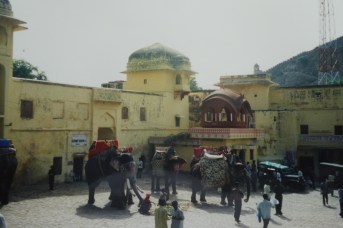
We completed our visit to Jaipur with a look at its Red Fort, perched high above a lake in a picturesque setting and more impressive for it than Delhi’s Red Fort. Since access to the fort was by an ascent of a steep hill-and in searing heat, we were treated to elephant transport, climbing up to a scaffold and waiting to be loaded on to the howdah [a seat strapped to the elephant’s back which accommodates several passengers]. Once we were installed on the howdah our elephant commenced its stately, swaying saunter up the hill, accompanied by numerous peddlers of gifts and goods, who called up and gestured to us en route.
P1000574

Husband’s attention was captured by one of the traders, who was keeping up with us whilst carrying a large selection of hats. Husband is prone to buying wide-brimmed summer headwear and continues to expand his hat wardrobe to this day, littering the house with them, bought from varied sources and countries, so as we continued swaying up the path to the fort he negotiated for a hat he fancied, finally reaching a satisfactory price and having the hat tossed up to him where he sat.

We disembarked on to an identical platform at the top, the fort entrance and went to the interior, which was ornate and beautiful, with mirror-inlaid frescoes and intricately patterned ceilings.

Afterwards, waiting  for our coach we were entertained by watching the off-duty elephants bathing in the lake with their mahouts. And as we stood, the mahout, astride his elephant, approached us and gestured for us to place a rupee note on to the end of the elephant’s trunk, which we did, delighted as the elephant passed the money back to the handler. A cunning trick, and the kind of activity that Paratha frowned upon, but by now we’d had enough of her control freakery and were opting out of some of her rules, at one point asking the bus driver to let us off on the way to yet another of her factory outlets.

Next day we were off on the coach again, this time to a bird sanctuary where we were to take a tour of the reserve by rickshaw before spending the night in the custom-built hotel.

The temperature at the bird reserve was uncomfortably hot-and exacerbated by its humidity. This was a damp, marshy piece of land, a haven for birds but an endurance trial for tourists. Enthusiastic as we are about wildlife we wilted in the sticky, cloying heat. We took our bicycle rickshaw tour, accompanied by another rickshaw carrying Steve and Jane.

The reserve was home to, among others, weaver birds, who’d woven their tiny basket nests and suspended them from the pendulous branches of palm trees.

The hotel was a modern, concrete, two-story block. We were allocated a first floor room flanked by a wide balcony that ran the length of the floor. As dusk fell this balcony gathered a covering of beetle-type insects so thick we couldn’t walk anywhere except on the top of them. It was a thick, crunchy, beetle carpet and the air and every surface crackled with them. Walking into our room was like entering a steam oven. We would never be able to sleep inside it. We contemplated hauling the mattress on to the balcony and quickly pushed the thought aside when we looked at the beetle layer.

But we were lucky. Our friends’ room was directly below and many degrees cooler. Would we like to sleep on their floor? We didn’t hesitate and hefted our mattress over the rail.

Next morning we were to travel to the last point of the Triangle. Agra!
Venturing Further Afield

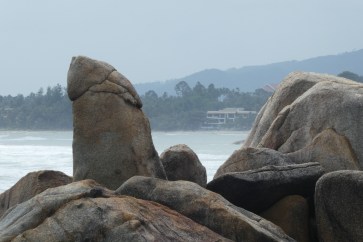
With just three days to go we wake to overcast skies and decide that this is the day we can venture out to see some sights. Outside the hotel we negotiate a price with the taxi driver who spends his time there and set off down the busy road parallel to Lamai Beach, first to see the Grandma and Grandad rocks. After a slow ride through the traffic the driver makes an abrupt turn left down a narrow, bumpy lane, winds between some buildings and comes to a halt in a car park behind a welter of assorted stalls and shops-their number somewhat out of proportion with the numbers of sight-seers around.

Our driver indicates the way we should go-a passageway through a shop piled high with hats and gaudy toys. The character of the beach here is changed from wide sweep of sand to cliffs and prominent rocks-none more prominent than the ‘Grandad’. And it is immediately obvious how the rock acquired its name.

P1000081

We clamber up to see the rocks from different angles then return to the taxi. The driver has brought a companion along for the ride, although we are not sure who she is-his wife, perhaps?

Next we wind up into the interior of Koh Samui to stop at a temple complex and I’m glad I thought to fling a thin sarong into my bag to aid modest dressing for temple visits.

Inside a gilded, glass case adorned with offerings and flowers sits the ‘mummified monk’, a disquieting exhibit, his sightless eyes staring out of his leathery face.

Leaving the main road we drive up through lush plantations of banana trees and orchards of rubber trees, each trunk circled with a band and a small cup for the trees’ sap to drain into. Then it’s on and up again until we reach a rutted track and pull into a parking area bordered by a fence. Behind the fence are elephants, prepared and ready to take tourists for rides through the forest. A stall sells bananas for the punters to feed them and there is a charge to photograph these exploited animals. We know that many elephants that work in this way are ill-treated and we have not come to see them, but to look at the waterfall.

While it is not exactly a raging tumult, the waterfall is impressive enough and surrounded by immense, tall trees. It is not seething with tourists but those that are there are either bathing in the pool or draping themselves in the path of my camera shutter. And I can imagine how different it will be when the rainy season is underway. In comparison to the Grandma and Granddad rocks the number of stalls on the path is restrained, consisting mainly of piled up coconuts and a few souvenirs.

Our driver and his silent companion are [justifiably] not much inclined to act as tour guides, dropping us at each location and waiting for us to return, although our questions are answered and our expressions of appreciation acknowledged.

We return down the track and head towards another beach area. Here is an impressive shrine and another [enormous] glass case containing a vessel and what appears to be another mummified monk-this one even more spooky, peering out at us with sinister stare. The vessel in which he sits is itself surrounded by dozens of model boats.

The beach here is stacked with the hard, white shapes of dead coral, beautiful but a telltale sign of poor sea health. But the area is almost deserted, the shrine showing signs of neglect. Clearly this is not a well-known site.

We have one last site to visit, a temple complex that quickly becomes my favourite The entire venue is snake themed, the temple walls adorned with vibrant scenes rendered in terracotta and best of all, outside, a long staircase leading to the beach is flanked by beautiful cobras, their mouths gaping as they reach the base as if to snatch the unwary person descending.

It’s the end of our whistlestop tour, but we’ve discovered there is much more to Koh Samui than beach life.