


We completed our visit to Jaipur with a look at its Red Fort, perched high above a lake in a picturesque setting and more impressive for it than Delhi’s Red Fort. Since access to the fort was by an ascent of a steep hill-and in searing heat, we were treated to elephant transport, climbing up to a scaffold and waiting to be loaded on to the howdah [a seat strapped to the elephant’s back which accommodates several passengers]. Once we were installed on the howdah our elephant commenced its stately, swaying saunter up the hill, accompanied by numerous peddlers of gifts and goods, who called up and gestured to us en route.
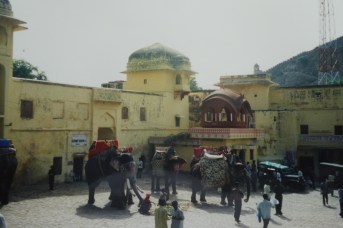
Husband’s attention was captured by one of the traders, who was keeping up with us whilst carrying a large selection of hats. Husband is prone to buying wide-brimmed summer headwear and continues to expand his hat wardrobe to this day, littering the house with them, bought from varied sources and countries, so as we continued swaying up the path to the fort he negotiated for a hat he fancied, finally reaching a satisfactory price and having the hat tossed up to him where he sat.
We disembarked on to an identical platform at the top, the fort entrance and went to the interior, which was ornate and beautiful, with mirror-inlaid frescoes and intricately patterned ceilings.


Afterwards, waiting for our coach we were entertained by watching the off-duty elephants bathing in the lake with their mahouts. And as we stood, the mahout, astride his elephant, approached us and gestured for us to place a rupee note on to the end of the elephant’s trunk, which we did, delighted as the elephant passed the money back to the handler. A cunning trick, and the kind of activity that Paratha frowned upon, but by now we’d had enough of her control freakery and were opting out of some of her rules, at one point asking the bus driver to let us off on the way to yet another of her factory outlets.
Next day we were off on the coach again, this time to a bird sanctuary where we were to take a tour of the reserve by rickshaw before spending the night in the custom-built hotel.
The temperature at the bird reserve was uncomfortably hot-and exacerbated by its humidity. This was a damp, marshy piece of land, a haven for birds but an endurance trial for tourists. Enthusiastic as we are about wildlife we wilted in the sticky, cloying heat. We took our bicycle rickshaw tour, accompanied by another rickshaw carrying Steve and Jane.


The reserve was home to, among others, weaver birds, who’d woven their tiny basket nests and suspended them from the pendulous branches of palm trees.
The hotel was a modern, concrete, two-story block. We were allocated a first floor room flanked by a wide balcony that ran the length of the floor. As dusk fell this balcony gathered a covering of beetle-type insects so thick we couldn’t walk anywhere except on the top of them. It was a thick, crunchy, beetle carpet and the air and every surface crackled with them. Walking into our room was like entering a steam oven. We would never be able to sleep inside it. We contemplated hauling the mattress on to the balcony and quickly pushed the thought aside when we looked at the beetle layer.
But we were lucky. Our friends’ room was directly below and many degrees cooler. Would we like to sleep on their floor? We didn’t hesitate and hefted our mattress over the rail.
Next morning we were to travel to the last point of the Triangle. Agra!




 Anecdotage