The Fickle Art of Reviewing

                How wearying it is that reviewing has become such a cynical marketing ploy, instead of the useful consumer tool it was invented to be. It is no surprise, these days, to learn that companies such as publishers and tour operators are prepared to pay vast sums to get positive evaluations, but saddening all the same, that large conglomerations see us, the consumers, as so easily manipulated.

                I was ‘stung’ a couple of times myself when trawling through the cyber aisles on Amazon. I was seduced into buying ‘One Day’, a shallow rom-com [never a favourite genre of mine], which was eulogised about by hundreds of gushing reviewers. I did, at least manage to get to the predictable end of the book. Then there was ‘Shantaram’, which also achieved massive acclaim, and which I assumed would be more my style-it concerning travel in exotic locations, and which I deleted after less than two chapters. I also vented my spleen by writing my own vitriolic review of this egocentric and tedious story.

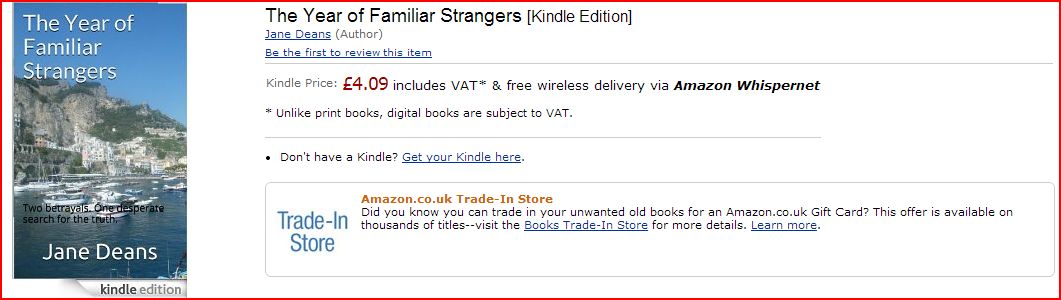
                None of this, of course applies to my own, lowly and self-published contribution to Amazon, my debut novel, ‘The Year of Familiar Strangers’ [by writer Jane Deans]! The book has managed to elicit two reviews so far, contributed by such acquaintances as I have persuaded to press finger to keyboard following their purchase. Between them they have bought it three and a half stars, hardly meteoric acclaim, but nevertheless respectable for a first go. Verbal feedback, however, has been startlingly gratifying. In another life, where I’d have begun to write novels in my youth, I might even have achieved the limitless wealth that could have bought me hundreds of rave reviews. Who knows?

                I get through a number of fiction novels each year, though I no longer look to Amazon to suggest the selection. It is tricky, as an innocent consumer, to know where to look for a good read. How can you be sure to get unbiased opinion? I go, often to book prize long-lists, which can be a reasonable guide; not so my recent purchase, the Booker choice of Richard House’s ‘The Kills’, which I found incoherent, confusing, boring and frustrating. I had more luck with Christine McKenna’s ‘The Misremembered Man’-a quick, light, amusing read with stereotypical characters but plenty of comedic, Irish, homespun philosophy.

                But I suspect my ‘big reading hit’ of the year will be the current occupant of my Kindle screen; A M Homes’ ‘May We Be Forgiven’, which has started explosively, a stonking rollercoaster of a story, darkly, bleakly comic in its exploration of a dysfunctional American family. It was an Orange prize winner, but gets mixed reviews, although I very much doubt anyone was paid to write them! 
Reading Life

                Reading habits differ as much as tastes in TV or music. There are those who do not read at all, choosing to derive their entertainment from the screen. There are those who eschew books in favour of newspapers, magazines or manuals. There are those who consider fiction beneath them and opt for worthy non-fiction. Then there are issues of class or generation.

Years ago I was quizzed by a gentile, elderly great-aunt-in-law as to what my preferred ‘light’ reading tastes were and I responded with more enthusiasm than prudence, eagerly blurting out a long list that included lurid thrillers, shallow romances, juicy, explicit murder mysteries and science fiction. Her stony faced response was an impressive put-down as she shared her leisure time favourites- Jane Austen, George Eliot-and for more vicarious pleasure, Charles Dickens. I refrained from inquiries about her ‘serious’ reading choices, fearing I may have already become so far out of my depth my feet had floated out from underneath me.

I was a voracious reader as a child; the child who could not be torn from a book for anything, not to help with the dishes, to lift her feet for the vacuum cleaner or for sleep. There were books I longed for, having heard them serialised on the radio [a joy children are deprived of these days]. The Christmas morning I awoke to find that Santa had left a hardback copy of ‘The Lion, the Witch and the Wardrobe’ on the end of my bed is my most memorable. I still have it, along with many other beloved childhood novels- Alice in Wonderland, The Wind in the Willows and Eleanor Farjeon’s beautiful take on Cinderella, ‘The Glass Slipper’.

As a teacher of young children I managed to squeeze in enough time to indulge my enjoyment of children’s literature by regular readings of my own favourites as well as theirs-Roald Dahl and Dick King-Smith included. It was gratifying to see them coming in with their own prized copies of these novels, even those whose ability was not quite, yet, up to the task of reading the stories themselves.

Then there are the film versions. I have never been able to shake the compulsion to see a film version of a book despite knowing from experience that it is never going to match the depth and pleasure of its print original.

Even now that I am approaching my dotage I still come across novels that captivate me to a point where I become evangelistic about them, urging others to read them and feeling vastly disappointed if the response does not match my own. D. C. B Pierre’s ‘Vernon God Little’ was one of these. I eulogised ad nauseam over it but found no one to share my enthusiasm. When my frustrations at the dearth of post book analysis became overwhelming I joined a book club, only to find that within the narrow confines of those who enjoy fiction novels there is the same mismatch of tastes.

But whatever is read, one truth remains. The written word is the most wonderful invention known to man!

Literature, Religion and the Other Thing

                We have come to Ireland, just as I am reading Maggie O’Farrell’s ‘Instructions for a Heatwave’. Set in London, against the background of 1976’s long, hot summer it is the story of an Irish family’s struggle with the disappearance of the patriarch, a plot device that serves to bring together the disparate adult children with all their demons including abortion, infidelity and dyslexia. When we travel I like to read a work of fiction that relates to the location I’m in, such as ‘Winter in Madrid’ by C J Sansom, when in Spain last year, although the selection of reading material is sometimes by design but more often by accident.

                The summer of 1976 stands out in my memory as no other for its exceptional heat-wave that seemed to last forever. I was working in Putney, London, in a special school-the best teaching job I ever had. There were 12 children in my class in a purpose built school made almost entirely of glass. The kindly, avuncular head teacher insisted we take our children out on to the grass under the trees each afternoon to avoid overheating so we decamped into the al fresco, where I then acquired the best tan of my life, and all before the holidays.

                It shames me to say I’ve only ever been for a short visit to Dublin before, despite my advanced years and the proximity of the emerald isle, but at least I’ve got around to it now.

                For a small country, Ireland seems to have produced a huge number of literary giants; James Joyce, Edna O’Brien, Maeve Binchy, Samuel Becket and Oscar Wilde, to name a few. It makes me wonder if one’s origins need to be rooted in a country with a strong history of religious conflict, poverty, oppression and hardship in order to be able to achieve success in writing. But perhaps I’m merely using lack of robust historical identity as an excuse for my own shortcomings!

                We spent our first day striding out on the coast path in a warm breeze, along strands of boulder strewn beaches in the company of seabirds. There were few other walkers, except for a couple we passed and exchanged pleasantries with. “Bless St Steven for the good weather”, the woman exhorted, startling me with this first glimpse into the Irish psyche. Later we came to ‘Our Lady Island’ where there was a special well and a shrine. Turning inland I was struck by the plethora of lurid, newly built bungalows, personalised with eccentric faux period features-stone cladding, gable adornments or pretend Georgian windows. A considerable number featured white, plaster columns at the door. Perhaps some salesman with an eye for the main chance had passed that way? Despite their proximity to the coast, none of the bungalows actually faced out to the Irish Sea for a stupendous view, although judging by the number of crumbling stone piles littering the countryside a sea view must once have been a desirable aspect. Tractors outnumbered cars by about five to one here in the lanes.

                Passing through the countryside and the villages sweeps me back in time, as in New Zealand, to my fifties childhood, when there was a village garage, a dairy, a rustic barn of hay bales and an overgrown churchyard, although without the eternal summer!


Shameless gadgetry of the reading kind.

Are you an e-reader or a p-reader? I am guessing you are a reader, because you are reading a blog-but which sort?

                The march of all things digital forges on like the charge of the Light Brigade. The digital front, I believe, cannot now be halted. We have seen this irrevocable development in music, where downloads have eclipsed all other forms including tapes, CDs, mini-discs and the like. Of course all these formats are still available, together with ‘vinyl’. ‘Vinyl’ however is very much the preserve of nostalgia junkies, those of us who lament the passing of the album and it’s arty, expansive cover…useful, as I recall, for all manner of activities-proper and improper.

                Increasingly, a similar divide exists in literary production. Among readers, as with music lovers, people tend to be either firmly in the e-book camp or clinging emotionally to p-books. In defence of p-books, most of the argument tends towards romantic and usually includes some of the following:

  • ‘Oh-but I love the smell of a real book’.

Yes-the smell. Most of my paperback purchases were from charity shops or second hand bookshops. The smell would often be accompanied by stuck together pages and unidentifiable stains…

  • I like to hold a proper book in my hands and turn the pages.

OK. [why?]

  • They look lovely on the shelves/add to the decor etc

They do. I still have packed shelves of real, proper books. They do look attractive. I just haven’t added to them in recent years.

  • You can write on them/highlight/return to parts/bookmark and so on.

Actually, I never did scribble on books, even as a child, when I believed, as I do now that a book was an object to be revered, treasured and kept pristine for posterity. You can do all of these actions to an e-book.

  • Bookshops and libraries will go out of business.

Many bookshops will go out of business, like record shops. They will either have to adapt in cunning ways or sink without trace. I think there will always be a market for children’s books, for example.


I am a convert to e-readers, although I have regrets about owning one from a certain, best-selling, market smothering, tax-avoiding company.  Before I succumbed to going all electronic my reading purchases were random and not necessarily successful. I was inclined to stick with writers I knew or titles I’d heard of.

I’d get anxious before any lengthy travel that I would be stuck somewhere remote without anything to read, not having the capacity or strong enough arms to carry the weight of that number of books [my reading appetite is of the voracious type]. Now I can load a library full of titles and if I’ve devoured them all I can access some internet and replenish the supply in seconds.

Husband has a subscription to a newspaper on his reader, so that he will never be anywhere without knowing the latest rugby results or how much lower the pound has sunk.

Most books are considerably cheaper to buy than their paper versions which means that the device has more than paid for itself by now. Classics are, for the most part, completely free. This has led me to tackle many titles I might have avoided, [with varying degrees of success!] I am still flogging my way through ‘Les Miserables’, albeit with interludes of respite, but I loved Steinbeck’s ‘The Grapes of Wrath’.


So I am wedded to my tiny, purple, leather clad gadget, even though I still read an occasional paperback for my book club. How about you?


Don’t blame me that its free!

                You have to give people their due. In this world of scammers, con artists, fraudsters and hoodwinkers, the ‘too good to be true’ message certainly seems to have got through. It is well nigh impossible to give something away free, without charge, no strings attached.

                Tuesday 23rd April was ‘World Book Night’. One of the events that mark this annual celebration of all things ‘book’ is a mass donation of free fiction novels to the public at large. It is the third year that I have volunteered to be a ‘book giver’.

                In the first year of book donations, we, the ‘givers’ had 40 copies of our chosen book to give. This was a tall order. I’d selected Margaret Atwood’s ‘The Blind Assassin’, a novel which I’d stumbled upon on a shelf of discarded paperbacks in a hotel in The Gambia-an unlikely find, but one which I’d been thrilled by. It led me to read many more of Ms Atwood’s works. I am always evangelistic about novels I’ve loved, boring the pants off anyone I meet about them-hence my enthusiastic approach to book donation. The opportunity to give away 40 copies of a book I’d enjoyed so much was irresistible, so  I was somewhat dismayed by the luke warm  reaction of many. I attempted to give copies away to local care homes and hospitals, where the reception varied from reluctance [‘er, alright-just leave them there’] to alarm, [NO-we don’t need BOOKS!]. I managed to get some of my neighbours to accept a copy with one outright success, a convert to Atwood, like myself.

                Last year I opted for a classic-‘Rebecca’ by Daphne DuMaurier. The number of books dropped to a more reasonable 20. I distributed them to groups in the community without too much trouble, although this was taking the path of least resistance.

                This year I chose Sebastian Barry’s excellent Irish tale, ‘The Secret Scripture’, written in the most beautiful, poetic style and documenting an astonishing and harrowing series of events in the life of an elderly woman. I loved it and wanted everyone else to. Thinking I should make more of an attempt to follow the World Book Night instructions I set off to give the books out to as many complete strangers as I could find, and since it was a warm, sunny day, striding off along the promenade by the beach.

                I homed in on my first victims outside the beach café; two women at a table.

                “Can I offer you a book to read?” I asked them. “It is completely free and a very good story.”

                “No! I don’t want a book. I’ve got a Kindle-look!” The woman held it up in triumph, as though she’d beaten me in some kind of competition.

                I kept smiling. “Yes, I have a Kindle too,” I said. “But you would have to pay for your download and this is a freebee.”

She stalked off, leaving her friend to do me the courtesy of kindly accepting the free novel from me. It was a long morning, nevertheless amongst the suspicion, rejection and cold shouldering I did enjoy one or two jolly, book related conversations and a couple of people were genuinely thrilled to be given a brand new paperback to read.

                I wonder what the titles will be next year?

Book Heaven

Today, Thursday 7th March, is World Book Day.

                Children, it seems are becoming less interested in reading books and less inclined to pick one up in their leisure time, according to a study last autumn, [http://www.bbc.co.uk/news/education-19511825].

                What a shock! Who would have thought it? And what has caused this ‘drop off’ of interest in books? Again, no surprises here. It is the rise and rise of screen based activities [or rather, non-activities, since sitting in front of one can hardly be described as active].

                Most people take for granted the fact that developing technology is, broadly speaking a good thing, and of course it is. It improves life in countless ways. But myself, I’d have to say that for young children it is something that they need exposure to in moderation. Computer games were in their infancy when my own children were young so I suppose I was fortunate not to have to face too much in the way of battles over restricting access, but if I were dealing with the situation now I would feel obliged to impose limits to playing on games consoles etc

                You could argue that it doesn’t matter, or that screen based games are beneficial. Late in my previous life as a proper working teacher there was one small boy who violently resisted all efforts to educate him and was both unable and unwilling to sit down and either read, write or listen to anything. His mum claimed that this behaviour was at odds with his manner at home, because he could sit for hours to concentrate on his Playstation games. Apparently, an ability to focus on shooting space aliens or achieving the next level in a car crash game denotes high order thinking. In order to address his fixation with computers we allowed him unbridled access to one in the classroom for writing tasks and so on. The result was not a success and he could generally be seen climbing around and under the worktop or disrupting others as before.

                And does it matter if they don’t read books? Well, no, as long as they read something. Because without the skill of reading life really does become very limited and difficult. There is a true story on the World Book Night website [[http://www.worldbooknight.org/books/2013] more of which in later posts] of an adult woman who’d never learned to read, and of the difficulties she faced in almost every area of her life. But I always told parents who complained that their child didn’t want to read a book that they could read a comic, a football magazine, a cereal packet or the Argos catalogue if they liked, as long as they read something.

                But aren’t we missing a trick? If our children are wanting to spend all their spare time in front of computer games then it is the games that should change, isn’t it? Surely it is not beyond the wit of manufacturers to incorporate text into them? There should be instructions, written dialogue, signs to identify, captions. I’m sure such games exist already, although probably not the popular ones, the ones they want to play. I’d make it compulsory to add text to computer games.

                To me, books, and in particular children’s books are simply wonderful, and will no doubt be the saving of bookshops, since there is no substitute whatsoever for sitting down to share a gorgeous, colourful, lift-the-flap, scratch and sniff, rhyming, pictorially stimulating, exciting or hilarious BOOK.