The Rain Across the Spanish Plain

Sometimes exploring an area in depth can make you realise how woefully ignorant you are, that there are so many world heritage status places you’ve never heard of-or at least-that I’ve never heard of.

Portugal’s Evora is one of these.

We took a couple of days’ beach break, just down the coast from Lisbon, at Caparica, where Lisbon-dwellers come at weekends for sea and sand but precious little else, Caparica being Lisbon’s equivalent of Southend on Sea. On the camp site you could have been fooled into thinking it was snowing, if the temperature hadn’t been 28 degrees, so much fluffy seed was blowing, blizzard-like across the site and settling, ankle deep on the ground or in heaps of white fluff inside the van.

Next, Evora.
P1070421

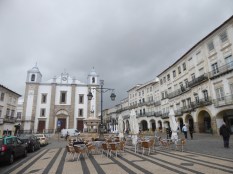
This walled medieval town is a pristine vision in white and ochre, packed full of whitewashed churches, monasteries, ancient university buildings and a wonderful, 15th century aqueduct which begins low, at the top of the town and lengthens as it descends. Homes have been made between the arches:

P1070471

The town is quiet, the gift shops awash with knick-knacks, but few buyers. I take pity and buy a small, red, cockerel embellished wine cork for a gift. There are a few other tourists. Did they, like us, stumble upon Evora? Or did they research it at home and make a special pilgrimage here?

For reasons that can best be described here

we need to turn towards the north and make our journey home. As yet it isn’t urgent but I’m aware that it may become so. We set off towards the Spanish border and Badajoz, which we’ve passed by on occasions but have been told is worth a visit.

The weather, never reliably sunny this trip turns overcast once more, but the journey is beautiful-rolling hills and vast cattle ranches, the road quiet and peaceful and we arrive at lunchtime.

The aire at Badajoz is brilliant; easy to locate, a convenient situation just across the River Douro from the town and services all provided free. Little wonder it fills with vans by the evening. We wander across the attractive footbridge, through the gate of the city wall and across towards the ‘Alcabaz’, the citadel which dominates the town from a high vantage point above the town. By this time it is raining and with an afternoon to spend we fritter some of it in a cavernous bodega.

P1070492

A return to Spain means a return to tapas, a variety of tasty snacks offered with every drink. Though we’ve lunched it seems rude not to stay and enjoy the fare-and it is raining outside the bar. Badajoz’s cloistered square is beautiful.
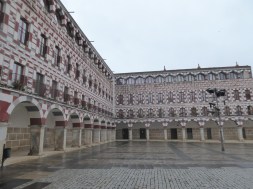
P1070488

Zipped into raincoats we brave the rain to stroll around the domineering Alcabaz, then it’s back to the aire, where some local residents whose house adjoins it have decided to share their music with us. Freddie Mercury’s vocals are blasted for an hour or two, but since I’m not averse to a bit of Queen myself I think it could be a lot worse…

Next day it’s on to Valladolid, where we make several circuits of the one way system before locating the motorhome parking bays. It’s a quick stopover and our sincere apologies to the parking authority for our inability to pay the 9.50 euros fee, but having managed to retrieve my bank card from the machine when it was stuck I didn’t feel up to giving it a second go!

Onwards and upwards…


Turning Portuguese

P1070246

The first time we visited Portugal was with a tent, a giant, swish ‘pyramid’ tent that we’d borrowed from Husband’s colleague. I had to crawl in and hold the central pole, getting hot and sweaty while Husband hammered the pegs in outside. On a site at Ancora [north Portugal] where an interested neighbour ‘advised’ us on where to have our doorway, we pitched under some sap-dropping trees that stained said tent for ever, resulting in our having to buy the colleague a brand new pyramid tent when we returned. [We’d also torn the fabric attempting to dry it out in a French motorway services car park].

P1070338

This was also the trip when we visited Porto by train from Viano do Costelo, buying return tickets and discovered on our return to the station to get back, that the train ‘does not return from here’. We had a wonderful, dockside meal and returned on a ‘milk’ train, from a different station at about 2am.

During this and subsequent visits, with various vans we’ve done the major must-sees of Portugal: Porto, Lisbon, Guimares, Coimbra, Sagres, Faro-

Mostly we’ve found the west coast to be more pleasant and less developed than the Algarve, but there are exceptions.

P1070360

Portugal, like Greece is one of those countries that never fails, with luscious countryside, beautiful historic cities, reliable, warm weather, delicious food [including the famous ‘pastel de nata’ custard pies], a gorgeous coast line and friendly people.

We find Lisbon much changed, with the addition of hideous cruise ships blocking views and throngs of tourists everywhere. Our previous visit was quiet and we were able to stroll the narrow lanes without stepping around selfie-takers. To anyone intending to visit Lisbon and considering an open top bus tour I’d say, ‘Don’t!’ You pay 11 euros to inch along for hours in stifling traffic, a woman wailing Fado songs in your ears. You get to see very little and anything of interest is zipped past or around before you’ve got your finger on your camera shutter.

I can get no purchase on the Portuguese language whatsoever. Spoken, it sounds eastern European with lots of sch, z and cz. Written, it looks remarkably like Spanish and meaning can often be deduced. We know we must take care not to speak Spanish to the Portuguese in spite of so many words being similar, nevertheless Husband is inclined to say ‘gracias’ instead of ‘obrigado/a’ for the first few days. My own knowledge of Portuguese is restricted to ‘obrigado/a’, ‘Bom dia’ and ‘ola’ so it is fortunate that almost everyone here speaks English very well indeed.

The Portuguese are fond of tiling the outside of their homes, which can look beautiful or tawdry; railway stations, hotels, churches-no building is safe from this treatment.

P1070332

And neither are the bone-shaking, tooth-grating streets, which are tiled in cobbles.

The Portuguese countryside is strewn with cork oak trees, the cork continues to be harvested and goods such as cork handbags can be seen in the shops. Perhaps the backlash against plastic will see a resurgence of the cork industry? It does seem to be a versatile material with useful properties: lightweight, water repellent, attractive.

In recent years, wildfires have decimated much of Portugal’s forests and evidence of this is everywhere.

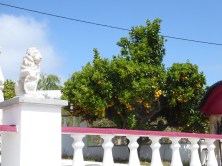
Orange and lemon trees abound, in gardens, parks and along the streets. They are all hung with tons of fruit which nobody seems bothered to pick, the ground around the trees littered with fruit just as the plums lie fallow in Gloucestershire.

P1070325

Before using the [very quiet] motorways you must register your bank card and attempt to forecast how much toll you will be using, which is tricky. Otherwise you can register at the first ‘portagem’ [toll booths] but then you’ll have no clue as to what is being deducted.

We’ll soon be leaving Portugal and crossing back to Spain-but I’ve no doubt at all that we’ll be back!


Santiago de Compostela-for Philistines.

Travel along Spain’s north coast and you will be guaranteed stupendous views, beautiful beaches and the sight of a great many ‘pilgrims’ trudging along the Camino de Santiago, following thousand upon thousands of sunburst signs as they make their way towards their Mecca, Santiago de Compostela.

P1070112

In true martyr-ish style, wholly in line with Catholic traditions, this Easter’s weather helps them on their way by being utterly appalling. This part of Spain is renowned for wet weather but this year’s exceeds all expectations. The entire country is deluged with torrential downpours while the UK basks in unusual warm sunshine.

Groups of walkers line our route, clad in voluminous, dripping capes that cover them and their rucksacks, giving them the appearance of soggy, deformed camels. Many have walking sticks and a fair number use Nordic walking poles. Is this a true dedication to the cause of suffering, I wonder?

The pilgrims come in all shapes, sizes, nationalities and ages; entire families with children, pairs of young girls, single people. Many meet up along the way and travel together, like the two young American girls with a short Portuguese man we met on one of our [non pilgrim] walks. Some look grimly determined, some chat as they walk, others sport beatific smiles as though already transported by their ordeal.

The nearer you get to Santiago, the more pilgrims there are, waiting at crossings, standing on corners, munching things, looking at phones.

P1070199

We’ve waited until Easter is over to visit Santiago and arrive on the Tuesday after, thinking it will be less fraught to negotiate the traffic, but we are still caught out by a parade of some kind and must effect a slow crawl through the narrow streets to find the camper-stop, which is situated up above the city-at least we can’t be flooded out. It is well organised and well used, a manned entrance cabin, tickets, a useful city map, water and emptying supplied.

Since there is no sign-from any source-that the rain is going to abate we don raincoats, grab umbrellas and run for the city centre bus, which takes us down into the heart of what is a beautiful, elegant place, wet or not.

Santiago seems designed for rain, cloistered walkways abound and there is no shortage of drains, into which rainwater gushes or tips from rooftop spouts. Crowds accumulate in the worst showers, huddling in doorways or squeezing into tiny shops selling religious icons and souvenirs.

P1070196

We are spoilt for choice for our naff shelf collection [read here].

At last we seek refuge from the showers in the cathedral museum, where I am clucked at for photographing. The art works are fascinating and also slightly bonkers, as religious art can be. The topmost floor is open to the elements with rooms off, containing cases of bejewelled, silver or gold crosses and paraphernalia in abundance-a demonstration of the wealth of the Catholic church.

Another set of rooms has wonderful, wall-sized Belgian tapestries depicting country scenes of people carousing at Inns. The detail is worth studying-drinkers at tables, dogs stealing food, babies being fed, a man peeing up against a wall-all most un-ecclesiastical.

When we tire of the relentless deluge we get the bus back to our warm and cosy van.

Next day there is a lull in the rain, long enough for servicing the van, then we’re off to brighter skies, drier roads and a quieter time-and Portugal!

It’s not so far. We stop for lunch on a small quay by the River Minho, choppy waves in the stiff breeze.

P1070217

Onwards to Vila Cha, the latter stages of the journey corrugated by cobbled roads. After a series of winding lanes we reach our chosen site, but as we approach we realise-of course! We’ve stayed here before. This is not bad news-the excellent restaurant opposite the entrance is still thriving!

The Rain in Spain

Comillas is a small, pretty town, a stone’s throw from the Northern Spanish coast and home to architect Antonio Gaudi’s ‘El Capricho’, a typically wacky house commissioned by a wealthy lawyer. It is one of Gaudi’s first works and one of only three buildings of his outside Catalonia.

On Good Friday of Semana Santa, Comillas is seething with day trippers and we are glad to have caught the bus here from our site. We join the queue for El Capricho and once we’ve bought tickets we have to run the gauntlet of hordes of visitors and guided tours throughout the rooms and on the balconies. But it is worth it. The villa is a joyous, colourful creation bedecked in sunflower glazed and vibrant green tiles, odd terraces and tiny windows giving on to views of the town’s terracotta roofs or of the surrounding parkland.

The rooms are beautiful, restful spaces with examples of quirky furniture and clever technology like slatted blinds that roll up sideways to open. This would be a wonderful home-and I hope it was enjoyed by the inhabitants!

Comillas is choc-a-bloc with market stalls, the cafes and restaurants full to bursting. We content ourselves with an ice cream in the square while we watch the stallholders pack up-then head to our bus stop for the ride back.

Next day we set off to Cudillero, an authentic fishing village akin to a Cornish coastal settlement. There is enough time for a walk down into the town, although it is a steep and treacherous one, the pavement horribly narrow and winding. En route the street is lined with buildings in various stages of decline and later exploration reveals a town of quaint charm but shocking decadence. Here and there are pockets of redevelopment-tricky given that the sides of the ravine are impossibly steep and homes are accessed by a tracery of stone steps, slopes and pathways in a higgledy-piggledy web.

Down at sea level the street is lined with bars and fish restaurants, everyone drinking until about 8.00pm, [by which time we are famished] and at last there are a few diners and we can sit down to peruse the menu. We choose a prawn salad and a seared octopus dish to share and a hake dish each. It is all delicious.

After lunch the next day we find an off-road footpath leading down to the town. We walk down-and up-and down-and up, by which time my knees are wobbly as jelly from steps and slopes.

Time to leave Cudillero. We make for Louro, just beyond Muras and rain sets in with a vengeance. The small town is nondescript but has a good beach along an attractive bay. It rains in a relentless deluge so that by next morning we feel it necessary to hunker down and ride it out.

Then we head off to Santiago de Compostelo, renowned for its rainfall, justified on this occasion as it rains en route, rains when we arrive, rains throughout the visit and continues to rain as we leave. But that, reader is another story…

A Dog’s Breakfast of Linguistics

Driving towards the Spanish border and San Sebastian I am attempting to reclaim, renovate and restore my rusty Spanish, a language that’s languished unused for a couple of years. A few words and phrases float in- ‘Si’ ‘No’ ‘por favor’ ‘gracias’ ‘lo siento’ ‘la cuenta’ ‘cervezas’ and ‘banos’. All the essentials. Then I get to wondering what the word for breakfast is and it becomes an irritation. I can find the German word-‘fruhstuck’ but I’m frustrated by Spanish breakfast. This is absurd, mainly because we’ve no need whatsoever to be ordering breakfast in Spain.

P1070024

We locate a site with great mountain views and stretch legs by plunging down a steep, bendy road towards the sea. The weather has turned hot and muggy and by the time we’ve returned and got some chairs out the first drops of thunderous storm have arrived. Rain continues until bed time but by morning it has all cleared and it’s bright, sunny and fresh.

P1070028

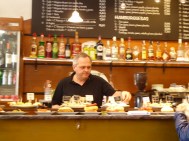
A convenient bus ride takes us into San Sebastian via Monte Igelda [where our site is], stopping at the ancient funicular en route. After locating the tourist office we follow a suggested walking route around the city which takes in major plazas, the waterfront and important landmarks such as the Basilica. We stop for tapas lunch at ‘Tapas Santana’, where a sumptuous display of tapas dishes fills the counter and hordes crowd in. I look at the menu and there it is: desayuno-breakfast. Of course!

Husband waves me to the counter to order, although I’m not ready, not well enough rehearsed in my renaissance Spanish. I muddle through aided by the kindness of the waiter and we are rewarded with a delicious lunch.

We leave next day for San Juan de Gaztelugatxe and get hopelessly muddled when our new SATNAV decides the best route is along unmade mountain cart tracks, but at last we find a sensible coast road, albeit winding and tortuous. The terrain here resembles the Amalfi coast but with fewer tourists even now at Easter time. After a number of glitches, including a near-death experience on the motorway when a bendy bus decides we are a pesky nuisance and attempts to do away with us, we arrive to San Juan de G, a destination better known as a location for filming Game of Thrones than for scenic or religious significance. It is, however spectacular.

P1070079

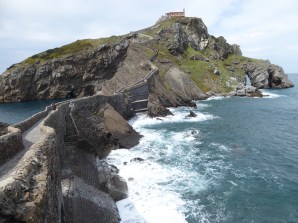
The tiny church of San Juan, dating from AD890,  is perched upon an island rock accessed by a winding path across a stone causeway. The path down [and up!] is steep and arduous. But plenty of people of all ages, sizes and fitness are tackling the walk. Remembering the Tiger Cave Temple climb in Thailand we decide this is a doddle, which it isn’t, but we make it down and up.

It is only a stone’s throw then down to Bakio, where a perfectly nice, free, well-serviced aire awaits. Here is surfing galore so of the many vans parked up a lot are typically bohemian and strewn with the paraphernalia of the sport.

Leaving Bakio we head off towards Comillas, the steady drizzle strengthening into steady rain, which continues throughout the day and is still dropping relentlessly when we arrive to our selected site. On into the evening it rains…and rains. Next morning it is still raining. So the rain in Spain is not restricted to the plain, clearly…

Normal for Now

I was sitting in the bar area of the Barfleur on its way into Cherbourg, reading Sally Rooney’s ‘Normal People’ when I glanced up as we were gliding past the Irish ferry, ‘W B Yeats’.

I’d just reached the part in the novel where Trinity student Connell gets totally wasted during his summer break and is lured back to the flat of his former secondary school teacher where she has the intention of ravishing him [until the excess of alcohol precludes the act].

I got to thinking, then that I’m pushed to recall the names of any of my secondary school teachers. I can remember my very first teacher, Miss Hunter, who I loved. I can almost   remember the name of my next teacher, in the juniors, Mrs  Someone. We moved. I know who my next teacher in the juniors was because it was my dad.

I passed the ’11 plus’ and had the dubious reward of going to Wisbech High School, where our newbie form was ruled over by an austere and frightening Scottish woman whose name escapes me, but might have been ‘Miss MacFarlane’. I was anxious the entire time, for two terms. Then we moved again and there was a plethora of remote characters who entered classrooms, delivered their notes and left.

In the sixth form, studying English literature, among other things W B Yeats was on the syllabus. I developed a lifelong dislike of W B Yeats’ work and to this day I shudder when I hear mention of ‘The Lake Isle of Innisfree’. We were never given a chance to explore and enjoy the work; never had the background explained or saw how it related to Irish history and politics-let alone to my own, teenage self.

‘Normal People’ explores a teenage love story from more contemporary times. In the story Connell connects much more to the texts he is studying. As students, he and Marianne drink, do drugs, party in much the same way that I did during my 70s student-dom in London. How long ago it all seems now-and it is!

P1060995

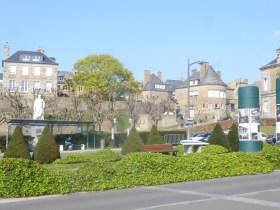
Now here we are in Avranches in the warm sunshine of an April evening, having driven off the ferry to travel hopefully and with the relief of the Brexit delay wrapped around us like a snug blanket-for now. It is pleasant enough to sit outside in the square with a beer and survey the elegant decadence that is commonplace in French architecture.

P1060994

When we pulled into the ‘aire’ there were already French motorhomes in place. We reversed back just as a couple were leaving to walk the few hundred metres into town. They turned, smiled and waved in greeting and I realised I was almost holding my breath until this moment. Maybe, just maybe we are still as welcome as ever in the places we love and will always love to go…

Sacrilege

NZ Queenstown

We travelled to New Zealand in the autumn of 2011 when the Rugby World Cup was scheduled to be held there. This was to be our retirement treat-a three month stonker of a trip that also encompassed Australia [where I have cousins] and a small add-on of a stay in Hong Kong on the way home.

The thrill of such an enormous piece of travel was tempered, initially by having our flight from Heathrow cancelled by Quantas for no reason we could discern. This meant that our onward flights from Brisbane were scuppered, messing up our arrival to Christchurch, New Zealand and losing us a night of accommodation.

2011 was also the year of Christchurch’s catastrophic earthquake, which was heartbreaking in itself, besides disrupting the Rugby matches and venues involved.

After a tortuous and exhausting series of flights we arrived to Christchurch’s small airport. In the arrivals hall we staggered to the information desk and were directed out into the sunshine of the afternoon, where a kindly driver took our bags and we slumped into the back of his car to be taken to the hotel. I felt I’d stepped into a warm bath.

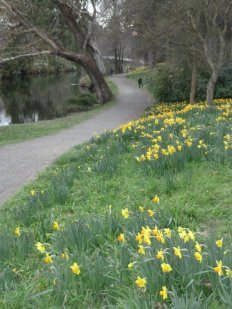
Even in my almost comatose state I was thrilled to see the verges and green spaces which were lined with nodding daffodils-a novelty for we northern hemisphere-ites in autumn.

NZ Xch

Although our hotel was a forest of steel ceiling supports and those roads that had not been blocked off were cracked with fissures the hotel staff welcomed us in.

Having slept we explored our area, Hagley Park and looked at the quake-damaged centre of town. The park hosted an exhibition of the proposed rebuilding of Christchurch.

A couple of days later we collected our rental camper-van, which was exquisitely equipped and set off to explore beautiful, pristine South Island on a gentle, meandering road that followed the railway track and took us through small communities, past stunning scenery and into wonderful camp sites.

Throughout this time I don’t think I ever stopped smiling. People were unerringly kind, the ease of travel unprecedented. In spite of the terrible earthquake we were welcomed. Even the creatures were friendly.

NZ ducks

The rugby games were like huge, joyous parties with dancing displays, music, dressing up and buzzing atmosphere. I lost count of the number of times we engaged with those around us, laughing, conversing and getting hugged.

In between matches we went sightseeing-following the beautiful, wild south coast road to stunning Milford Sound, viewing penguins and snow-capped mountains and scoffing New Zealand pies and scones from the dairies. Then we turned north via Kaikoura, went whale-watching and walked in glorious Abel Tasman National Park before taking the ferry to North Island.

In Wellington the camp site was full so the local rugby club accommodated us, throwing open their showers and their clubroom and even offering us a curry sauce to go with the chicken we’d bought to cook. We visited the amazing hot springs and geysers at Rotarua, 90 Mile Beach, Coromandel, the gigantic Kauri pines.

The trip remains, to this day my favourite to date. If asked I don’t hesitate to say that New Zealand is my favourite of all the destinations we’ve visited for the reasons I’ve detailed and so much more.

What has happened there is heart-breaking. This most beautiful and idyllic of countries has been sullied for it’s innocent beauty.

If you peddle hate posts on social media; if you keep recycling jingoistic, populist, right-wing propaganda; if you keep screeching about ‘taking back control’ and closing borders, building walls to keep people out and showing hate to other races and religions you are perpetuating acts of violence and terrorism.

Enough said.


A Take on Transport

I used to love driving. I was late to learn, at 25, pootling around Putney in south London all of one cold, dark, snowy winter in the evenings after work, with my British School of Motoring instructor. My steering was unorthodox, he told me and said that I should have some lessons in daylight since I’d only ever driven at night.

I passed my second test, at Teddington-a place I knew no more of than Guildford, where I’d failed 2 weeks before. Then I acquired my little old, faded green Austin A40 with a steering wheel like a bicycle wheel and doors that stuck and had me crawling through the hatchback to enter and exit. But I was ecstatic to be independent at last.

Throughout the early years of motherhood, when there was only one family car, the independence was gone with the vehicle and I was reduced to shank’s pony, pounding the streets with a mewling sprog in a pram and wondering how it had come to this?

In the single-parent-working-full-time years I regained some autonomy with a battered Volvo and could load kids inside and camping gear on the roof rack in the holidays or collect bits and pieces for the ramshackle home I’d purchased and was attempting [on evenings and weekends] to do up. I loved to drive. I enjoyed long journeys-even when it took 9 hours of traffic jams to get to the Kendal home of friends I been invited to for a weekend.

Somewhere along the years to old age however a gradual falling out of love with driving took place; not that I won’t or don’t drive, but I’ve come to appreciate other modes of transport, becoming a fan of buses, especially with the gaining [finally] of my pensioner bus pass. I’m not the only bus-pass-holder to take a child-like pleasure in gaining the front seat on the top deck, either…

Then there’s the train, where a ‘seniors’ railcard gives a worthwhile discount. Of course it isn’t as glamorous as it was when I was a child, when you walked along the corridor and slid open a door to a compartment, but if you are lucky enough to get a seat it’s possible to drift into a reverie and gaze out; or listen to others’ conversations [real or phone]. These days train travel can be a frustrating and tiring business, as we found when, having travelled, 2 weeks ago, 4,000 miles by air through the night on a trans-Atlantic flight to Gatwick, arriving at 5am, all the trains south towards Southampton and beyond had been cancelled ‘due to signal failure’. Lovely. Just what you’d wish for after an 8 hour night flight.

On flights, ferries, trains and buses, where someone else has the responsibility, I think the trick is to sit back and relinquish control. Watch the movie, look at the view, listen to the conversations, read your book. Better to travel hopefully [and also to arrive!].


Bajan Escape [part 2]

P1060810

[To continue…]

After a few days it’s clear why Tom and Francine have holidayed here in this hotel in Barbados for 45 years. It’s Tom’s kingdom, his empire. He knows everyone and everything. He spends his days wandering the grounds and pool, chatting to anyone he comes across and teasing the housekeeping staff. When she arrives to their room with a mop and bucket he tells Harriet, ‘Here-let me show you how to do it’. They all adore him. ‘I’m nearly 80!’ he says, grinning and rubbing his bare chest, ‘People think I dye my hair’.

One afternoon we go to Oistins, which boasts an extensive fish market, for a walk to the southern tip of the island. A parade of rocks has been eroded underneath by repeated waves so that they seem to hover above the foam, each wave producing a booming sound as it pounds in and back on itself in a tall plume of spray.

P1060840

On Friday nights Oistins Fish Market turns into a huge party with live music and nowhere to sit at the trestle tables that host diners every evening for freshly grilled fish-marlin, lobster tails, shrimp and a plethora of other sea produce. We choose a different night to sample the menu at ‘Uncle George’s’ [recommended by our neighbour, Mike] and we are not disappointed. We also get to chat to 2 young Canadians on a Caribbean tour away from their busy hospital jobs.

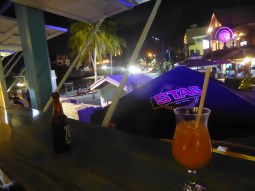
In the evenings we stroll to our local ‘KT’s’ bar or a little further into St Lawrence Gap-a magnet for revellers, cocktail seekers and diners, many who’ve hotfooted straight from the cricket ground where England has trounced the West Indies. The tiny bay is lined with bars and restaurants of any and every cuisine and all busy.

P1060822

The flight home draws closer. We conquer the mysteries of the public transport system and board a bus to ‘Sam Lord’s Castle’ on the Eastern coast. It is a bone-shaking ride up and across plains, through villages, past the airport; some homes are traditional, single-storey cottages in paint-box hues, others grand mansions in the making, ever more ambitious as we near our destination. There is some confusion when we alight as ‘Sam Lord’s Castle’ is neither a castle nor is it indicated in any way. This is because it is a bus stop, and the driver has not seen fit to tell us we have arrived, with the result that we must travel a few stops back.

Down a narrow road and through a passageway we access the sea at last, the Atlantic crashing against limestone outcrops in mountainous plumes, booming as it ploughs a relentless furrow under each knobbly spur. This is Shark Hole-mentioned in guide books but without a café, a bar, a gift shop or so much as a sign to advertise its thrilling allure, hence the complete absence of human life except for ourselves and a lone fisherman.

P1060879

There is little shade as we walk along the rugged coast, needing to cut in at intervals to avoid trespassing over manicured lawns. Fearful of the searing heat and of missing the bus back we return to the shade of ‘Sam Lord’s Castle’ [the bus shelter] where we wait 40 minutes to be rewarded by the appearance of one.

Our water supply was running low when we stepped off the bus outside KT’s bar, where cold beers and washrooms are both very welcome!

Later it’s down to Sharkey’s at St Lawrence Gap for the last supper-coconut prawns at a long table where we’ve been squeezed in between cricket fans and 2 ladies having an earnest conversation about relationships. We wait for our meals [Husband has opted for West Indian curry] and watch plates of wings and bottles of beer go past and I think there could hardly be a better place to holiday in February-unless you know better, Reader, perhaps?


Bajan Escape

P1060901

The elderly [even to us] occupants 0f the rooms either side of ours are happy enough with the hotel, modest though it is. Mike and Linda [to the left on our ground floor terrace] are heavy smokers-a surprise given that they are liberal, forward thinking Canadians-as are most of the residents. Mike, squat, chunky and clad in long shorts and vest, cups his cigarette angled towards his palm and almost hidden behind his back in apologetic discomforture.

They are all enthusiastic advice givers and we the [relatively] younger newcomers. On our right, Tom and Francine express shock at our nine-hour flight.

By morning the rigours and frustrations of the long flight have dissipated, erased by solid sleep uninterrupted even by the Canadians’ loud, evening conversations and coughing. The walls are thin though and when I wake during the hours of darkness I’m treated to all manner of sounds; the vibrant chirping of miniscule tree frogs that punctuates Bajan nights, trickling water from surrounding rooms, vague traffic hum and exuberant taxi horns.

P1060899

We wake to sun, cloud, a garden view of palms and flowers. Either the room smells less musty or we’ve grown used to it already. The steady breeze blows warm as we sit on the tiny patio to drink the coffee that Husband has managed to coax from a machine in our tiny kitchenette. We are equipped with the basics, [though not a kettle] giving us options to concoct, re-heat, eat out or get take-out.

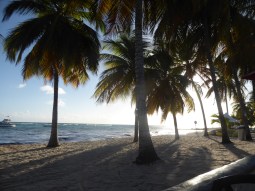
Since our arrival in the early evening we’ve found 3 ATM machines, 2 supermarkets, an express shop, several bars and the nearest beach, which held an alluring promise in the warm, balmy darkness-a small, palm-fringed bay overlooking moored fishing boats and dotted with pastel bungalows, bars and modest apartments. There is nothing high-rise here in Worthing-no gargantuan piles of corporate resorts.

We set off to the larger supermarket, Massy’s, where Waitrose products at inflated prices nestle smugly amongst the local stock. We are spoilt for choice and select chicken and salad for our evening meal, corned beef in a tin with a key! [a throwback to my childhood] and ‘Banks’ beers. The corned beef is welcome after the lacklustre hotel breakfast offering-a couple of pieces of watermelon plus 2 miniature slices of toast and some rough coffee.

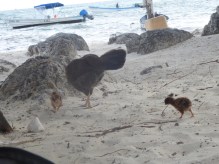
Later we wander along to the beach with towels and books to while away a few hours beneath a palm tree while Henny-Penny and her two small chicks scratch in the sand around and beneath the sun loungers.

P1060858

A cockney middle-aged couple manhandle a wheelchair across the white sand, its passenger a very elderly woman, in all likelihood an aged parent. They settle next to a geriatric gent carrying a portable oxygen tank from which a tube leads to his nostrils. Nevertheless he gamely sets up his towel and prepares for some sun. Maybe Husband and I are not so infirm after all…

Francine’s brother, Bruce has a room a few doors along from ours. He is a small, neat, dapper man in pristine shirt and gabardine shorts-slow to smile or respond, unlike brother-in-law Tom, whose large, blousy exterior matches his expansive personality. Tom tells us his brother-in-law was widowed only a year ago and has the beginnings of Alzheimer’s disease. A flimsy bamboo screen separates our tiny patio from theirs, making eavesdropping inevitable. Tom asks Bruce what arrangements he’s made for his funeral; ‘where does he want to be interred?’

‘They can do what they want with me!’ Bruce spits back. ‘Throw me in the lake!’ The reply is inaudible. Later, as I lie waiting for sleep I hear Francine making placatory noises as Bruce’s voice is raised, ‘I worked hard all my life-gave it 100%!’ His sister murmurs, ‘Shut up Bruce, shut up’…

Bajan escape continues next week.