A Tiny Taste of Freedom

We are in Devon, south west England, just for a week. I’ve paused my antipodean travelogue for this diversion, mostly because any kind of change of scene is a novelty in these restricted times.

The 20/21 winter was long, difficult and gloomy, with its deluge of grim news and statistics pouring out day after day. It prompted a longing for at least some spring weather and lighter evenings. Nobody wants to wish their life away, least of all those of us with fewer years ahead, nevertheless I longed for spring. Now here it is; and with it a small loosening of the bonds that tied us.

We are re-aquainting ourselves with our campervan, which we have used for odd days out but not for an overnight stay since last summer. The weather is fine, with a cold-edged wind as we prepare and pack and I know for sure I’ll have forgotten items or will have packed entirely unsuitable clothing.

We sweep down and across our home county of Dorset following a route we’ve travelled many times but that always provides magnificent views of the Jurassic Coast and charming villages along the way.

We’ve had to begin reserving, planning and booking- a strategy we’re unused to employing as we usually travel on a ‘where shall we go today?’ basis, once, famously turning right at Bordeaux instead of left for the Med due to a forecast of snow, and landing up in the beautiful sunshine of Portugal instead.

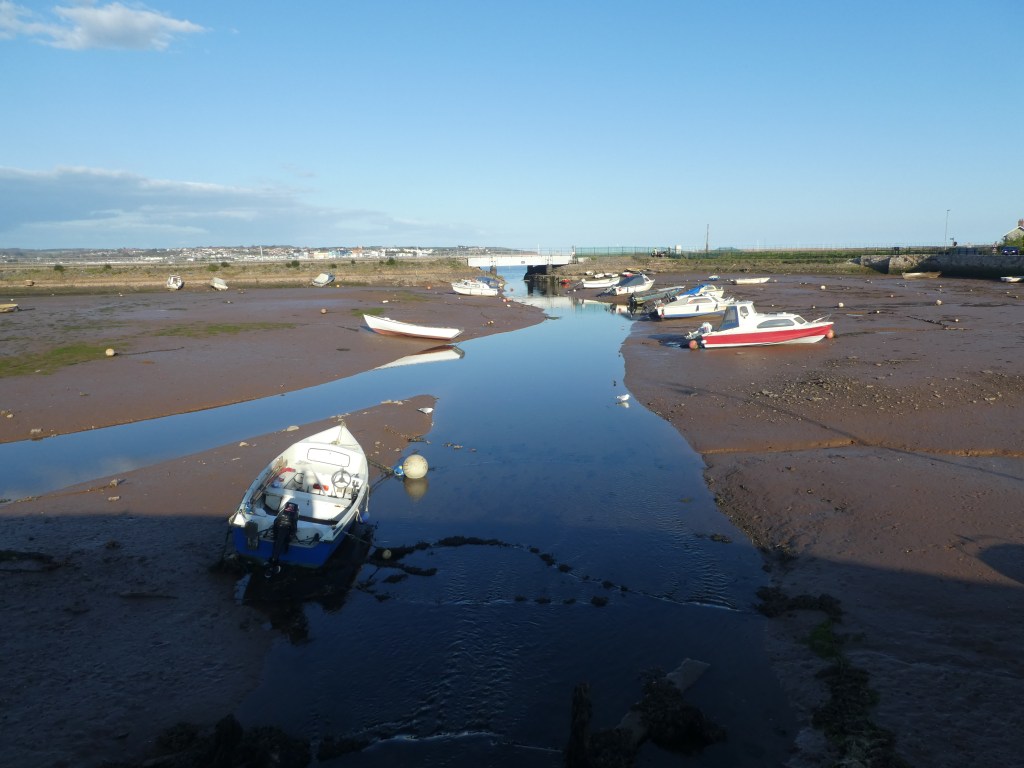
Our first destination is in the village of Starcross, between Exeter and Dawlish, a farm site in a valley with a stream and a pond, beautifully laid out. We have a pitch overlooking the hens’ enclosure. It is warm enough to have coffee or lunch outside and I become fascinated by hen society; the way they move en masse from one area to another or individuals make sudden bursts of running for no apparent reason. When I approach the fence they all gravitate to me, presumably in hopes of food although I prefer to imagine it’s in greeting.

Having set up, we walk into Cockswood, a few minutes away, to sit in the outside area of The Ship pub for a drink and to reserve a table to have dinner next evening. There is just enough warmth in the sun for it to be comfortable.
We swing easily into van routine, sleeping well and waking to tea before morning chores; emptying and water-filling. There’s plenty of time to read, write or potter [Husband’s preferred activity] then after lunch we set off for our first, amoebic cycle of the year, towards Dawlish. I’ve got over my first cycle wobbles by the time we reach Dawlish Warren, a funfair and tourist spot which is seething with revellers, although my thighs are aching, but when we turn up towards Dawlish itself the hill proves too much and I have to alight and push. I’m alarmed! Is this the end for me and cycling?

Next day we stride out along the footpath towards Exeter, past Powderham Castle and the church then along the river bank towards the canal. we stop for a rest at the loch, where the pub is doing great business, most tables being occupied. We turn back and sink onto a bench, footweary by the coffee kiosk in Starcross for reviving tea and cake.

Grace is also known as the novelist, Jane Deans. Her new novel, The Conways at Earthsend is now out and available from Amazon, Waterstones, Goodreads, W H Smith, Pegasus Publishing and many more sites. Visit my author page on Facebook: (1) Jane Deans, Novellist, Short Fiction and Blog | Facebook
The Travelling Sofa of 2020

We must not complain. It’s been my silent mantra this year. Be glad we are safe, well and adequately fed, live in a lovely home in a pleasant place. Nevertheless this has been the first year for almost thirty years we haven’t crossed the water to Europe and set off, meandering with no fixed plans and half an eye on the weather forecast.

We have, in fact holidayed during 2020. Way back in February, in what seems like a century ago we took the plunge and went off on our pre-booked, long-haul, winter sun trip to Thailand, to Koh Samui. We deliberated, yes, worried, yes, took advice, yes-and then went, carrying face masks, hand gel and all the paraphernalia we have subsequently become accustomed to. It was tricky; hot, suffocating queueing in Bankok airport wearing masks, but now I look back and am so glad we braved it. Our ten days was wonderful, with no virus on Koh Samui, everything relaxed and easy.

In the summer we were able to get away to UK destinations in our camper van, starting with a cautious outing locally, down the coast to Osmington near Weymouth. We became more confident and travelled to Suffolk for a couple of weeks, looking at a part of the UK we are unfamiliar with. Later on we stayed in Cornwall, the sites busy but safe so that the trip felt almost ‘normal’. All these trips are documented on Anecdotage in previous posts.

We have not planned any travel for 2021. Unlike many, I’m not expecting a miraculous transformation of our viral fortunes just because it’s a new year. We are consistently [and annoyingly] reminded that ‘the virus doesn’t recognise Christmas’ so why should it then recognise that the date has changed?

Instead I’ve daydreamed, ogled at and imagined all the places I’d still love to go, as yet unvisited or fond favourites we’ve returned to many times. Here then, in no particular order is my list.

New to us

* Canada. We went to Canada for a few hours, once, walking across the border at Niagara from the USA. Perhaps we’ve watched too many snowy landscaped serial killer thrillers [including the excellent ‘Cardinal’] during lockdown, but I feel myself drawn to those vast frozen expanses and opportunities to see bears and whales. A rail trip through the Rockies would make a wonderful addition to a visit, too!

*Likewise, Iceland. Without the polar bears and whales but with hot springs and a chance to see the Northern Lights, perhaps. Scandinavia has been another source of serial killer TV entertainment this year, with Iceland’s own, bleak contributions.

*Santorini. I’ve visited many of Greece’s gorgeous islands, but have still to set foot on Santorini, with its towering cliffs and nearby volcano. I believe it does suffer from heavy tourist footfall but this does not prevent me dreaming about standing and taking in those views with a stunning sunset.

*St Petersburg. I may be basing my desire to see St Petersburg on screenings of films like Dr Zivago, but portrayals of this iconic city look impossibly romantic.

*Rorke’s Drift. I’d like to visit this site, famous for a battle during the Zulu wars, for personal reasons. An uncle on my mother’s side of our family won the VC at the battle, for defending the place [which was a hospital and stores]. He is depicted in the film, ‘Zulu’. I’ve little interest in safari holidays, but this is a part of Africa that tempts me. I’d also be excited to go to the Victoria Falls, of course!

*In due course, the USA may become visitable again, now that a sensible choice of president has been made. I’d love to see southern states and also to explore more of the East Coast.

Old Favourites

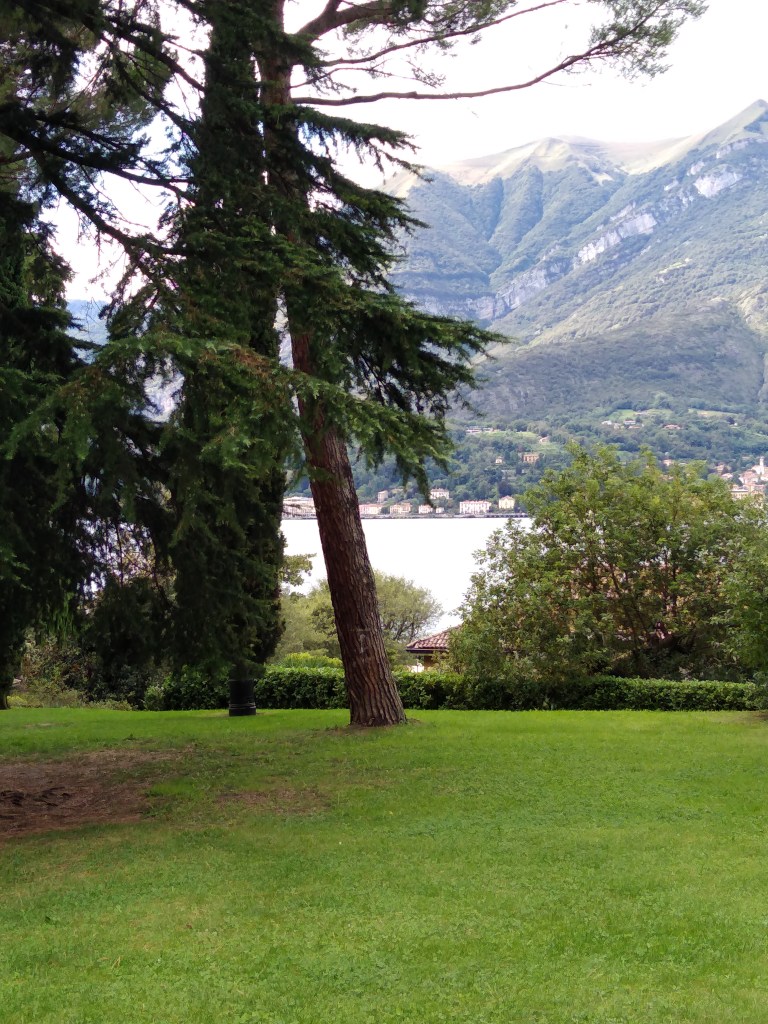
*The Italian Lakes. In 2019 we made a late summer trip to Lakes Lugano, Como, Iseo, Garda and Maggiore. Every lake was sheer magic, each with its own character and features. Each lake was a wrench to leave-until we arrived at the next. The lakes are like a siren call, with their beguiling sunsets and abundance of art. Let me at them!

*Croatia. A stunning, unbeatable coastline and islands. And Dubrovnik is one of my favourite European cities. Then there is Plitvice-a world heritage lake site with astonishing waterfalls, an unforgettable experience.

*Romania. Strictly speaking it isn’t an old favourite, as we whisked through on our return from the Greek mainland, but the brief glimpses we got made me long to go back and explore properly. Transylvania next time!

*South West France. We’ve spent more holiday time here than anywhere else, so much that there is nowhere from Bordeaux to the Spanish border we havent been! But it is beautiful and feels like home each time we go.

There are countless more places-places I only visit on my travelling sofa. I can’t complain. Until we are set free again I’ll continue to sofa-travel-and maybe you, reader can achieve some sofa-trips of your own? Have a Happy New Year in whatever way you are able!

Autumn Getaway 2

When I am kept from sleep by a dull ache in my hips and knees I wonder why I’m so enthusiastic about walking the Cornish coast path and then I remember that a time is coming when I won’t be able to.

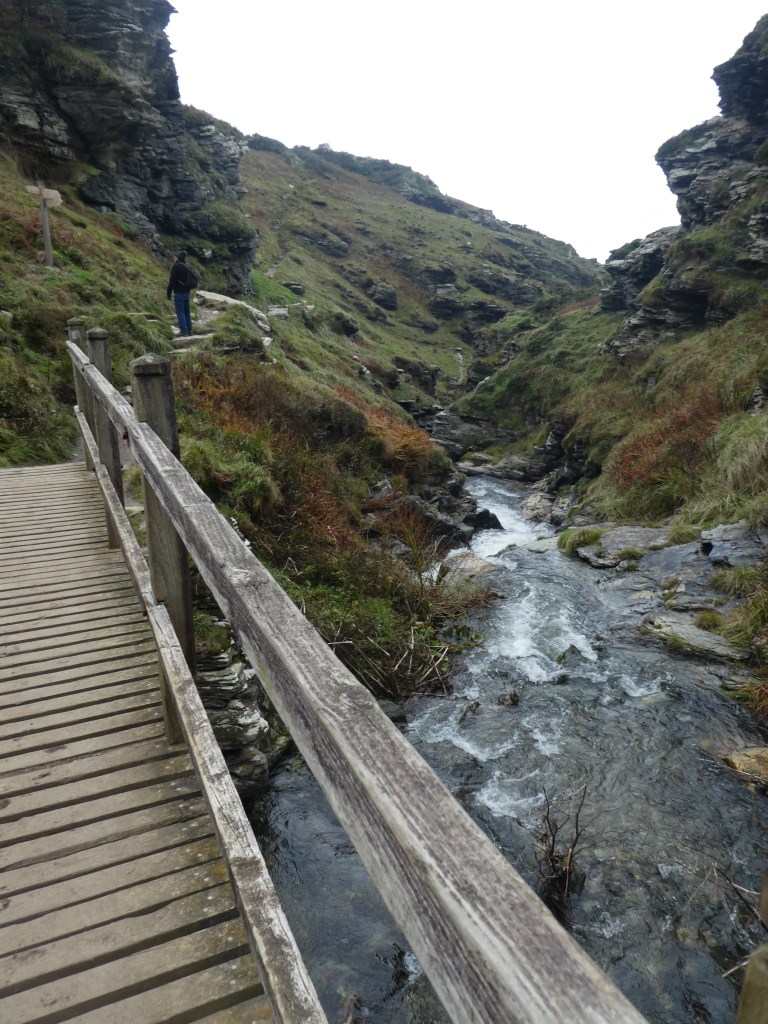
We move on from Batallack, near St Just, to a site with wonderful, dramatic views at Trethevy, near Tintagel. Tintagel always sounds as if it should be a settlement for an elven community and it transpires that there are Cornish influences in Tolkien’s Lord of the Rings. It’s breezy but dry, as once installed, we set off to walk into Tintagel, short in distance and long in time. The descents and climbs begin quickly with a sharp drop from our camp site into a deep ravine and across a footbridge then up the other side with steps and slopes until we reach a gentle, upward field.

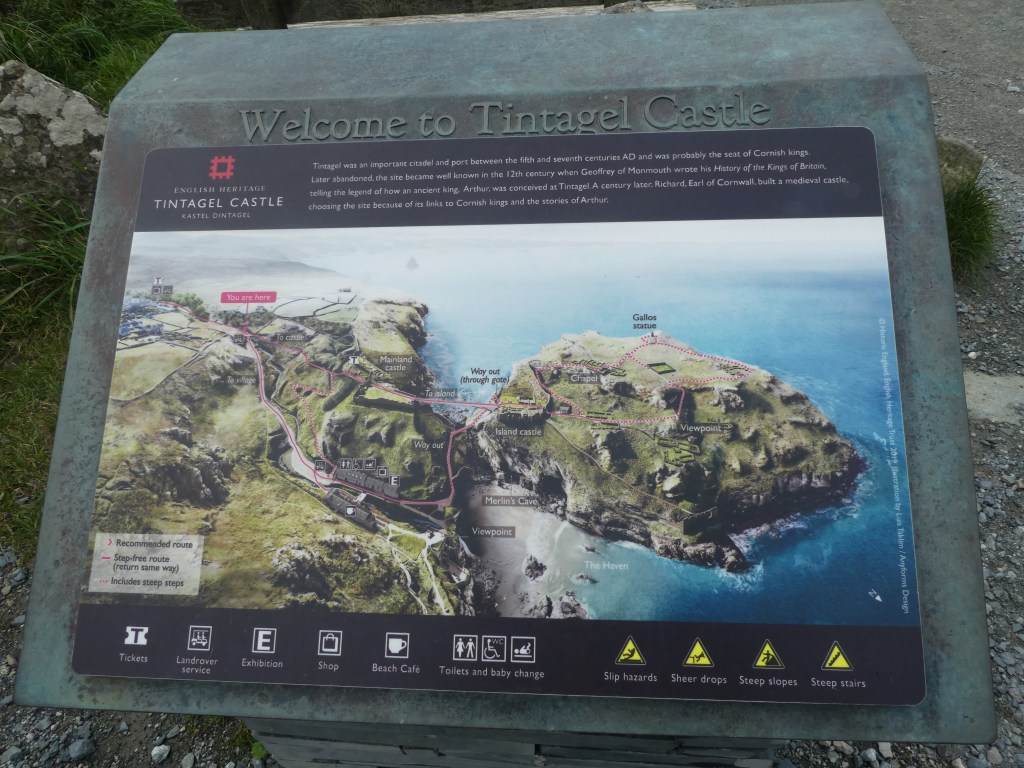
We reach the top of the field where a glimpse of a turret suggests Tintagel Castle but is, in fact a grand hotel, then we round the rocky headland and drop down again, this time for a view of the footbridge across to the castle, now a ruin and accessible only by reserving tickets from ‘English Heritage’. Foiled again, by our ineptitude in booking ahead!

We aren’t devastated. It’s another steep walk up to the village [on the road this time] passed by shuttle runs of land rovers taking sightseers down to the castle and back and those of us who walk it feel smug, if not achey, from gaining the top under our own steam.

We’ve a couple of hours to kill in Tintagel village, which we fritter by having tea then meandering in and out of gift shops and picking up a few things, which helps the local economy in these straightened times.

For once, we’ve been prepared and booked a table for dinner at the excellent ‘Olde Malthouse Inn’, a lovely old stone building in Fore Street. The meal is delicious enough to merit being Husband’s birthday dinner, even though there is still a couple of days until this milestone is reached. There is a relaxed ambience and we are not too out of place in our muddy walking gear. But we are saved from braving the soaring and plummeting coast path home by an elderly, jovial taxi driver who proudly declares he’s never set foot on the coast path.

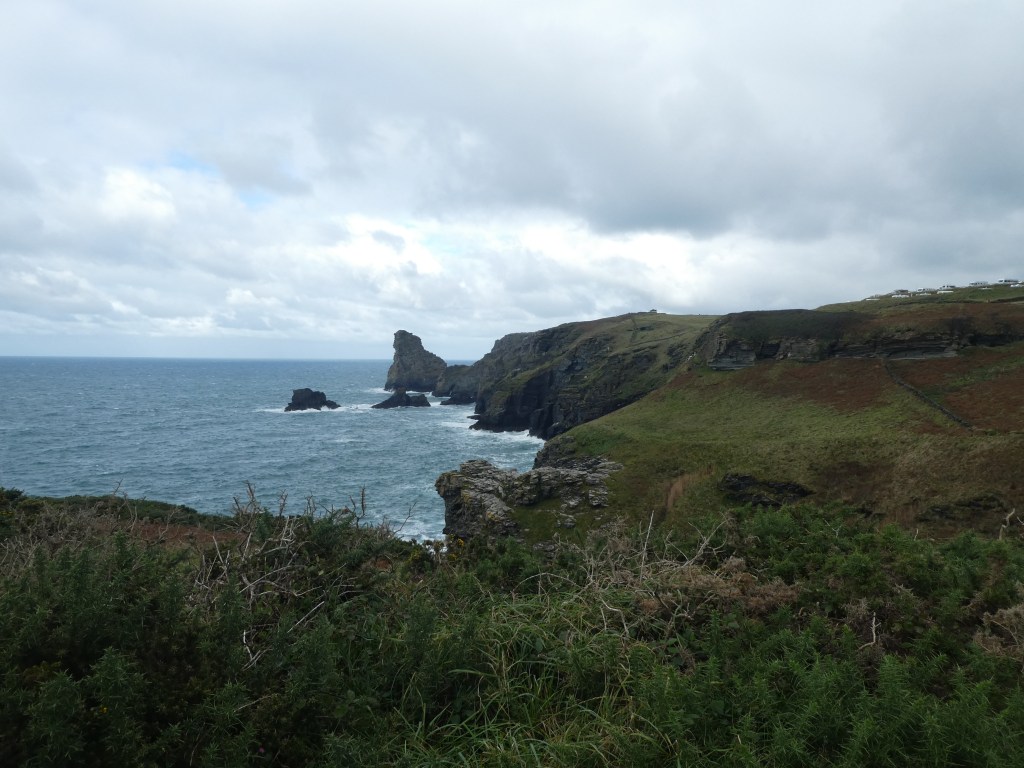
Next day it’s our last walk, in the opposite direction to Boscastle, famously devastated by floods in 2004. The walk is mostly undulating but punctuated by steep steps in places. We climb to the coastguard lookout in a white tower, where it feels like the top of the world, then down into Boscastle’s tiny harbour, now restored and lined with tourist shops.

Further up there are cafes, pubs and a smattering of shops. It only remains to find the bus stop for our return to the site, where a visiting fish and chip van is the main attraction of the day!

Goodbye Cornwall, for now. But we’ll be back!

Autumn Getaway

I’ve returned from time-travelling travel to present day travel for this week’s post.

It occurs to me that we, [that is to say, Husband and myself] have not got the hang of this Covid thing at all. Yes-we are practised in the art of mask-wearing. Yes-we wash our hands lots. Yes-we keep our distance [not from each other, you understand]. Yes-we don’t throw big parties. But we haven’t got to grips with planning ahead, reserving, booking and being organised.

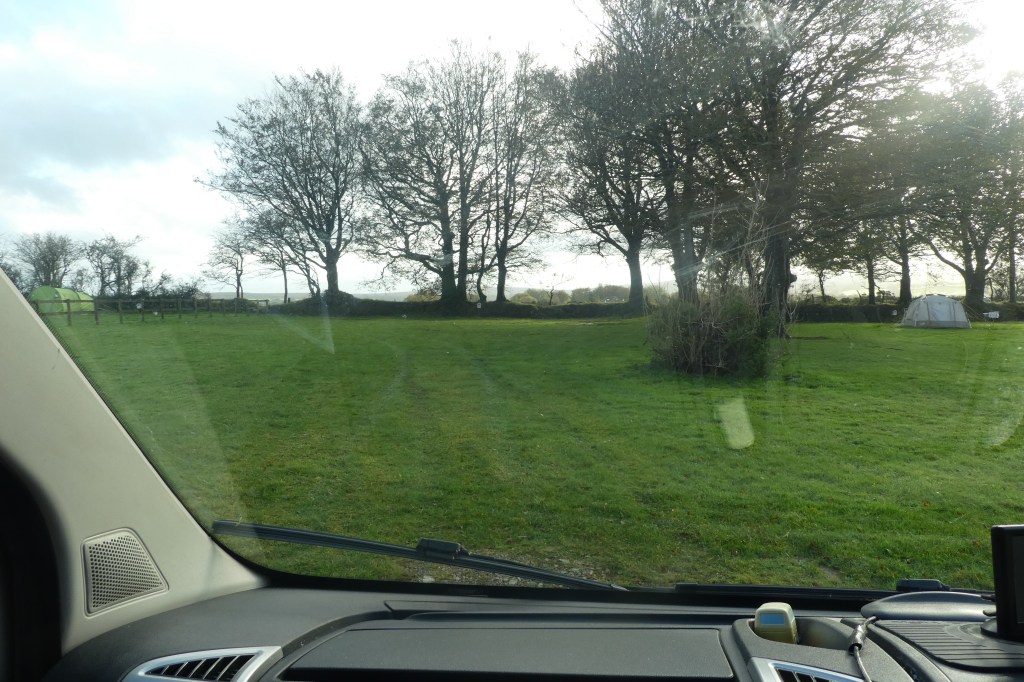
We have come west to Cornwall, via Dartmoor in Devon, where we stayed at a pub campsite and took advantage of the hearty meals on offer. Our departure was delayed due to Biblical quantities of rain which penetrated our house roof [again]. But that is another story. The rain has turned from relentless deluge into squally, intermittent showers punctuated with gusts of wind, a marginal improvement, although I wouldn’t volunteer to swap places with the occupants of the two tents on the site.

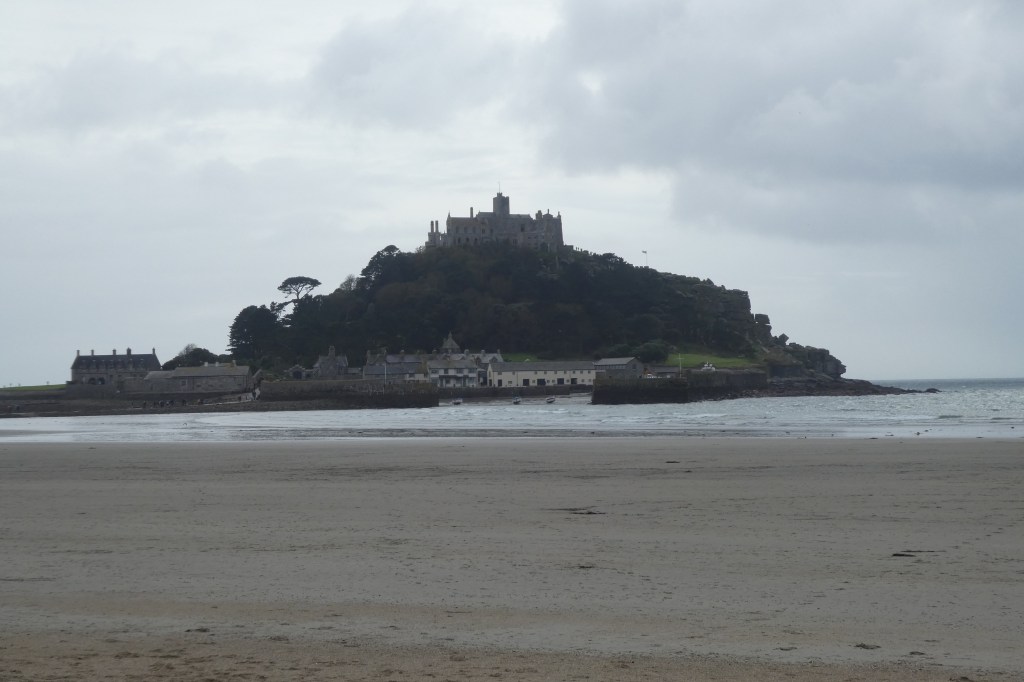
We head off in the morning, making for St Just, beyond Penzance, which is towards Cornwall’s ‘toe’ and on the Atlantic coast. But we aren’t in a hurry and having picked up home-made pasties in a farm shop we attempt to park in Launceston without success then find a picnic area where we can stop, make coffee [a distinct improvement on the kiosk Nescafe from yesterday] and continue on our way. After a blustery drive we stop for a break and spot a castle perched on a hill, poking up behind a field. It is, of course, St Michael’s Mount, twin of French Normandy’s Mont St Michel.

It’s years since I visited St Michael’s Mount. We decide to take a detour. When we reach Marazion, the tiny town that faces the mount, the car parks are choc-a-bloc and having been denied access to the National Trust park we have no choice but to pay a steep £8 to park in the ‘alternative’ one.

Then we battle our way across the cobbled causeway towards the Mount, sandblasted and peppered with rain, but when we get to the threshold there are NT staff in masks checking tickets and there is nothing for it but to turn back. We fight our way back across the causeway, mercifully still not breached by the waves and have a stroll up through Marazion, which, though pretty enough is upstaged by St Michael’s Mount sprouting from the broad beach in a dramatic fashion.

We return to the car park where we feel smug making a cup of tea to utilise our £8 fee.

We head off to our pre-booked site at Batallack, near St Just and a few strides from the coast path. The owner is amenable, the site pleasant, with a smattering of occupants.

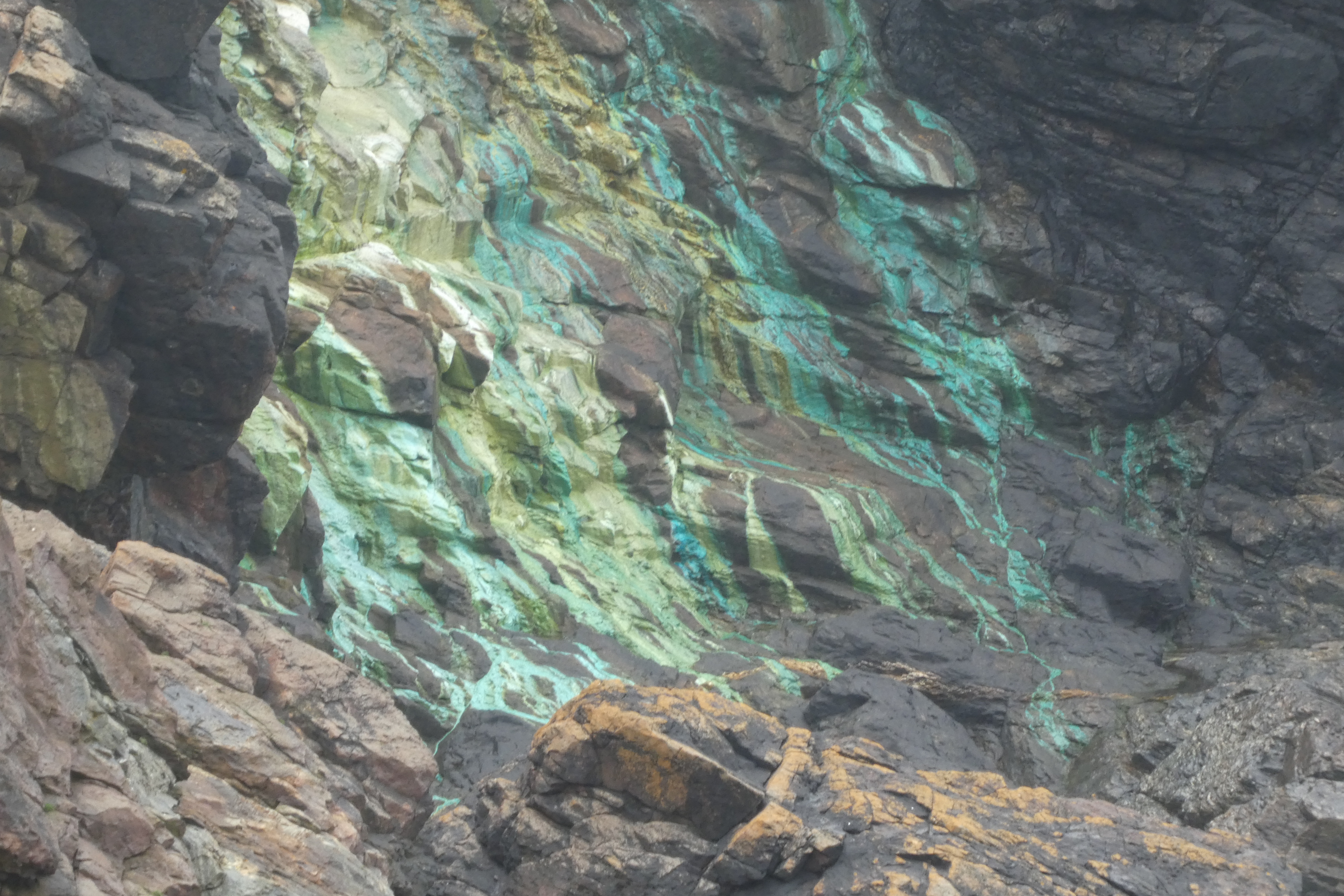
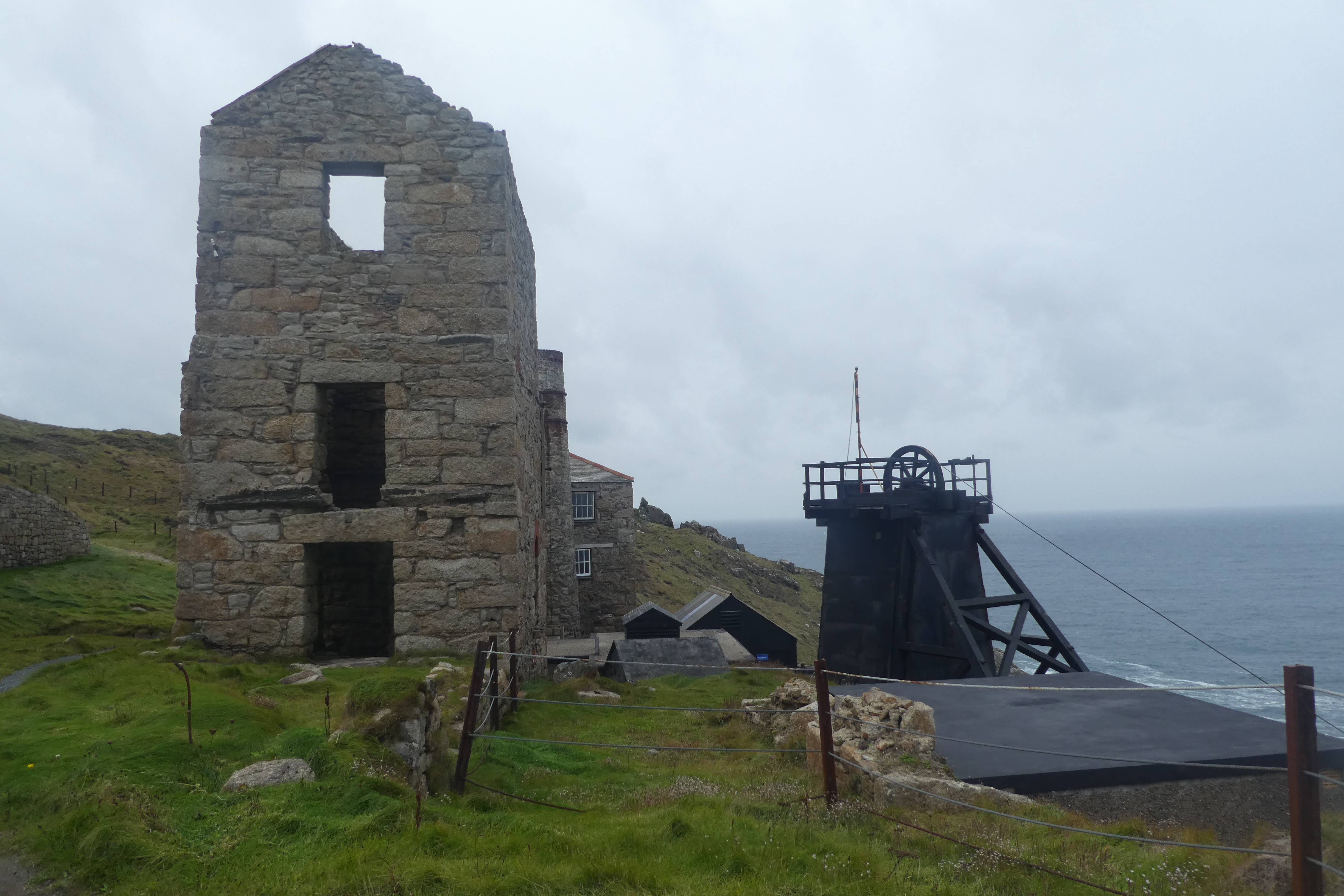
Next day is cloudy but dry as we set off to walk along the coast path towards Pendeen, where we can get a bus back to the site. As soon as we reach the path the scenery is rugged, rocky cliffs falling steeply down the sea and peppered with the remains of chimneys and wheelhouses from all the old tin mines, all of which have been at least partially restored. The path dips and rises, providing some stiff climbs and descents. In one cove the rocky cliffs are striped with green where arsenic has leeched from the old mines.

After a couple of hours a dank October drizzle sets in, soaking us as we climb steeply up towards the road to Pendeen. We reach the village, legs aching, and scan the main road for a bus stop. The map app on Husband’s phone has disappeared so having spotted a car park sign I make the assumption this is the village centre and we make for it, nipping into the village pub to confirm we’re en route. Sure enough there is not only a bus stop but a shelter! and a few minutes later the double decker ‘coastal breezer’ comes around the corner to take us back to our site. Bliss!

The Power and the Story

A chance meeting with neighbours on our site at Felixstowe, who’d recommended a site to us, had sent us scuttling back to the coast at Sizewell. Sizewell was an old fishing village once. Now it is better known for accommodating a notorious nuclear power station, Sizewell ‘A’, now decommissioned and encased in 3 metres of concrete. Sizewell ‘B’ sits next door to this huge, grey, man-made monolith and is sky-blue with a white dome, like a space-age cathedral. On arrival to Sizewell I experienced an irrational frisson of trepidation, perhaps brought on by a recent viewing of the hit series, ‘Chernobyl’.

Sizewell ‘C’ is now on the agenda, unpopular with many, judging by the signs dotted around the surrounding villages.

An extensive wind farm, Greater Gabbard was just about visible on the horizon out to sea. Once we were installed at our site and settled outside the bar, [which overlooks the wild beach], I eavesdropped on a neighbouring conversation in which a woman expressed vitriolic hatred for the wind farm, barely visible even on this clear, sunny evening. To her near left the twin power stations rose up menacingly, compounding the irony of her invective.

But despite the power monsters in their varied forms, this is a wonderfully wild and unspoilt piece of coastline, rich in wildlife. There are extensive marshes, forests and beach habitats. At the entrance to the beach car park a jaunty cafe, ‘Sizewell ‘T”, was doing a roaring trade in chips and ice creams.

It is a popular spot for locals and the touring section of our site was busy with a steady stream of visitors, although the shower blocks are closed.

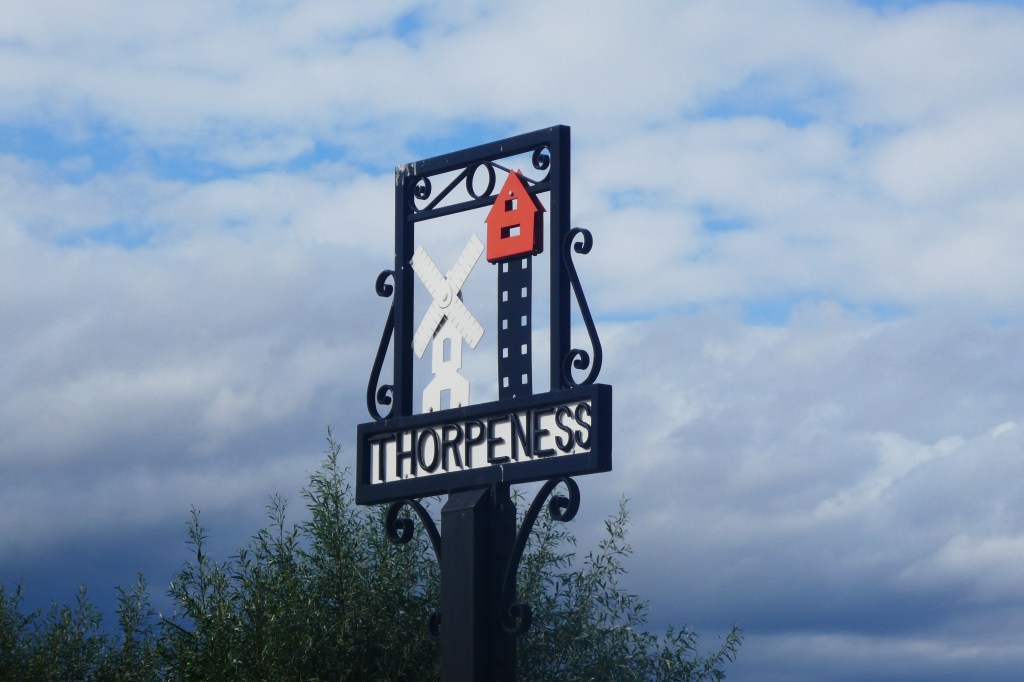
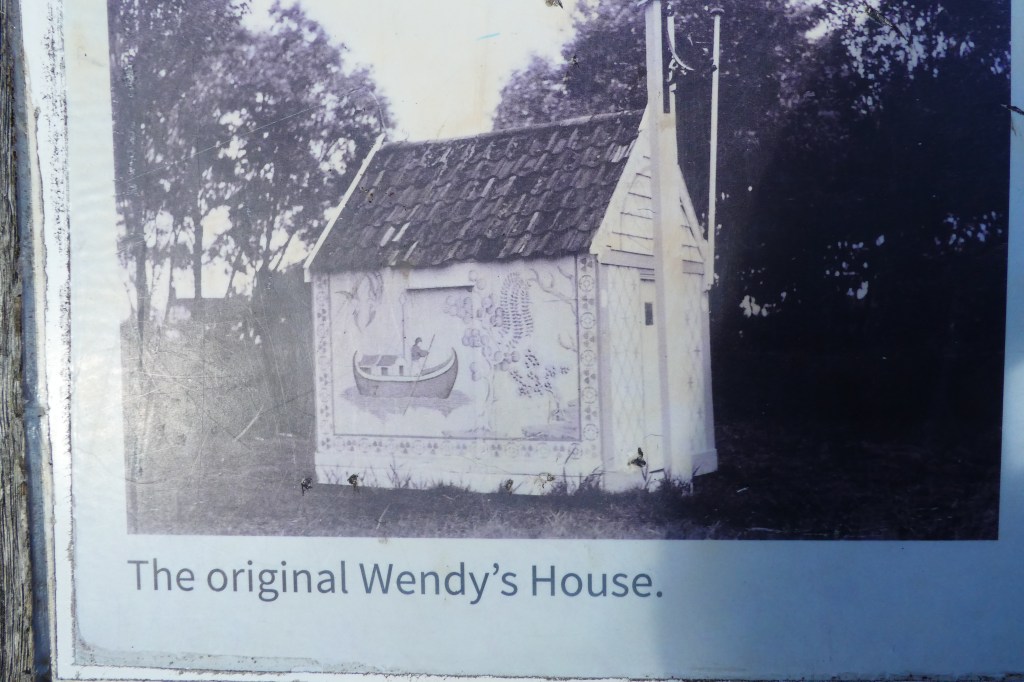
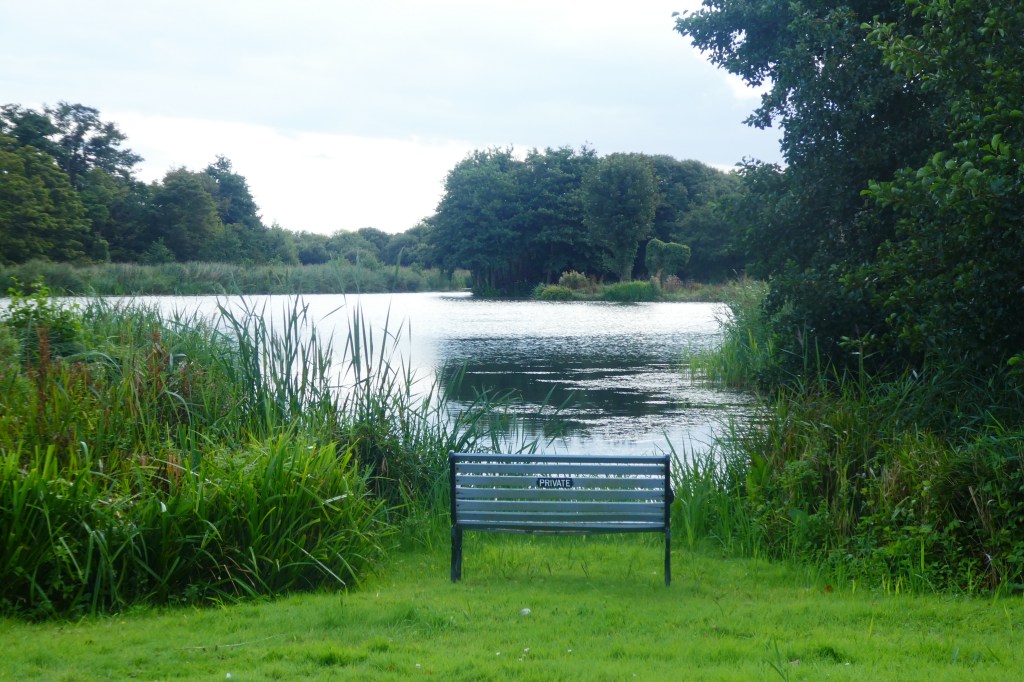
We strode out along the beach, the weather clear and balmy and then down into Thorpeness, a cute, coastal village, thronged with visitors on this sunny afternoon. The village boasts a ‘mere’. Here was the original ‘Wendy’s House’ of J M Barry fame, also an immaculate windmill and the famous ‘house in the clouds’, which can be rented for holiday stays.

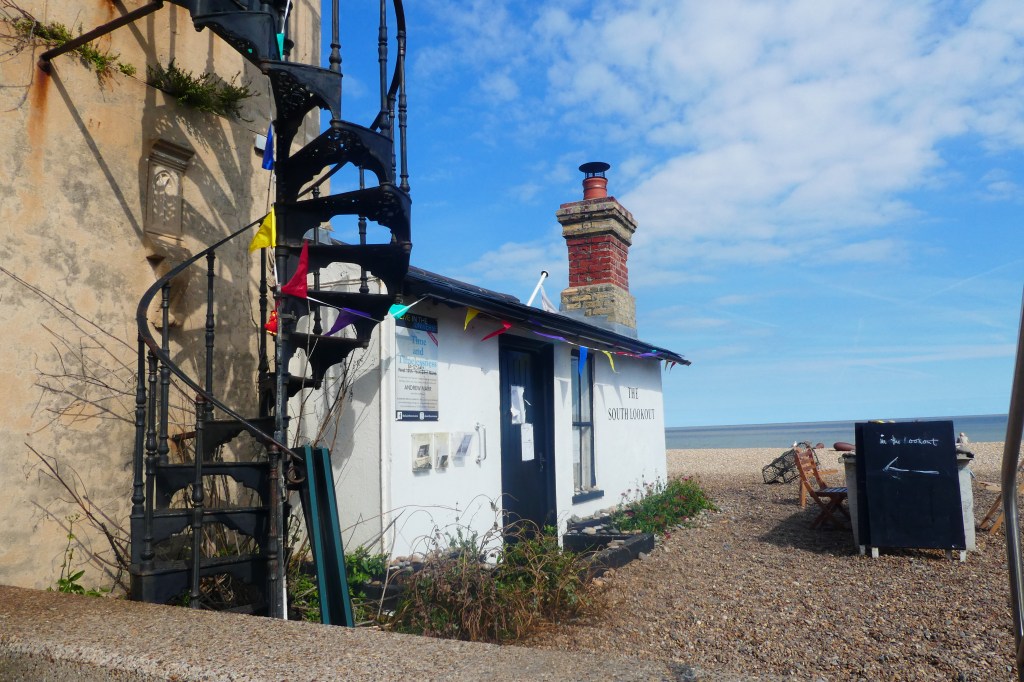
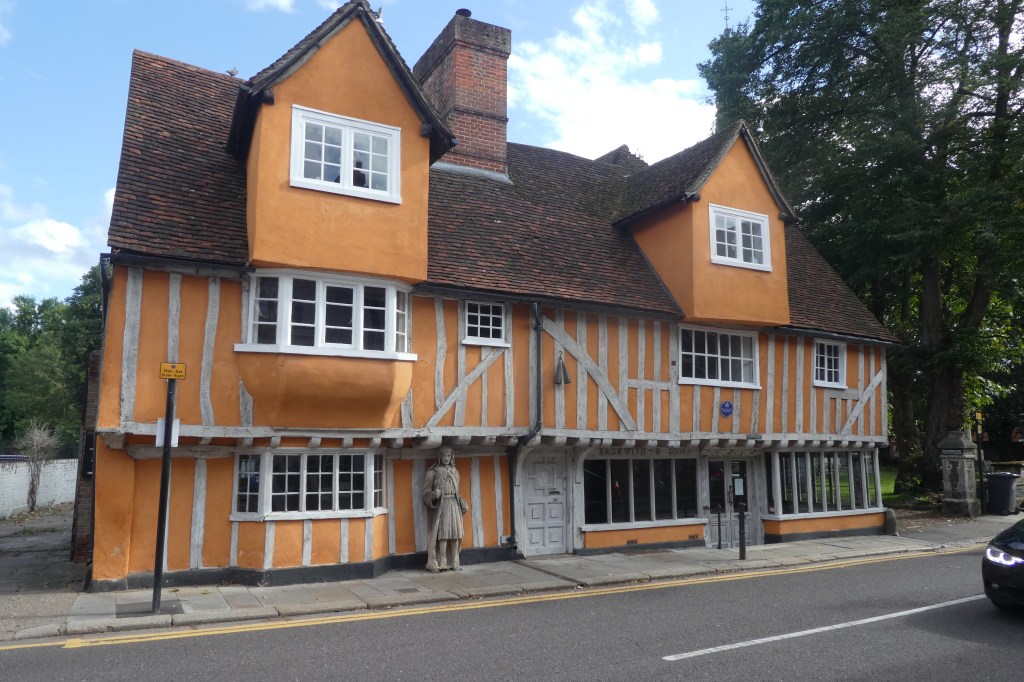
Aldeburgh is supposedly a simple cycle away from our site, though the path morphed from flat tarmac to rutted, sandy track in no time. Again, the town was busy with tourists, too many for the High Street pavements to cope with. It’s a pleasant seafront with fish smokeries and a broad, green swathe on which stands the ‘Moot House’, a half-timbered building housing what must be a tiny museum.

It took longer to queue for the checkouts at Aldeburgh’s High Street co-op than to explore its two or three streets. Provisions were running low and Sizewell is short on grocery stores [there are none].

Next day, with the promise of rain on our last day we cycled again, this time to Dunwich. The route was hilly, a surprise for the knees. Dunwich is a minute village, one street of cottages dominated by a pub/hotel, but with a cafe and kiosk near the beach. There is also a ruined abbey and a museum of sorts. Taking what Husband termed a ‘short cut’ back to our site at Beach view, we found ourselves in the National Trust reserve. ‘Strictly no Admittance without Tickets’ stated the sign as Husband rode through, oblivious. A second turning before the entrance booth took us along a heather lined track. ‘No Horses, no Bikes!!’ proclaimed the sign, which Husband peddled past, heedless. After several wrong turnings we arrived at a ‘kissing gate’ and were obliged to manhandle the bikes through it by up-ending them.

Our last day at Sizewell dawned humid and drizzly. After lunch we walked, taking in the beach and a dripping forest, sweltering in rainwear; and returning to our site for tea and cake.

Unknown Territory in our Back Yard

Four years of my childhood were spent in north Norfolk, in the environs of ‘The Wash’, a flat, featureless, agricultural landscape devoid of trees or anything of interest. You would only consider holidaying there if you were an obsessive ‘twitcher’. The Wash has a large population of water and shore-loving birds.

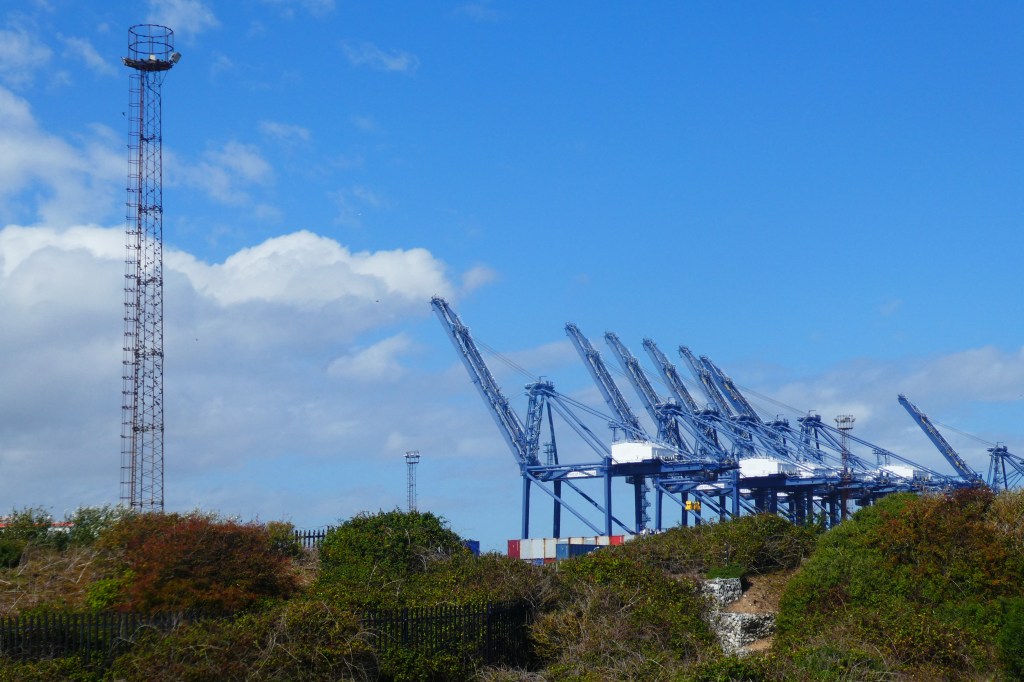
Other than this area, I know little of the area of the UK known as East Anglia, the part that sticks into the North Sea like a rounded carbuncle and boasts the largest container port in the UK, Felixstowe, in Suffolk. The town is also a seaside resort of the traditional British kind, with an abundance of fish and chip shops, ice cream vendors and gaudy amusement arcades. If you look along down along the handsome promenade from the north end, towards the pier you will see the pier head and rows of tall, port pylons rising above it. It makes for an interesting view.

Looking for hitherto unexplored parts of our island we stop at a site here, near enough to hear the cranes grinding and clanging at night as they reach down for each container and hoist it up high on to the impossible stack of the ship that is to transport them somewhere.

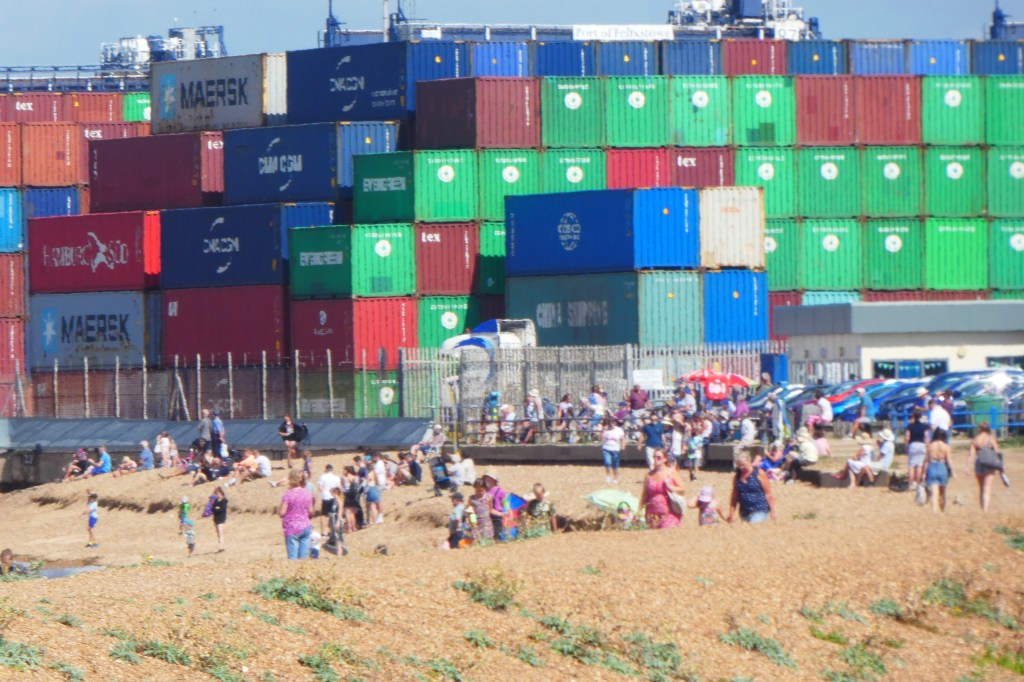
Next day we cycle through the nature reserve on a stony track dotted with clumps of hardy sea cabbage and when we reach the end the giant ship with its towering cargo is almost within touching distance, rearing up behind a shingle beach scattered with bathers and sunbathers.

Away from here, back at the seafront, the prom and gardens are pristine monuments to tourism, without a trace of irony. After a cycle northwards up the coast we take a ferry ride across the Orwell estuary, a staggering £12 return for a 2 minute voyage! But the last ferry returns at 5pm and we’ve scarcely half an hour’s cycling. When we get back the cafes and kiosks have closed.

On a patch of grass by the prom we can sit in the sunshine with a beer and watch the container ships queuing to get into port. Later we dine at the Steak and Lobster Restaurant, taking advantage of the cut-price, early weekday deal the government has provided, though we need no motivation!

The UK weather unleashes its predictable inclemency and a whole day is spent confined to van, writing. Valuable but not physically tiring enough to allow sleep.

Unable to reserve nearby sites we are forced outwards to Hertfordshire, to spend 3 nights outside the county town, which is ok, since neither of us has visited before. A late afternoon stroll around the town in the sunshine is enough to see the place-a pseudo castle, one or two historic buildings and a welter of pubs besides the usual high street carrying the usual stores.

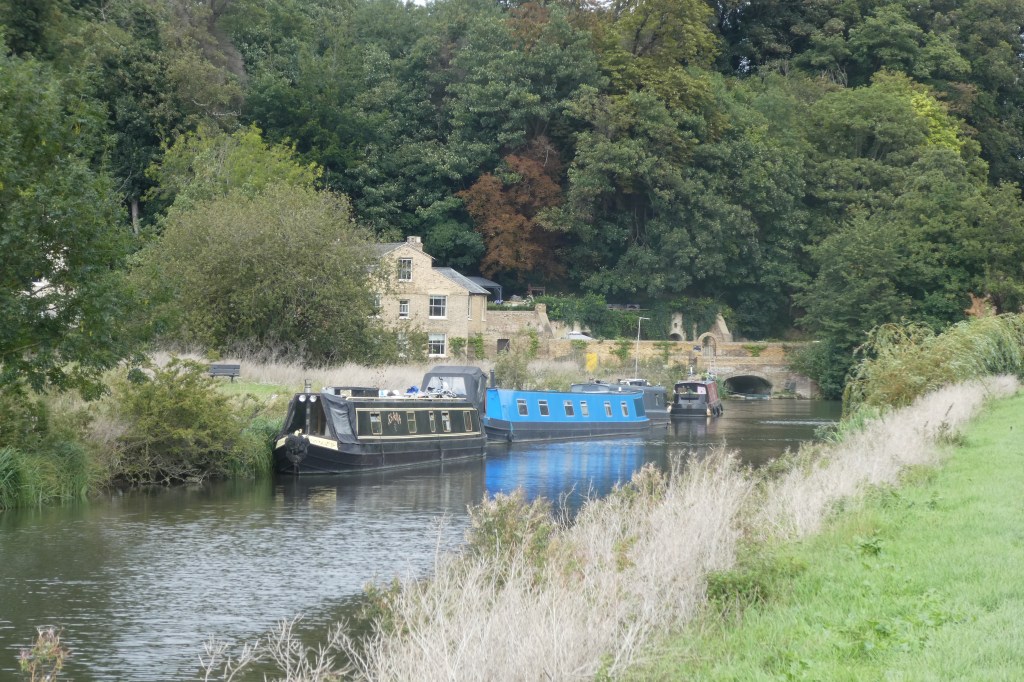
But it does have a creditable cycle path along the Herford canal, continuing along the River Lea, and with a dry-ish day we spend a few hours cycling the tow path, past more narrow boats and barges than I’ve seen on one stretch, ever. The water is busy with river revellers, shouting, splashing, occupying locks, attempting to open/close locks, or [for those whose boats are their homes] pottering on their rooftop gardens and undertaking repairs.

Later, in a quiet, more picturesque part of town we find ‘The Barge’, a beautiful old pub by the canal offering splendid food in a lovely setting.

Then it’s time to move back East…

The Power of the Written Word

So 2019 is grinding towards an end, and what a complex, mangled year it has been for us, here in the UK.

On our small island with its natural water barrier between us and the world, a civil war of words has raged since 2016, over whether we should pull up the drawbridge to our sea moat and withdraw into our brittle little shell or continue to relate with our nearest neighbours in the same convivial way we’ve enjoyed for 50 years.

I’m disconsolate to say to my overseas readers, not only that the drawbridge fans have won the war of words, but that all of we ordinary citizens, those of us who don’t have huge investments squirrelled away or are not hedge fund managers, who are not the fabulously rich elite and right wing newspaper owners, we have all lost.

I can’t dwell for too long on an issue which has been divisive enough to make me sick at heart. Instead I turn for comfort to my own community and to the groups which provide solace, friendship and distraction in these gloomy times.

While I have only been a member of my current book club for about a year, the members feel like old friends already, with their lively, cheerful discussions and their enthusiasm for reading and sharing views. During the evening we spent enjoying a Christmas meal I discovered I am the oldest in the group [by 4 days!], although I’ve never felt myself to be a different generation. I love the range of ages and stages of life. Members relate to the books differently depending on these stages, which provides a wealth of varied insights. The group has grown so much that numbers have had to be regulated!

In contrast, my writing group, the wonderful Spokes, has kept going for years with fluctuating numbers, on occasions dipping to three of us, the original three. We’ve moved venue several times and seen writers come and go, some getting published, some moving to new areas, others giving up their writing journey. But new members always turn up, currently a disparate but interesting set of characters with very different levels of expertise to bring to our group. People have different reasons for attending a group; perhaps writing is an outlet for them, perhaps they are serious about pursuing writing as a career, or perhaps the feeling of belonging and being valued is all they need.

We are fortunate, these days to be housed in our wonderful, local library, a facility denied to many since austerity crept around the country pruning services to the ground. If you are still lucky enough to live near a functioning library, please use it! There are few greater treasures than books, even in this digital age.

So at this point, I wish you-readers from all around the world, all faiths or none, all nationalities, a very happy and peaceful Christmas.


Mad Malls or Sad Streets?

I grew up in a series of three small villages, each of which was served by one, modest grocery shop. The first, which I was sent to from age four, was a minute, dark, cavern accessed by a house door and called ‘Mrs Russell’s’. She had a big old, dark wood counter, sold everything, including cheese by the slice-which she cut from a cylindrical block with a wire-and ‘Fruit salad’ or ‘Blackjack’ chews at four for a penny; also ‘Eiffel Tower’ lemonade powder which she ladled into a paper bag so you could tear off the corner and suck the powder from it directly.

When I lived in Putney, south London in the seventies, Tesco had a store in the high street which still used counters to serve shoppers-and not a trolley or a basket in sight.

In the UK shopping streets are dying and our own, small town’s high street is no exception, with fourteen coffee shops in one relatively short stretch [making local headlines], too many salons, too many tattoo parlours, too many charity shops and most crucially-too many empty shops.

If shops are empty it can only mean that the rents and rates are much too high. Some of the premises have been languishing unloved and uninhabited for so long that vegetation has taken root inside the windows and you could be forgiven for thinking the shop was selling weeds [like the old dead wasp joke].

We are all too used to supermarket shopping; too used to dashing in, picking up packets of this and that and dashing to the checkouts.

But I believe the only way to revive town centres is to return to smaller stores and  specialist stores like greengrocers, butchers and bakeries. Towns that have such shops are mostly thriving. It would also begin to address the horrors of the plastic mountain we are constructing. Once, people took a shopping bag to the greengrocer and the assistant would pile the items straight into the bag. You would take the bag home and sort the items out at home. Nothing bad happened. Some of the vegetables may have needed washing-a chore that should be done whether they’ve been bagged or not.

Meat or fish would be wrapped in some paper. Bread was the same. Milk got delivered in glass bottles. Cakes were placed into a beautiful cardboard box so that it really felt like a special treat when they were bought.

Aside from these essential shops I’d love to see some real recycling, some ‘upcycling’, a repair-anything shop and a swap shop-or perhaps all of these in one, bigger store.

But all of this would take much more imagination, foresight and gumption than we are ever likely to see from our local council, who would far rather leave shops empty and falling into ruination than lower the rates [or better still, waive them for an innovative project].

Perhaps you, reader have a wish list for your local shopping centre. What would be on it?

A Struggle too Long

One hundred years ago in the UK women got the right to vote. There! None of us can really imagine what a hard struggle it was to gain this crucial entitlement, but some brilliant, brave women strove for it and got it and we must never take it for granted.
There have, of course been many ‘watershed’ moments along the path to equality of gender but the most important thing to remember is that the path has not yet reached its destination. That is to say, women still have a long way to go before they can live lives as free and as privileged as men.
It seems to me that the principal reason for true gender equality taking such a long time to achieve is that, having enjoyed the benefits of privilege for centuries many men [not all] are unready and unwilling to give them up and the very fact of them being in positions of power and wealth [in boardrooms, for example] is self-maintaining.
You have only to glance at the vitriolic comments following any article on inequality to see how reluctant many are to surrender the superior lifestyles, the casual attitudes to degradation, the enhanced salaries and all-round benefits of not being a woman.
Here in the UK some areas are gradually improving. The number of women members of parliament has increased slowly over the years, although in 2017 the ratio was still 70:30 per cent in favour of men. There are some women cabinet ministers. The prime minister is a woman [although it is a downright shame that the only two women prime ministers in UK history are both from the political right].
But on the whole progress is slow. That even within the ongoing ‘me too’ campaign, an organisation [The President’s Club] sees no shame in staging a men-only night of debauchery in which women are paraded and objectified demonstrates how little men of certain wealth, status and notoriety care or notice. And until men [mainly white and older] begin to sit up and take notice and understand that they should not abuse their power in this way gender equality will continue to be an uphill slog.
Then in the wider world, daily, systematic abuse of women continues, with underage marriage [still legal in a number of US states], rape as a weapon of war, slavery and traffic endemic in many countries, repression and deprivation of rights rife in still more.
I had my own brush with the equal pay issue over 40 years ago when a student, working a summer job, nights in a soup factory, where we students manned machines packing powdered soup. Six or seven of us would work at the machine, moving place every hour in a non-discriminatory way. When I discovered the male students were paid more each week and asked why I was told that they ‘might be required to lift something’. Were they ever? What do you think?

The All-inclusive Trap

Searching for winter sun, an escape from the dreary, grey drizzle or the bitter winds of this UK winter means travelling long-haul. The options are: far east [Thailand etc], Africa [tried, tested and now not tempted] or Caribbean. We’ve sampled a few islands in the West Indies now, with pleasing results, Barbados and Antigua having proved particularly lovely destinations. Mexico, last year’s experiment boasted beautiful weather but was less fun in that there were few options outside of the hotel.
And here’s the difficulty. In choosing a Caribbean or most other long-haul destination you are stuck in the inevitable groove of ‘all-inclusive’ deal, as after intensive research we have found it to be cheaper than either flying and booking hotels separately or B&B. An all-inclusive deal is likely to mean a vast, corporate hotel sprawling on a coastal strip and boasting several restaurants, bars, pools, terraces, a spa, a gym, shops, ‘entertainment’, beach with loungers and umbrellas and the ubiquitous ‘buffet’.
Hotels like these are betting on the hunch that most guests prefer to stay within the confines of the hotel complex and couldn’t give a cow’s udder about setting foot outside the gate to meander in the environs and hobnob with the locals. And it is true for many, who like to get up, sling their beach towels on their preferred loungers, wander into breakfast, order a cocktail and slump then slump on their sun bed until a member of staff bearing a tray offers more refreshment. There’ll be a further stint of slumping followed by lunch…
For some with a more active schedule in mind there might be a short session of aquarobics or pool volleyball-but then it’s back to the more serious business of slumping, punctuated by propping up one of the many bars.
We can manage a day or so of this, given sunny weather and a beach walk. But after a while some ennui creeps in. This is when we need to get out.
On our recent trip to Cuba the few days in Havana was perfect. We had breakfast in the hotel, we were within walking distance of the delights of the city and had the remains of our days free, at liberty to explore. Once we’d moved to the beach hotel, however there was a short stretch of beach to walk and everything else required a taxi or a bus ride-both of which we did. In one direction lay a sterile and uninspiring marina; in the other the town yielded more sightseeing and entertainment and it was there that we avoided incarceration.
One of the reasons for avoiding cruises is the enforced imprisonment aboard a floating, all-inclusive hotel, with nothing to do but eat and drink.
Our next expedition, already in the planning stages will be very different, involving an extensive road trip by camper van. On our journey we’ll stay where we want for as long as we want, moving on when we’ve had enough of a place and opting to explore by foot or bicycle. What a pity we can’t take the van to winter sun destinations!