Unknown's avatar

About Grace Lessageing

I am writer of novels, short stories, flash fiction, blogs. I lead a creative writing group. I am an Ex infant teacher, living in Christchurch, Dorset, UK. My brand new novel, The Conways at Earthsend was published on January 28th 2021 can be found on Amazon, Waterstones, Hive and Goodreads and is available in either paperback or e-book versions. You can also read The Year of Familiar Strangers, available as an e-book from Amazon. You can visit my website: janedeans.com or my author page on Facebook: https://www.facebook.com/Jane-Deans-Novellist-Short-Fiction-and-Blog-102757711838272 Happy reading!

History Lessons

What will be said, in the future, about the events of the twenty first century?

We still read, write and discuss wars and atrocities of the past. It is constantly said that the ghastly horrors of The Holocaust should never be allowed to happen again. We think that we’ve made progress and we’ve moved on. There are historical novels detailing civil wars, world wars, unspeakable acts perpetrated by countries against others, individuals against their own nations, extremist religious groups against innocent fellow countrymen, random acts of cruelty and subjugation. Movies are made-sometimes heroic, sometimes merely grisly.

Getting towards the later part of life leads to a lot of reflection, which can be irritating for younger generations but is inevitable. They’ll be doing it, too when the time comes.

I remember how horrified and frightened my mother was at the end of her life by the news that an Australian nurse working in Saudi Arabia had received the punitive sentence of some extreme number of lashes. It was more than twenty years ago. Supposing she were around today to learn that dozens of children and teenagers have had their lives and the lives of their families destroyed by a random, pointless deed?

I also remember that Offspring 2 was at uni in London during the events of the July 2007 tube and bus bombings. I was at work on that day and only discovered during a coffee break that the atrocity had occurred. I remember the feeling of terror and foreboding as I tried to reach her by phone and the powerful waves of relief as I finally heard her voice. She’d missed the events by an eyelash, returning to fetch forgotten keys and then attempting to catch a later train. She was stranded but alive. It seemed all that mattered then.

How easy it is to say, ‘We will not be cowed. We will not be threatened and forced to change how we live!’ These are the words of those untouched by the violence and loss.

But the lives of those whose children or parents are lost or maimed have been changed for ever.

There is less of my life in front than behind now. My concerns are more for those generations below mine; with how their lives will pan out and a part of me wants to know how it will be for them in the future. Looking at history in terms of human nature I think it unlikely that there will ever be true ‘peace on Earth’. More probable is the likelihood that climate change will have escalated and usurped human nature in terms of threats.

But what will be learned in history? Because the world seems incapable of learning anything from history so far…
 

Speaking the Lingo and Talking the Talk-

A language cannot be hard to learn. A child can do it.

OK, although most linguistics experts agree that children are quicker and learn new languages with ease than adults.

Of course there are some notoriously difficult languages, such as Japanese and many of the obscure African languages that utilise clicks and other sounds that are not in our sound vocabulary, but where European languages are concerned I don’t believe there is anyone who cannot become familiar enough to understand and make themselves understood in a relatively short space of time. And while heavy work is made of conjugating verbs and swatting up vocabulary lists in schools it is only necessary to spend some time living, working or travelling in a country to learn the basics of that country’s language.

For some, however even the radical step of moving to a new country does not lead to language acquisition-you have only to visit some of the areas of the Spanish Mediterranean with large concentrations of British to see this. Many ex-pats remain solely English-speakers in spite of adopting a new land. Heaven knows what the Spanish think of this…

Our latest trip covered a number of countries and languages, prompting some challenging demands on my inconsistent language skills. As a schoolgirl I learned French, German, Latin and Spanish with varying degrees of success. That I had most success with French I attribute to long summer camping holidays in France with non-French-speaking parents. Like many I gave up on Latin early, seeing no point in continuing and I was a miserable failure at German, whose grammar mystified me [and still does]. The Spanish was an add-on to A-levels, and seemed easy for being similar to French.

We travelled across Northern France into Germany, then Austria. Unlike the French, Germans are not only excellent English speakers but are also happy to speak in English-particularly, at this time on the subject of Brexit. ‘We DO NOT understand the Brexit!’ they told us on more than one occasion. What are we to say? We could only agree that, no, neither could we. On then to Italy. Italian is a most beautiful and musical-sounding language, enough to make anyone want to learn it for the sheer pleasure of speaking it, but for anyone who has learned Spanish the similarity between the two languages leads to much initial confusion. I consistently muddled my ‘grazie’ with my ‘gracias’, my ‘due’ with my ‘duo’ and my ‘per favore’ with my ‘por favor’ etc. After a week or so I fared better and, armed with the ‘Lonely Planet Phrase Book’ was able to stumble through some phrases. I felt inordinately proud when my much practised ‘lavatrice giettone, per favore’ resulted in the swift handing over of a washing machine token, more so when ‘prego’ was the response to my ‘grazie’.

Of course most people understand a nod or a shake of the head and when one set of words doesn’t work another way of saying something often does. And we are yet to meet anyone who doesn’t understand a smile-


Ten Things about Italy

We moved towards the last leg of the trip, leaving Italy to return to French soil in the shape of Corsica-one hour from and in sight of Sardinia. I began to reflect on the things I’d learned about Italy from having spent a longer and more comprehensive block of time in the country [albeit mainly in the south]. Here, in no particular order are some of them:

  • If you want a coffee in Italy, forget about Starbucks and Costa. It will be no use asking for a cortado, a machiatto, a cappucino or a flat white. These are coffees that sound Italian, that someone in marketing has thought up. You may get a latte [although to my mind you may just as well get a cup of hot milk, but in any bar you can have an espresso [beloved by most Italians]-a tiny shot or an Americano-a tiny shot with extra hot water. I achieved my preferred coffee by asking for Americano with ‘piccolo latte’.
  • Despite the Walls ice cream ad, asking for a cornetto will get you a croissant. The custard ones are wonderful.
  • It is well known that Italian drivers are amongst the worst, most aggressive and dangerous in the world.Sicilian drivers are the worst in Italy. The cities of Messina, Catania and Palermo boast the worst of the worst. Intersections in Palermo are akin to some demonic, vehicule version of the Hokey-Cokey, with everyone rushing into the middle, hooting, shouting and gesticulating. Traffic lights are entirely superfluous.
  • Service stations and some cafes have a most eccentric and baffling system for purchasing coffees and snacks whereby a ticket must be got from a cashier in advance of items being prepared. So confused were we the first time that we gave up altogether.
  • Whilst we sweltered in T-shirts and shorts in the fierce May sun the locals went about their business swathed in multiple layers of puffa jackets, body warmers and scarves. I imagine we seemed insane to their chilly selves.
  • Despite the likes of Versace etc Italians slob around as style-less as the rest of us. On the ferry to Sardinia there was a distressing array of bri-nylon track suits. The women are welded to their cosmetics, rarely to be seen without a full face of make-up and the men are fond of their hair, often sporting outrageous styles. Thy are also as weight challenged as anybody else.
  • To chomp your way through a typical Italian menu you would have to be Billy Bunter. There is a bewildering number of courses, the second of which is a full plate of pasta. Best advice is to skip the pasta course.
  • It seems a cliche but Italians are correct to be proud of their gelati. Italian ice cream really is the best. The coffee cone I had in Venice was the most delicious ice cream ever.
  • The contrasts are extreme. In the East of Sicily, where package tourists congregate the roads are akin to the Etna volcanic landscape, the fly tippers have carte blanche and the drivers are suicidal maniacs. The West is a pristine, smooth, quiet haven. In Palermo there are beautiful, renovated piazzas with clean, restored basilicas, cathedrals and monuments. Step away down a narrow alley and you will be instantly into a third world ghetto of open sewers, garbage, feral dogs and dodgy characters.
  • Italian is a most beautiful, musical language about which I intend to devote an entire post in due course…

Oh The Joys of Sicilian Public Transport…

Taorminha. Sicily’s tourist jewel; the magnet for package holiday visitors and justifiably so, perched high on cliffs, the many levels of buildings clinging like limpets in precarious view of the azure sea and topped by the Greco-Roman amphitheatre with its outstanding panorama of Mount Etna.

We shouldn’t miss Taorminha. Having settled into our ramshackle site overlooking a black beach at the edge of the small seaside town of San Alesso Sicula we investigated transport options. Driving up the almost sheer cliff face was out of the question but buses made regular trips and a timetable was posted at reception.  We strolled out into the modest little town and stopped for a seafront beer then found the bus ‘fermata’ ready for tomorrow.

The bus came, and on time. There were some moments of anxiety as it appeared to go in the opposite direction but then it turned in towards our goal, along the autostrada the finally up a series of hairpin bends, up and up into the town, where the driver reassured us that we should wait, later for the return bus. So far so good.

Even now, in April the historic streets were thronged with tourists, the bars and gelaterias doing thriving business. The theatre and its views are worth the hype. The lackadaisical service at the famous ‘Wunderbar’ was not. We gave up waiting and got a drink at the modest bar by the bus stop. Then we waited. And watched the battered, scraped, stove-in and dented vehicles lurching by. And waited.

‘He’s just late’ suggested Husband, ‘It’s the traffic’.

Less sanguine, I nipped into the information booth and learned that the return stop had been changed that afternoon and was now the bus station, many levels down. It had left. The next bus was at 19.40pm. Wonderful.

We got an overpriced and mediocre meal before trudging down to the bus depot to wait. The sun was gone, the evening cooling. Buses came and went with shrugging drivers. At last, cold and disillusioned we returned to the information booth to be told the bus driver, who’d evidently chosen to go home for dinner rather than do his last run, would come back for us at 21.30pm. Unable to face the inhospitable bus station once more we climbed into a taxi. This is Sicily.

We left San Alesso to meander along the south coast towards Mount Etna and a site that boasted an uninterrupted view of this, one of the world’s most active volcanoes. There among a strip of unedifying bars, guest houses and hotels with bizarre South American influenced names-‘Ipanema’, ‘Mokambo’-we found our site. Clearly Sicilians feel there is no advantage in capitalising on proximity to another tourist magnet. There was no ‘Etna Bar’, ‘Lava Lounge’ or ‘Eruptions Night Club’. The site was modest but clean and adequate, with precious few visitors for such a prestigious position. Etna’s head lay still shrouded in clouds but remained an impressive sight, towering above the coast with snow clad slopes.

Next morning, however we were treated to a clear, unsullied view of the entire volcano and its vast crater. Result!

Crossing the Void and having to Avoid…

We wrenched ourselves from beautiful, sunny Paestum having ascertained that thunderstorms were amassing and that the next day, Easter Sunday would be a quiet, truck-free day on the roads.

Italy’s south west coast takes in Basilicata first then Calabria-the toe and the poor relation of Italy’s mainland. But the coast road is stunning and scenic, twisting and turning around a mountainous fringe as it wends south; a coastline to rival the famous Amalfi road and far less travelled. It was indeed quiet, Italy’s biggest religious holiday when families get together to celebrate.

As promised, towards mid-afternoon the glowering clouds vented in a thunderous, lightning-ridden deluge as we neared Italy’s toe and a few glimpses of Sicily.

Since Abruzzo we’d descended into internet silence and it was becoming clear that something was amiss concerning connectivity. We stopped just before the port town at ‘The Mimosas’, quiet, low season and dispiriting in the showery weather. The small beach, however offered our first, shadowy view of Sicily.

In the town where we were to get across the Straights of Messina we were to experience a taste of what was to come in terms of southern Italian driving behaviour. In the narrow streets there were vehicles parked on both sides, cars coming through, cars reversing, cars double-parked or parked across the road. Knowing where the port was located was no help in determining how to get to it. We drove around and around, helpless until a bystander helped out for a small remuneration, showing where to buy a ticket and where to join the queue. The stretch of water is narrow and offers a view of Messina sprawled along the coastline of Sicily.

The ferries came and went in a relentless stream, uninfluenced by the religious holiday of Easter Monday and soon we’d driven into the bowels of one. We joined the throng of passengers climbing up to the café and there was just time to get a coffee before the vessel docked-at Messina!

Having disembarked and trundled off the dockside into the rambling town we began to experience the complete and utter bun-fight that is Sicilian driving. Vehicles shooting out of side roads and parking spaces, no indication of intention, overtaking on both sides, double and triple parking, stopping mid-road and getting out, disregarding red lights, other cars and any kind of safety procedure. This was to be the norm.

The outskirts of Messina, a long built-up stretch were lined with scruffy housing, numerous assorted vans, trucks and cars selling mostly green beans heaped up in mountains in car boots and on truck beds. This is clearly not a wealthy area.

Later the road morphed into seaside suburbia and we found the way to the autostrada where we made for the first site [near as we could get to the tourist hotspot of Taormina]. Elements of doubt crept in as we bumped around an unmade road and past a cement works sporting a statue of a praying monk, [San Cementus, perhaps? –the patron saint of concrete?] but there was the entrance, shrouded in a choking cloud of barbecue smoke on this holiday afternoon; the small, dishevelled site crammed with holidaying Italians. We were shown a spot overlooking the sea front. Here at last!


Going South

While it is fair to say I’m less confident at driving the van than I was I don’t expect Husband to undertake all the driving. On a trip like this it would be tricky to do the distance. So I take a turn to give him a break.

We leave Venice and turn south on the coast road towards Rimini and Ancona. The journey is without incident and a little slow due to the 50kmh limit almost all the way. I am happy enough driving through the built up area where I cannot overtake and cannot be overtaken. At the end of the long day we arrive at a coastal site south of Ancona where a handful of motorhomes have also stopped. The site opened a few days before but is clearly not ready to receive visitors, the bathrooms strewn with electrical cables and tins of paint, the sound of sawing and the to-iing and fro-ing of the workmen as they labour.

At reception I am told to return in half an hour, even though the vast expanse of site is so sparsely occupied as to be almost empty. At last we are supplied with a shower key for a slot to provide hot water, the delivery of which lasts all of 2 minutes-enough time to work shampoo up to a lather and little else…

Of the numerous toilets, only one is able to be sat on, the remaining cubicles being the archaic, squatty type. Half of these are filled to the brim with excrement. We are not impressed!

Next day I take first turn, assured by Husband that we’ll do autostrada; that we can ‘just drive’ and it will be easy. I turn on to the motorway, settling behind a lorry until I feel confident enough to overtake. It is a large tanker. Seeing a space, I pull out into the middle and begin to pass-just at the sign for a lane closure, the tanker’s lane. Horrors! The lorry driver makes his predictable, terrifying move as I am part-way past, indicating and lurching sideways in a bid to bully us in. By now I’m hyperventilating, yelping. Husband urges me to put my foot down and go, which I do…then I am past and I can swing back in, gasping in relief. A few moments later, as we limp along behind the next lorry the tanker driver regains his advantage, displaying his superiority from his testosterone filled cab and I let him go. That’s enough near-death experiences for one day.

Later we leave the motorway to climb into the mountains of Abruzzo and stop at Opi to be greeted by the owner speaking American English in a beautiful, remote site surrounded by towering peaks and woods supposedly occupied by bears and wolves. Across the field there is a lone, Dutch motor-home but the couple are enjoying their solitude. After dinner we sit by a huge wood burner in the empty restaurant, share a local brew of beer and chat to the owner’s daughter, recently returned from Boston.

In the cold night I fancy I hear wolves baying. The friendly site dog is sitting outside in the sunshine waiting to greet us next morning and as I wander up the lane to supply the fluffy donkey with a carrot a troupe of little pigs and a gaggle of white ducks come running up.

Then we are off again, heading down off the Appenines and away to the west to skirt Naples-I am adamant this time that I will not drive on the motorway. But we are to encounter far worse driving related incidents as we progress south.

At last we are over at the opposite coast, The Mediterranean, at Paestum and we settle down for a couple of nights by a beach under the shade of some eucalyptus trees with a handful of German, Swiss and Austrian neighbours soaking up the warm sunshine.

Snippets from Four Countries-

I last visited Strasbourg as a teenager. But Husband had never been and one advantage of becoming ancient is that you can revisit old haunts and not remember a thing about them.

       It is a gloriously hot, blue-skied day. We are able to cycle from the site into the city, which is thronged with shouting school parties but still gorgeous with its covered bridges, medieval architecture and sparkling waterways. We stop to rest our feet [a feature of sightseeing these days] at a table outside a bar in a pretty square and remember why we like to travel this way.

        Next day we are off through Germany, taking in the edge of the Black Forest, which is all cuckoo clocks and cow bells, and catching some squally rain as we climb higher, the temperature having plummeted as we arrive at Salem, near the Bodensee, our stop for the night. Just outside the village on a hillside, the site has a small bar with the type of German beer that Husband likes. The night turns icy enough for our little heater and extra blanket to be barely adequate.

The following afternoon we cycle to the Bodensee, a magnet for German tourists though precious few foreigners. Few places are open but look set to begin the season in earnest for Easter weekend. We lose the next day’s travel due to over-excited consumption of beer, but set out for the German/Austrian border on the next morning, settling for Wertach as an overnight stop. It is a pleasant, Alpine farming town. I am startled by the cigarette machine in the washing up area.

As we are leaving an older German fellow tells me ‘We CAN NOT understand the Brexit’ and I can only reply that ‘No, neither can we’.

On to Austria, a slow crawl across the Fern Pass on an ill-chosen, holiday Saturday. But the scenery compensates for the traffic jam-snowy peaks glistening in the sun, ski runs zig-zagging down under gondolas and ski-lifts. Our chosen destination-Feriensparadies on the Natter See- is elusive, confusing Mrs Garmin, our austere SATNAV lady, who sends us off up winding mountain tracks filled with pole-wielding hikers in an unlikely quest for the site. At last we arrive to Feriensparadies, which justifies its coy location by being spectacular; a sun soaked hollow in the snow peaks with pitches facing the cherry blossom fringed lake. The staff are charming, the views are breath-taking, a free shuttle bus can take us to Innsbruck, where we can ride the funicular and gawp at the splendid medieval buildings and the services are nothing short of luxurious. All power to the Austrians!

Regrettably, after 2 nights it is time to crack on-and so on to Venice, which I don’t need to describe since a great deal has been written elsewhere about this extraordinary, watery city. It is another re-visit for me and new to Husband. As we meander the alleyways and over the bridges with our cornettos I ask him if it lives up to the hype. ‘90%’ he says, not revealing the 10% in which it fails…

Starting Out

I am standing in our kitchen, one hand holding the pull-out pantry door open. I am frowning at the shelves, thinking, ‘what the Hell do I pack into the van to go on an extended trip?’

We are preparing for our first trip of the year and have worked through the administration tasks; channel crossing booked, euros loaded on to travel card, banks informed, van serviced and cleaned, insurance [personal and vehicle] updated, guide books and atlases collected, neighbours and family told, lists compiled.

Laundry is ready, clothing and bedding and towels [two sets to ease laundry while away]. Much to non-motorhome owners’ surprise we don’t sleep in sleeping bags but use a duvet and fitted sheet, just like home, but with the addition of a blanket in case of cooler nights.

Then I am flummoxed by the culinary provision. We are in the habit of starting off with a basic set of tins, jars, herbs and sauces but for the life of me I cannot recall what. I DO know that industrial quantities of Yorkshire tea bags will be required, since proper tea is not something that can be found in a European supermarket. We are constrained by the space, which consists of two very small drawers and a tiny shelf with an area like the bottom of a single wardrobe underneath [used mainly to house Husband’s beer supplies]. I wait. I know this will all come back to me and sure enough, as I begin to select tins it does: 2 tins of tomatoes, 2 mini tins of peas, some baked beans and any other vegetables that might be handy. I add rice, pasta, miniscule pots of mixed herbs, cornflour and ‘Bisto’, mustard, tomato sauce and puree and a bottle of olive oil. I’ve just about done it. Then there’s the fridge…

We stumble up at what is an indecent time for late-rising retireds and I take whatever is left in the fridge out to the van’s little fridge. While it looks a modest quantity in the house fridge it takes more ingenuity than is readily available at an early hour to squeeze into the van’s cold storage. But it is done.

At last we are en route and wending our way up to Folkestone for Le Shuttle, a journey we have not made for some time, but is without mishap. Before long we have rolled into our place along the austere interior of the shuttle train and it is underway; little more than a half hour later and we’ve arrived in France for the first leg of this year’s odyssey.

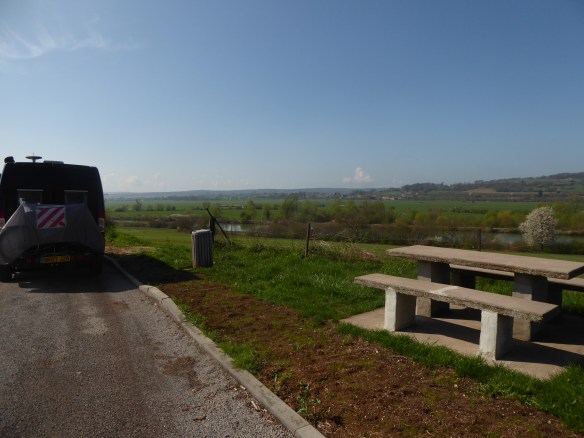
We head towards northern France, equipped with a new ‘Aires’ book to inform our overnight stops. I realise we’ve left the new loaf in the bread bin at home. It will be colourfully hairy by the time we return but nobody is perfect and France, above all is not short of the odd Boulangerie. Alsace is luscious in the spring sunshine.

The first aire looks dubious; nothing more than a roadside parking lot and no other vans installed. We move on to another, next to a park off a quiet road, with ‘vidange’ provided. Almost simultaneously a French motorhome pulls in beside us and we are fine for the night.

Next morning is bright and sunny as we make tea and swing into van routines. It’s all coming back to me. I stroll up to the Boulangerie for a loaf, dithering over what to choose. There isn’t much left so I settle on two 60 cent baguettes. ‘Deux euros!’ The stern Madame, folds her arms in resolute emphasis as she sees me glance at the price label on the shelf. I am not willing to argue. I pay up in meek submission. Is this the Brexit effect? It remains to be seen.


P1020835


Ditch the Bucket-

By the time you read this we’ll be wending our way into the next adventure.

If anyone were to ask me what the most important ways to enjoy retirement were I’d have to say having adventures.

Adventures come in many forms. They may entail travelling somewhere, but travel is not essential to having escapades. All I’m saying is escape from routine is a requirement of happy life. It doesn’t matter what the escape is. A visit somewhere different, an encounter with someone new, learning a skill, joining a shared initiative-these are all adventures, as was the move to a new house we made last year.

A friend who, [by her own careful, clever planning], achieved early retirement tackles a different, arty hobby each year. Some enterprising older folks in Devon have established a business growing and marketing oysters-and have provided employment for many younger people along the way.

You hear a great deal about ‘bucket lists’. In my view these smack of the ghastly ‘targets’ that those of us who are retired are so relieved to have left behind. You don’t want your adventures to be a source of anxiety. It is a blessing to be flexible, to be able to change your mind, revise plans. As we age there are going to be many things we’ll never do, skills we won’t learn, marathons we won’t run, places we’ll never visit, foods we won’t eat, books we won’t read and plays we won’t see.

Three years ago we’d a mind to escape the chilly UK spring and take our camper van down to the Spanish Mediterranean coast where we would visit friends and find somewhere without too much development to enjoy some sunshine [not an easy undertaking, as those who know that coastline will know]. Passing heaps of scruffy snow in northern France we got down as far as Bordeaux and realised the temperatures were not likely to improve any time soon, so took the decision to turn right instead of left, aiming for Portugal. As soon as we crossed the border from Spain it was warm sunshine all the way. Result!

Of course much is published about the poor, subsequent generations and how we, the Boomers have robbed them blind and how they’ll be working themselves into their graves. Most of us, however have done all we can to support our children through further education and beyond, while also caring for aged parents. But having read that life expectancy is increasing by five hours per day I feel that our children and grandchildren, too will enjoy the benefits of retirement, albeit at a later age. I’ve pledged to do my utmost not to be a burden to them when they get there!

Until that time I remain unapologetic about enjoying our freedom. I imagine there may well be a time when I’ll only be able to enjoy the photos and the memories so I’m making sure there will be some to look back on…


Thoughts in the Aftermath…

We are in one of those grim periods following an Islamic terrorist related incident, when the news is laden with endless analysis, eye witness interviews, past incidents of a similar nature recalled and the same, frightening, inevitable images relayed repeatedly on our screens.

Will our children and grandchildren and their descendants ever know a time without threats, suspicion, random acts of violence and hate?

Those of us who were born in the fifties, in the aftermath of the Second World War experienced childhoods of peace but relative austerity. There wasn’t a great deal to go around. In the countryside where I grew up our parents cultivated gardens, kept hens, made things last. We were not hungry or deprived, neither were we unhappy. As children we knew nothing of the hardship, terror and atrocity that the war had created, perhaps because of the resolve our parents had to look forward and put all the horror of war behind them.

The random acts of terrorism that democratic countries are experiencing in our times cannot be compared to those wars. A war in the old-fashioned sense would have a conclusion, however many years it lasted. The Jihadist incursions into Syria and Iraq are on the run as they are routed from their strongholds and this can only mean relief and freedom for the oppressed people they have bullied for so long. But the success of the armies fighting them in these far away, Middle Eastern countries does not mean that the extremists will have disappeared or can somehow filter back into conventional, peaceful, happy life. Because whatever it is that is eating away at them will not go away.

I don’t believe that the perpetrator of the Westminster attack was a normal, balanced human being. While IS may have claimed the incident as a successful strike by one of their ‘soldiers’ this man was no more than a dysfunctional, disaffected petty criminal, whose life had been one of disappointment and disillusion. Such spiritually impoverished people are easily deceived into believing in some kind of cause, however distorted and hate-ridden it may be and can turn to extremism as a release for their built-up frustrations.

Sadly, as the war in the Middle East grinds slowly to a conclusion it is likely that we’ll see more isolated attacks by unstable, lone aggressors. But while the violence is devastating and life-changing for any victims involved the perpetrators must be regarded as sick individuals who’ve grasped at a distant, evil organisation and deluded themselves into thinking they belong, rather than elevated members of some dystopian group.

We should take heart from the images we’ve seen of random pedestrians running to aid those who were hurt with no regard for their own safety, for the selfless courage of the policeman who gave his life to protect others and from the stoical adherence to ‘life goes on’ that Londoners have shown.

Most people are good. That is what matters.