Unknown's avatar

About Grace Lessageing

I am writer of novels, short stories, flash fiction, blogs. I lead a creative writing group. I am an Ex infant teacher, living in Christchurch, Dorset, UK. My brand new novel, The Conways at Earthsend was published on January 28th 2021 can be found on Amazon, Waterstones, Hive and Goodreads and is available in either paperback or e-book versions. You can also read The Year of Familiar Strangers, available as an e-book from Amazon. You can visit my website: janedeans.com or my author page on Facebook: https://www.facebook.com/Jane-Deans-Novellist-Short-Fiction-and-Blog-102757711838272 Happy reading!

Fiction Month 2016.

This week marks the start of Fiction Month on Anecdotage. In this first, dark story two very different daughters attend a celebration of their father’s life-only to find that his young widow is absent. But where on Earth can she be?

The Crackling Feast [Part 1]

                Who are all these people? Alex squints into the still bright glare of the late afternoon sun as she tries to identify someone-anyone amongst the chattering guests. She watches them standing around on the paths and the lawn, glasses in hand, appearing and disappearing in the intermittent billowing smoke. This disconnect must come from living at the opposite end of the country and having become an infrequent visitor.

“He knew a lot of folks, your dad. He was involved in everything, you know; amateur dramatics, music society, history society, Scouts, gardening club, church council…”

“I know.” She cuts him off. It is Reg, her father’s old scouting friend. He is bent and frail, the hand enclosing his supporting cane wrinkled and liver spotted. His voice has grown tremulous.

“He was generous with his time and his money. Look at all this! Even at the end he made sure that everyone he knew could have a get together and have a good time. But Jacintha’s not here. I find that odd, don’t you? Do you know why she chose not to attend?”

Alex turns from the photos she’s been inspecting, the visual archive of her father’s life. She’s in some of them, a grinning toddler wielding a beach bucket or sitting squarely with a large dog. There’s one of them all together; she and Christina, their mother and father, posed against a backdrop of the Houses of Parliament.

“No. I’ve no idea why she isn’t here, Reg. Have you asked the solicitor?”

The old man shakes his head, shuffling away towards the bar and muttering. “It’s not my place to pry.”

Now her sister is making her way across the grass, clutching her wine glass, wrinkling her nose as a drift of smoke engulfs her. “Darling!” she drawls, kissing Alex on the cheek. “Good God-was that us?” She bends towards the photo, a slender vision of elegance in pale green shot silk. “Whose idea was it to have this ghastly hog thing? It’ll make everyone’s clothes smell like a bloody bonfire, not to mention greasy drips all over everything. I can’t believe Jacintha allowed it; she being such a rampant vegan and all that other hippy stuff.”

“Jacintha’s not here.”

“No, she isn’t, is she? There might be a God after all.”

Alex raises a brow at her sister. “She made Dad happy, Chrissie and looked after him when his health failed. You surely didn’t begrudge him some happiness in his last years.”

Christina straightens and takes a sip of dry, white wine. “I don’t begrudge him getting a wife younger than us. I do begrudge her taking our inheritance. I don’t know about you, darling but I could just do with a few grand at the moment.”

Alex sighs. “Divorce is expensive, you know that better than most.”

Her sister’s impudent grin is accentuated by the jaunty hat perched on the salon-perfect highlighted hair. “It is an essential, darling, not a luxury. Have you met Simon yet?”

Alex frowns. She must mean Simon Patterson, their father’s solicitor. How is Chrissie already on first name terms? Feeling an urge to escape the sibling she cannot relate to she leaves her with the photographs and wanders out towards the source of the smoke, where a rectangular metal box like a coffin revolves over a nest of coals. Here, intense heat has not deterred a throng of spectators all fascinated by the revolving steel casket. Upon each revolution an oblong window reveals a glimpse into the interior, where the russet skin has already wrinkled and cracked in glistening rivulets of fat, a plump carcass sizzling and spitting on its long skewer. The watchers murmur together in a shared commentary of greedy anticipation and disgust. “Mmm-smells wonderful, doesn’t it?” “How long until it’s ready?” “Not sure if I fancy it now”.

Alex stares, fascinated as the window comes around. Whatever body part is visible has not burnt enough to obliterate a dark blue shape like a stamp.

She leaves them to their ghoulish observations and returns to the house; the home that they grew up in, now customised by Jacintha’s enormous paintings, batiks, weavings, appliqués, pots, sculptures and installations. She’d been nothing if not prolific in her output, filling every wall, alcove, shelf, nook and cranny with her creations, eradicating every vestige of their mother in a sustained and vigorous onslaught; elimination by pottery. Alex climbs the stairs.  From the landing window she can see the carvery taking place below on a trestle table which is also laden with bread rolls, paper plates, bowls of salad and plastic boxes of apple sauce

In their marital bedroom she opens the door to an immense old oak wardrobe in which the profusion of Jacintha’s hand-dyed flowing skirts, shawls and dresses is barely contained and wonders where her father kept his clothes? A musty scent emanates from the clothing-faded perfume overlaid with hints of her skin. She’d been into anything alternative and believed that a rigorous regime of personal hygiene destroyed the body’s natural oils. Alex can remember the shock she and Chrissie had experienced on meeting her, almost ten years ago now. They hadn’t been prepared for their father to begin a new relationship, still less with a pierced, tattooed, dreadlocked artist wearing rainbow harem pants.

She is startled by her sister’s voice calling upstairs and returns to the landing to look down.

“There she is! We were looking for you darling! Come down and meet Simon.”

Alex makes a slow descent to shake the hand of a tall, angular man standing by her sister. He is a man who is accustomed to a luxurious lifestyle, judging by the sweep of his grey hair and his casual but expensive clothes. A pale blue cotton sweater is slung around his shoulders and his feet are bare inside designer deck shoes. “I own a classy yacht” the clothes say and the deep, tanned skin is a clue to where he sails it.

“I’m delighted to meet you”, he tells her, his voice deep, rich and aristocratic. Chrissie is wearing an expression Alex has seen before on too many occasions, like a child with the run of a sweet shop. “Come on Alex. Let’s all go and get some food. We should sit down or we won’t get a table. The firm that supplies these hog roasts is something else, you know. All their carcasses bear a trade mark. I saw it come in on the truck, proudly displaying a shield in blue ink on its rear end.”

She follows the two of them outside and over to the counter, where a queue has formed for rolls stuffed with hot, greasy pork, crisp crackling and sweet apple sauce. Next to them in the line a woman is also explaining to her companion that each hog carcass is etched with a code in some kind of hieroglyphics detailing the heritage of the pig, its lineage and place of birth. “It seems almost indecent, doesn’t it?” she laughs. “As if we were eating someone we’ve been introduced to!” Her friend is chuckling and Alex feels a slight nausea at the idea of the greasy meat topped with crisp, bubbly crackling. Ahead of her she can see Chrissie and Simon sharing a joke or an intimacy, her head tilted up towards his, her lips parted in a smile. The familiarity of this scene makes her weary. She breaks free of the queue and walks down to the end of the lawn to sit on a bench in the shade.

Read Part 2 of ‘The Crackling Feast’, the conclusion, next Sunday- 
Cake Stories

What a phenomenon ‘The Great British Bake-Off’ became. I say ‘became’ because now that it is to decamp to a non-BBC channel I’m expecting it to die a death. Having reached its denouement, the result and resulting endless analysis is to be seen and heard everywhere; on the national news, in the press, on FB and in the pub. The success of the programme remains a mystery but perhaps it has to do with warm, cosy smells, gloomy autumn days and the grim world that lies outside our kitchens as the prospect of a Brexit winter looms.

At the start of retirement baking was an activity I embraced with enthusiasm, allocating a day to it and producing all varieties of delicious concoctions like scones, fruit cakes, apple cakes and pies. This regular activity had to be curtailed, however due to the fact that Husband and I were consuming the products of my labours with a predictable result. You have to wonder at the success of ‘Bake-Off’ in the face of the national obesity problem. Cake consumption equals fat. How does stick-thin Mary Berry manage to look like a tiny insect? Does she run marathons, swallow diet pills or induce herself to throw up once she’s reached the invisibility of backstage?

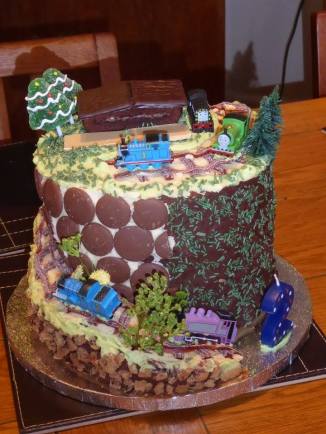
Whilst I no longer bake regularly I do, if an occasion demands produce a cake. During the years when my offspring were children I made their birthday cakes, beginning with simple designs like trains or rockets and progressing to more complicated constructions as they grew and their requests grew more demanding. I took up the gauntlet, making, amongst other cakes a treasure chest, a goldfish, a hamster, the three bears’ cottage in a forest, a riding stables [with Liquorice Allsorts jumps], a hippo [challenging], Minnie Mouse, Winnie the Pooh, Bart Simpson and bizarrely, ‘Beavis and Butthead’. I imagine this last suggestion was a cynical, adolescent comment on the childish nature of birthday cakes from one who was about to leave childhood but the task was accepted at face value and duly completed with creditable outcome.

In their later teens cakes reflected their pending adulthood. There was a car with an ‘L’ plate, a Mars bar and a football pitch as well as a ridiculous abstract creation made entirely from chocolate confectionary. Then they left, linked up with partners and I considered that the duty of birthday cake care had passed to others-

-that is, until the next generation arrived. Now the cake tins, the greaseproof paper, the mixer and bowls and the spatula are all once again employed; only this year there is the added anxiety of a new, unpredictable oven. Will this year’s cake rise to the occasion? Last year’s cake consisted of a railway track up a mountain with a station at the top.

I’m thinking that if the Bake-Off contestants can manage to produce their offerings in unfamiliar ovens in a tent in the middle of a field then I should be able to throw a birthday cake together in my new kitchen-shouldn’t I?

10325691_1027311583999601_1494427206964450707_n


Keep it Local

What kind of environment would we like generations to come to inherit? Do we even care about the world that we will no longer inhabit?

In a week that has seen a brand, spanking new shopping centre opening amidst much celebration in large city in the North of the UK I cannot help but heave a weary sigh. This has all happened before. In the 80s there was an explosion of shopping centres, vaunted as exciting, innovative temples to consumerism and incorporating restaurants, cinemas-even an indoor theme park with fairground rides [at The Metro Centre, Gateshead].

The UK is entering an era of financial uncertainty. Many areas of trade, finance and employment are already showing signs of slowing and inflation is set to rise after a long, settled period. You have to wonder why anyone would view a large, new shopping centre as a good idea.

My own, subjective, personal view of shopping centres is that they do not represent [as one of the instigators of the Leeds structure suggested] an ‘experience’:

“You can’t just build the same environments you’ve done for the last 15 years,” he says, “you have to create places that people want to touch, want to feel, want to be in. The retail is almost secondary. Experience is everything.”

The retail is almost secondary? Why go then? And what does he mean by ‘spaces that people want to touch, want to feel’? I am imagining crowds of shoppers, bags in one hand, the other feeling along the walls outside the shops or perhaps bending to pat the shiny floors. I can think of more uplifting ways to ‘experience’. Why not visit an art gallery or a museum? Better still, go outside and walk-in a park or along a canal tow path, or across a field.

I can’t remember when I’ve ever spent an entire day at a shopping centre. These days I take the view that if I can’t find what I’m looking for in an hour I won’t bother. And when I shop I don’t want to run the gauntlet of endless traffic to be enclosed in an emporium consisting of malls, escalators and mile upon mile of over-lit, over-heated, stuffy shops. I may want to visit a couple of shops, but not to be stifled. I want to go outside between one shop and another. I don’t want to spend hours trundling up a multi-story carpark ramp attempting to find a space and then not be able to locate my car again afterwards [or even remember which storey it is on].

Not everyone is fortunate enough to live where they can walk to buy items they need and not everyone is willing to do so, but in these times of increasing traffic and pressure on our economy shouldn’t we be looking to work, shop and pursue leisure activities in our local areas?

Coupling up…or Disentangling…

There must be a reason why the popular press loves to dollop liberal helpings of news about celebrity couples all over their pages. Does it make enjoyable reading because relationships are what interest the public more than anything? Who is with who? Who has had a baby? Who has been seen on holiday cavorting in the waves with who? And even more riveting: Who has split up with who? Who is having an affair/threesome/visits to prostitutes/paedophile allegations? Recently we’ve seen the split of Hollywood royalty ‘Brangelina’ as well as having to suffer the odious Donald Trump crowing about Bill Clinton’s indiscretions [of years ago-and for which he paid a hefty price].

You have to feel for the poor celebs. Their relationships have to weather the storms of fame, being in the public eye, having to undergo endless photo shoots for ‘Hello’ magazine, having loads of money and getting photo-zapped by stealthy paparazzi whilst exposing their flesh on expensive yachts. One or two famous couples have also amassed more children than the old woman who lived in a shoe by jetting around the world and hoovering up spare tots like flies on a window sill.

But what of we mere mortals? Observing couple behaviour is an interesting slant on people watching and a sport I’ve been enjoying during the time we’ve been away. Unless it’s an arranged marriage a relationship will usually have begun with some mutual attraction or downright lust from one or both partners. The lust gets tempered over time for a variety of reasons. Babies are renowned passion killers as are domestic chores and financial duress. For some couples, however this round of domestic obligation can be the cement that sticks them and an adhesive that fails once the chicks have fledged and the pair realise that the sprogs was all they had in common. I know a number of these.

Many couples, however seem to stick together even though nothing remains or they’ve forgotten why they became one to begin with, sharing their accommodation and little else. In our local hostelry the same individuals [almost exclusively male] can be seen any or every night of the week, leaving spouses to their own devices. Most people don’t want to be joined at the hip, and a few different interests in retirement is a good idea, but some seem not to have contact at any point, like the couple in a motorhome in Agde, France, one of whom spent each day cycling and the other inside watching TV. I’ll leave you, reader to imagine which half of the couple indulged in which activity.

Separating is scary and expensive for we commoners, more so in older age, but myself I couldn’t contemplate living the meagre remainder of my life with a cold vacuum of relationship in which the property we occupied was the only thing in common.

Living in a Cultural Desert

The time has come to finally accept that summer is now over for this year. We managed to extend it by a month or so by nipping off to warmer climes, but even there autumn is nudging in. I tend to go through a period of mourning at this time-not being a fan of winter, the cold or the dark. We also have to turn our attention to all the outstanding chores that are necessary when one takes up residence in a new abode-a list that is lengthening as I write.

In our absence an invasion of a miniature sort has taken place in that the outside and all its mini creatures has invaded the space. Chez nous has become spider haven, with a spindly arachnid lurking in every conceivable corner. Going to the study to get a pen [with which to redirect a pile of wrongly addressed mail-some of which had already been redirected here] I made the mistake of reaching out only to find I was plunged into an Alien-like scenario, my hand ensnared in a gargantuan, cloying candy floss of gossamer. Ugh!

Outside, much of the stalwart inroads that had been made before departure in taming the rampant ivy, brambles and unwanted interlopers is now rendered inadequate by their enthusiastic return. October is the month I’ve allocated for planting the climbers I’d brought with me when we moved so time is of the essence. Accordingly I’ve now crippled my back and various other parts with a marathon session of planting. Re-acquainting myself with the garden has only served to demonstrate how much work there is to do in it.

This is also the time when I turn my attention to cultural life and begin to cast around for entertainment to fill long, dark evenings. Those who’ve read these scribblings before will know how much I abhor musical ‘shows’ and how much I love a good play. Here in the provinces, however we are not well served. My own small, local theatre has a programme of events that includes a few broadcast screenings but is dominated by tribute acts, mediocre musical soirees and the odd has-been. The venue is run by volunteers, is a cosy and welcoming space with an art deco façade. It should be a magnetic powerhouse of activity.

A little further afield, in the seafront, tourist metropolis only a bus ride away there are two large concert venues, both touting…yes, tribute acts, has-beens and performers I’ve never heard of. There is nothing for it but to go to the movies. The critics have done a hatchet job on ‘The Girl on the Train’ [a novel I enjoyed] so I may have to try Woody Allen’s latest offering.

After much searching I discovered that Nina Conti-a comic genius with puppetry-is on at the end of the month; on I went to the seating plan. Nothing in the circle except for single seats or restricted view. Nothing in the stalls except for single seats or restricted view. It’s no surprise. I’m not the only person starved of quality live entertainment!

It’s No Joke

The news that Terry Jones is suffering from dementia is terribly sad. What a miserable, cruel illness dementia is-swooping down on anyone from any lifestyle or walk of life. In Terry Jones’ case, [as in Terry Prachett’s], targeting a giant of an intellect-a genius with words and humour; a person who made his living from the spoken word, from comedy.

I was a teenager when Monty Python’s Flying Circus hit the small screen. The humour was fresh and surreal, unfathomable to our parents, which made it even more irresistible to me and to my friends. There had been a few attempts at this kind of bizarre comedy before, with shows like radio’s ‘Round the Horn’ and ‘The Goon Show’ or TV’s ‘Rowan and Martin’s Laugh-in’ although it was American, but nothing that resonated with us on the scale of Python; nothing as zany, dreamlike, weird and downright hilarious.

In our teenage get-togethers, alongside gathering to listen to music albums we re-lived episodes of Monty Python, crying with laughter again as we recalled each episode and able to recall every sketch word-for-word. I adored ludicrous sketches such as the two frumpy women in a launderette earnestly discussing John-Paul Sartre or the cheeky ridiculing of Morris dancing where the dancers slapped each other with a dead fish. Then there was the device of bringing parts of one sketch into another. A scene outside a bank would include a long queue of people in rolled up trousers wearing knotted hankies from a previous sketch [‘I’d like to tax people what stand in water’].

Later shows sought to emulate the alternative angle. ‘The Young Ones’, ‘The League of Gentlemen’ and ‘Little Britain’ followed in the footsteps.

Otherwise, since that time, apart from one or two, longstanding, notable radio comedies [‘I’m Sorry I Haven’t a Clue’, ‘Just a Minute’] there’s been very little laugh-out-loud comedy on offer. Sit-coms become ever more tired. The channels churn out contrived panel shows featuring the same worn-out comedians peddling the same, stale, clichéd patter.

I still laugh at slapstick comedy and am easily able to enjoy the humour in a children’s entertainment such as Punch and Judy, which probably explains what a simpleton I am.

Each generation has their own set of beloved, cultural icons from music, film, literature and comedy. My grandparents had Charlie Chaplin, my parents had Arthur Askey and Bob Hope. I’m sure there are young comedians around who understand the challenges that today’s young generation faces. I know there are new sit-coms and every season a whole raft of new comedy movies, although as I’ve written before, the genre of American rom-com does nothing for me at all.

I’d say we are ready for a new, fresh approach in comedy-to distract us from all the nasty world events, if nothing else. But in the meantime I’d like to thank Terry Jones for all the sheer, unadulterated pleasure he’s provided over the years. Bless you Terry-you are a genius!

About ‘Nora Webster’

I just finished reading Colm Toibin’s ‘Nora Webster’. Although a companion book to the more commercially viable ‘Brooklyn’ which was made into a film, I found it an altogether more thoughtful and evocative novel.

Set in early sixties Ireland, it is the story of widowed Nora’s journey into some kind of independence and happiness following the death of husband, Maurice.

At the beginning of the novel I felt that Nora’s conservative, narrow way of life had everything to do with her staunch Catholic background but as I read on I began to see that the era in which the story is set was itself an era of conservatism. This will resonate with anyone who was born in the fifties as I was.

The story plays out against a background of the Irish troubles, when TV news footage impacts on Nora’s family life in their jittery responses and constant anxiety.

Nora struggles with bringing up her four children, with money and with every decision, since during her marriage she’d looked to teacher husband, Maurice to decide everything. ‘What would Maurice do/say/choose?’ she asks, constantly. My own mother was the same, an unwaged housewife, leaving every decision for my father to make. Her views, like Nora’s were my father’s views. We all holidayed in his preferred destinations, bought things when he wanted them, agreed with his political viewpoint and his wellbeing was paramount in the family. This, I believe was commonplace in the post-war era.

Nora’s children are her preoccupation, a constant worry as she has to find a job and keep it under some trying circumstances. At first she either relies on advice from family or makes knee-jerk decisions which she then regrets. But gradually she learns to trust her own judgement and gains confidence. She finds joy in the appreciation of music and takes singing lessons.

The older of Nora’s sons exhibits behaviour which we would now realise is autistic, being disruptive in class and obsessing about photography. The behaviour deteriorates in the time after Maurice’s death. One of her daughters, Aine becomes involved in the struggles and the other, Fiona, a student teacher wants to spread her wings and spend money that Nora doesn’t have.

Most of these difficulties are likely to plague any single parent today. Juggling the needs of a family and the imperative to hold down a job is a tricky business. The problems that Nora experiences are no more trivial for the children being older.

Nora is a complex character, reserved but at the same time feisty. I liked how she stood up to a difficult manager at work and manoeuvred herself into a better position. She is constrained by her religion and influenced by the religious figures in her life. In many ways this is a feminist novel. I wish I could say that life is completely different for women today but there are still too many outstanding inequalities to address.

Hurt One or Two Living Things

Hurt No Living Thing

Hurt no living thing:
Ladybird, nor butterfly,
Nor moth with dusty wing,
Nor cricket chirping cheerily,
Nor grasshopper so light of leap,
Nor dancing gnat, nor beetle fat,
Nor harmless worms that creep.


Christina Rosetti’s famous poem exhorts us all to refrain from harming tiny creatures; a lofty ideal, but one that is tricky to follow. I notice she keeps to insects that are both beautiful and/or harmless such as ladybirds or beetles and does not venture to suggest that we should preserve locusts, tsetse flies, head lice or maggots. And was Christina a vegan, I wonder?

It is easy to admire and wish to preserve ladybirds and butterflies. It is even possible to tolerate annoying wasps, who gyrate in an irritating, menacing fashion around your alfresco lunch if you adopt a laisser-faire attitude. And hornets should be given a wide berth at all times. For those of us, however who seem to be a favourite snack for mosquitoes, midges and any other blood sucking insects there is a strong desire to smash them into a pulp. Anyone who has lain awake tortured by the hot itching of myriad bites will understand this.

I’ve been attacked by most of the common, European biters. Years ago there was a local, Dorset, river dwelling blood sucker called The Blandford Fly whose bite induced ankle swelling akin to elephantiasis together with a flu-like fever. I’d had at least two of these before the little monsters were sprayed prior to hatching.

Of course in tropical climates there are some truly nasty insects-grubs that burrow into skin and eyes, wormy things that colonise the bodily systems. But here in France, in the pine woods of the south west my own, personal běte noir has to be the horsefly. If horseflies are beyond your experience consider yourself blessed.

My first real run in with them was a few years ago whilst enjoying an innocent cycle up a quiet lane in the forest of Les Landes. It was a hot afternoon, provoking sweat to erupt between my rucksack and the fabric of my T-shirt. As we passed a particular spot a swarm of horseflies erupted from the trees and up beneath the rucksack, biting as they went. The result was a constellation of itchy, angry, red, raised lumps that lasted for a couple of weeks.

Then last week, after a hot afternoon I emerged from the shower and sat to drag a brush through my wet hair, rising to glance in the mirror at the result. It looked as if two brown stickers had attached themselves to my face-one at the hairline, the other on my jaw. In my innocence I was slow to recognise the sinister, brownish, frog-with-a-touch-of spider [but without the charm of either] forms of horseflies, which had attached themselves greedily to my face and had begun feasting before I’d so much as dried off. While the itching has now subsided the scabby lumps persist. Now I am applying liberal dousing of repellent prior to each cycling jaunt, although this afternoon the little scamps were invading my helmet and ignoring the deterrent lotion by hitching a ride on my skin.

No, Christina I’m afraid exceptions must be made. Ladybirds and grasshoppers, yes-horseflies-NO.

Don’t Breathe until you’ve Strapped on the Button-

We are used, now to seeing those posts that invite us to join in congratulatory admiration for friends’ achievements. You know the ones. So-and-so has just run X miles or, J Bloggs has cycled to here; there will be a map to show you exactly the route they took. These posts fall into the same category as those selfie shots, a cloud of grinning friends all having a ball or seated around a table of delicious, ‘Masterchef’ style food-or standing on The Great Wall of China or Golden Gate Bridge. It is rare to see a photo of someone grappling with a flooding washing machine or in the aftermath of open-heart surgery.

Creeping along into this melee of ‘tell-all’ comes the tiny, wearable, digital device. Of course, monitors of all descriptions have been around for ages, but these, ever-smaller, watch-like buttons are becoming more sophisticated than ever. According to devotees they will tell you how many steps you’ve taken, monitor your heart rate and inform you of how you’ve slept.

It seems to me that this is taking self-absorption to another level. Why do we need a device to tell us how we’ve slept? I am still compos mentis enough to know whether I’ve slept or not-because if I was awake I probably knew about it already. I also have a fairly good idea whether I’ve walked anywhere or if I’ve been a lazy slob slumped on a sofa with a book. I’ll let the health system deal with my heart rate, though if I’m feeling ok why worry?

Won’t these little, wearable buttons give us the same paranoia that googling symptoms does? Supposing it tells you you didn’t sleep a wink last night? What will you do? Go back to bed that minute to recoup the lost hours? Only walked eight thousand two hundred and fifty four steps? Quick-get outside in the garden and do a few circuits before ‘Eastenders’. Eaten too many calories today? Nothing to eat tomorrow!

Worse still, in a sinister vision of the future, supposing some popinjay in the health department of a nanny state government comes up with the brilliant idea of linking their use to the health system. You will be required to wear a monitor at all times if you wish to be entitled to health care. You will be resuscitated only if you have slept for the mandatory eight hours last night. You will qualify for a hip replacement only if you have completed your compulsory ten thousand steps per day. Goodness! A veto on surgery for smokers or the obese has already raised its ugly head. Linking healthy lifestyle to healthcare entitlement can only be around the corner.

Or why not programme the devices to issue warnings? They could jolt us with an electric shock if we sip at a second Sauvignon or munch on a MacDonald’s and sound an alarm to alert us to getting on with our ten thousand steps. Does it remind you of any famous novels? Just remember that 1984 was over thirty years ago.

The Muddle that is Memory

As I grow older I realise more that memory is a capricious servant and not to be relied on. It unnerves me, this haphazard facility, as it would anyone who has more years behind them than in front. We joke about senility. ‘He makes new friends every day’ we say about close relatives suffering from Alzeimers. But it is a state to be feared as we age, even though research turns up new developments in treatment all the time.

We have travelled down the west coast of France more times than I can either count or care to admit-certainly, during the last twenty five years or so far more times than to London. And yet it takes re-visiting to stir my memories. I am as unable to grasp the gist of a place from Husband’s descriptions as I am able to recall what I went upstairs to get when I’m at home. ‘You must remember’ he says, ‘there was an Irish couple’ [there are many Irish couples] or-‘there was a small bar by the entrance’ [true of so many places].

We visit old haunts, reluctant this time to be intrepid adventurers, having done enough pioneering on the house move front this year.

We find a site, new to us. We cycle out along the salt marsh, a wide, flat expanse of watery fields criss-crossed by irrigation channels. Grey eels undulate along in the water, darting from one clump of weed to another. It all looks eerily familiar then we approach an oyster farm and there, there is the little sea-food shack and bar where I took Husband’s photo on our anniversary-memorable in that his chin rests on his hand and his expression as he peers over the top of his beer is nothing short of grumpy.

We did remember Pornic and eventually the site we’d stayed in. We’d walked there last time and caught the train back. I had a sudden recognition; a path over a deep, rocky cove peopled with dozens of naked men-many in couples. Such sights are not unusual on French beaches. I’ve long since adopted a ‘seen one, seen ‘em all’ strategy for them.

We travel further south to another small, seaside town I’m sure we’ve visited before. The large town square bordered by the post office and the town hall seems familiar, as do the narrow streets lined with bars, ice cream parlours, ‘churros’ counters and stalls selling bracelets, hats and keepsakes. Here in September there is a throng of tourists-many our age or older-wending their way along and pausing to browse the proffered nick-knacks as they chew on sugary, doughnutty churros or tuck into mountainous ice cream cones.

So the memories are there-not readily available as a neat, annotated and dated time-line but in a jumbled, half-buried pile in the cobwebby cupboard of my brain. When one is prompted to surface it is a pleasure. The offspring jest, as I myself would have done when stories are repeated or exaggerated, but this will happen to them, too at some unspecified future date.