Unknown's avatar

About Grace Lessageing

I am writer of novels, short stories, flash fiction, blogs. I lead a creative writing group. I am an Ex infant teacher, living in Christchurch, Dorset, UK. My brand new novel, The Conways at Earthsend was published on January 28th 2021 can be found on Amazon, Waterstones, Hive and Goodreads and is available in either paperback or e-book versions. You can also read The Year of Familiar Strangers, available as an e-book from Amazon. You can visit my website: janedeans.com or my author page on Facebook: https://www.facebook.com/Jane-Deans-Novellist-Short-Fiction-and-Blog-102757711838272 Happy reading!

Safely Delivered

Moving home is very much like having a baby. You wouldn’t entertain the idea of doing it again until the memory has faded into a distant smudge and is embellished with a liberal dollop of nostalgia. However stressful the build-up [the labour] has been it is as nothing compared to the climax, which is either a smooth, trouble-free relief or a frantic, screeching panic.

We moved one week ago, which means that the pain and the panic are fading but it’s best to remember that in the scale of life’s most stressful events moving house is up there in the top three along with bereavement and divorce.

The day began well, with a removal van turning up at 8.30am prompt and we were ready, everything boxed, everything labelled, everything [almost] cleaned and spruced up for the new occupants. The lorry looked too small but we were assured by the two movers that our belongings would disappear into it and they set to, rejecting offers of tea and biscuits, fitting tables, chairs, beds and mattresses together into the space like some sort of domestic 3D jigsaw.

Then they were gone, with a cheerful ‘call us when you’ve got the keys to the new house’, off for a much deserved full English breakfast somewhere while the van full of our life’s effects languished unloved outside the depot.

We waited, we hoovered, we looked at our phones, we checked that the land line was operating. We had a coffee. I wandered out to the garden to pluck out some stray weeds and tuck in some wayward strands of creeper. We checked again. We ate a sandwich, had another coffee. The phone rang and I jumped in a febrile lather of excitement. It was the removal chap. ‘Had we heard anything?’

I went across to say goodbye to some neighbours, returning to find a car in the driveway. The new occupants had arrived. ‘Come in!’ we told them. But now we were becoming spare parts in our own house-which was still our house until the solicitor deemed it acceptable for us to access our new property. The money was wending its way along the eight-house chain but had yet to reach the top. I rang the solicitor to be told she was having lunch. We stood by our bags of final bits and chatted to the buyers of our house. They were beside themselves with exhilaration as their removal lorry arrived. ‘Get your stuff in!’ we told them and as we stood our space began to fill with their belongings, compounding our feelings of being interlopers.

At last we could stand it no more. We got into the car with our pitiable bits and pieces and made our way to the new house. If nothing else we could sit outside it and anticipate. The day was wearing on [by now it was mid-afternoon].

But all was well, of course. Upon rounding the bend we were greeted with the sight of our lovely removal men, busily heaving our furniture into our new home. The doors, it seemed had been left open. We cast caution to the wind and entered, eventually receiving a call from the estate agent to pick up some keys.

And did we cry bitter tears for our old home? Did we wander the rooms of the new house under a pall of homesickness? Aha! You will have to wait and see…

Moving on…

A letter to the new owners of this house:

Welcome to your new home. If you can be just a fraction as happy here in this rather grand, elderly house with its unbeatable location and its creaking, gurgling idiosyncrasies as we have been you will have made the right choice. Estate agents like to describe it as having ‘kerb appeal’ and judging by the attention it is given from passers-by this may be correct.

P1020091

When we first came to look at it twenty years ago we’d no clue it would be located on the cliff top, a short stroll down a zig-zag path to the vast sweep of Bournemouth Bay, since there was no mention of its position in the small, black and white advert in the local newspaper, merely a smudgy photo of the front door. It seems incomprehensible now that a sea-front location would be unmentioned. Upon entering the house I experienced that immediate recognition that this was the house for us, even though Husband needed convincing.

P1020098

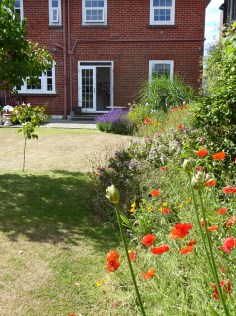
To begin with it was locked into an earnest, seventies style décor and many of the original. 1920s features had been replaced with teak-effect and wood chip wallpaper but the beautiful staircase and elegant doors were all there. We set about alterations, combining three rooms to provide the spacious kitchen/dining area that is still a popular choice today. Much later, longing to be elevated to a level where we could enjoy a sea view, we had a section of the roof cut away and the loft converted to provide a crows’ nest. It altered the appearance of the house in a way many would consider a travesty but has been the room we’ve lived in the most. The garden is unrecognisable from the bland space it was and now boasts mature borders, a beautiful pond, trees, a summerhouse and two patios. The old garage is adorned with Virginia creeper and climbing hydrangea and a riotous tangle of honeysuckle, jasmine and ornamental hops tumble together from the fence.


Every home carries in its fabric stories of the inhabitants down through the years-even if they are untold. Here there have been wedding celebrations [two], arrivals, departures, parties, Christmas gatherings, murder mysteries, milestone birthdays, air show gatherings, musical soirees, a new generation coming along to explore, visitors, a burglary, barbecues and so much more.

My homecoming from work was always a joy, the sky becoming vast as I came nearer, the sunsets stunning and the winter gales a thrill.

P1020107

Our next home is a complete contrast, having been built much more recently with a light, contemporary interior, loads of glass and an open-plan design. We are swapping our sea panorama for a view over the river and the water meadows and the garden is a wedge of lawn leading to a small wooded area containing giant trees. The historic centre of the provincial town is just a few minutes’ walk along the road. Will we be as happy there as we have been in the old house? It remains to be seen.


Perchance to Dream…

In my previous life as a proper working person I never felt sated by sleep. On Fridays I’d need to sleep when I arrived home in order to be able to go out later in the evening. I’d continue to catch up all of each weekend and would be feeling energetic by Sunday evening-all ready for Monday again. Once a holiday began I’d sleep for several days, waking only for meals-once, memorably, sleeping all the way down through France whenever I was in the passenger seat, although I did manage to stay awake for my turn at driving, otherwise both mine and Husband’s sleep might have been permanent.

As a child I slept in a coma-like state and was infuriated by discovering events I’d missed during the night, such as thunderstorms or Santa Claus. Later, as a student I’d often fall into inebriated sleep in the small hours, having discussed the meaning of life in endless meaningless conversations.

Like all new parents, when the babies were born I could never remember what it was like not to feel tired and longed for the heady days of lie-ins at weekends. Seasonal time changes were torture, with everyone else gloating in October when the clocks changed about ‘getting an extra hour’ [which of course is nonsense]. Tiny tots know nothing about such matters and render you an hour worse off by keeping to their usual early-rising timetable.

Then life became more leisurely with the onset of retirement, which was delightful. It was bliss to wake on Monday mornings at whatever time we chose. I remember that my father, on reaching retirement considered it essential to stick to his working pattern of rising and continued to be up and about as if he were to commute somewhere-but for what? In order to stroll up the road for a newspaper? To go out and dig the garden? As far as I am concerned these tasks can be ruled by me in a reversal of the previous order.

These days sleep tends to get interrupted by the requirements of ageing, internal workings. Often Husband will be returning from a nocturnal trip to the facilities as I get up to go and vice versa. But whereas he will fall immediately back into his deep, snore-laden slumber there will be occasional nights when sleep eludes me and I resort, having done the required tossing and turning to composing a story [or this blog]. If all else fails I creep out, make a cup of tea and settle with a book. My old game of finding a subject with each letter of the alphabet has faltered due to having exhausted all the categories. Rivers, capitals, flowers, foodstuffs-if there is a category left un-plundered by my wakeful brain please let me know.

However the night’s sleep has been I am usually asleep by about 8.00am-just in time to be woken…


Festival Time

Weather or not [and more often inclement]-it’s festival season. They’ve become bigger and more elaborate over the last fifty years. As a teenager I escaped the parental gaze and attended plenty of concerts, some of which were outside, notably Pink Floyd in Hyde Park on a blazing hot day, July 1970. I was seventeen. The concert, like other Hyde Park gigs, was free.

The mother of all music festivals, Woodstock had been in 1969. It held an alluring, magical quality for us then; we who would never have the option to attend packing instead into the cinema to worship our heroes-Hendrix, The Who, Janis Joplin, Ten Years After and the rest.

Festivals began to be a feature of the summer. The Isle of Wight, Glastonbury and Reading became fixtures and were supplemented by a rash of music events as time progressed.

Now it seems there is a festival on somewhere every week during the summer months but the free and easy ethos of the sixties is long past. Most of the larger, well known events carry an eye-watering ticket price, often with facilities to match, for those prepared to pay. Glastonbury offers luxury yurts with en-suites, although those with a thirty pound, pop-up tent are still welcome. There are multiple stages offering a range of entertainments, food from every culture, handy stalls flogging much needed wellies and waterproof capes.

Last weekend we were once again running our own, local, modest music festival on a green stretch by the River Stour. The festival has run for twenty five years, charging a small sum for entry and donating any profits to charity. The performers play free, the staff are unpaid volunteers; but the festival is under threat from council regulations and spiralling costs. Sadly, security has had to be put into place to keep real music lovers, festival goers and families just wanting a happy day out safe from gate-crashers, those wanting to bring their own alcohol rather than using the festival beer tent and other party poopers. They are few but still not welcome.

In addition to all of this, we volunteers are almost all getting on in years. Putting up fencing, constructing a stage, fetching and carrying, bin emptying and litter picking late into the night takes a toll-especially on Husband, who has the added anxiety of responsibility for administrative matters. As a lowly ticket seller and general helper my duties are less imperative, but the role can be varied. This year I undertook tasks ranging from repairing plastic swords [purchased from a toy stall] to retrieving a pair of stray dogs that threatened to run wild inside the compound. Then there are arrogant young men who strut past the ticket booth with a nonchalant swagger and have to be called back, large families who flock in, people for whom complaint is a lifetime goal-especially when it comes to forking out £5 for a day’s music!

But in a quiet moment, when the sun shines and we pause to survey the arena where groups of festival goers are lounging on picnic blankets, children playing, a swarm around the beer tent and a full marquee it feels like a great thing to do.


Welcome to our Shores!

It can’t have escaped the greater part of the world that here in little old Britain we are experiencing a time of flux. Amongst the dire predictions of disaster that are flying from every media orifice are those of unaffordable foreign holidays, difficulties over flights, problems with customs queues, visas, reciprocal health cover and more besides. Horrors!

The gloom that has settled over our British summer is further compounded by an unseasonal bout of wet, windy and miserable weather. So not only are we facing the prospect of holidaying in the domestic bliss of our home shores but will be doing it in thick sweaters, raincoats and wellington boots.

To be fair, wet, windy and miserable summer weather is so far embedded in the ethos of a British holiday it has become an essential component-part of the essence of a traditional British seaside vacation. For the uninitiated, what else should a new visitor to British shores expect from their holiday?

To begin with, there is the matchless experience of staying in a British hotel, guest house or B&B. Where else are you provided with sticky carpets and overpowering aromas of disinfectant? You may get to sample the famous, ‘full English’ breakfast-a carb and fat-fest consisting of a lack lustre sausage, some pinkish, slimy bacon, a greasy egg and blotting paper toast. This feast is designed to arm you for the rigours of the day to come, when you are to set off out into the gales and torrential rain for some sightseeing.

What should you see? You should not miss the delights of the pier, where you may stagger along against the wind to the end, where although the view may have been obliterated you will be able to while away an hour or two feeding coins into slot machines-this will also provide some shelter. Exiting the slot machine arcade gives you an opportunity to enjoy the pier for a second time as you stumble back to the promenade. You may wish to hire a deck chair for an hour or two, weather permitting. Be sure to open your umbrella. You will be rewarded by the sights of British beach-goers as they walk their dogs or scour the beach with metal detectors. There may even be a lone swimmer-dressed of course in wet suit, goggles and cap.

If you have made it to lunch time you should not pass up an opportunity to try that great bastion of traditional English cuisine, fish and chips. Years ago this mainstay of the national diet was served rolled up inside sheets of newspaper, providing the added bonus of reading material once the contents had been consumed. These days, with the onset of health and safety, together with dwindling newspapers the packaging consists of a polystyrene box and may or may not be furnished with a plastic fork. Examples of the packaging are readily available to view around the streets and pavements of our towns.

The afternoon can be spent browsing the shopping centres, where a range of pound stores and super-buy  emporia interspersed with charity shops will clamour for your attention. Your evening will consist of a return to your accommodation for a tepid shower in your rustic ensuite, followed by an evening meal in one of the many and culturally varied restaurants at your disposal. Will you choose the kebab house, the Indian, the Chinese or MacDonald’s?

Well-what are you waiting for, international tourists? The pound has rarely been lower! Welcome to the UK!


The Future According to Grace

Developments in technology move faster than it takes to draw breath, don’t they? This is how it appears, anyway to one who is becoming ancient. A small item in the [on line] paper I read bore the headline ‘How to organise and store your digital photos’. Goodness! A couple of decades ago storing photographs was all about new developments in photo albums and shelving. Do you mourn the loss of photo albums? Or are you delighted to have less dusting and more space in your home? So many technological developments concern scaling down-in some instances to nothing at all.

The same applies to books of course. Myself, I am a convert to digital books-with the great exception of children’s literature, of course. To me the content over-rides any sentimental attachment to paper. I am uncertain, however on the issue of ‘condensed book apps’ which precis novels down into 15 minute reads-this may be carrying minimalism a little too far.

Then there is television. Sets are becoming ever slimmer. Who remembers the enormous sets of the fifties with their tiny, flickering screens inside large, elaborate wooden cabinets? And film-videos seemed like an incredible leap forward in innovation but were soon replaced with the much reduced DVDs then the physical was done away with altogether by downloads. Music has moved in the same direction, with one click replacing the need for record players and records, cassette tapes and ultimately CDs.

Could this happen in the kitchen? It may have already begun. The need for kettles has been negated by taps that produce boiling water and there is more in the pipeline [so to speak] with robotic food preparation and smart this, that and the other.

And while all this minimalising, scaling down and disappearing altogether has been going on, we, the owners [figuratively] of all this technology become bigger and bigger. I wonder then that technological wizardry has not been developed to shrink humans, too. Yes, of course there are gastric bands and so on but these are not guaranteed to be successful or permanent. The idea of shrunken food, however has been tackled in literature. Turn-of-the-century writer Stephen Leacock [http://www.online-literature.com/stephen-leacock/literary-lapses/10/] wrote an amusing short story about a baby who snatched and swallowed a tablet containing 13 Christmas dinners which did not end happily.

The obvious outcome must be that the need for human beings is removed altogether. I imagine there will be developmental stages where man and computer merge. In the beginning the machine will be an appendage such as we see already [think earphones and those weird Bluetooth thingummies fastened to peoples’ ears]. The takeover will progress with insertions into brains, replacement limbs and organs then mobility aids will remove the need for limbs [now think Daleks from Dr Who]. Reduce the jelly-like substance at the heart of the machine and…Bingo! Man disappears from the Earth to be replaced by technology. I just hope the machines make a better job of it all than we have.

Will we Stay or Will we Go?

So-this is the week. We are to discover if we will stay or not. We have very little control over what will happen, a state that leaves us feeling powerless, impotent and often frustrated. There is too much information or there is not enough. The information is poor quality and we have no idea what to believe of what we hear. Will we be moving? Or will we be staying? We have waited sixteen weeks to find out if we’ll be moving house…

I remember the first EU referendum in 1975. I was barely out in the world of work and grappling with juggling first job, first live-together relationship and first home, none of which endured much longer than two years. With little information or experience I voted not to join, based, I recall on the fact that the price of butter had gone up.

This time of course we are bombarded from both sides with ranting, supposed statistics and naked self-advancement dressed in thinly veiled national fervour. ‘All you need to know’ is broadcast every day in every facet of the media. ‘Facts’ are paraded as if they are true. Debates are held in a constant stream on all channels, Everywoman leaping to her feet to declare her opinion; Everyman springing up to shout her down.

And this is the problem. Exacerbated by the tabloid press, ‘debates’ whipped up into a frenzy by shouting, screeching, pointing members of the public and raft upon raft of dodgy statistics and made up facts, the entire situation has become a hate-fest; an excuse to vent negative feelings and exploit bitter sentiments. Some of it is disguised with ‘reclaiming Britain’ as if the UK had somehow floated away from its inhabitants and some of it is just streams of invective. Most is aimed at immigration so that you are left thinking that people from countries other than ours can enter but we cannot leave. Not so. 1.3 million British people live abroad in Europe, most in Spain, which houses very many retirees. They are not working and contribute little to the Spanish economy except in purchases of alcohol [this I have seen for myself]. Should Spain kick out these layabout pensioners?

Now that the ugliness of the campaign has become beyond hideous with the murder of a young, talented Member of Parliament we can only hope that those pedalling inflammatory, bombastic rhetoric will temper their rantings into something more rational and reasonably argued. There is nothing wrong with disagreeing. But you have only to look at social media to see that the ‘hate immigrant’ campaign has opened the door to right-wing organisations; organisations whose misplaced fervour appeals to loners, misfits and those with mental health issues. The killer of Jo Cox was one such individual. Let’s hope he’s the last.


The Pursuit

Here is a thing about ageing. I’ve noticed that feelings of excitement in the anticipation of events come less often and are less intense than when younger. This, I suppose is only to be expected, since when we are young we experience far more for the first time and all emotions are more intense. Teenagers, for instance have a tendency to overdo delight; hence the ‘Oh my God’s’ and flinging themselves at each other when passing exams or the Kevin-like sulks at being requested to join their family at the table for a meal or do some homework.

Excited anticipation tends, also to be destroyed by a long wait, or by a promise that doesn’t deliver. Think of the child who waits for an absentee parent to come and take them out.

We [that is Husband and myself] have been waiting an unaccountable length of time for a house move. The thrill of finding a property we liked has ebbed away like the flame in a dwindling candle with every passing week and been replaced by niggling anxiety or increasing weariness. I regret this to the point of resentment. To feel excited anticipation at my age is a rare gift which has been withdrawn.

Happiness is a fickle phenomenon. It alights at unexpected times or fails to materialise when it is due. You can prepare a surprise party, plan a holiday, go for a special meal, buy a long-awaited book or finally arrive at retirement only to find yourself mired in a slough of disappointment. Disappointments and anti-climaxes can be compounded by other people if in your anticipatory impatience you’ve indulged in sharing, like the time as a thirteen-year-old I arrived home early from having been ‘stood up’ outside the cinema only to witness my mother relating my misfortune to visitors. I’ve begun to wonder if ‘friends’ are taking delight in our responses to their enquiries as to whether we’ve moved. It seems crucial to take an impassive stance rather than reacting, whatever, although my fears of conspiracy theory may only be due to wait-weariness.

Sometimes though, a spontaneous moment provides joy-or at least a sensation of comfort and pleasure. A walk around my garden as it bursts into life-even if it is soon to belong to others-is a guaranteed spirit raiser. Coffee and a gossip with a friend, an evening of excellent music, a few hours in the enchanting company of a toddler are all happiness-making.

At a change of level, for those living in the hell that is Fallujah, happiness or excitement is probably brought on by getting something to eat, a few hours of silence or some clean water; for anyone coping with a debilitating disease a period without discomfort. It pays to remember that happiness and misery are relative, like everything else!


The Good the Bad and the Unreadable

It would not be an exaggeration to say that writing has spoiled reading for me. This is not to say that I no longer read. I do. In fact I consider that reading-widely and variedly-is essential for anyone hoping to produce any written work of their own. But the sheer hedonistic escapism that ensues when you are engrossed in a rip-roaring, breath-taking story is rare nowadays.

I became a voracious reader as a child, devouring the written word as soon as I could read; beginning with fairy stories and developing an appetite for fantasy in the form of the Narnia books, Alice in Wonderland and Through the Looking Glass and the Alan Garner novels. A friend with a penchant for Enid Blyton led me to flirt briefly with The Famous Five but I was soon disenchanted by the formula aspect of the plots [although I was keen to replicate the ‘gang’ aspect by forming a club and pursuing some vague exploits].

Later I flogged my way through Agatha Christie and Ngaio Marsh, indulged in an Ian Fleming phase with some gentile porn thrown in [a furtive, febrile partaking of Lady Chatterley plus a few dismembered sections of Frank Harris’s ‘My Life and Loves’ undertaken during geography lessons and passed around partly opened desks-little wonder I was not invited to pursue my geographical studies].

Later, during my hippy phase I spent every spare moment during one week reading The Lord of the Rings and became sucked in to the extent that when Gandalf disappeared down the chasm I was devastated to the point of despair and felt my own life to be at an end. Such is the susceptibility of youth-and Tolkien’s writing of course.

As a student I was influenced to read more widely and began to enjoy modern classics like Catcher in the Rye or Sylvia Plath’s fascinating and darkly comic The Bell Jar. I became aware that there were differences between good and poor writing.

Once real life had set in with the onset of work, marriage and babies there was a hiatus in my reading while I dipped into Dr Spock and Penelope Leach whilst wringing out the nappies. Still later, teaching left no time or energy for reading outside of holiday periods, when I’m sad to say pure escapism took over in the shape of thrillers. There was a Stephen King period, a Ruth Rendell/P D James/Minette Walters period and even a Lee Child stage before, short of a book I stumbled upon a dog-eared paperback in a hotel in The Gambia. It was The Blind Assassin. The title grabbed my attention then I was gripped, following up by reading more Margaret Attwood. I discovered Donna Tartt’s The Secret History and began to read Sebastian Faulkes, Ian McEwan etc

At last the work of good writers lured me into having a bash myself-a foolish notion. The work of such writers only serves to underline how futile my own attempts are. Worse than this-the [still published] work of poor writers induces a powerful frustration. I wasted a lot of time last year trying to read ‘A Brief History of Seven Killings’, which won the Booker Prize!

Onwards and upwards…

Boomers’ Bloomers [again]

Baby boomer:    a person born during a baby boom, especially the one in the US or UK between approximately 1945 and 1965: Ageing baby boomers are creating a greater need for healthcare. baby-boomer. adjective [before noun] › The baby-boomer generation is now hitting retirement age.18 May 2016

We ‘boomers’ are in trouble again. Not content with having had free university education, ‘good’ pensions, having the gall to buy properties and now living long enough to be using up all the healthcare budget we have transgressed further. The offence? We have failed to teach our progeny horticultural skills. There! How appalling! We should have been outside in the garden with our new-borns teaching them the difference between bindweed and broccoli instead of idly dandling them on our knees. We should have set our toddlers to weeding, hoeing and tying in the runner beans rather than reading them stories and letting them splash around in paddling pools.

Having been born and raised in the countryside I did actually learn a great deal about gardening at an early age; though not grand or modernised the properties we inhabited were always surrounded by large pieces of garden which my father tended with gusto-perhaps because he came from a family of market gardeners. The fruit and vegetables he grew were more than a supplement to our diet; together with the hens we kept they almost were our diet. Yet we were not coerced into digging and weeding and were left to our own devices, excavating our own plot behind the shed to find buried treasure and taking stray worms down to the hens’ enclosure or trawling the small stream with jam jars on strings. I do remember being interrogated as to why I’d pulled up a cabbage and explaining that it was to see if it was growing, a reply not received with indulgent approval-nevertheless it had been growing.

But I knew about gardening. I knew that you could graft one type of apple tree on to another, that potatoes needed to be earthed up, that you could make compost from garden and vegetable waste. I knew the names of things-vegetables, fruits, flowers and weeds. I also knew the names of trees and wild flowers. At school, with no danger of a ‘national curriculum’ we went on nature walks-a long crocodile of hand-holding pairs strolling the lanes and scrutinising the banks and hedgerows so that we knew which tree conkers grew on [not a conker tree!] and bringing back specimens for the ‘nature table’. I grew up able to identify common birds from plumage and song and to know a number of wild flowers, plants and trees.

Just as a garden itself cannot be made instantly you can’t ‘teach’ gardening. The skills and knowledge develop over time with trial and error and a little research now and again. The best gardens evolve-like the twenty year old patch I’ve grappled with and am about to leave. How will the next garden grow? I look forward to finding out…