Encounter with Vampires

Husband’s sights are firmly fixed on Heric for our next stop. The plan is for us to cycle some more parts of the towpath along the Nantes-Brest Canal, stretches we didn’t travel last time we came. He’s chosen a site near Heric for its proximity to the canal,

The weather has become very warm, sticky and sultry. We arrive to the site and notice immediately that it’s not near any kind of community that we can walk or cycle to and that the main road is very busy and inhospitable to pedestrians or cyclists. But for all that it looks a cute site, not huge and with some quaint features,

I’m standing at the check-in desk, proffering our ACSI card when I feel several sharp, piercing sensations at my ankles. When I glance down there’s blood emerging from small puncture holes. The itching soreness begins straight away and I know the culprits- having plenty of experience, of course they’re horseflies. It’s not a good start and I’m keen to leap into the van and get at the antihistamine cream before my ankles swell to elephants’ dimensions.

We get parked and install all of our cooling technology [ie fans]. A desultory inspection of the small site reveals a half-resurrected bar area, an indoor pool and a ‘zoo’ [consisting of two goats]. one goat is tethered, the other wanders at will but when she appears by the van she is disdainful of the lettuce I offer, preferring the dead, brown laurel leaves that have fallen from the hedge.

It transpires that the site is not, as claimed, by the canal at all but 7k away, meaning that a 7k ride will be necessary before we even begin on the towpath. Hmm. A jovial Irishman stops to chat. He comes here every year, ‘Yes- there are horseflies. His wife gets bitten a lot. No- it’s not near the canal. Do we not have electric bikes then?’

No, we don’t.

Given that we’re not near anywhere and I’m being eaten alive by flies we opt out of a 3 night stay, deciding to move on tomorrow.

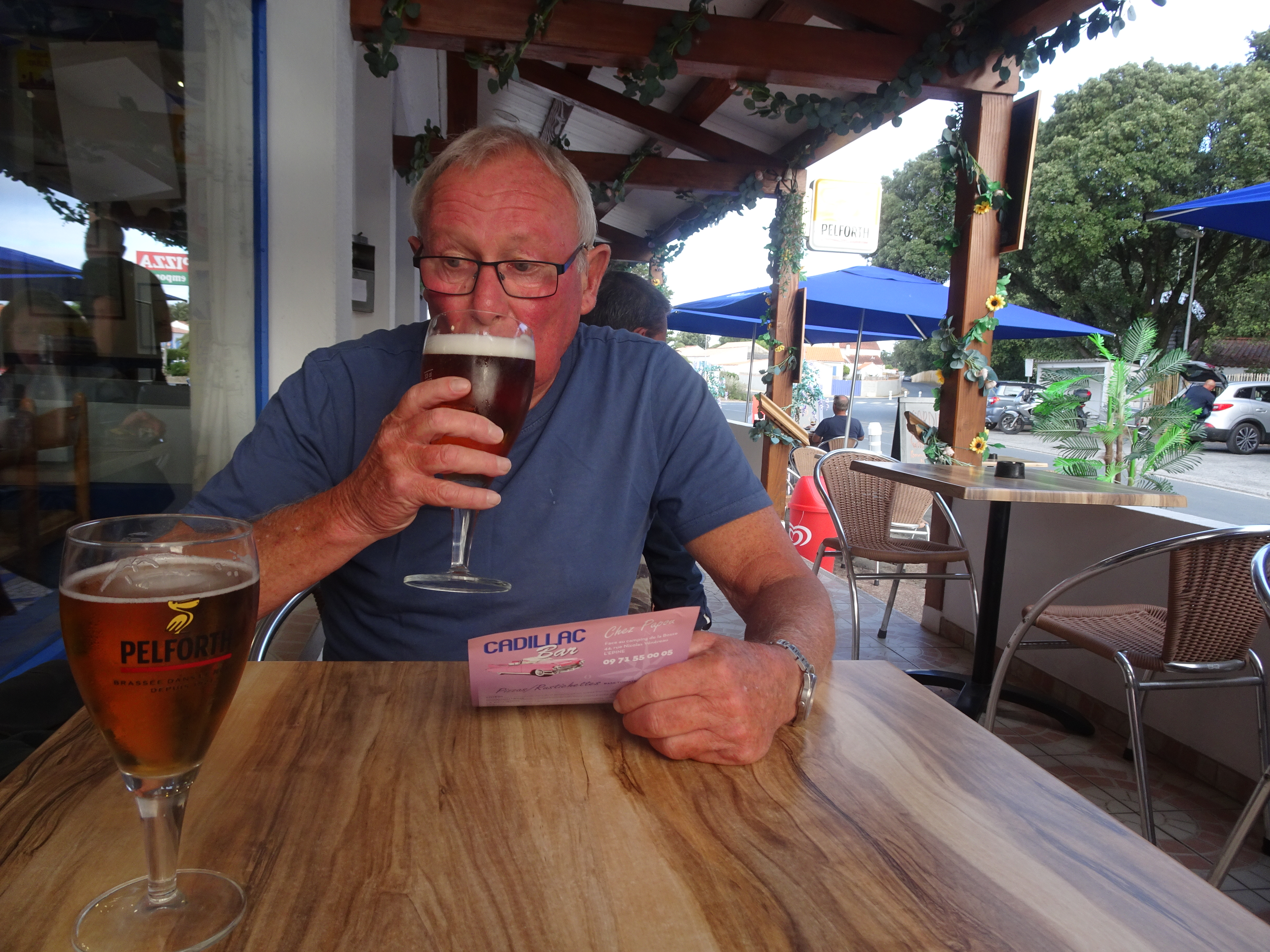
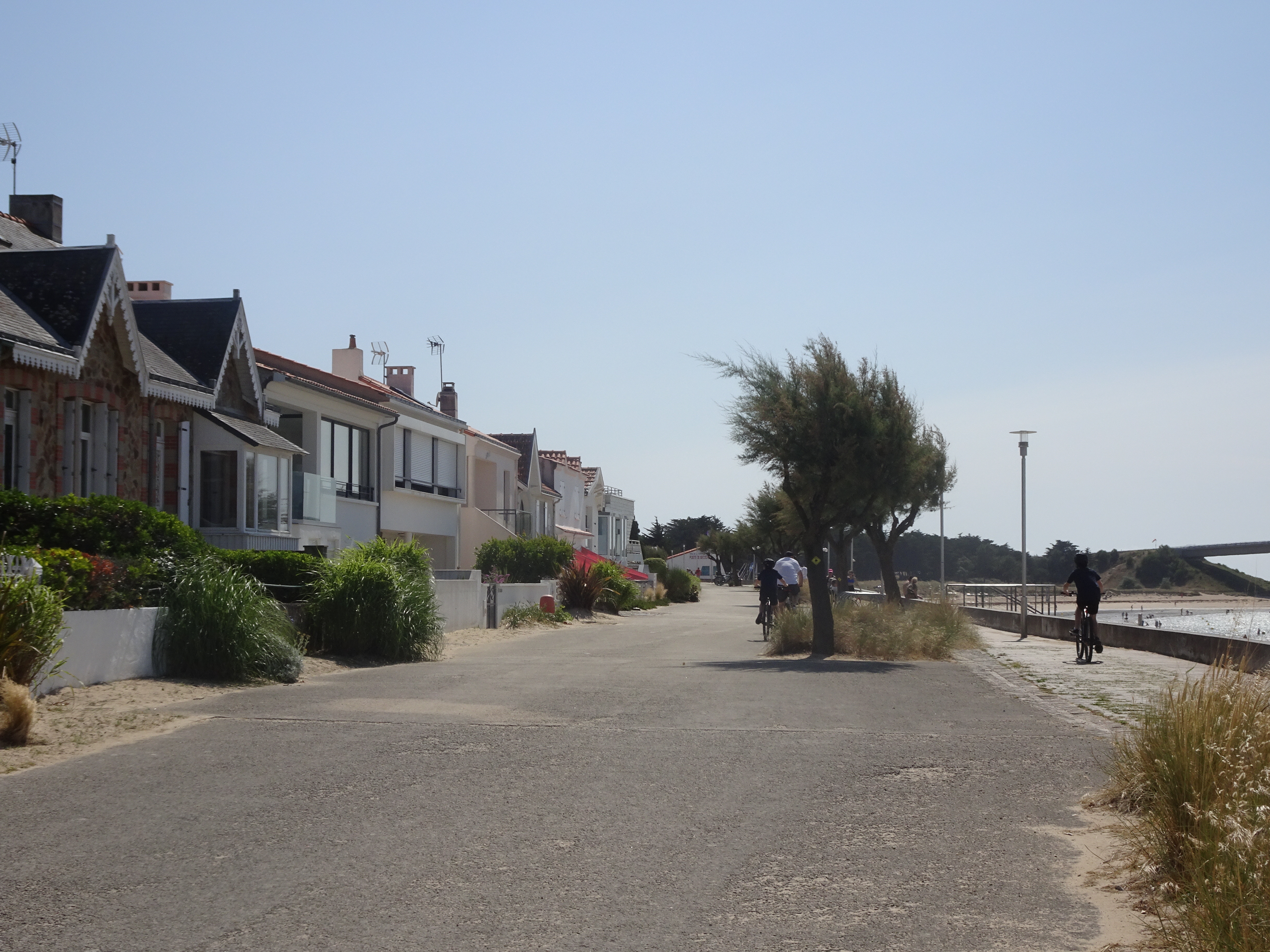
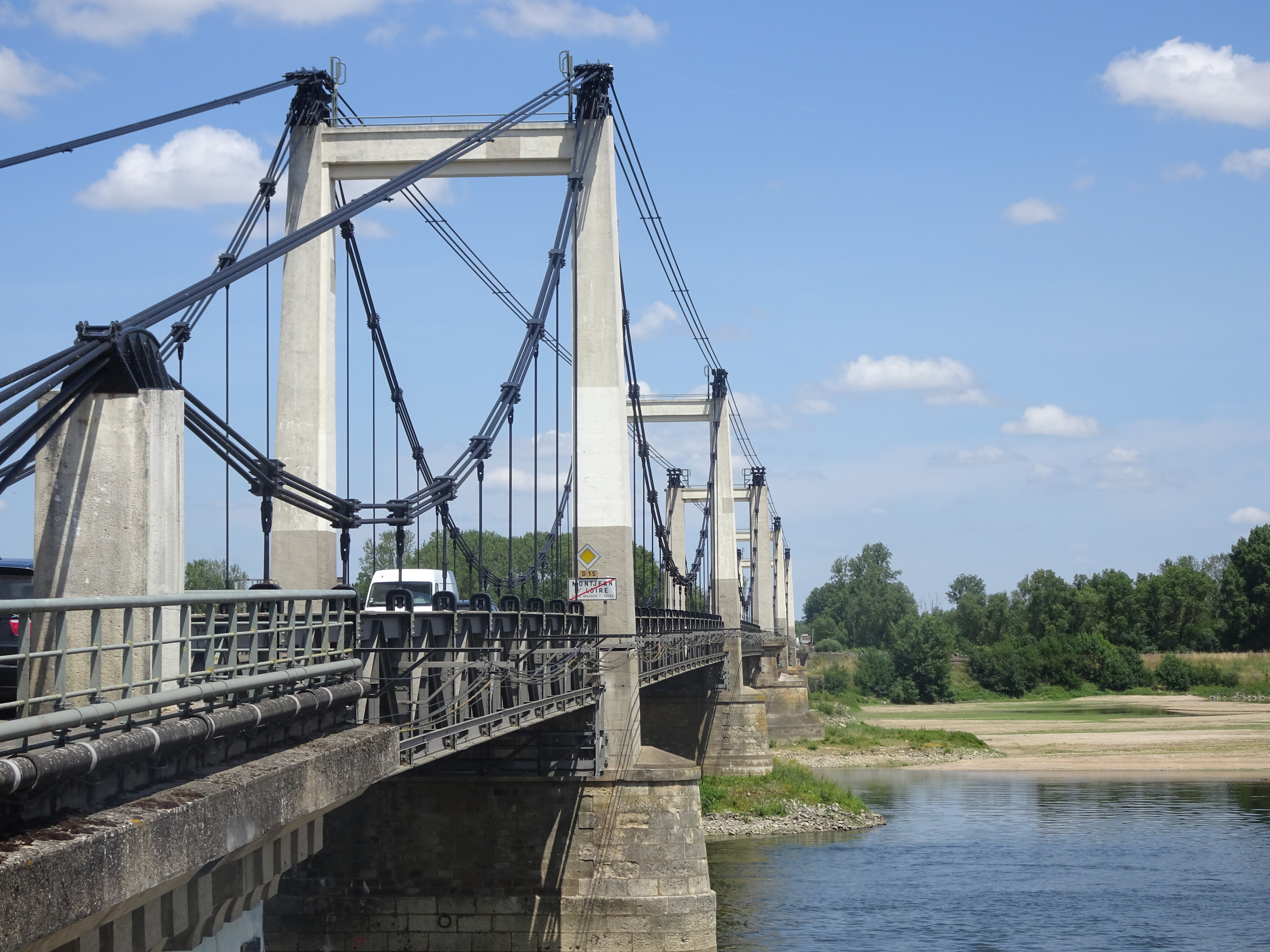
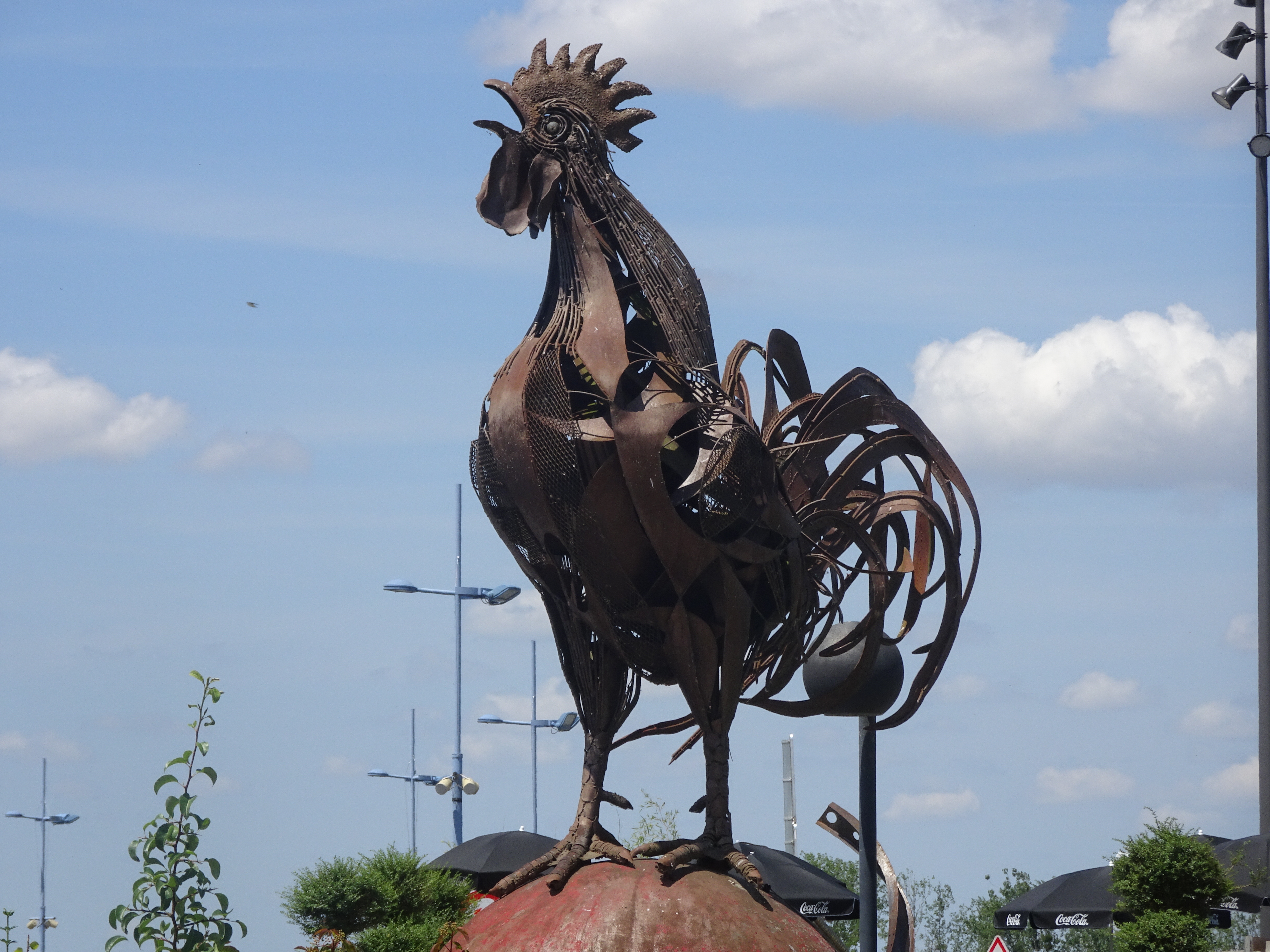
We travel on down to the Loire, at Montjean-sur-Loire, where it is still hot but offers much more convenient cycle paths from outside the site gate. Montjean is a pleasant town with an imposing church and lots of arty sculptures everywhere, There’s a handsome bridge across the river but it’s a shame to see the mighty Loire reduced to a narrowish channel with a wide expanse of beach each side. A couple of bars by the bridge are open for early evening drinks in the sun,

The temperature has climbed unto the 30s but next day we get into cycle gear and head off across the bridge, which is easier than expected, to follow the track along the riverside. Here the narrow roads are shared, bike/car, car users giving priority to cyclists, so that there is no irate hooting or swooshing past with centimetres to spare.

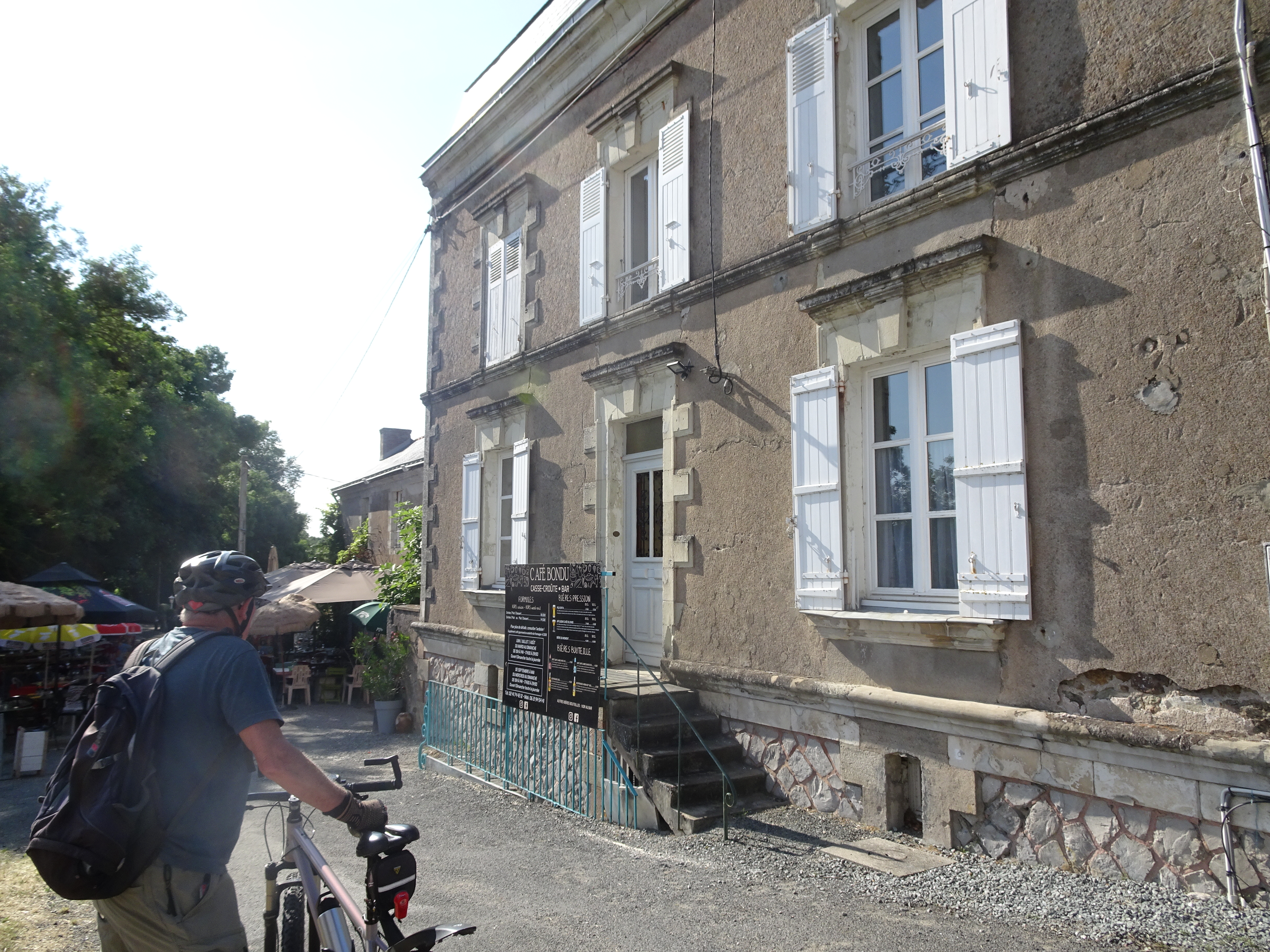
Although we’ve left our cycle until late afternoon it’s still hot and feels like hard work in full sun. We’re glad to get to the next bridge and cross back before plunging into a wooded stretch.We come to another bridge and there’s a beautiful cafe/restaurant across the road which we must leave for some other time. We press on, but the path appears to be heading off in the opposite direction, across the fields. Using guesswork, we cycle through what appears to be someone’s garden, Monsieur mowing the grass assuring us that ‘Oui’ this is the correct route and at last we’re back in Montjean and sinking down into seats at the bridge bar, under a sunshade…

Grace is the alter ego of novelist and short story writer, Jane Deans. To date I have two published novels to my name: The Conways at Earthsend [https://www.amazon.co.uk/Conways-at-Earthsend-Jane-Deans-ebook/dp/B08VNQT5YC/ref=sr_1_1?crid=2ZHXO7687MYXE&keywords=the+conways+at+earthsend&qid=1673350649&sprefix=the+conways+at+earthsend%2Caps%2C79&sr=8-1 and The Year of Familiar Strangers [https://www.amazon.co.uk/Year-Familiar-Strangers-Jane-Deans-ebook/dp/B00EWNXIFA/ref=sr_1_1?crid=2EQHJGCF8DSSL&keywords=The+year+of+familiar+strangers&qid=1673350789&sprefix=the+year+of+familiar+strangers%2Caps%2C82&sr=8-1 Visit my writer Facebook page [https://www.facebook.com/search/top?q=jane%20deans%2C%20novellist%2C%20short%20fiction%20and%20blog or my website: https://www.janedeans.com/

Bimbling

Husband coined the term ‘bimbling’. It refers to the way we sometimes meander in an area- a kind of ‘slow travel’ if you like.

Circumstances have kept us at home for longer than we’d have liked, but now we have a window of opportunity and here we are in Normandy, having completed our tried and tested Brittany Ferries crossing; all the usual routines- stumble up, last items [fridge] in the van, off to Poole, queue, on to ferry, grab coffee and [excellent, French] pastry, retire to the downstairs recliners for a snooze.

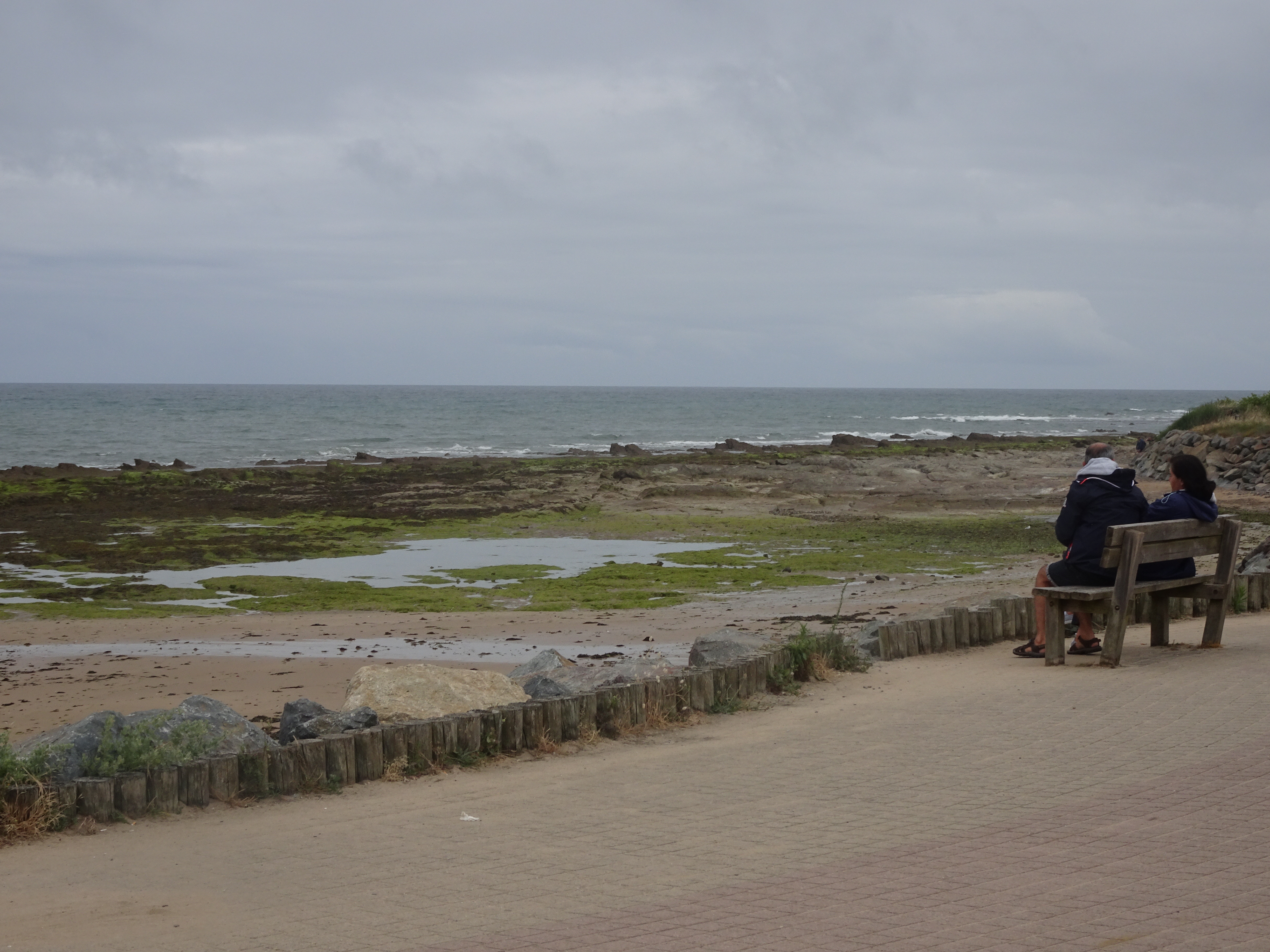
Rather than disembarking and shooting off down the Autoroutes though, we motor a couple of miles along the coast, to a tiny hamlet called ‘L’Anse de Bruick’, a terraced site overlooking a small, exquisite beach. Once established on our pitch we wander down to the bay and it’s a sandy carpet fringed with emerald boulders and rock pools alive with all manner of creatures.

It’s the bar for internet on this first night, as the site is enclosed by an ancient quarry and there’s no signal to be had anyhwere else [cunning of the site, of course].

Next day we drive east along the coast road, stopping by the rocky shore to get a walk on the coast path followed by lunch. The path winds through grass and wild flowers grown tall and teeming with bees and butterflies- it’s a welcome sight, since at home the principal insect in our garden seems to be the mosquito…

Then it’s off into Cherbourg to complete our first task of the trip- to get a carte SIM for our little mobile wifi pebble. It’s always a challenge for my linguistics, always at the start of the travel and I must explain what we need and why, whilst also explaining that we don’t have the required skill to ‘recharge’ the SIM ourselves. I tell the Orange salesperson that we were here last year and offer a small, silent thank you to some unknown deity that we’re dealt with efficiently and without question- and Bravo! We have wifi- although not in the current site in a quarry dip.

We’re off next morning, a short hop to St Martin de Brehal, by the seaside. The site is large, open, clean and tidy, a short walk along the prom to a few bars and restaurants, a pleasant enough place though not characterful enough to photograph. We go for a cycle along the quiet marsh roads, past dunes and roaming sheep. It’s our first cycle of the year so easy does it! But we follow it with an attempt to get to Granville, along the coast, via the prom cycle track and it fizzles out before we’ve got far. We turn off inland but it’s clearly too far to Granville…some other time, perhaps-

Later we sit in the evening sun at a corner restaurant and it’s summer solstice- the longest hours of daylight better still here, where the light remains in the sky until past 11pm.

In the morning we’re off again- south and west.

Grace is the alter ego of novelist and short story writer, Jane Deans. To date I have two published novels to my name: The Conways at Earthsend [https://www.amazon.co.uk/Conways-at-Earthsend-Jane-Deans-ebook/dp/B08VNQT5YC/ref=sr_1_1?crid=2ZHXO7687MYXE&keywords=the+conways+at+earthsend&qid=1673350649&sprefix=the+conways+at+earthsend%2Caps%2C79&sr=8-1 and The Year of Familiar Strangers [https://www.amazon.co.uk/Year-Familiar-Strangers-Jane-Deans-ebook/dp/B00EWNXIFA/ref=sr_1_1?crid=2EQHJGCF8DSSL&keywords=The+year+of+familiar+strangers&qid=1673350789&sprefix=the+year+of+familiar+strangers%2Caps%2C82&sr=8-1 Visit my writer Facebook page [https://www.facebook.com/search/top?q=jane%20deans%2C%20novellist%2C%20short%20fiction%20and%20blog or my website: https://www.janedeans.com/

Wish You Were Here

Jacob is lonely and a loner, until events conspire to change his circumstances. A brand new story on Anecdotage for you today…

              The postcard has been on Jacob Cunningham’s shelf for almost ten hours; and for at least two of those hours Jacob has sat and frowned at it, the remaining hours having been occupied by work, sleep, travelling to and from work and shoving a ready meal into the microwave oven. Jacob is not one to prepare elaborate meals, having only himself to feed and care for, so he rises from his armchair, takes his eyes off the postcard just for the time it takes to heat the meal and returns with the plastic tray and a fork to his chair, cutting down the time and effort involved in taking a plate from the drawer and having to wash it up afterwards. It’s a meagre life, almost monastic in its austerity.

              While he chews, Jacob revisits all the thoughts and ideas he’s had so far about the postcard, which is handwritten and unsigned. First of all, could it be from a friend? Jacob ties his brows into a perplexed knot as he considers this. The problem, as far as he sees it, is that he has no friends, or at least nobody who fits into the friend category. He does, of course have colleagues, if you count his line manager at the Co-op and the two check-out staff, Olek and Sue, who greet him when he arrives and bid him goodbye if they catch him leaving. No one at the Co-op, however, would be likely to send him a postcard, would they? And no one knows his address, except perhaps for Big Beryl, his manager, who interviewed him for his role as warehouseman and shelf-stacker. The idea of Big Beryl sending him anything, least of all a postcard is beyond Jacob’s imagination. In any case, she isn’t on holiday and when she has been on leave, she’s returned to work in an even worse humour than usual, having spent her time caring for her unruly grandchildren, not be-sporting herself on a sun-drenched beach in the South of France.

              Jacob plucks the card from the shelf and inspects it again. The photo is of the beachfront at Nice, a curving bay of creamy sand decorated with palm trees and fringed by pastel coloured apartment blocks, the balconies all facing out to an azure sea. The entire scene is bathed in sunlight and Jacob can make out figures walking along the path between the sand and the road, the Promenade des Anglais, as the caption informs him. He’s read it countless times. He flips it over, stares at the stamp, a rectangle with a turquoise, monochrome image of a young woman in profile. She’s wearing a cap and has long, flowing curls escaping from underneath it. The postmark is from three days ago.

              He appraises the handwriting. It’s elegant and curving in an old-fashioned way that is seldom seen these days. He thinks. You seldom see any handwriting at all these days. In fact, you seldom see postcards. No one writes, not letters, not postcards and rarely greetings cards. It’s unusual to receive anything handwritten.

              His next thought is of family members. Neither of Jacob’s parents is alive and he was an only child, much loved- even doted on, by his mother and father. He doesn’t know why he had no siblings but suspects it was more for economic reasons than anything else. His Dad was a skilled man, a tool-maker, but spent the whole of his working life on the same factory floor without ever achieving a promotion like line manager. His mother had worked in a care home, loving the work but receiving little remuneration. They’d been proud people, though, his parents, and kept the small, terraced, two -bedroom house they’d worked to buy spotless and tidy. Jacob closes his eyes. Thank God they weren’t around to see how little he’s made of his life, how he struggles to just about cover the rent on his housing association, one bedroom box of a flat and works as a dogsbody in a supermarket.

              For a moment, he allows the idea that the postcard is from his son, Lee to drift into his mind. How old is Lee now? Early twenties? Mid-twenties? Where is he, even?  The thought that a child of his could be holidaying in such a place, a place for rich, privileged, classy people fills Jacob with a warm, proud glow, before his imagination hits the brick wall of reality. Of course, Lee isn’t rich, privileged and classy; far from it. Lee will have been as lost to life as Jacob is himself, following Jenny’s death. He takes a quick, inward breath when he thinks the words, ‘Jenny’s death’. It isn’t something he often allows himself to dwell on. He wishes it were different, that he’d tried harder with Lee, but then his own, fragile, mental state had been like a raw wound, exposed and ugly as if anyone could see it and recoil from it.

              If only he’d tried harder with Lee when there had been two parents. Jenny was a natural mother, dealing with all the trials and tribulations of parenthood like she was born to it and delighting in all the joys, too, whereas he himself had been at a loss even before she went, never slotting into life as a dad, with all the pleasures that other fathers and sons seem to share- no football games in the back yard, no mock wrestling, no fishing trips or scoffing popcorn in front of the TV. It’s painful to recall how stiff and uncomfortable he’d been as a dad. No wonder Lee had left home as soon as he was able, vacating the house while Jacob was at work, leaving nothing to indicate his whereabouts and not answering any calls. He’d been sixteen then. Jacob had spent many sleepless nights wondering and worrying and feeling he ‘d let Jenny down. The police response had been, at best, lacklustre; too many teenage runaways to deal with, they said. If the boy wanted to disappear then he would.

              None of this is shedding any light on the mystery of the postcard. He reads the message again:

Hi there!

Sun, sea, palm trees, French cuisine and all the vin you could want! This place is formidable! I should have done this Europe trip years ago! You should try it, Jacob. It’s true what they say about travel broadening the mind! Leaving tomorrow for Italy. Watch this space! xxx

‘Watch this space?’ What does that mean?

Jacob doesn’t have too long to consider what the words mean. Four days later there’s another postcard waiting on the mat when he returns from work. He stares down at it, at the shiny surface of the photo, pausing and frowning at it before placing his carrier bag with a ready meal and one can of beer on to the floor. He reaches down and plucks it from the mat. This time the photo is of a cluster of yellow and ochre buildings terraced above the sea, the lowest and nearest building looking like a café or bar with white parasols outside. In the foreground there is a row of white boats pulled up on what looks like a road; in the middle distance a greyish beach. He continues to inspect the scene as he picks up the bag and pads the few steps into his tiny kitchenette and slumps down on to his one dining chair. ‘Genoa town beach’ proclaims the caption under the picture, and at the top of the beach he can just make out a restaurant with outside tables bathed in the golden, evening light, tiny figures seated around one. He imagines the scene. They’ll be eating pasta and drinking wine, those people.

At work next day, Jacob withdraws the cards from his back pocket and perches on a palette in the yard. He’s studying them when Sue emerges from the delivery entrance and wanders over to join him.

‘Alright Jacob?’

He nods, glancing up at her then back at the Italian post card.

‘That looks nice. I wouldn’t mind being there now, would you?’

Jacob looks sideways at her as she sinks down beside him on the palette. She nods at the cards in his hand. ‘Well, some bugger’s having a good time, eh? Is it a family member?’

He frowns, shakes his head. ‘Tell you the truth; I don’t know who it is.’ He pauses, searching for the words, unused to conversation. ‘I’ve received these two postcards but they aren’t signed and I don’t know who sent them.’

Sue leans forward, eyes wide. ‘Oooh! I love a mystery, me! Who do you think it might be? Who do you know that travels a bit? Could be a youngster, I should think. What’s the handwriting like?’

He turns the cards over to display the neat, curving script. ‘Maybe not a young person, then’ she suggests, peering at the writing. ‘And look, there’s no surname in the address side.’

Jacob sighs. It feels different, sitting out here with another person. He’s used to taking breaks alone, looking at his phone and sipping from his thermos cup but having Sue’s substantial, interested presence feels soothing somehow and when Big Beryl appears in the doorway to give them both a pointed stare, he feels disappointed that his break is over.

Over the next couple of days Sue asks if he’s any nearer to finding the sender of the cards, then on the day before his day off, while they are outside sharing a break he finds himself having a proper conversation with her, telling her things he’s never shared with anyone- stuff about Jenny and about Lee. He feels like a tap in his head has been undone and some of the pressure released.

‘So you don’t reckon the postcards are from him then, Jacob? From Lee?’

He shakes his head. ‘No, no. I don’t know how he’d have got the money to travel like that. And I think he’d write ‘Dad’, not Jacob.’

On his way out, shrugging into his jacket and picking up his carrier bag of groceries, Sue stops him. ‘What are you doing with your day off? Got any plans?’

He pauses, scratches his head. ‘Bit of cleaning, washing- stuff like that.’

She grins. ‘Not much fun!’

He shrugs. Fun doesn’t figure too much in his life these days. Sue persists. ‘If you don’t have much planned, you’re welcome to join our walking group. We go out most Sundays. It’s not too strenuous and they’re a friendly enough bunch. The more the merrier!’ She tells him where and when the group meets but that there’s no obligation, if he doesn’t fancy going.

              That evening he rummages in the bottom of his narrow wardrobe until he finds a battered, shabby pair of trainers, trying them on before placing them ready by his bed. In the kitchen bin there’s an old plastic bottle which he rinses and puts on the draining board ready to be filled with water. He sleeps a deep, dreamless sleep, untroubled by postcards or anything else.

              He’s up in good time, out on the landing locking his door as his neighbour two doors along steps outside. They nod to each other, the extent of their contact to date since Jacob moved in five years ago. He knows there’s a family there, West Indian, two young children- but hasn’t spoken, having not progressed beyond the nodding stage. Now the young man calls to him.

              ‘Morning!’

              Jacob looks up, startled, then rallies. ‘Yes- morning to you, too’ The neighbour approaches as he’s putting his key away.

‘Can I ask you something?’

Flustered, he drops his water bottle then straightens. ‘Er, yes, yes ok.’

‘Have you had any post that wasn’t addressed to you? You know- with someone else’s name on?’

Jacob shakes his head. ‘All my post has my name on’ he says. ‘Sorry- I must dash. I have to be somewhere.’

As he walks down the stairs, the novelty of having to be somewhere swells inside him like a malt whisky. Down in the square he spots Sue milling about among a small group dressed for walking in cagoules and hiking boots and he’s conscious of his scruffy trainers and cheap windcheater jacket. But Sue grins when she sees him, drawing him in and introducing him, although he’s taken aback when she says ‘and this is my partner Raj’.

They set off along the street towards the outskirts of town, Jacob finding himself walking alongside Raj, who engages him in easy conversation. During lulls he wonders if he’d begun to think of Sue romantically and decides he hadn’t, not really; he’d been seduced by her warmth and friendship. Now she’d been generous enough to share her friends with him too. He’s a lucky man.

He’s unused to walking but after a mile or so he finds a rhythm and a stride then he and Raj settle into a companionable silence that enables him to take in his surroundings while his mind meanders into a journey of its own. They’ve got out into the lanes now and are heading towards a village pub where they’ll get lunch- ‘a ploughman’s’, Sue had explained the day before. He settles in the garden at a table with Raj, Sue and a couple of the others. Raj is solicitous, including him in the conversation and asking his opinion.

It’s only when he gets home that he realises how tired he is, sinking into his armchair and kicking off the trainers before closing his eyes. When he opens them it’s late and the first thing he sees are the two postcards, confronting him as if he’s abandoned them for the day, which of course, he has. He spent an entire day without thinking about them- or about Jenny or Lee.

Sitting with Sue on the palette on Monday morning he confesses he’s sore and stiff.

‘But did you enjoy it, Jacob? Will you be coming next time?’

He nods. ‘But I might go and have a look at some proper hiking boots at lunch time though.’

‘Had any more of those postcards yet?’

He reaches into his back pocket and pulls out this morning’s arrival. The mystery sender is in Rome, the card a picture of the Coliseum.

Sue takes the card. ‘Wow!’ She gazes at it. ‘Have you travelled much, Jacob?’

He shakes his head. ‘Not much out of the country, no. We went to Devon once, when Lee was little. Stayed in a caravan. It rained a lot so we felt a bit cooped up, you know.’

Next morning, as he’s exiting the flat, his neighbour appears, a rucksack on his shoulders, says ‘Morning’ and strides away down the landing. A young woman, presumably his wife, hangs out of the doorway holding a Tupperware box.

‘Jacob! Jacob!’ she hollers as he disappears down the stairs.

Jacob? Jacob frowns, then dashes along to the stairwell and calls,

‘Hey mate, mate!’

Below him the dark head of his neighbour turns up towards him.

‘I think you’ve forgotten your lunch’.

The other Jacob grins and leaps back up, taking two steps at a time. He runs back, grabs the box and dashes for the stairs, calling ‘Cheers’ as he passes Jacob.

He re-enters his flat and collects the postcards before knocking on the neighbours’ door. When the woman opens it, she’s all prepared to go out, with a toddler in a stroller and another standing in a coat.

‘I’m sorry to disturb you,’ he begins, ‘I have a feeling these are your husband’s postcards. You see, I’m called Jacob, too.’

Outside on the palette, he tells Sue of the development. ‘Goodness! What are the odds of having two Jacobs within two doors of each other, do you think?’

Jacob remembers the young woman, Tara’s face as he thrust the misplaced cards at her; remembers her delighted smile and tinkling laughter, the wide eyes of the toddlers on him as he stood in the doorway.

‘Are you up for next Sunday’s walk?’ Sue asks him, ‘we’re going over the downs, weather permitting of course’.

‘Yes. I’ll be trying out my new boots’ Jacob lifts up his feet to display the brand, new hiking boots he’s been wearing to work to get accustomed to, on Sue’s advice.

Later he plods along the landing towards his flat and spots something on the floor by his door. It’s a bottle of red wine and an envelope. He carries the items inside before sitting down and opening it.

‘For our neighbour and friend, Jacob’  it says, ‘to thank you for finding our lost post’

He stares at the card for a long time. At last he stands and places it with almost reverend care on the shelf where the postcards used to sit, then he removes his walking boots and pads into the kitchenette, taking a plate, knife and fork from the cupboard and setting them on the tiny, formica table before placing his meal in the microwave oven.

Grace is the alter ego of novelist and short story writer, Jane Deans. To date I have two published novels to my name: The Conways at Earthsend [https://www.amazon.co.uk/Conways-at-Earthsend-Jane-Deans-ebook/dp/B08VNQT5YC/ref=sr_1_1?crid=2ZHXO7687MYXE&keywords=the+conways+at+earthsend&qid=1673350649&sprefix=the+conways+at+earthsend%2Caps%2C79&sr=8-1 and The Year of Familiar Strangers [https://www.amazon.co.uk/Year-Familiar-Strangers-Jane-Deans-ebook/dp/B00EWNXIFA/ref=sr_1_1?crid=2EQHJGCF8DSSL&keywords=The+year+of+familiar+strangers&qid=1673350789&sprefix=the+year+of+familiar+strangers%2Caps%2C82&sr=8-1 Visit my writer Facebook page [https://www.facebook.com/search/top?q=jane%20deans%2C%20novellist%2C%20short%20fiction%20and%20blog or my website: https://www.janedeans.com/

Mystery on the Dwarfdale Flyer

              “How do Verna! By ‘eck, its cold in that waiting room this morning!”

An icy blast accompanies Jacob Hutton into the compartment as he settles himself opposite Verna, unbuttoning his jacket to reveal his customary navy-blue dungarees. Verna chuckles, brushing imagined flecks of dust from her sackcloth apron with large, work-red hands.

“Morning Jacob! Warmer in here, I don’t doubt.”

              She turns to glance at the basket beside her, lifts the blue and white cloth to check its contents and, satisfied, nods back at Jacob.

“I haven’t seen Arthur lately. Do you think he’s alright?” Jacob shakes his head, the habitual pipe in his jaw wobbling like a signalman’s flag.

“Nay, I said to my Mavis, it’s a while since Arthur came up to town, though now I come to think of it, he’s been looking peaky, so he might of come down with summat.”

“He works too hard, that’s what. He’s wearing himself out, all that digging, it must be a worry competing with all them new fangled machines they have nowadays. I saw one arriving only yesterday where that new bridge is getting built, all painted up, some digger or suchlike. Nothing stays the same, does it? Happen one day eggs will be factory made and then me and my hens will be out of a job an’ all!”

Verna, soothed by the rhythmic rumbling of the carriage, leans back to watch the passing scenery, as familiar as parlour wallpaper, the paint-bright emerald of the trees interspersed with a red and white signal box or a water tower. She catches a glimpse of station huts and a whiff of acrid smoke as the train begins to round the bend on the approach to Dentlake Junction.

“Poor old Arthur. I know how he feels. We’re none of us getting any younger, and I feel a bit worn out me self, what with getting up at crack of dawn every day. Them cows don’t milk themselves do they?”

Now she scrutinises Jacob, Verna realises that he does indeed look worn out. There are greyish patches emerging on the tip of his nose and his cheeks, his hair is more white than youthful chestnut, even his clothes have taken on a frayed and faded appearance. Worse still, on taking a closer look down at her own, solid form there are worn, shiny areas on her stockinged legs, an alarming, deep gouge in the brown, woolly sleeve of her coat.

The train grinds to a gentle halt as they pull in to Dwarfdale, where half a dozen passengers are preparing to board. Jacob gets to his feet, pulling his shabby jacket together, and opens the door to see a figure they both know, and yet almost unrecognisable in his renaissance.

“Arthur!” They shout, gladdened by the sight of him, vibrant, bright-eyed and fresh, as moments later they are lifted up and placed gently on a table amongst the paints and brushes behind the toy shop window.

Grace is the alter ego of novelist and short story writer, Jane Deans. To date I have two published novels to my name: The Conways at Earthsend [https://www.amazon.co.uk/Conways-at-Earthsend-Jane-Deans-ebook/dp/B08VNQT5YC/ref=sr_1_1?crid=2ZHXO7687MYXE&keywords=the+conways+at+earthsend&qid=1673350649&sprefix=the+conways+at+earthsend%2Caps%2C79&sr=8-1 and The Year of Familiar Strangers [https://www.amazon.co.uk/Year-Familiar-Strangers-Jane-Deans-ebook/dp/B00EWNXIFA/ref=sr_1_1?crid=2EQHJGCF8DSSL&keywords=The+year+of+familiar+strangers&qid=1673350789&sprefix=the+year+of+familiar+strangers%2Caps%2C82&sr=8-1 Visit my writer Facebook page [https://www.facebook.com/search/top?q=jane%20deans%2C%20novellist%2C%20short%20fiction%20and%20blog or my website: https://www.janedeans.com/
Caught

Trap; an unwitting moth flutters in an innocent, random pattern only to be ensnared, caught in a mesh of elastic threads, thrashing wildly but doomed as the predator pounces to inject the body with piercing jaws, stilling the spasms, rolling it with rapid efficiency into a food parcel; to be consumed later.

              Here in my father’s back yard, in the still warm air of a September evening, I am glad of a distraction from my task. I light a cigarette and inhale, watching the curling twist of smoke wind upwards. Excitement over, the rotund spider withdraws to the shadows, out of sight until aroused by the next tweak.

              Back inside I gaze around at the devastation I’ve wrought and think it’s enough for today. Amidst the piles of books, sets of musical scores, files of correspondence and personal papers in my father’s study there is a box containing old photographs and it is these I’ve been perusing, losing a sense of time both literally and figuratively as I delve back into his life; a jumble of grey-brown, faded and dog-eared images chronicling events and scenes, depicting some characters I remember and many I do not.

              I realise I am hungry but have no wish to eat here, alone amongst the detritus. I will walk down through the village to the pub. Before leaving I slip a photo into my pocket, a picture of Imberton Village Dance Band on stage. In the twilight, the quiet of the somnolent village street is punctuated only by the last, retiring song of a blackbird as he defends his province and by the distant, mechanical hum of a lawnmower.

              To stroll along this street is to walk in my childhood steps, the way I went to school; down along the hot tarmac, treading on the raised tar bubbles that erupted like sticky larva under the sun’s  hot rays. Here in the gateway by the open field my brother and I paused to see who could pee the furthest as our exuberant, steaming fountains arced over the gate. On past St Mary’s where we languished, imprisoned at Sunday school, the time hanging heavy until we could loosen our collars and race back home to lunch, through the ivy clad churchyard, whose deceased inhabitants now play host to a newly interred inmate.

              It is growing dark by the time I am level with the gravel track that slopes up towards Abbott’s, where a lone street lamp casts enough light for me to make out vestiges of the faded imprint on the side of the building; ‘Abbotts Grocery’. I pause for a moment, remembering. The old red brickwork had been painted yellow, the words in red and green, though now all that is visible is a faint square of flaking cream with a few pinkish lines. Old Ma Abbott, who’d seemed ancient to my seven year old self, must be long gone by now. But what of June? To my naive, infant scrutiny she had appeared grown up, although she couldn’t have been much more than sixteen when we plagued the shop in our crude, heedless bids for amusement. She would greet us, soft voiced, smiling with wide spaced, guileless eyes like a baby fawn’s as she tipped Rhubarb and Custards from a jar into a paper bag or ladled out ‘Eiffel Tower’ lemonade powder. I’d peer at her upswept, beehive hairdo and the way her wide skirt fanned out like daisy petals, buoyed up by layers of stiff petticoats as she climbed the step to replace the jar.

              I’d been the youngest, tolerated but not acknowledged, the tagger-along, more spectator than participant as we roamed the village in search of diversion. We built dens, made bows and arrows or rudimentary, wooden guns, climbed the hay bales in Worts’ barn, fished in the stream, spoke in hushed whispers about the mysterious Bryant sisters, whose nocturnal activities had provoked speculative gossip from our parents. We played endless games of Cowboys and Indians or Cops and Robbers, when my involvement was accepted if I agreed to be the Indian, or the ‘baddie’ and submitted to the inevitable tying to a post to be danced around and jeered at or executed by bow and arrow or firing squad.

              A few heads turn as I enter the pub, one or two nodding and murmuring in uneasy recognition. I am known to them nowadays only by association with my father. They are caught in the uncomfortable circumstances that accompany a meeting with the newly bereaved. I order my meal and take my pint to a lone, corner table, allowing them to continue their conversations unburdened by the obligation of sympathy.

              While I wait I withdraw the photo and place it on the table. The band members are on a wooden stage flanked by velvet curtains in what looks like the village hall. My father is seated on a stool at an upright piano, to the right of the picture so that his face is only visible in profile, mouth open, his head tilted down, intent on his fingers as they depress the keys; one foot underneath pushing down on a pedal. To the left of the stage his brother Dib sits leaning forward to strum his banjo, a bowler hat perched at a jaunty angle, staring a broad grin into the camera despite the cigarette jutting from the corner of his lips. I guess that the slim, smiling woman in the centre at the microphone, dressed in a neat, dark frock with a lace collar is Doris Lampard. Behind them, less distinct are a guitarist and a drummer.

              I am aware of someone standing at my elbow; a stooped, portly, elderly figure leaning on a stick, sharing my view, peering with rheumy eyes at the picture. I recognise him as Arnold Goodridge, one of my father’s friends, although I’m unsure of the connection. Perhaps he’d been a fellow parish council member, or they went to cricket matches together.

              “That would have been a Saturday nighter,” he says, gesturing at the photo. “There’s your Dad, on the old Joanna, and your Uncle Dib up front. He was a lad, that Dib!”

The bloodshot eyes are lit with interest as he leans forwards to peer closer. I pull out a chair, inviting him to sit and he accepts my offer of a pint. He squints at the aged image, pinching it by the narrow, white border as he holds it up to the light.

“I know that Doris used to sing,” I tell him, “but who are the other two- the guitarist and the drummer?”

I wait while he examines the scene, his breathing rapid and wheezy, the sound my father’s piano accordion made when he was warming it up. He takes so long to answer his pint arrives and he lifts it to take a long draught before he speaks.

“That there,” he prods the guitarist in the picture with a thick, stubby finger, “is old Ernie Brabrook. He used to have the butchers, up on the Copseway. That’s up the road behind your Dad’s place. And that fellow behind the drums is Dick; Dick Abbott that had the grocers shop. You’ll remember that from when you was a nipper.”

I nod.

“I do remember. Walking past it tonight made me think of when we used to go up there for sweets. I’m afraid we went in more for the thrill than to buy anything. We were terrified of Mrs Abbott so we dared each other to enter.”

The old man smiles his understanding.

              “Oh ah! She was a hard woman, Mae Abbott. Bitter, with a wasp sting for a tongue. Weren’t no one missed a tongue lashing from Mae at some point. ‘Course Dick got it the worst. He spent as much time as he could out of her way; he had his grocer’s round in the daytime, doing deliveries, then he’d be out with the band as often as you like, four or five nights a week sometimes. He played in the darts team, too.”

              “So Mae didn’t go along to see the band? I suppose if Dick was on stage she’d have no partner for dancing.”

              “Mae? No! She weren’t one for dancing. Back when they was first married she had June to look after. She only ever went out on a Sunday, to church, as I recall.”

              “June must have been born quite soon after they were married, then.”

              He scratches his head, frowning at his glass.

              “Things was different then.”

              For now the old man has completed his narrative. He drains his pint and hauls himself to his feet as my meal is delivered to the table with enquiries as to whether I’d like any sauces and another drink.

Arnold is shrugging his coat on, turning to leave then he stops to voice a thought.

              “I might have one or two of them photos at home, the band and that. I’ll have a look and bring them round, if you’re interested.”

I am. I thank him.

              “Arnold, before you go, can you tell me anything about June? Does she still live in the village?”

He grips the chair back as he faces me, his knuckles white, his breath whistling.

              “I’d have thought your Dad would have told you. She passed away. Must have been twenty years ago; not that long after Dick, but before Mae. It were a sad business.”

              The spiders have retired for the night when I go out to take a last cigarette in the cool air of the yard. This small space, illuminated by a shaft of light from the doorway is cluttered with accumulated rubbish and scruffy with weeds, neglected and unloved, another task to be undertaken before I leave. My father had been devoted to his small garden, growing gaudy dahlias and rows of fat onions, trimming the hedge and tending the pond, now relapsed into a murky, stagnant pool, clogged with choking blanket weed. When my mother died he’d withdrawn to the house, leaving his beloved plants to fend for themselves, as if the garden itself had been responsible for her death. Grief affects people in strange ways, driving them to relinquish lifetime habits and adopt new ones. I think how little I knew him in the later years, my visits short and peremptory and executed from a sense of duty.

              I make my way to bed in the tiny, inhospitable guest bedroom, crawling between slippery sheets topped with unaccustomed, heavy layers of blankets and an eiderdown; the bedding a relic from when we were boys, although never in this cramped bungalow designed for retirement. The elderly bed springs creak and protest as I fidget, sleepless with memory. June Abbott; she’d have been in her sixties now. What had happened to her?

              Next morning a stiff breeze has sprung up as I stroll up to the village store on the Copseway to buy a newspaper and a pint of milk. On the way I search for the old butcher’s shop that was Ernie Brabrook’s, but almost all the buildings that housed businesses have been converted to dwellings, either having been demolished and rebuilt or their big front windows bricked in and I no longer recall the exact location of Ernie’s place. All I remember is standing inside while my father waited for his order to be prepared, the sawdust floor dusty beneath my feet and the cold, raw carcasses dangling, white on their metal hooks, an odour of chill sweetness and the resonant thwack of the butcher’s cleaver as he prepared chops or steaks.

              The store assistant is solicitous. My father will be missed by the community, she says, and how am I getting on with clearing up the house? Feeling heartened by her concern I ask if she knows anything about Imberton Dance Band and the various members. She nods as she packs my purchases into a bag.

              “My parents used to go dancing every Saturday. A girl called Mavis used to come and babysit us.”

              I take the photo from my pocket and place it on to the counter. She looks closely before shaking her head.

              “I can see that’s your Dad, in his young days, and that was his brother. But I don’t know the others I’m afraid. I’d have been too young, I suppose.”

When I mention Dick Abbott a look of recognition springs to her face.

              “I was in the same class as June at school. We were a fair bit older than you and your brother I think, so we’d have left to go to the secondary by the time you two were in the juniors’ class. She was sweet, but she was a bit soft, if you know what I mean; not the brightest, but always kind and smiling. It was awful, what happened to her.”

              “I heard she died. What was it, illness?”

She purses her lips, looking grave.

              “No, nothing like that; she drowned in the brook that runs along the bottom of the field behind the house. ‘Accidental death’ they said it was, although no one knew how she came to be there. She was in her night clothes when they found her; all a long time ago now.”

              I take a diversion back to the bungalow, down an old, overgrown footpath that leads to the narrow rivulet behind what was Abbott’s shop, with a dwelling at the rear. We’d dangled jam jars on strings into the stream to catch tiny stickleback, bearing them home triumphantly then being made to return them by our stern parents. The brook is no longer the rushing torrent of my memory, rather a thin trickle, banks overgrown with tall, bushy nettles. I wonder how she could have drowned, here in the shallows where the water is inches deep and the gravel of the stream bed ruffles the flow. Further up the sloping field the back of the house is just visible, changed now; refurbished. A new wire fence provides a barrier before the brook, where none was before. Perhaps she sleepwalked down to the stream and fell, found herself tangled in the undergrowth or mired in some mud. I’ve an image now of her night clad body lying cold in the water under the moonlight, her dark hair loose and mingling with the eddying current, but surely she’d have called for help?

              My father’s modest house, the pride and joy of his later life seems diminished now that his furniture and effects are packed up to be distributed or disposed of. The rooms are strewn with cartons of bric-a-brac, books or bin bags full of clothing ready to be taken to charity shops. The walls bear the ghostly shapes of the pictures and mirrors that hung against them. His upright piano awaits collection. This is all that remains of his life. We humans spend a lifetime accumulating objects only to leave them all behind us for another to discard.

              I make tea in the ancient ceramic teapot my parents always used. It is lined with a crust of brown stain but to succumb to dunking tea bags into cups feels a betrayal here in their kitchen. While I’m waiting for the tea to brew I ring my wife to tell her I’m almost done with the clearance and I’ll be returning home tomorrow.

              I’m about to pour the tea when I catch sight of Arnold Goodridge unlatching the front gate and labouring up the path towards the front door and I think he must have smelt the tea to have timed his arrival like this. He settles into the worn settee with the ease of one who has sat there, in that same spot on many occasions, leaning his walking stick against the arm and placing a bulging manila envelope on the seat beside him. He glances around the room at the bare walls and loaded cartons as he sips the tea, nodding in sage acknowledgement, his chest still heaving with the exertion of his walk.

              “Going up for sale, is it?”

              “I’m afraid it is, Arnold. The family is too far flung to keep it. I’m hoping to drop the keys with the agent tomorrow, on my way home.”

              He puts his cup and saucer on the coffee table and opens the envelope to pass me a few photos. I move to sit next him while he describes each scene. There are more pictures of the band, of course, but also snaps depicting charabanc outings to the seaside, village fetes and family parties, many showing my parents and their friends, the most striking aspect their smiles as they face the camera. It would be easy to assume that their lives were one long holiday on which the sun never failed to shine.

              I pore over one shot of the beach, where my parents and another couple, all dressed in their Sunday best, are installed in deck chairs on the sand behind a number of children of varying ages playing with buckets and spades. Amongst the offspring is a young girl of about eleven, with soft, dark eyes, clad in a typically substantial swimming costume of the era, her arm around a sturdy child who I recognise as my brother. He is looking into her face with an adoring smile.

              “There’s June,” Arnold offers. “She always did love the littl’uns. She’d have made a good mum if she’d had the chance.”

              “Arnold, how did it happen? How come she drowned in the brook? There’s so little water. And why was she wearing night clothes?”

              He gazes at the photo as he begins to talk.

              “It was like I said. When Dick started stepping out with Mae they was only young, so it weren’t really serious, if you see what I mean. Then she fell pregnant with June and it was all Hell let loose. In them days it was like the end of the world. It weren’t long before that a young couple had drowned themselves in the lake from the shame of it and the fear of being found out. There weren’t any choice for them. Dick had to marry her quick, so when the baby came they could just say it was a bit early, like.

              They lived with Mae’s parents to start with. It must have been hard for Dick. He was always a bit of a one for partying, had an eye for the girls. He could of taken his pick of ‘em, too if he’d wanted. But he was stuck with Mae then, and didn’t he know it! She never forgave him for landing her with a baby so young and I don’t think she ever thought he was good enough for her neither.”

              “But she must have loved the baby when she came along. June was so pretty and so sweet!”

              “She were. She were a cracker! But she were never the brightest, if you get my meaning. She weren’t going to get to college or anything like that.”

              “Is that why she ended up helping in the shop when she left school?”

              He nodded.

              “Mae hated the shop, like everything else. She thought it was beneath her to work behind a counter; didn’t think she should work at all. ‘Course the shop folded in the sixties and Dick retired then. It had never made much money. Customers preferred the stores up on the Copseway and you could see why. Mae drove them all off, with her spiteful tongue and her nasty ways.”

              “So what did June do, when the shop closed down?”

              “She took up hairdressing, somewhere down Hardwick way I believe it was. Of course she favoured her Dad for looks, so she weren’t short of a few admirers. I think she did do a bit of courting, while her Dad was still alive but nothing serious. Then Dick passed away, a bit sudden. After his funeral no one hardly saw Mae. She stayed indoors, kept herself to herself, and June stayed looking after her. There weren’t no more gentlemen callers because Mae wasn’t having it. She were too scared June would up and get married and leave her. Thing was, with Dick gone she only had her daughter and they used to say in the village that were when June changed, stopped smiling, like. Some said it were because of losing her Dad, but I reckon there were more to it than that. That bitter old witch made her life Hell, that’s the sum of it. She tormented her and bullied her until her life weren’t worth living. And June, she were caught, like in a trap. She’d nowhere to go and couldn’t leave her mother. It got so she couldn’t stand no more. So she took the only way out she could. There were more to the stream in them days, but most folks don’t need a lot of water if they’re determined to drown their selves. You know the rest.”

              He puts the photo on the coffee table before looking up. When he catches my expression he puts his hand on my arm, his face softening.

              “I shouldn’t of probably told you all that, what with your Dad and all. Not exactly a cheerful story, is it? But you got to remember it were all a long time ago.”

              “No, I’m glad you did. And I’ve enjoyed looking at the photos and hearing all the other stories.”

              On his way out Arnold stops on the path to button up his jacket.

              “Know what I reckon?” There is a mischievous gleam in his eye as he adjusts the stick in his grip. I shake my head.

              “Them lot in the band, they’ve been up there waiting for your Dad to join them. Now he’s got there they’ll be making heaven jump to the beat with all their tunes!”

Though I don’t share his conviction, the image is so pleasing I have to smile as I thank him again.

              I wake to an overcast sky, feeling moved to make haste with loading my car and starting on the long drive home. There is little of any monetary value amongst the house contents and nothing of use or ornament to us, the next generation, for whom tastes have changed. I have wrapped and packed the few items my brother and I decided upon as keepsakes; one or two first editions, leather bound, a hand painted tea set, a couple of prints and the box of photographs, which I have volunteered to sort and annotate. Everything else will be removed by a clearance company, leaving the empty shell of the house ready for viewing by prospective buyers. Once I have locked up and pulled the front door shut behind me I know I will not be returning. I pocket the house keys in readiness for the estate agent.

              Before leaving the village I pull into the lay by outside the churchyard. I want to spend a few minutes alone by my parents’ grave, an action I doubt my busy life will allow in future. The new plot, freshly piled with earth stands out like a brown scar among the neat, green mounds surrounding it. Soon the simple headstone will bear the addition of my father’s name informing the reader he is ‘reunited at last’ with my mother. There are, as he requested, no bouquets wilting on the soil, donations having been made, instead, to the hospice that cared for my mother. He’d been pragmatic to the last, made all his wishes clear; his only desire to be laid to rest here in the rustic setting of the village churchyard next to his deceased wife.

              I have no faith in an afterlife. I believe that our allotted span above the earth is what we get. I know that my parents are not here, under the soil in this country graveyard, nor do they exist anywhere except, for a short passage of time, in my memory. But the shady, green space with its gentle hummocks, vases of chrysanthemums and trailing ivy is a peaceful spot for contemplation and remembrance. I wind my way through the graves, stopping here and there to read a name and a date where they are visible, not obliterated by algae and age. As I round the corner by the low stone wall I halt as my attention is caught by a simple, marble, upright slab with the inscription, ‘June Elisabeth Abbott, 1945-1978, ‘Resting where no shadows fall’.

              I perch nearby on a neighbouring slab. Her plot is overgrown, a joyous carpet of daisies and dusky pink autumn crocuses. A light mist of drizzle has begun to drift down, lifting a rich, earthy aroma from the vegetation. Somewhere close by a robin begins to trill a jaunty song. Then, at last I feel the tears well up and course down my face in hot, salty tracks until I drop my face into my hands and I’m howling, there in the secluded churchyard with the ghosts of my past for company.

              After a while, when the tears have drained away I stand and brush the moss from my clothing before walking back through the grassy mounds and ancient stones to the gate. In the car I pick up my phone and call my wife. She asks if I’m alright. I tell her I’ve missed them all; that I love them and I’m ready to come home now. I start the car. When I get home I want to hold them, my wife and children; catch them in my heart and never let them go.

Grace is the alter ego of novelist and short story writer, Jane Deans. To date I have two published novels to my name: The Conways at Earthsend [https://www.amazon.co.uk/Conways-at-Earthsend-Jane-Deans-ebook/dp/B08VNQT5YC/ref=sr_1_1?crid=2ZHXO7687MYXE&keywords=the+conways+at+earthsend&qid=1673350649&sprefix=the+conways+at+earthsend%2Caps%2C79&sr=8-1 and The Year of Familiar Strangers [https://www.amazon.co.uk/Year-Familiar-Strangers-Jane-Deans-ebook/dp/B00EWNXIFA/ref=sr_1_1?crid=2EQHJGCF8DSSL&keywords=The+year+of+familiar+strangers&qid=1673350789&sprefix=the+year+of+familiar+strangers%2Caps%2C82&sr=8-1 Visit my writer Facebook page [https://www.facebook.com/search/top?q=jane%20deans%2C%20novellist%2C%20short%20fiction%20and%20blog or my website: https://www.janedeans.com/
The Exchange

I am first. I am always first; always too early. I don’t mind. Getting here before the others gives me an opportunity to peruse the cakes and pastries at my leisure without the pressure of pretending disinterest. By the time they turn up I’ll have chosen; even, perhaps have consumed something. I’m leaning in favour of the ‘special’, a slice of Christmas cake, a rich, aromatic slab speckled with fruit and topped with a glistening, tooth tingling band of white icing and a dark green fondant holly leaf.

              On the other hand, if I buy it now I may not have finished devouring it by the time one, or both of them appear, which would present an unseemly image. I should wait. I exert a seldom utilised self control, and having made a mental note of my preferred option I go straight to a table-the only remaining table, which is next to the toilets.

              There are diners who are perfectly at home eating alone, able to consume an entire meal in solitude without appearing uncomfortable. They pull out a phone or a tablet with what seems like an endless deluge of emails, texts or photos, or they have some absorbing task to complete. I could take out my phone, but then I’d have to feign interest in the one text I’ve received today, from ‘Store 21’, alerting me to their ten percent off day, a snippet of information I have already viewed and which is unlikely to sustain my interest for the unspecified period I must wait. I fall, instead to studying the menu and have read it all through twice and memorised it before I spot Beverley weaving her way through the tables towards me.

              While her sunglasses are incongruous on a winter’s day in the gloom of this dark corner of the café by the lavatories, she is dressed in her customary way, in flowing layers and expensive fabrics. She is a tall, statuesque woman and can get away with this look in a way that the shorter and dumpier of us cannot.

              I rise to greet her and we embrace gingerly, like wary politicians before she discards her tweed cape and sinks down on to the seat. She is forcing a wan smile, which may indicate tiredness or something more sinister. When she tells me that Ava will be late I can only smile. Ava is late in the same way that I am early-by default. Not wanting to share too much before she arrives we talk of the weather, the traffic, how busy the shops are. I know my eyes are straying towards the menu as my stomach growls in an impatient demand for the slice of Christmas cake, although Beverley is occupied in checking her phone to see if Ava has called again.

              Then she is coming in, bumping tables and customers with assorted bags, turning this way and that as she scans the café for us. For a few moments I observe Ava, taking in her discomfort, her small, breathless panic as she stares over the heads of the assembled diners until at last I relent and offer a wave.

              She bustles up, all puffing and blustering excuses. ‘What a busy life I lead’, she seems to say, though the bulging bags of her purchases tell a different tale. She is so sorry to have kept us waiting and only wants a black coffee. She places a solicitous, manicured hand on Beverley’s arm and inquires if she’s alright because she looks tired. I volunteer to order, more a ploy to ensure the capture of the Christmas cake than a magnanimous gesture, returning to the table to find them already engaged in showing each other photos on their phones. In the competition of life’s successes Beverley has scored the giant prize of acquiring a grandchild.  

              They turn to me-a diplomatic nod of interest in my unglamorous existence. Has George retired yet? Is Jacob working now? Still living at home? Such a shame. 

              The order arrives; black coffee for Ava, cappuccino for Beverley, hot chocolate and the cake for me. There is a slight pause as we all regard the cake, before I lever off the first, sweet, rich forkful.

              Ava is asking Beverley how Rob’s business is going now, since he had to reorganise and lay off staff. Bev removes her sunglasses and rubs her eyes, bloodshot and dark ringed. The business is ‘ticking over’. They’ve begun looking for a smaller property in a less expensive area, seeking to down-size, to release capital. She speaks to Ava, avoiding my gaze. I am allowing a chip of hard, sugary icing to melt on my tongue, recalling how I visited for coffee one morning and found her in the kitchen, working her way through the contents of a vodka bottle with a determination that had eclipsed her memory the invitation. The failure of the business is not the sole reason for needing to release capital.

She straightens, takes a sip of the creamy cappuccino. In an abrupt change of subject she questions Ava about Matthew. Does Ava have any recent pictures? Ava reddens as she fumbles with her phone, then hands it across the table. Bev studies the photo of Matthew for what seems like a screen bite as Ava glances at me, eyes wide in her frightened face. Matthew is only two, an ‘afterthought’ as Ava describes him. Holding out the phone, Beverley frowns at the tiny sparrow of a woman opposite her and declares she cannot see anything of Steven in Matthew and I’m thinking, no, because there is nothing of Steven in Matthew-a fact that Ava confessed to me prior to his birth when faced with the dilemma of whether to tell her husband he was not the father. I lick my finger to sweep the remaining crumbs from the plate, wondering how three years can have passed since Ava blurted the tale of her sordid affair out to me in a moment of tearful desperation. What should she do? Should she tell Rob he could be the father of her baby? I’d advised her to leave well alone-after all he might not be the father. Who would know? She was frantic, sobbing. The child might resemble her friend’s husband; and of course, now he is older, he does.

I ask Ava if she has any photos of Lucy and I am rewarded by her feverish smile as she replaces Matthew’s guilt-inducing image with that of her student daughter.

Plates of beer battered cod with potato wedges and mushy peas are delivered to a neighbouring table, momentarily distracting me with the waft of delicious, hot grease. It is what I would choose if I were lunching.

We three have less in common these days; now that our children have grown. Once, as young mothers meeting at the school gate, starved of adult company, we could never see enough of each other. When I look at them now I think how age is most cruel to the once beautiful; Beverley no longer the willowy, well healed style guru, Ava’s slender, elfin appeal grown brittle as a dried twig. Beverley didn’t understand Rob, she’d explained when justifying her adultery to me. He’d needed someone to talk to, someone to console him when things went wrong with the business. If I’d considered that she’d undertaken the consolation with a little too much enthusiasm I’d kept the thought to myself. In any case, Beverley was too embroiled in her own dalliance with Mr Smirnoff to care or even to notice what her husband did.

All that remains of the hot chocolate is a circle of glossy, brown sludge in the bottom of the mug, a last scraping I might attempt to access with the long spoon if I were on my own. Ava still has half a cup of cold, black coffee, impressive as ever in her ability to make a coffee last for the duration. She is reaching into one of the bags to bring out two small parcels wrapped in co-ordinating Christmas paper from Marks with matching gift tags. Not for her the ironed out, salvaged wrapping from last year or three-for-a-pound from Savers. I wonder why it is we’ve continued with this ritual.

We have exchanged gifts every Christmas since we met, the first few years’ offerings being humble, home-made items, sewn or baked or grown, rather than the competitive quandary the exchange has now become.

Beverley presents her own gifts. They will have been purchased from a craft stall or a tiny, beach front gallery; a driftwood photo frame, shell jewellery or a hand-thrown pot. They are wrapped with that artful carelessness she retains, as though she has scoured the beach for cast off paper and string. Ava plucks her package from the table and turns it in her red-tipped fingers, exclaiming how interesting it looks. I assume from the shape that she has the pot this year. Sensing their expectation I withdraw the two, identical parcels from my bag.

Infrequent as they have become, I have grown weary of these meetings; weary of these two self absorbed women and their confessional outbursts, the inconsequential chatter and the shadowy events that lie under each rendezvous like bubbling volcanic pools. I have extracted what I needed from them only as recompense for my services over the years as confidante, counsellor, shoulder-to-cry-on and keeper of secrets. Now I am ready to move on.

Ava thinks the parcels look the same. They look like books. Is it a novel? Do they have the same gift? I nod. The same book?  Yes. Is the author someone they’ve heard of? I’m still nodding. When she tells me she hopes it ends happily because she can’t bear sad endings I say she will have to wait and see. Bev has shown little interest and has already stowed her holiday reading away in the leather appliqué satchel she brought and stood up. I’m guessing she is anticipating her first, warming, reassuring slug of liquor of the day as if she were going to meet her own secret lover.

Ava straightens and tuts, rearranging the silk scarf around her neck, smoothing her blond, highlighted hair. I wait for her to say she must look a sight but she gathers her bags and reels off a list of appointments she has before picking Matthew up from nursery; travel agent, chiropodist, the returns counter at Burberry. She wants to know where I’m parked because we can walk together and I know she is anxious to find out if I think Bev suspects anything. I could tell her that Beverley wouldn’t notice if a bomb exploded here in the café but I surprise her, instead by deciding to stay here, in my seat, alone at the table.

Then they are gone; the farewells said; the promises to meet again soon and the air kissing are all done. I don’t need to consult the menu before returning to the counter, since the seductive, lingering aroma of cod and chips is pulling at my senses and cannot be ignored. I am happy to sit alone now while I wait for my lunch, and contemplate a future which exists without Ava and Beverley but with a significant upturn in my fortunes, now that the royalties for ‘The Exchange’ are flowing in such a satisfying way and my account is inflated by a substantial advance for the second novel. Is it a sequel? No. I have said everything I want to say about those two parasites. They can edit their own future. I’m still working on mine.

Grace is the alter ego of novelist and short story writer, Jane Deans. To date I have two published novels to my name: The Conways at Earthsend [https://www.amazon.co.uk/Conways-at-Earthsend-Jane-Deans-ebook/dp/B08VNQT5YC/ref=sr_1_1?crid=2ZHXO7687MYXE&keywords=the+conways+at+earthsend&qid=1673350649&sprefix=the+conways+at+earthsend%2Caps%2C79&sr=8-1 and The Year of Familiar Strangers [https://www.amazon.co.uk/Year-Familiar-Strangers-Jane-Deans-ebook/dp/B00EWNXIFA/ref=sr_1_1?crid=2EQHJGCF8DSSL&keywords=The+year+of+familiar+strangers&qid=1673350789&sprefix=the+year+of+familiar+strangers%2Caps%2C82&sr=8-1 Visit my writer Facebook page [https://www.facebook.com/search/top?q=jane%20deans%2C%20novellist%2C%20short%20fiction%20and%20blog or my website: https://www.janedeans.com/

Continuum

The festival season is just around the corner, so here’s a fitting piece of fiction to capture the anticipation, the shared thrills and the bitter sweet memories of youth…

              We are waiting. Mickey elbows Dylan and stumbles to his feet, mumbling something incoherent. I glance at Shona, who is wearing her habitual expression of puppy dog longing. ‘Take me!’ it says.

              Dylan shrugs before shambling off after Mickey. He calls over his shoulder, ‘I’ll bring us back some chips’, then he’s gone, plunged into the throng that’s gathered for this year’s headliners ‘Continuum’, whose gear is just being set up.

              Shona looks at me pink faced. She leans forward and grips my arm. ‘Maz-has Dylan said anything about Mickey and me?’

              I don’t want this. I don’t want another ‘does Mickey care about me?’ discussion.

              On stage, the roadies are threading cables around the platform and repositioning parts of drum kit. I take a bottle of sun lotion from my bag and unscrew the top, squirt a little on to my finger, inhaling the coconut smell as I spread it over my forearms. I offer the bottle to her. ‘You should cover up, Shona,’ I warn her, ‘the sun is stronger than you think.’

              With her fair skin and white blond hair she could burn in a rainstorm, but she shakes her head. ‘Tell me’, she pleads. ‘What’s Mickey said about me?’

              I’m scanning the surrounding crowd now for Dylan’s large, reassuring bulk to reappear with the chips and it’s getting tricky keeping this space with standing, jostling fans closing in around us. How will Dylan and Mickey find us? The ‘Metallica’ T-shirt they tied to Shona’s umbrella as a marker is submerged and in a moment I’m going to surrender to claustrophobia so I get to my feet like everyone else. I lean down to her.

              ‘Can we talk about this later, Shona? We need to pick our stuff up and get ready for Continuum. If we hold up the umbrella the boys will see it.’

              Shona didn’t come for Continuum. On the train she’d played no part in the argument about which of their two albums was better or whether the new bass player was any good. She hadn’t joined in with any of the songs and had admitted to not owning any of the band’s music. Shona is here because of Mickey. Mickey is barely aware of her existence.

              She is up at last and I can pull the rug up, roll it and stuff it in my bag. I turn to her. ‘Look!’ I shout, ‘the announcer is on stage. They must be ready to come on! Where have those boys got to?’ I squeeze the T-shirt clad umbrella under my arm and stand on tiptoes, straining to see above the mass of bodies.

              ‘Maz’ she persists. ‘What do you think I should do?’

              I want to swat her like an irritating fly now and I’m mad at Mickey for leaving her with me. ‘What do you mean, ‘do’? Just enjoy the band, Shona, like everyone else. It’s what we came for.’

              But she is not to be distracted. ‘You and Dylan,’ she says, her voice raised to a plaintive squeak above the burgeoning excitement of the fans, ‘You’re so good together. I want that for Mickey and me. I want us to be a proper couple like you are.’

              I turn on her. ‘Shona, Dylan and I aren’t a ‘couple’. We’re just mates hanging out until we go to uni. We get on ok, that’s all.’

              She stumbles a bit, jostled by fans behind her and turns to throw them a furious look. ‘All I want is Mickey. I want him to marry me.’

              I stare at her. How can she be so deluded?

              There is a roar and as I stretch to see over the heads in front I spot Jacob Rimmer, the band’s vocalist and frontman running on to the stage. He takes the mike from its stand and bounces to the front. ‘Hello Wilchester!’ he calls and is met with a deafening din from the hoards below. I’m grinning with the infection of the thrill as the remainder of them run on to take their places. ‘Are you ready for Continuum?’ he hectors and the response is an ear-splitting bellow.

              At this moment Dylan reappears, pushing through, head and shoulders above most of them. He’s cradling three polystyrene boxes like babies in his arms and my relief is about more than chips. He hands us a box each as the first, pulsing drum beats herald the first number, prompting us to grin at each other like idiots then we’re nodding, stamping and hollering along with everyone else in between hot, greasy mouthfuls. I love this. I love the shared adulation, the belonging, the elation of knowing all the songs and joining in companionable singalong. It is all at an end too soon, even with two encores.

              As the crowd begins to thin I realise I’d forgotten about Shona but she’s still there, behind us, looking kind of droopy, as if she won a holiday and it was to Skegness. Dylan reaches out and grasps her round the neck, pulling her to him in a clinch. ‘What did you think of THAT then, Shona-lona?’ he bawls, ignoring the woodenness of her response and the tears that are making their way down wet channels on her face.

              ‘Where’s Mickey?’ Shona hiccups, slumping against Dylan, who has a way of pulling in his chin and frowning when he’s flummoxed, which makes me laugh. Releasing her from the bear hug he shakes his shaggy head. ‘Haven’t seen him.’

              ‘We’ll give him twenty minutes then we’ll need to get the train,’ I tell them, ignoring the girl’s stricken expression. ‘You can wait, Shona if you want but I’m not missing the train home because of him.’

              We’re picking up the chip boxes and collecting our belongings when he reappears, loping towards us, an inane grin hovering around his lips. As he reaches us he folds his gangly frame down on to the ground and motions us to do the same. He stretches out his long legs and leans back on his hands, revealing a ribbon of smooth, tanned stomach in the gap of his between his T-shirt and jeans. His head rolls back and he sighs. ‘Man…’ he slurs, ‘man…. Shona has knelt on the grass beside him but Dylan and I stare down, rucksacks on our backs and still holding the chip boxes.

              Mickey’s unfocused eyes fix on Shona. ‘That was some fantastic shit, man’ and as she kisses him he rolls backwards on to the grass pulling her to him. She’s smiling like she won the lottery.

              ‘Come on, let’s go’ I say to Dylan. He gestures towards Mickey, who is uttering senseless chuckles where he lies with Shona draped over him like an exotic quilt.

              ‘We can’t leave him like this, Maz.’

              ‘He’s got Shona to look after him. I don’t want to miss the train!’

              Dylan hands me his chip box, stoops and grabs Mickey by an elbow, dragging him up, shouting, ‘What did you take, Mick?’ He’s a big guy, Dylan, as tall as Mickey but with a beefy frame. He puts an arm around Mickey’s waist. Shona’s hanging off the other side as if she’s welded to him.

              We make slow progress towards the station, surrounded by thousands of homeward bound fans which makes me wonder if we’ll even get on a train let alone get home but Dylan manages to drag Mickey all the way to the station, up the stairs, on to the platform and at last on to the train where we sink down in a heap by the exit doors.

              It’s nearly Christmas. From my seat on the coach I’m gazing out at the drab towns as it travels southwards. I’m wondering if my choice of St Andrews was a deliberate ploy to get as much distance as possible between my home town and uni. This is my first visit home since I left in September and I’m hoping to help the time to slip away by catching up with friends but my messages and texts to Dylan have not been answered so I suppose he’s been as caught up in university life as I have. I don’t call my parents as often as I should, although the few times I’ve spoken to Mum she’s had no news of any of them-Dylan, Mickey or Shona. The Continuum gig seems a lifetime ago now.

              I’ve left it late to do any Christmas shopping so I struggle up on my first morning at home and walk down into town, where the familiar streets look smaller to me and a little tired; some of the High Street businesses have disappeared or been replaced by charity shops but at least it’s warmer here than in Scotland.

              I’m browsing in the fair trade shop when I think I see Shona. I say ‘think’ because to begin with it’s just the back of her, the signature white hair hanging down like a waterfall but when she turns I get a shock. Her shape has transformed and she has the substantial swell of pregnancy. Before I’ve time to move she’s spotted me and she’s making her way around the display to reach me.

              ‘Maz! It’s great to see you!’ As she leans forward to air-kiss me I’ve an uncomfortable sense of the proximity of her bump, as yet unmentioned. ‘You’re looking,’ I hesitate ‘-well’. She steps back and circles her protruding stomach with her forearms, her eyes dancing with excitement.

              ‘I’m having a baby in March.’

              ‘Congratulations’, I murmur, ‘Is it…?’

 She breaks in. ‘It’s Mickey’s.’

              I’m nodding but I can’t look her in the eye. ‘And are you and Mickey…?’

              She laughs. ‘No, Maz I’m not with Mickey any more. But my baby will have a dad. We’re living with my Mum at the moment but we’re going to get a flat as soon as we’ve got enough money for a deposit.’

              I’m struggling to understand. This is Mickey’s baby but he won’t be the father.

              ‘You met someone when you were pregnant?’ She shakes her head, chuckling.

              ‘No-no one new. I’m with Dylan, Maz. He wants to take on me and the baby, too. He doesn’t care that it’s Mickey’s. He got a job at the DIY store and they might be making him a department manager. You must come round and say hello!’

              Back home in my bedroom I put on my headphones and listen to ‘Every Life’, my favourite Continuum album. Sitting on the edge of my bed, listening to Jacob Rimmer screaming out the lyrics the tears stream down my face. Dylan. Big hearted Dylan. No wonder he didn’t reply to my messages and texts. All this term I’d thought he was at uni and he never even started. I’ve lost him and with him my old life, my home life, my formative life.

              Christmas comes and goes. I go through the motions with my family, the traditional, familiar routines a soothing background to the mourning I feel. Much as I love my family I realise I’m looking forward to getting back to St Andrews now, to throwing myself into the new term.

              At last I’m on the coach, pulling northwards, the January skies leaden and a fitting backdrop for the grey cities we pass and the dreary mood I need to leave behind. I listen to music, read a course book and at some point I sleep. It is late when we pull into the bus station. I stand to pull my rucksack from the rack, shuffle down the aisle to the front and down the steps into Scotland. There is a fine drizzle falling so I lift my face and let the soft mist bathe it, tasting the wet smoky air and I’m smiling. Soon I’ll be back in halls. There’ll be news, gossip, coffee, doors open, laughter, music blaring. This is my new life and I love it.

Grace is the alter ego of novelist and short story writer, Jane Deans. To date I have two published novels to my name: The Conways at Earthsend [https://www.amazon.co.uk/Conways-at-Earthsend-Jane-Deans-ebook/dp/B08VNQT5YC/ref=sr_1_1?crid=2ZHXO7687MYXE&keywords=the+conways+at+earthsend&qid=1673350649&sprefix=the+conways+at+earthsend%2Caps%2C79&sr=8-1 and The Year of Familiar Strangers [https://www.amazon.co.uk/Year-Familiar-Strangers-Jane-Deans-ebook/dp/B00EWNXIFA/ref=sr_1_1?crid=2EQHJGCF8DSSL&keywords=The+year+of+familiar+strangers&qid=1673350789&sprefix=the+year+of+familiar+strangers%2Caps%2C82&sr=8-1 Visit my writer Facebook page [https://www.facebook.com/search/top?q=jane%20deans%2C%20novellist%2C%20short%20fiction%20and%20blog or my website: https://www.janedeans.com/
Back into Oxford-

We’re undertaking a rain spattered bus tour of Oxford, sharing the top deck with a couple from Sidney. This typical British weather won’t be what they’re used to and I’m sad for them- or perhaps it’s a novelty and renders their experience more authentically British?

Our bouncy, enthusiastic guide, Catherine keeps us interested with plenty of anecdotes and by making references to our respective home locations. She knows plenty about everywhere, seemingly and hails from Somerset, herself. As we make our soggy way through the streets and past the individual colleges she provides us with a ‘who’s where’ of writers, artists, politicians, artists and otherwise famous people who attended them. There’s a comical moment when she mentions Boris Johnson and Husband interjects with ‘BOO!’ causing much hilarity from the Australian couple.

We’re not tempted to ‘hop-on-hop-off’, or certainly not to hop off, although the Australian pair alight when we pull into the bus station, taking their wheeled cases with them and off to Scotland, as the woman tells me.

It’s day 2 of our mini stay at the club site just on the outskirts of the city of Oxford and the morning arrives with much improved weather. After our previous day’s soggy walkabout we dined in the local pub- a perfectly acceptable pub meal- and all is well.

For this next day we’re meeting family members at the park and ride and heading back into city for a closer look at some of the colleges and historic buildings. After meeting up we clamber on to a double-decker bus and up the stairs to the top. The front seats are empty! In our dotage, we’ve all regressed to childhood in our delight in sitting on top at the front for the bus ride, enjoying a wonderful sense of almost-vertigo as the tall vehicle rounds corners, lurching like a galleon on the sea, and we’re able to peer down into peoples’ gardens or into top floor windows.

We alight in the city centre. Husband, who has a map, becomes the navigator. As usual I’m having to run to catch up most of the time due to photographing things [Husband has never been one to pause for photographical activities]. We get to look at a lot of things we passed on the ‘open-top’ and viewed through rain-streaked windows but this time the sun is out and even warm.

Today we can take ourselves to a restaurant and enjoy a long, leisurley lunch and we opt for a French bistro down a little side street, https://www.pierrevictoire.co.uk/find-us/. It’s great food in a rustic space that feels comfortable and intimate- ideal for catch-up chats.

There’s more wandering after lunch, although nobody feels like a long hike, or clambering up the ‘motte’ of the old castle which is surrounded by paths and also flanked by the historic jail.

Eventually we’re back at Queen’s College and the little old coffee shop, feeling it would be churlish not to stop for tea and cake before we amble to the bus stop for another lurching, swaying ride back to the park and ride. There’s more tea at the van and we bid our goodbyes. Home tomorrow…

Grace is the alter ego of novelist and short story writer, Jane Deans. To date I have two published novels to my name: The Conways at Earthsend [https://www.amazon.co.uk/Conways-at-Earthsend-Jane-Deans-ebook/dp/B08VNQT5YC/ref=sr_1_1?crid=2ZHXO7687MYXE&keywords=the+conways+at+earthsend&qid=1673350649&sprefix=the+conways+at+earthsend%2Caps%2C79&sr=8-1 and The Year of Familiar Strangers [https://www.amazon.co.uk/Year-Familiar-Strangers-Jane-Deans-ebook/dp/B00EWNXIFA/ref=sr_1_1?crid=2EQHJGCF8DSSL&keywords=The+year+of+familiar+strangers&qid=1673350789&sprefix=the+year+of+familiar+strangers%2Caps%2C82&sr=8-1 Visit my writer Facebook page [https://www.facebook.com/search/top?q=jane%20deans%2C%20novellist%2C%20short%20fiction%20and%20blog or my website: https://www.janedeans.com/
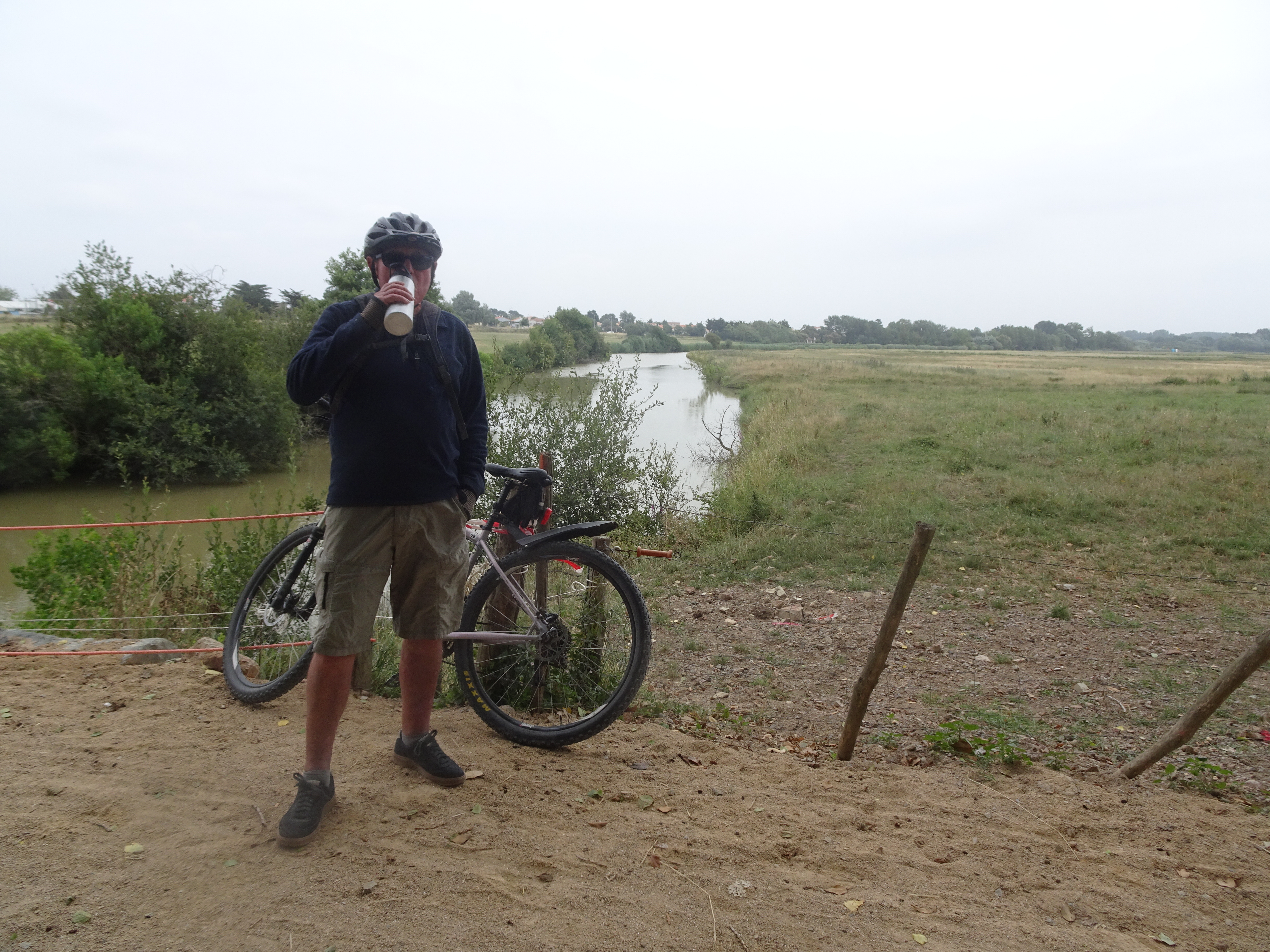
For our first foray by van this year I know I’m bound to forget something and of course, I do. In spite of copious list-making, notes to myself and references to our inventory we get as far as the supermarket before realising I’ve neglected to pack a bottom sheet for the bed. I’d been congratulating myself on even remembering the bedding itself- having once forgotten all of it- when it dawned on me, half way down the first aisle of Saunsbury’s. But all was not lost and I picked up a perfectly serviceable cotton sheet in the bedding aisle for £6 [a spare, white cotton, fitted sheet is always useful].

The weather is kind and it feels good to be off in the van- even if only for a couple of days and not very far. We’re going to Oxford, a mere two of hours away, to a site we’ve stayed in before which is conveniently next to the ‘park and ride’. Oxford is notorious for its lack of parking, snarled up streets and throngs of sightseers, making bus travel into city essential.

For non UK readers, Oxford is well known for its historic, 900 year old university and has been called ‘city of dreaming spires’, a description coined by the poet Matthew Arnold. The beautiful college buildings are spread over a wide area, some open to visitors to wander inside the gate and gawp at the splendid quadrangles in honey-coloured stone. Oxford has been a popular film location for many years, providing the set for Harry Potter films and much of Philip Pullman’s Northern Lights trilogy, among other productions.

First we settle into our pre-booked pitch and have a gentle wander around our immediate locale, where there’s a weir and canal boats moored. The site is almost always busy but we’re here mid-week. A weekend stay would be impossible in this popular spot. In the evening we stroll along the main road to the nearest pub, which is perfectly adequate for an evening meal next day.

The next day we wake to a gloomy start, with grey clouds and an ominous sky. This does not bother the ducks on the grass outside the van, who wait for the staff member to unlock the office and head inside to pester him for breakfast- a well-rehearsed morning ritual.

But we’re not too downhearted, as for the time being we’re not going to walk much and had already planned to use the open-top bus. It’s a strategy we sometimes employ for looking at cities, giving us a chance to choose what we’ll come back to and providing us with an interesting [hopefully] and informative narrative.

We get to use our [oldies’] bus passes for the journey into town then, having located the bus tour office we clamber on and up. We’re fortunate. The covered area at the front of the bus has only two occupied seats. Catherine, our guide follows us upstairs. We’ve earphones but they’re not necessary as she’s sitting behind us!

Regular readers will have learned about Elton, our reluctant guide on Cape Verde [https://wordpress.com/read/feeds/118951799/posts/4623291456] but Catherine is everything that Elton was not; well-informed, enthusiastic, engaging and fun. Our top deck just has ourselves, an Australian couple and herself so we can sit back and enjoy the ride, the stories and the views through the rain-streaked windows…

Grace is the alter ego of novelist and short story writer, Jane Deans. To date I have two published novels to my name: The Conways at Earthsend [https://www.amazon.co.uk/Conways-at-Earthsend-Jane-Deans-ebook/dp/B08VNQT5YC/ref=sr_1_1?crid=2ZHXO7687MYXE&keywords=the+conways+at+earthsend&qid=1673350649&sprefix=the+conways+at+earthsend%2Caps%2C79&sr=8-1 and The Year of Familiar Strangers [https://www.amazon.co.uk/Year-Familiar-Strangers-Jane-Deans-ebook/dp/B00EWNXIFA/ref=sr_1_1?crid=2EQHJGCF8DSSL&keywords=The+year+of+familiar+strangers&qid=1673350789&sprefix=the+year+of+familiar+strangers%2Caps%2C82&sr=8-1 Visit my writer Facebook page [https://www.facebook.com/search/top?q=jane%20deans%2C%20novellist%2C%20short%20fiction%20and%20blog or my website: https://www.janedeans.com/

Spring Fiction 3

This week’s post features a third tale from the archive- one that is based on a true story told to me by the Milo character!

Bella and Roly

     It is inevitable that at the very moment she appears over the small hillock Milo is bending to attend to a small, neat pile of excrement, fumbling as he packs it into the plastic bag he has reversed over his wrist, tying the ends together and looking around for a waste bin. In the absence of this facility he clasps the bag in both hands behind his back, attempting to match Bella’s attentive exploration of a clump of grass by perusing the horizon. A miniature speed boat is making a dash towards Christchurch harbour, its droning hum and distant splash barely claiming his attention. When she draws nearer he is able to appreciate today’s outfit; Capri pants and a sleeveless, black, polo-necked top. ‘All very Audrey Hepburn’, he thinks. He has perfected the art of scrutinizing with one eye whilst pretending to look elsewhere with the other, or so he imagines.

    She stops for a moment to call Roly, who emerges from the undergrowth like an attack vehicle, heedless of the prickly gorse and bounds along the path towards and past her, having perceived, doubtless by nose that Bella is nearby. The little westie realizes and makes for Milo, her protector, cowering behind his ankles so that he can just spot the black tip of her nose poking from between them. Roly, brazen in his interactions, lopes up to them both and attempts to thrust his course, brown nose through from the front, eliciting a laughing remonstration from his owner.

“Roly! That’s not very polite, is it?”                                                                                         

    Milo manages a weak smile which he knows must look imbecilic. He is unable to fend off the giant, woolly poodle whilst hanging on to the plastic bag. Deciding it would look odd to bring one hand around to the front and leave the other behind his back, he stays in position to be buffeted and slobbered upon by the ignorant Roly. He makes an attempt to reconfigure his smile, succeeding only in achieving a leering grin as he senses a trickle of sweat running down the side of his face. By now Roly has begun to express interest in the bag, meaning that he will have to ‘come clean’ in more ways than one. She comes to his rescue.

“Roly, GET OFF! Oh, I’m so sorry. Let me help you.” She leans down, treating him to a view of her neck in all its slender vulnerability, strands of blond hair sliding across it like silk. He must speak now or be forever categorized in her head as a simpleton or mute. She has grasped the dog’s collar and is tugging him away.

“Ah go on, you’re alright. He’s only being friendly, aren’t you lad, eh?” Too late Milo reaches to touch the top of the poodle’s head, revealing the swinging bulge of plastic bag. She asks, “Can I get rid of that for you?” and before he realizes she has whisked the bag from his hand and dragged an unwilling Roly across to a waste bin on the other side of the path, which he has overlooked in his preoccupation.

“Thanks. I didn’t’t see it, the bin there, must be going blind,” he says and sifts through his mental reference of small talk for some gem of conversation to keep her on the path a little longer. She lets go of Roly’s collar and returns, bending down to Bella.

“Oh, she’s so sweet!” she coos. “How old is she?”

Milo feels more confident now, drawn on the subject of his little dog.

“Sure she’s only a year-just had her birthday, didn’t you Bella?”                                                                     

________________________________________________________________________

    A few days later Milo is driving to Alfred’s office to deliver some drawings. He whistles through his teeth in time to the bronchial rattle of windscreen wipers and glances in the mirror to check on Bella in her customary position on the parcel shelf. Milo reflects on the progress he has made since last week, checking off newly discovered facts. He now knows her name; Louise. He practises saying it. “Louise”, prompting Bella to shift her gaze, pricking her ears in curiosity. He knows where Louise lives; an immaculate cliff top ‘des res’ with stunning views of the bay. He knows that she has a son who is away at boarding school; that she is married. Why is it that on the very few occasions he has ever met desirable women they are always attached? Or is it that he is only attracted to attached women? No, this can’t be true, as he becomes attracted first, before he discovers the attachment, unless, of course married women exude some mysterious, chemical element that ensnares unwary single men.

    He pulls in to Alfred’s yard, takes the document case from the back seat and calls to Bella, who hops out and follows him through the drizzle into the office. Draughtsman work has always provided him with an adequate income, although since his divorce from Diana he doesn’t enjoy the lifestyle he used to have. He feels no resentment about this state of affairs, having assumed the blame for it long ago, but he experiences a pang of inferiority when he thinks of Louise’s husband, Stewart, a banker who travels the worldfor his commodities trading, whatever that is.

————————————————————————————————————

    During the next couple of weeks a routine develops in which Milo takes Bella out most afternoons and it is understood that they will meet Louise and Roly. He is not sure how this routine has evolved, but is thrilled that it has. The walks, he notices are becoming longer, making him later home, but now that the evenings are lighter he is able to work on his drawings until late, so he is unwilling to curtail them.

   On one such afternoon he arrives with Bella at their usual meeting place, stomach churning in anticipation, and loiters on the path, leaning on a bench seat. There is a small, brass plaque in the middle of the backrest. ‘In memory of Connie Blakely’ it reads, ‘1910-1989. She loved this spot’. Absorbed as he is by the sunshine, the views and his thoughts, he fails for once, to notice Louise’s arrival, so that she is there, next to him like an unexpected apparition.

“Hi there!” she greets him. Her voice is almost breathless, seeming on the verge of laughter. Today she is wearing a pale yellow sundress, the thin, shoestring straps allowing tanned shoulders to be displayed. Milo knows something about fashion in all its descriptive detail, from having listened to the trivial banter of his two daughters.

He turns towards her, the stirring he always senses in her presence beginning uncomfortably early, and nods.

“Ah, you’ll have been taking advantage of this weather then? You’ve got the makings of a good tan there”. She smiles. Her eyes are hazel, and one has a small fleck in the corner which might be regarded by some as a flaw, but to Milo it only adds to her loveliness, contributing a kind of vulnerability, making him want to…..

    The moment is shattered by a high pitched shrieking that splits the air in two and renders any conversation pointless. They turn round together, the sight that meets their eyes one of abject horror, one that will haunt Milo in his thoughts and in his sleep for weeks to come. Roly and Bella are locked together like a single, demented creature, the monstrous, woolly poodle almost entirely encasing the little terrier as he pumps away into her and snarls a drooling, lascivious grimace while beneath him the smaller dog is wailing and yapping. Louise gasps and dives towards the pair. She moves to grasp Roly by the collar but is repelled by his snapping. She shouts his name in a futile attempt to dislodge him. Milo, feeling sick now, moves behind the couple to try and pull the larger dog off, an action that proves hopeless. The two humans can only stand back and watch in silent revulsion, waiting until the awfulness is over, the shrieking subsides into a pitiful whimper and Roly has disengaged himself with a self-satisfied grunt, loping off into the undergrowth with a callous air of indifference.

   Aghast, Milo lunges for Bella, who is still crying, though rooted to the spot, and picking her up, without any word or thought, runs with her back the way he has come, back to the main road and on, not drawing to a halt until he gains the sanctuary of his own shabby front garden. He rustles in his pocket for his house key, fumbling, hampered by the small dog tucked under his arm, manages to get the key into the lock and enter, slams the door with his foot and leans against it, as if under siege.

   As his heavy breathing subsides he takes stock of the situation. Although Bella’s cries have settled to a whine she is trembling. He takes her through to the kitchen with a view to getting her some water but as soon as he lowers her to the floor she scuttles under the cupboard where she remains, continuing to complain in an almost accusatory fashion. He spends the greater part of an hour lying on the floor attempting to coax her out before giving up and deciding he needs a drink. He pours a generous slug of Irish whisky-a Christmas present from his daughter Siobhan, then wanders into his living room and sinks onto the settee, exhausted.

————————————————————————————————————

  Seated with Bella in the vet’s waiting room, Milo peruses the various posters advertising vitamin supplements or advocating inoculations. There are only two other patients besides Bella. One is an elderly, depressed-looking cat with a strange, milky eye, the other unidentifiable due to occupying a small cage, but presumably a diminutive rodent. Normally Bella would be demonstrating her disgust at having to attend the surgery by growling and barking in a sharp, irritating way, but since what Milo terms in his mind ‘the assault’ of two days ago she has been quiet, even the whimpers having settled into silence. Now, in the waiting room she sits, mute on his lap and makes no effort to bully the grey cat or poke her nose into the hamster cage.

“Mr Doyle?”

When Milo takes the little dog into the surgery she shrinks to the farthest edge of the table so that a protective hand is needed to prevent her from sliding off. The vet, apleasant woman in her forties, smiles encouragement.

“What can we do for you today?”

It only takes moments to relate the story, although Milo has had to rehearse it in his head on the way in order to find appropriate words for the vile act. The woman is used, however to embarrassed dog-owners and puts him at ease with her matter-of-fact response, questioning him and nodding whilst stroking the top of Bella’s head. She inspects the terrier and pronounces her generally in good health and no harm done.

“But what if she’s conceived?” Milo asks.

“Well” she begins, “She may be pregnant, but it’s too early to tell yet. The problem is she’s really too young to whelp, barely a puppy herself. We usually prefer bitches to be a little older before they have a litter. We’ll just have to wait and see what happens. She will recover from the upset of it all, of course. In the meantime just treat her as normal, offer her food, walk her and so on. If she is expecting you’ll need to have her looked at-and of course you’ll need all the help you can get!”

————————————————————————————————————

   It is three weeks before Milo can summon up the courage to walk Bella on the cliff top path. She is almost her old self again in all respects bar one. She is expecting puppies. He has started out at the time he would have left if he’d been anticipating a meeting with Louise. He does this without any notion of what he will do if he sees her. Part of him dreads seeing her, part of him is desperate to, yet this anomaly is not to be resolved today, since he and Bella are almost alone on the cliff top, a situation that induces both relief and disappointment. Sitting on ‘Connie’s’ bench and looking out at Old Harry Rocks he speculates that she may be away on one of their frequent trips to St Lucia. This being the case, Roly would be incarcerated in the upmarket kennels she has mentioned, a fitting sentence for one guilty of such a violation, he decides. Walks have become as uneventful as they were before he first saw her, not unpleasant but without anticipatory excitement or post-walk, lingering lust. He misses her.

________________________________________________________________________

    It is to be three more weeks before he sees her again. June is living up to its flaming reputation, the sun producing a shimmering haze on the horizon, beads of sweat on his back and a lumbering waddle from swelling, tubby Bella. Spotting Roly first, his heart leaps in exhilaration before lurching into the depths as he remembers that his sartorial standards have slipped during her absence and he has pulled on his most disreputable shorts, a stained vest and a pair of worn loafers. Then she is there, an apparition in blond and gold, adorned in a stripy, halter-necked top and matching shorts, her laughing grin and enthusiastic wave causing him to forget all that has passed. He has stopped on the path and Bella has taken the opportunity to lie down, panting hard, tongue lolling out. Roly gives her no more than a passing sniff as he lopes past. ‘Will she notice Bella’s condition?’ wonders Milo, ‘Or will I tell her?’

————————————————————————————————————

    Milo will always say, when recalling the night that Bella’s puppies arrived, that no event in his life has been so exhausting or so stressful, even including the nights he spent years ago rocking his new born children. After all, one small baby cannot possibly demand as much attention as seven blind, mewling, squirming pups. It is difficult to say who was more traumatised by the experience, he or Bella but by the time the last tiny creature has emerged, wet fur plastered to its slippery, little form, both man and dog are spent. During the next few hours the vet’s warnings are proved to be justified in that Bella wants nothing to do with the tiny, squeaking things and takes herself to the furthest corner of the makeshift run he has constructed in her attempt to be free of them. Milo, left with the task of hand rearing the puppies, lacks the time or energy to daydream about Louise and has no opportunity to either work or sleep. Help is subsequently forthcoming from Siobhan, who drops in one evening to find her father slumped on the floor asleep with a recently fed, somnolent pup on his lap and offers to take a turn with the two-hourly feeds.

    After three weeks, when Milo and Siobhan have begun to feel that they have never executed anything else except this ceaseless round of feeding, cleaning up and mothering the squalling litter of puppies, Bella’s progeny have begun to explore their immediate environment, tumbling on top of each other in interactive play. They are balls of caramel coloured fluff, impossible to tell apart; four males and three females. Now that they can be left for short periods Milo can resume his drawing work and take Bella out walking, an activity that she is happy to return to since it removes her from the seven small beings she loathes and resents the most.

    Seated at his drawing board ready to begin work one afternoon, he takes a pencil from the tray, feels the sharpness of the point and begins to apply some shading to the curved side of a pipe joint. The doorbell rings; an irritation. He is scowling as he hops off the stool to answer the door, a blurred shape like a distorted photo in the glass.

“Am I disturbing you?”

He flounders as he grapples with a mixture of disbelief, pleasure and embarrassment, eventually finding his voice.

“Not at all. Come in, why don’t you? Did you want to see the pups then?”

The puppies’ enclosure dominates the kitchen so that it is necessary to sidestep around it to gain access to the cooker, sink and worktops. Louise climbs into the pen, exclaiming in delight and scoops up a yapping, fluffy ball.

“Will you have some tea?” Milo has made it to the kettle.

“Please,” she nods without turning round, the puppy nestled against her. Her dress is one of those garments that starts pale at the top and darkens towards the hem, sky blue turning to azure.

“What are you going to do with them?” she asks, “I’d love to take one, when they’re ready of course. And I feel awful about the trouble you’ve had. It must have affected your work and everything. We wanted to try to make up for it, if we can. I had an idea.”

————————————————————————————————————

    It is late summer. Milo leans on the balcony rail outside his new studio and watches the afternoon ferry as it inches away across the channel. Behind him Bella and her son, Fergus doze together in a basket, companionable now that Fergus has ceased the demands of puppyhood and Bella is protected from further mishap by the ministrations of the vet. Milo thinks he will go down and make tea soon, although he is still overcoming the awkwardness he feels whenever he uses their designer kitchen. In only a week she will be back, presenting him with the now customary dilemma of proximity and longing. But for now the ferry, pinkish with late afternoon sun vanishes over the horizon as he stretches and yawns with something that almost resembles contentment. 

Grace is the alter ego of novelist and short story writer, Jane Deans. To date I have two published novels to my name: The Conways at Earthsend [https://www.amazon.co.uk/Conways-at-Earthsend-Jane-Deans-ebook/dp/B08VNQT5YC/ref=sr_1_1?crid=2ZHXO7687MYXE&keywords=the+conways+at+earthsend&qid=1673350649&sprefix=the+conways+at+earthsend%2Caps%2C79&sr=8-1 and The Year of Familiar Strangers [https://www.amazon.co.uk/Year-Familiar-Strangers-Jane-Deans-ebook/dp/B00EWNXIFA/ref=sr_1_1?crid=2EQHJGCF8DSSL&keywords=The+year+of+familiar+strangers&qid=1673350789&sprefix=the+year+of+familiar+strangers%2Caps%2C82&sr=8-1 Visit my writer Facebook page [https://www.facebook.com/search/top?q=jane%20deans%2C%20novellist%2C%20short%20fiction%20and%20blog or my website: https://www.janedeans.com/