A Capital Visit

We’ve been dropped off in Valletta’s big square, flanked by the Grand Master’s Palace. While the golf cart transport had boasted its ‘hop-on-hop-off’ facility, this turns out to be the one and only ‘hop-off’. Hmm…

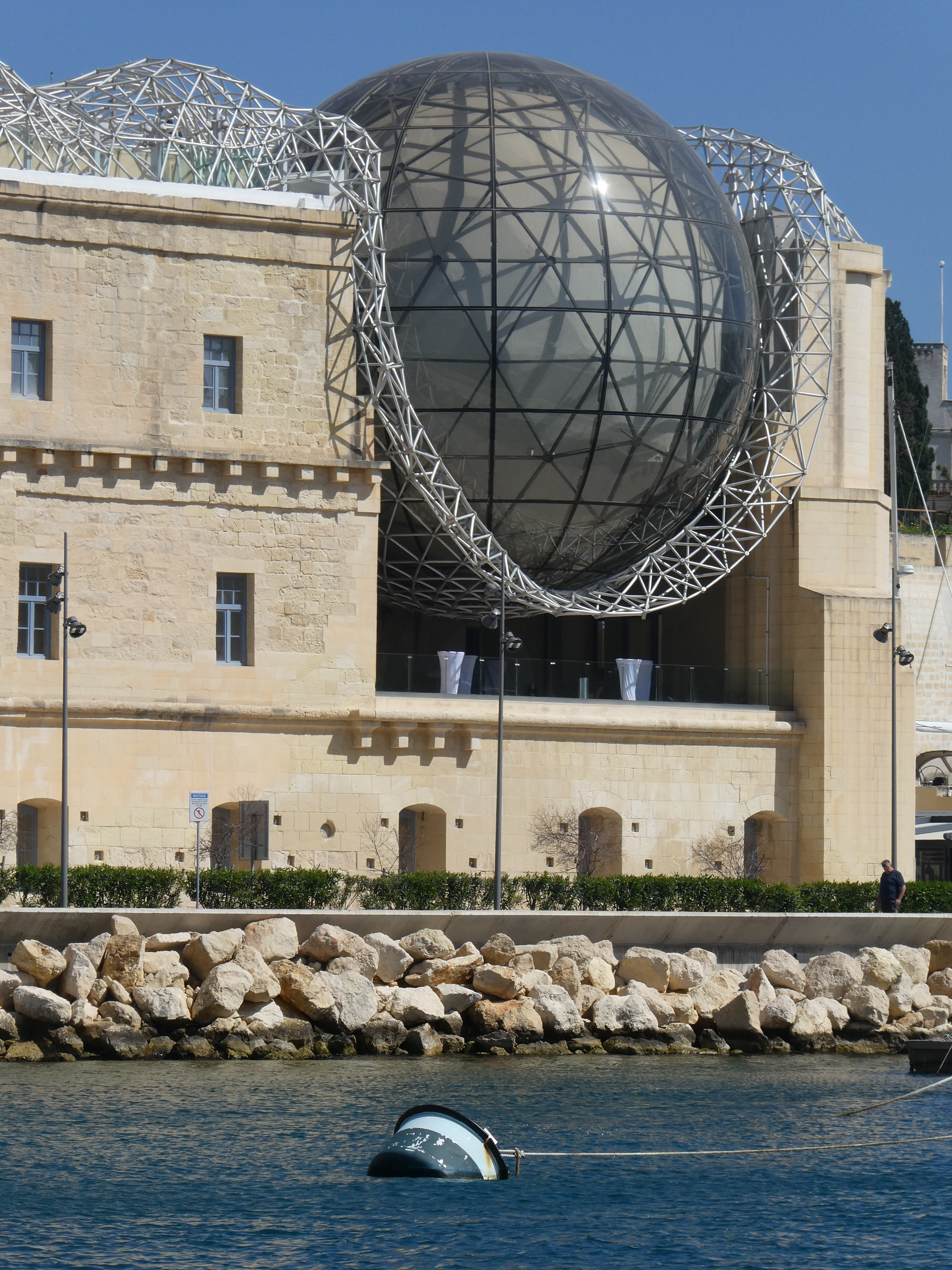
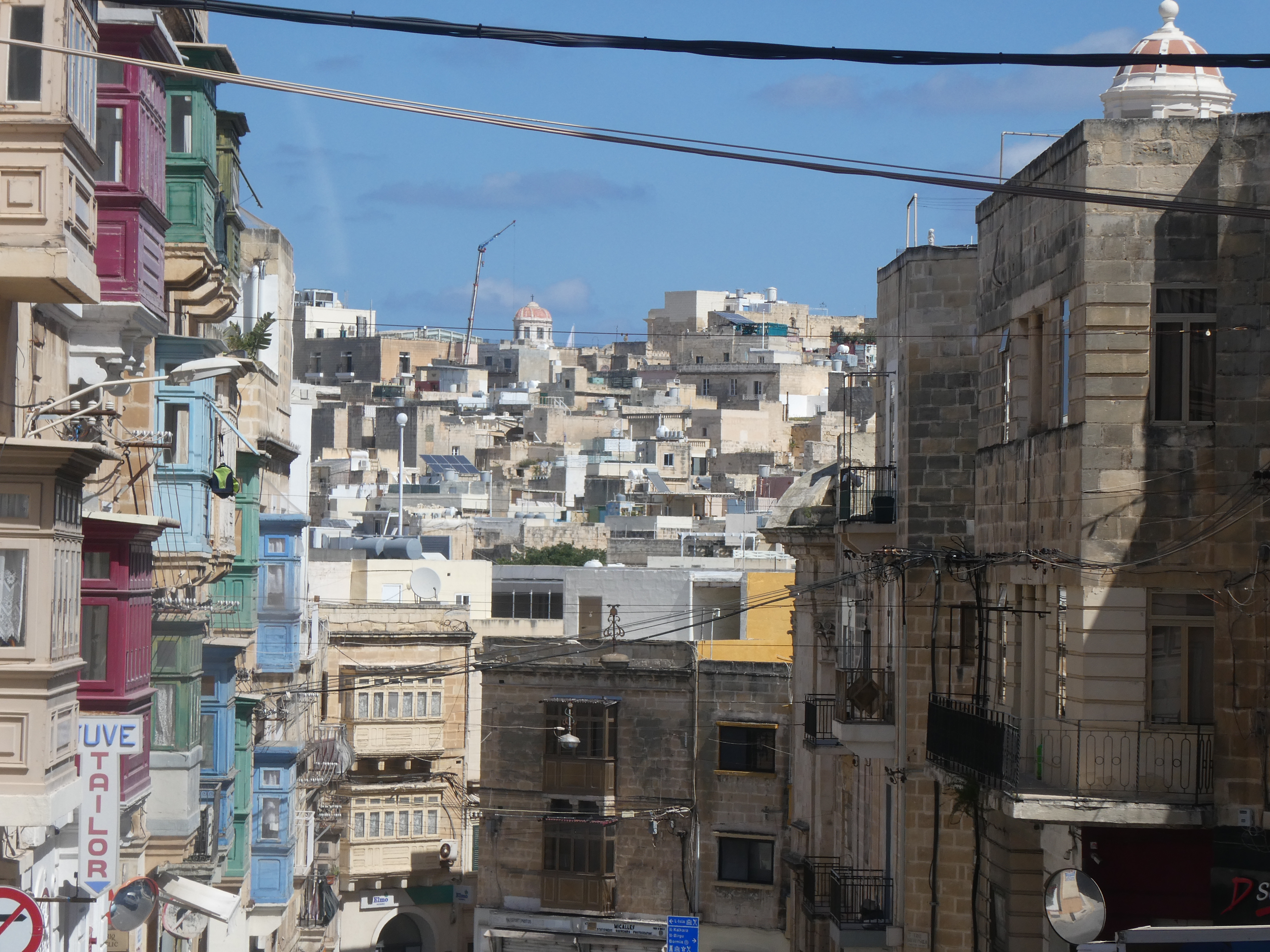
But we’ve arrived at the top of the steep climb from the harbour, at least and can wander a bit. I’m fascinated by the architecture- especially the ‘gallerija’- the protruding windows everywhere, mostly painted green. They were constructed to allow ladies a view of the streets.

While yesterday had been sunny and breezy, today is overcast and breezy- but we’re undeterred and can get a first look at this most beautiful and historic capital. The palace is open to visitors but we’ll leave it for now and stroll [carefully] the streets to get a flavour of the place. The square is at the end of a main street, Republic Street, a wide, paved, straight road lined with elegant old buildings of honey coloured stone. This large square leads to a neighbouring, smaller one housing a library, in front of which a terrace is crammed with cafe tables.

The entire street is thronged with tourists, even on this cool, windy, overcast March day. the rest of the street is lined with gift shops, cafes, bars and the art gallery- which is not the home of the Caravaggio exhibition, we are to learn. It is housed inside St John’s cathedral- further back, where a long, snaking queue is waiting. We continue along to the end of Republic Street and out into another large square with a vast, elegant facade. A throng of flag-waving, whistle- blowing teenagers in matching T-shirts is on the steps, just as a cavalcade arrives bearing the prime minister! There is very little in the way of security. We could walk right up to him and splat a custard pie in his face should we wish- which we don’t. He spends some time chatting to his young fans.

On the way back along Republic Street, we decide to join the queue outside the cathedral, since it hasn’t grown. We reach the entrance and get a bag search then enter the cathedral- and it is breathtaking, every surface an intricately decorated work of art. The floor consists of colourful scenes in marble, the main body of the building a riot of silver and gold, each tiny chapel encrusted with decor and the ceiling astonishing.

As for the Caravaggio ‘exhibition’, it consists of one painting, accompanied by video footage of his life and work. He was an interesting character and a bit of a rogue- having murdered and escaped capture- but I already know about him, so we drift off and make our way back to Republic Street, from where it’s all downhill to the ferry.

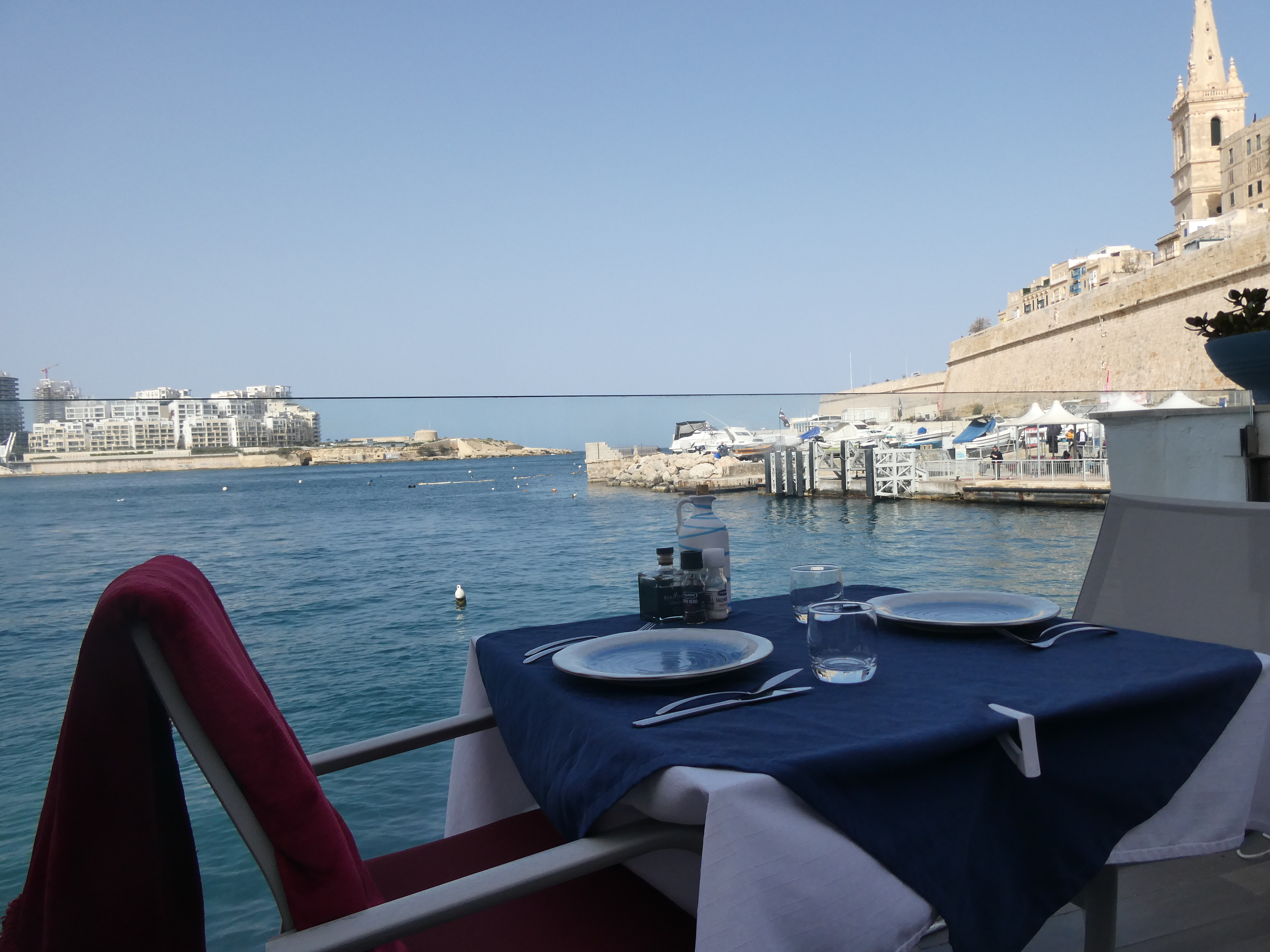
On Sliema side, there’s a wealth of cafes and restaurants to choose from. Most offer a mainly Italian style menu, although Malta is noted for rabbit dishes- not an ingredient I’m drawn to. But pasta is fine by me. Next to our hotel is the Queen Elizabeth pub, too, peddling a range of British pub grub and almost-beer. It’s convenient for us and an improvement on the hotel dinner offering.

Novels by Jane Deans [Grace]: The Year of Familiar Strangers and The Conways at Earthsend. Visit my website: janedeans.com

Small Island

Once upon a very long time ago, a beautiful, olive skinned Maltese woman met and was courted by a red-haired, British sea captain. They married and she was brought to live in Plymouth; at least- that’s the vague bones of the story of my great grandparents and I may have embellished even this, sketchy tale. But my mother somehow inherited the olive skin and the jet black hair which I assume were attributes of my great grandmother.

It has taken me all these years to visit the small, Mediterranean island of Malta, birthplace of my great grandmother and ideal, we think, for an early spring break.

We can fly from our local airport- a mere 10 minutes taxi ride from our house. I’ll skip the grim realities of flying with a budget airline this time, having detailed the joyless experience in a previous post…

We arrive in the dark, mid-evening and are transported to our hotel- an enormous, shiny block at the end of the peninsula of Sliema, which faces, on one side, across a stretch of water, the beautiful and historic capital, Valletta. We have not stepped out of the plane into a hot and balmy night. It’s breezy and tolerable- warmer than at home in the UK but not ‘sitting outside’ weather. Still…we’re here.

After being shown to a vast room complete with vast bed, we return down to ground floor and are just in time to consume the remnants of dinner- which had been ‘Tapas night’ but was now a range of tenuously described tapas in a less than newly prepared state, for which we pay a princely sum- not being in a position to seek an alternative. We repair to the bar, whose meals would have constituted a better proposition, had we known they were available. Still…

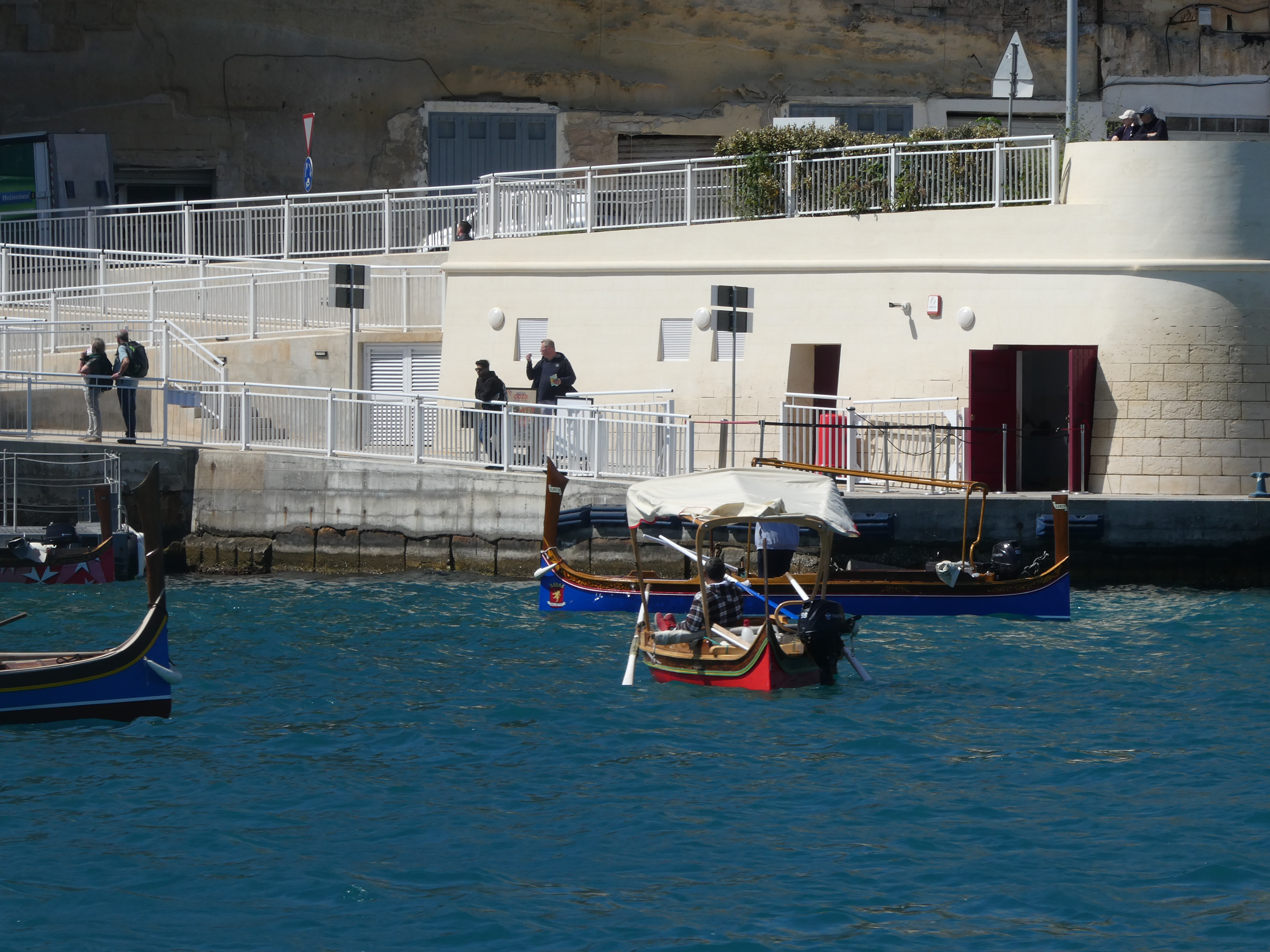
After breakfast [the usual hotel buffet-style bun fight], reception furnishes us with a map and we’re lucky to meet Karen, who is a fount of information and ideas- then we set off to explore, although in a slow manner, due to my incapacity of the hip. It’s sunny but with a cool wind as we walk [hobble in my case] down past the conglomeration of high rise flats and hotels that comprise Sliema’s waterfront towards the bend housing ferry terminal, bus stops and cruise jetties. The other side of the road is lined with cafes and restaurants- all busy.

We’re beginning to find our way around and Karen has given us some good ideas. We can get a pass for two bus tours plus a harbour tour, which seems a good deal and will give us a chance to see as much of this small island as possible in our week. For now, we’ll attempt a ferry crossing to Valletta for an initial look round, which might be challenging for me, given that I’ve acquired a hip problem. Still…

The ferry is efficient and only takes a few minutes to travel the short stretch of water between the two cities, although when we disembark, the first hurdle looms- an extremely steep climb up to the first level of Valletta. There are, however, a couple of ‘golf-cart’ type buggies offering ‘hop-on-hop-off’ tours for 5 euros, which seems cheap- and we are about to discover why. The buggy takes us up and around a few of Vallettas narrow streets then stops in the main square- and that’s that. Still…

Novels by Jane Deans [Grace]: The Year of Familiar Strangers and The Conways at Earthsend. Visit my website: janedeans.com

The Courtyard Pest

Nancy has moved to be near her daughter but has left her old life behind. How will she adjust? A neighbour is offering support; or is he?

                  Nancy wakes again. The grey glow of an autumn dawn is seeping between the curtains. This room is still new, shadows in strange places. She pushes the quilt back, eases pale legs over the bedside then pads across the carpet to the en-suite, shaking her head at the incongruity of it. An ‘en-suite’! Imagine!

On the way back she pauses by the window to peer out at her tiny patch of yard, bare except for the wooden bench, a flat-warming gift from Sarah. “What will you do with this courtyard?” her daughter had asked her as they sat on it, only three days ago. Nancy shrugged. “Not sure yet. A few pots. A bird feeder.”

Sarah laughed. “You and your birds!”

But they were company; bird company was easier to come by in a strange town than the human sort.

There is a movement, a flicker in the passageway outside the yard gate, caught in the corner of her eye as she stares. But it is nothing; a moving branch across the faint light. She sighs. It is still only six. She must try to get back to sleep. The days are already too long to fill.

She is washing up her breakfast bowl when the doorbell rings, a shrill unaccustomed sound above the murmur of the radio news programme. A silhouette fills the door’s frosted glass as she fumbles with the key. “Won’t be a minute!” she calls and at last the door yields, revealing Jeffery, from number five. He leans down towards her, eyes protuberant in his florid complexion. “Is the door a bit stiff? I can fix it, if you like.”

She knows her smile is weak. “It’s just new, that’s all; new to me.”

Clad in a beige waistcoat with pockets, he is grasping a canvas shopping bag. “I’m off down the road. Can I get anything for you? Hexton’s bread is marvellous. Shall I get you a loaf? And I’m going to D0-IT-ALL for a few bits this afternoon if you need anything”.

It is only eight. Early, Nancy thinks, to be setting off for the shops. What time does he get up, this neighbour? She has a sense that he must have been waiting until it was an acceptable time to call on her. She shakes her head. “It’s kind of you but I’m going out myself later.”

“Like a lift?” He breaks in. Too fast. She maintains the narrow opening, lifting her chin. “I shall walk. I like to walk. It does me good.”

He takes a step back and she lets out a breath.

“OK. By the way-watch out for rats, won’t you? Some have been seen in the alley at the back. They’re probably from the social housing in the close. Vermin, that’s what they are.” Nancy nods, unsure whether he means the rats or the residents of the housing association development opposite their flats.

He turns with a wave and withdraws, swinging the canvas shopping bag as he plods around the corner.

Later, as she drifts along the unfamiliar High Street Nancy wonders if she should have asked Jeffery to fetch her some compost for her courtyard pots. Has she been a little hard on him? He is only being neighbourly. She did ask Sarah if Danny might be able to take her to the garden centre but they are so busy all the time.

It had been Sarah’s idea for her to move here, to be nearer the family. Nancy was reluctant at first, then attracted by the notion that she might be of some help now that Sarah and Danny were both working full time. She’d thought she might be able to collect the boys from school, help with homework, even make some meals when the parents had to work late. But Sarah pointed out that the boys had little need of childcare and either went to clubs and after school activities or messed about with their friends.

Nancy stops to study a display in the window of ‘Chic Shack’, a small shop selling household items, many of which appear to have been made from driftwood, or been painted and subsequently had patches worn off. She snorts. These are things that wouldn’t have got into a jumble sale in her day.

Since she moved to be near Sarah she’s had no more contact with her and the boys than she did when she was seventy eight miles away. At least then they’d talked on the phone every evening.

Later, when she’s finished clearing up her supper things and is settled in front of the TV the phone rings.

“Will you be in tomorrow evening, Mum? Danny can drop your compost off then. He’ll pick it up on the way home from work”.

Nancy had been looking forward to a morning at the garden centre and had been going to suggest she treat them all to lunch. “It’s very kind, when he’s so busy.”

“It’s nothing. How are you settling in? How are the neighbours?”

“Oh-the couple in the flat above are very nice. They say Good Morning”. She hesitates. Jaqui and David are polite but self-contained and disinterested.

“Anyone else?”

“There’s Jeffery.”

“Is that the man with the wild, grey hair and the county accent?” Sarah met Jeffery when Nancy was moving in. He’d been on the forecourt sweeping up and had introduced himself, shaking their hands and offering assistance. “Has he been a nuisance?”

“No. He’s friendly enough. I’ll see you later.”

“Not me, I’m afraid Mum. Just Danny. I’ve got to collect Lewis from football training.”

Danny arrives with the compost, leaving the engine running while he heaves the bags into the small yard outside her living room and waving a cheerful goodbye as he drives off. Nancy surveys the three bags stacked against the fence. At least she’ll have something to be getting on with tomorrow. She can’t get to the garden centre for spring bulbs but the ‘Supercuts’ shop had some mixed bags on offer outside in a basket. She is about to close the curtains when a face appears above the fence, prompting her to cry out in alarm, hand over her mouth. An arm waves at her. She opens the patio door. Jeffery.

“You’ve got your compost then? Want a hand with the planters tomorrow? I can bring a trowel.”

She sighs. “Alright. Just not too early.”

Nancy’s sleep is restless. In her dreams giant rats stream over the gate, flooding her tiny yard, squeaking at her, hectoring, chastising, although she can’t catch the words. She wakes many times, hears scraping sounds, feels disorientated and sleeps on to an unaccustomed eight o’clock.

She is on the phone when the doorbell rings, chatting to Meg. When she’d heard her friend’s voice she’d visualised her unruly hair and bright lipstick and felt tears pricking her eyes. ‘Yes’ she tells Meg, ‘the move was fine. The flat is perfect. Just what I wanted.’ She doesn’t say it was what Sarah wanted.

“And how have you been, dear? Any more falls?”

Nancy shakes her head then realises Meg can’t see. “No. And I don’t need to use the stick Sarah got me. I’m as steady on my feet as I’ve ever been. I’m not sleeping well, but I suppose it’s just the newness of the place.”

There is a pause.

“We all miss you here, Nancy. ‘The Nettlehide Players’ isn’t the same without you.” The tears are threatening again. “We should arrange a meet up. Shall we? A weekend, even! There’s always the coach-why don’t you come to me? Or I’ll come down if you’ve room. What do you say?”

“I’d like that.”  The bell is ringing. “I have to go, Meg. We’ll arrange it.”

Jeffery is wearing overalls and brandishing a trowel. “I’m not quite ready” she tells him. “You’d better come in. Would you like a cup of coffee?” He takes up all the space in her miniature kitchen, scrutinising the tiny room, unabashed.

“You don’t have much…” he sweeps the trowel around at the walls “…stuff, do you? My place is an Aladdin’s Cave! You must come round.” She brushes past him to get to the kettle before reaching into a cupboard for a small jar of Nescafe. “Could I have tea? I’m not a fan of instant. I grind my own beans. Costa Rican. A friend gets them for me. Have you tried Costa Rican? It’s marvellous!” She replaces the jar and pulls out tea bags. “I’ve got a spare tea pot at mine. Do you want it?” he asks, watching her. She takes the two mugs of tea outside and places them on the wooden seat.

“Where are you having the pots?” Jeffery gestures at the tall, terracotta planters which are dotted about on the paving slabs in what Nancy considers a satisfying, random arrangement. She stares at him.

“They’re staying where they are.” Nancy’s chin lifts a little then she stoops to take the bags of bulbs from under the bench. He shrugs. “I prefer a bit of symmetry myself.”

When Nancy can take no more advice about which bulbs to put where she goes in to make more tea. They sit on the bench to drink it.

“So, Nancy, what did your husband used to do?”

She frowns at the paving slabs by her feet, taking a sip of the tea. “I’m sorry?”

“Your husband. What was his line of work?-if you don’t mind me asking. I was a financial adviser myself. Got it all up here still.” He places a finger on his unruly hair. “If you need any help with investments, that kind of thing, you have only to ask!”

She is silent for a moment, placing the mug on her lap between her hands.

“I’ve never been married”.

“Oh I’m so sorry!” he blurts, drops of tea splashing on to his overalls.  “I’ve been married three times. Had five children. Not that I see much of them of course. They’re spread far and wide. One in Singapore, one in America. I expect they’d contact me if they were in trouble. No news is good news, as they say.”

Nancy stands up and holds out her hand for his cup. “Thanks for helping. I’ll have to leave it there for now, though. I have an appointment after lunch and will need to clear up and get changed.”

Having had to demonstrate her intention by leaving the flat, she wanders along the High Street and turns down the lane leading to the library. There may be a noticeboard showing local events, groups and activities or at least someone who could point her in the right direction. The building is new with lots of internal glass. She spots a small, neat, grey woman like herself wearing a navy raincoat and realises it is herself, reflected in a rotating door.

The vast space is decorated in garish lime greens and scarlets. At a circular desk she has to wait as one librarian is attending to a young woman with a foreign accent and another is talking on the phone.

At last she is directed across to an area designated ‘local information’ where there are brochures, wall maps and a noticeboard advertising special interest groups and activities. She reads each flyer. There is a cycling club, meeting each Sunday morning at seven, a ‘knit and natter’ group in a church hall on Monday afternoons, there is the WI, the University of the Third Age and Psychic evenings. On a low table is a file labelled ‘cultural events’ and she bends to begin flipping through but is interrupted by a commotion around the reception desk.

Nancy straightens to peer around a bookcase and sees a figure in a beige waistcoat gesticulating at the librarian, who is responding by adopting a decidedly non-library tone and pointing in the direction of the exit doors.

“Mr Marsh, as I’ve said before we cannot stock every periodical and the library is run according to local authority guidelines. Now I’m sorry but unless and until you are able to follow our code of conduct I am going to have to ask you to leave the building and you may be barred from entering the premises in future.”

Her neighbour doesn’t spot her as he is escorted out of the exit doors. She sits down to look through the file of cultural societies, noting one or two phone numbers down then waits ten minutes before she leaves to avoid bumping into him.

She has walked twenty five yards before a dizzy spell threatens to topple her and she stops by a bus stop, clutching the side of the shelter until it has passed, then perching on the narrow plastic bench inside. A bus pulls up, disgorging several passengers; the driver leaning forward to see if she’s getting on. She shakes her head and takes a few deep breaths as the doors wheeze closed.

Back in the flat she feels jittery and unsettled. Perhaps getting on with her unpacking will help. But when she leans down from her bed to get a box out from underneath the dizziness descends like a fog and she sits back up, closes her eyes and sinks on to the pillows. A deluge of jumbled images gushes in to a background of piercing squeaks which rise to a crescendo, at which point her eyes fly open and she is aware of the door bell ringing with an insistent, lengthy clang.

“I didn’t know if you were in.” There is an element of reproach in his frown. “I thought I’d better let you know I’ve put some rat poison down in the alley. In case you go out that way. Let me know if you see anything, won’t you?”

It takes Nancy a moment to gather her thoughts. “Yes. Thank you. I will”.

He clears his throat. “Can I interest you in an early evening glass of wine? Over at my place?”

She pulls the edges of her cardigan together, aware that she is dishevelled from sleep. “Just a small one” he continues and she can think of no excuse to refuse. She keeps him at the door while she slips her shoes on and fetches her bag and keys. “All secure?” he asks, as she locks the door.

His flat is as different from hers as an identical design could be, the surfaces crammed with objects, odd-shaped stones, pieces of wood, metal parts of things; the walls clad in pictures, photos, mirrors and hangings. It feels claustrophobic, as if the entire space is closing in on her. She murmurs ‘thanks’ as he hands her a glass, watching as she takes a cautious sip. “Know your wines?” he asks, “Where do you think that one’s from?”

Tempted to say ‘Tesco’ she perches on the edge of a sagging sofa covered in piles of magazines and shakes her head. He grins, holding his glass up to an imaginary light. “Algeria! You wouldn’t know, would you? A friend brought it back from a trip for me. I love the stuff.” He places his glass on the edge of a shelf, snatches up an object from the coffee table and offers it to her. “What do think this is? Any ideas?” She turns the small, circular, metallic item in her hand. It has an opening with a serrated edge like tiny, sharp teeth

“A nut-cracker?”

He chuckles. “It’s a pepper grinder. African. I bet you’ve never seen one like that before!”

She clears her throat. “I must go, Jeffery. I have some calls to make. Thank you for the wine.”

“You haven’t finished it!”

“No. It’s very nice. But I’m not much of a drinker. It goes straight to my head I’m afraid”. She picks up her bag. He continues to stand, tilting the glass up to drain it then twirling the stem as he watches her.

Back in her flat Nancy makes some tea and takes it into the sitting room. She finds the numbers she wrote down in the library. As she picks up the phone she is distracted by a sound. She sits still and concentrates. There! A scraping, grinding sound, like a pot sliding along on the slabs of the courtyard. Jeffery told her if the rats got into the yard they might dig up the bulbs. She goes to the patio door and pulls a curtain back, peering along the shaft of light that’s been cast. But there is nothing other than the pots standing motionless in their places. A rat, however large, would not be strong enough to move a large, terracotta pot full of earth. The sound must have come from something in the alley; someone trundling something along there, perhaps. She picks up the phone again.

It is two twenty three when she wakes, having fallen asleep thinking about her telephone conversation with Rebecca Fripp, of the local amateur dramatic society. Rebecca’s response to Nancy’s enquiry had been luke-warm, as if she’d be doing her a favour by allowing her to attend a rehearsal. But they always needed ‘front-of-house’ help, she’d said, even though Nancy’d explained about her experience in set design. Once she is awake, she is unable to drift off again and thinks that perhaps she should get up and make tea. She stretches out her hand to the light and there! There is the sound: scrape. Outside the windows.

She freezes, stomach churning, her skin prickly; but forces her feet to the floor; tiptoes through to the kitchen. She takes her time in the half light, pulling open a cupboard door to withdraw a heavy pan with a long handle. She breathes in long, slow pulls like an automaton. She returns to the living room, pan held to her side in one hand and uses a finger to create a slit of light in the long curtains.

A wind has got up, stirring the trees over the alleyway and chasing leaves around the small yard; but there is also a dark, rounded shape moving around the pots. Nancy grips the pan handle and uses her other hand to inch the patio door open. The swishing breeze is louder as she steps outside, flattening her nightie against her legs. She searches for the shape then spots it-moving from behind one pot to another. In two paces she is there. She pulls her arm back straight like a forehand smash and swings hard at the shape. Crunch! The contact is sickening, jarring her arm as she stumbles. The shape topples and she drops her weapon. She takes a step forward to look but the foot gives way, sliding and she falls to her knees in the wetness, confused. There has been no rain so why is there a puddle? Reaching out she feels fur, wetly sticky; then she is swaying, sinking as the fog descends.

She is dressed and in the chair when Sarah arrives. “Ready, Mum?”

Got your tablets and everything?”

Nancy nods. She stares at her daughter, eyes wide. She swallows. “Sarah-I can’t, I don’t…”

“Shh-Mum it’s ok. You don’t have to go back to the flat. Danny and I have packed all of your stuff. You can take a case with you today and the rest will follow.”

“How…how is he?”

“He’s doing alright, Mum. He’s a tough old boy. His skull has a small fracture but it will heal. He doesn’t blame you. He’s an idiot to have been there in the middle of the night! ‘Checking the rat bate’, apparently.

A solitary tear rolls down her mother’s face. “I’ve caused so much harm. I’m so sorry”

Sarah takes her hand. “No, Mum. I’m the one who should be sorry. I should never have nagged you to come. Now we must go or we’ll be late.”

Nancy stands and accepts her daughter’s supporting arm. In the car she sinks back, closing her eyes to picture Meg’s sparkly eyes and the way specks of scarlet lipstick are visible on her teeth when she grins. “You don’t have to downsize, dear” her friend had told her, sitting by the hospital bed. “Just come back and live at my place. We can look after each other, can’t we? And you can come back to The Nettlehide Players, where you belong.”

Nancy had nodded, feeling relief course through her like a transfusion. Of course. It was all anyone wanted or needed. To belong.

Novels by Jane Deans [Grace]: The Year of Familiar Strangers and The Conways at Earthsend. Visit my website: janedeans.com

Renaissance

Those who were children in the UK in the 1950’s and were lucky enough to have a tiny, wood-encased TV will remember the wonderful children’s programmes we enjoyed- albeit in black and white. For the uninitiated, a sample can be viewed here: [https://www.bing.com/videos/riverview/relatedvideo?q=The+Woodentops&mid=F5A95F8B27952BC4A7F0F5A95F8B27952BC4A7F0&mcid=05BDF3745CE94B47919BD6175DC52B5D&FORM=VIRE

                She stirs. Her eyelids part in a narrow slit although it is still dark. What has woken her? She shudders and feels a sharp intrusive dig on her left side, wedged as she is between two others.  There it is again; a blow to her ribs. Her eyelids widen as she gasps, feeling around with her right hand for the offending weapon. An elbow.

‘Jenny!’

She stiffens. ‘Get off me! What are you doing?’ Her small, high voice is thick and slurred from under-use.

‘There’s someone out there. I can hear sounds-steps. Listen.’

Jenny groans. ‘Leave me alone, Will. I’m asleep.’

‘You’re not asleep. You are talking to me.’

She lifts her head as far as the space will allow. In the oppressive darkness of their space there are rhythmic snores amid the sighing breaths and snuffles of sleep as well as an occasional whimpering yap from the dog as he dreams of biscuits and buried bones.

‘There!’

She feels her brother’s hissing breath as the sound of steps approaching and receding invades her consciousness. In the gloom she knows he is listening too just as she knows everything he is thinking. After a moment a thin strip of light appears below them along the floor. She takes in a sharp breath and needs to cough but stifles it, reaching instead for her twin’s hand. There is an abrupt rattle as the door knob is twisted which prompts rousing from the others and whimpering from the baby, who threatens to howl.

‘Did you hear the voices?’ Jenny can feel Will trembling. The dog is stirring, a low growl heralding what could become a tirade of barking.

‘Don’t panic. I’ve got him.’ It is their father who has wrapped a restraining hand around the dog’s muzzle.

They are all awake now and straining to hear. The footsteps have disappeared but the light remains. Jenny frowns, trying to think how long they’ve been here and what prompted them to have been banished to this dark, musty cell. She can remember someone saying they should be kept as she was brought in but none of them knew what they did to be banished and hidden away like pariahs. If the footsteps return they might find out. She allows herself to hope.

She tries to stretch her limbs but in doing so elicits an outraged ‘Oy! Watch yourself!’’ from Sam who is squeezed next to her other side.

Mrs Scrubitt’s voice is tremulous as she utters, voicing all their thoughts into the half- light. “What are they going to do with us? They might be having a clear-out, like. Will they be…doing away with us, do you think?’

Jenny trembles. Sam’s mum is right. They could be cast into a bin somewhere or thrown on to a bonfire. Mummy intervenes. ‘There’s no use in worrying what’ll happen. What will be, will be. Whatever they do we’ll be all together, like always.’

They are startled into silence then as the footsteps return, more this time. There are voices at the door and they hear a key in the lock. The door opens, deluging their small closet with blinding light, forcing them to wince and squint at the unaccustomed brightness.

Jenny swallows and lifts her chin as they prepare to face whatever fate awaits them. A large face looms into hers and she shrinks back into a space she does not have. There are two of them scrutinising, exclaiming.

‘Take care! They’re very old, you know-nearly seventy years!’ The voice booms like a fog-horn in the little cupboard until Jenny’s ears feel like exploding balloons.

‘They’re in good shape though!’ The second voice is softer. After a moment a warm, scooping hand envelops her and she is off the shelf, travelling outside the safety of the cubby-hole and along a bright, white corridor. She closes her eyes as the glare prompts tears to stream down her face. Then she is in a large room, comforted to be sitting on a surface she recognises as wood and mummy and baby are placed next to her.

The two giants discuss them. ‘Of course, if we’re going to remake it there will need to be changes. The show was made before political correctness was thought of.’

The other one chuckles. ‘Yes of course. We can’t have a Mrs Scrubitt and we’ll need to address the nuclear family issue. Plus the fact that they are all white, fully-abled and middle class.’

Jenny glances across at Mrs Scrubitt whose face has become an unnerving, chalky white and whose mouth is open in a silent cry.

‘I’m not so sure that they were middle class. He is a farmer.’

‘Yes but Mum doesn’t go out to work and they can afford to employ servants.’

‘OK. Well maybe we can use Mrs Scrubitt as extended family and Mum can be a farm worker, too? And how about giving one of the twins a disability? I don’t know about Sam Scrubitt though. There may not be a role for him.’

Jenny and Will exchange a stricken look as Mrs Scrubitt claps a terrified hand over her mouth.

Four months later they are on set. Jenny has become adept at the sign language she must use to communicate with her twin, they have all learned to call Mrs Scrubitt ‘Grandma’, Mum has had a new wardrobe consisting of overalls, has got the hang of the power tools she must use and they’ve all adjusted to their new, ebony colour as well as remembering to call Sam, who’s been given some exuberant dreadlocks, ‘Denzil’.

Novels by Jane Deans [Grace]: The Year of Familiar Strangers and The Conways at Earthsend. Visit my website: janedeans.com

All True

Tempus fugit. Time flies. And one of life’s biggest ironies is that it seems to accelerate as you age, so that, for the young, nothing can come fast enough, then at some point during adulthood it has all passed like speeded up film, then, I suppose there will be a time when it has all disappeared…Pfffttt! Out like a light; although I prefer not to linger on that thought.

For those of us who can no longer consider ourselves to even be middle-aged [a term that alters as the years pass to refer to an older and older age], there are often reminders of our elderly state.

There are the obvious health issues. Bits begin to wear out or become troublesome. Many people are spared doctor and hospital ministrations- the lucky ones, from having ‘good genes’ perhaps and/or having lived following a healthy lifestyle. Recent health crises in my own life lead me to believe that the genes are the stronger influence, since I’ve done my best with exercise and diet for most of thetime- if you ignore the student years…

And while I believe that genes have caused most of my own issues to date, I continue to exercise on a regular basis and eat the items we’re being told to and eschew the foodstuffs we should avoid [mostly].

For me, exercise must be enjoyable in order for it to be sustained. If it hurts [too much] or is boring, I don’t want to know.

My favourite activity has always been dance exercise. In the beginning there was aerobics. Then, along came step aerobics. I fell in love with leaping about on and over the step, probably doing untold damage to my joints in the process.

During this time, middle age, I also ran. I ran all the days I wasn’t doing step aerobics [ie 4 days a week], 5k or so on weeknights and longer distances at weekends. I had no days off.

I continued this way for years until an unnerving crunch sprang up in my leg, feeling like I could collapseat each step. As things worsened, I cut back on running and step aerobics. Then Zumba became a thing and I took to it straight away, joing in with gusto and enjoying the company of other, like-minded dance-exercise enthusiasts.

The pandemic came, killing off live classes. I searched Youtube to find online Zumba classes, of which there were many, though they varied in quality. I tried lots and found a few that suited, which was good enough when confined to home. But there’s nothing like a live class for enjoyment and motivation.

After we were released from confinement I continued with online classes until a new Zumba class popped up in a venue 5 minutes walk away from my house and I shot round there like a rat up a drainpipe. And this, lovely reader, is what I’ve been doing ever since.

EXCEPT; Here’s the thing. I realised my beloved trainers- the ones I went to the specialist running shoe shop for because I pronate, have worn out, demonstrated by the fact that my toe is poking up through the worn fabric and the plastic toeguards are coming away. How long have I had them? Certainly since my running days.

I venture to the specialist running shoe shop, where there is, allegedly a sale on, taking my elderly trainers with me. It’s only a small shop and manned by a single guy- young, dealing with a customer when I arrive. He leaves the customer on the treadmill and comes over. I show him my trainers, at which his eyebrows shoot up towards his hairline.

‘These’ he says. ‘These went out of production when I was seven’.

Goodness. That long ago, then?

He sells me a later version of the shoes. 40% off. I’m happy, even if I’m old…EXCEPT: Now my hips are protesting blue murder and all exercise is suspended for the forseeable…bleurgh…

Novels by Jane Deans [Grace]: The Year of Familiar Strangers and The Conways at Earthsend. Visit my website: janedeans.com
Caught

In melancholy mode today

Trap! Paralyse! Consume! An unwitting moth flutters in an innocent, random pattern only to be ensnared, caught in a mesh of elastic threads, thrashing wildly but doomed as the predator pounces to inject the body with piercing jaws, stilling the spasms, rolling it with rapid efficiency into a food parcel; to be consumed later.

Here in my father’s back yard, in the still warm air of a September evening, I am glad of a distraction from my task. I light a cigarette and inhale, watching the curling twist of smoke wind upwards. Excitement over, the rotund spider withdraws to the shadows, out of sight until aroused by the next tweak.

Back inside I gaze around at the devastation I’ve wrought and think it’s enough for today. Amidst the piles of books, sets of musical scores, files of correspondence and personal papers in my father’s study there is a box containing old photographs and it is these I’ve been perusing, losing a sense of time both literally and figuratively as I delve back into his life; a jumble of grey-brown, faded and dog-eared images chronicling events and scenes, depicting some characters I remember and many I do not.

I realise I am hungry but have no wish to eat here, alone amongst the detritus. I will walk down through the village to the pub. Before leaving I slip a photo into my pocket, a picture of Imberton Village Dance Band on stage. In the twilight, the quiet of the somnolent village street is punctuated only by the last, retiring song of a blackbird as he defends his province and by the distant, mechanical hum of a lawnmower.

To stroll along this street is to walk in my childhood steps, the way I went to school; down along the hot tarmac, treading on the raised tar bubbles that erupted like sticky larva under the sun’s hot rays. Here in the gateway by the open field my brother and I paused to see who could pee the furthest as our exuberant, steaming fountains arced over the gate. On past St Mary’s where we languished, imprisoned at Sunday school, the time hanging heavy until we could loosen our collars and race back home to lunch, through the ivy clad churchyard, whose deceased inhabitants now play host to a newly interred inmate.

It is growing dark by the time I am level with the gravel track that slopes up towards Abbott’s, where a lone street lamp casts enough light for me to make out vestiges of the faded imprint on the side of the building; ‘Abbotts Grocery’. I pause for a moment, remembering. The old red brickwork had been painted yellow, the words in red and green, though now all that is visible is a faint square of flaking cream with a few pinkish lines. Old Ma Abbott, who’d seemed ancient to my seven year old self, must be long gone by now. But what of June? To my naive, infant scrutiny she had appeared grown up, although she couldn’t have been much more than sixteen when we plagued the shop in our crude, heedless bids for amusement. She would greet us, soft voiced, smiling with wide spaced, guileless eyes like a baby fawn’s as she tipped Rhubarb and Custards from a jar into a paper bag or ladled out ‘Eiffel Tower’ lemonade powder. I’d peer at her upswept, beehive hairdo and the way her wide skirt fanned out like daisy petals, buoyed up by layers of stiff petticoats as she climbed the step to replace the jar.

I’d been the youngest, tolerated but not acknowledged, the tagger-along, more spectator than participant as we roamed the village in search of diversion. We built dens, made bows and arrows or rudimentary, wooden guns, climbed the hay bales in Worts’ barn, fished in the stream, spoke in hushed whispers about the mysterious Bryant sisters, whose nocturnal activities had provoked speculative gossip from our parents. We played endless games of Cowboys and Indians or Cops and Robbers, when my involvement was accepted if I agreed to be the Indian, or the ‘baddie’ and submitted to the inevitable tying to a post to be danced around and jeered at or executed by bow and arrow or firing squad.

A few heads turn as I enter the pub, one or two nodding and murmuring in uneasy recognition. I am known to them nowadays only by association with my father. They are caught in the uncomfortable circumstances that accompany a meeting with the newly bereaved. I order my meal and take my pint to a lone, corner table, allowing them to continue their conversations unburdened by the obligation of sympathy.

While I wait I withdraw the photo and place it on the table. The band members are on a wooden stage flanked by velvet curtains in what looks like the village hall. My father is seated on a stool at an upright piano, to the right of the picture so that his face is only visible in profile, mouth open, his head tilted down, intent on his fingers as they depress the keys; one foot underneath pushing down on a pedal. To the left of the stage his brother Dib sits leaning forward to strum his banjo, a bowler hat perched at a jaunty angle, staring a broad grin into the camera despite the cigarette jutting from the corner of his lips. I guess that the slim, smiling woman in the centre at the microphone, dressed in a neat, dark frock with a lace collar is Doris Lampard. Behind them, less distinct are a guitarist and a drummer.

I am aware of someone standing at my elbow; a stooped, portly, elderly figure leaning on a stick, sharing my view, peering with rheumy eyes at the picture. I recognise him as Arnold Goodridge, one of my father’s friends, although I’m unsure of the connection. Perhaps he’d been a fellow parish council member, or they went to cricket matches together.

“That would have been a Saturday nighter,” he says, gesturing at the photo. “There’s your Dad, on the old Joanna, and your Uncle Dib up front. He was a lad, that Dib!”

The bloodshot eyes are lit with interest as he leans forwards to peer closer. I pull out a chair, inviting him to sit and he accepts my offer of a pint. He squints at the aged image, pinching it by the narrow, white border as he holds it up to the light.

“I know that Doris used to sing,” I tell him, “but who are the other two- the guitarist and the drummer?”

I wait while he examines the scene, his breathing rapid and wheezy, the sound my father’s piano accordion made when he was warming it up. He takes so long to answer his pint arrives and he lifts it to take a long draught before he speaks.

“That there,” he prods the guitarist in the picture with a thick, stubby finger, “is old Ernie Brabrook. He used to have the butchers, up on the Copseway. That’s up the road behind your Dad’s place. And that fellow behind the drums is Dick; Dick Abbott that had the grocers shop. You’ll remember that from when you was a nipper.”

I nod.

“I do remember. Walking past it tonight made me think of when we used to go up there for sweets. I’m afraid we went in more for the thrill than to buy anything. We were terrified of Mrs Abbott so we dared each other to enter.”

The old man smiles his understanding.

“Oh ah! She was a hard woman, Mae Abbott. Bitter, with a wasp sting for a tongue. Weren’t no one missed a tongue lashing from Mae at some point. ‘Course Dick got it the worst. He spent as much time as he could out of her way; he had his grocer’s round in the daytime, doing deliveries, then he’d be out with the band as often as you like, four or five nights a week sometimes. He played in the darts team, too.”

“So Mae didn’t go along to see the band? I suppose if Dick was on stage she’d have no partner for dancing.”

“Mae? No! She weren’t one for dancing. Back when they was first married she had June to look after. She only ever went out on a Sunday, to church, as I recall.”

“June must have been born quite soon after they were married, then.”

He scratches his head, frowning at his glass.

“Things was different then.”

For now the old man has completed his narrative. He drains his pint and hauls himself to his feet as my meal is delivered to the table with enquiries as to whether I’d like any sauces and another drink.

Arnold is shrugging his coat on, turning to leave then he stops to voice a thought.

“I might have one or two of them photos at home, the band and that. I’ll have a look and bring them round, if you’re interested.”

I am. I thank him.

“Arnold, before you go, can you tell me anything about June? Does she still live in the village?”

He grips the chair back as he faces me, his knuckles white, his breath whistling.

“I’d have thought your Dad would have told you. She passed away. Must have been twenty years ago; not that long after Dick, but before Mae. It were a sad business.”

The spiders have retired for the night when I go out to take a last cigarette in the cool air of the yard. This small space, illuminated by a shaft of light from the doorway is cluttered with accumulated rubbish and scruffy with weeds, neglected and unloved, another task to be undertaken before I leave. My father had been devoted to his small garden, growing gaudy dahlias and rows of fat onions, trimming the hedge and tending the pond, now relapsed into a murky, stagnant pool, clogged with choking blanket weed. When my mother died he’d withdrawn to the house, leaving his beloved plants to fend for themselves, as if the garden itself had been responsible for her death. Grief affects people in strange ways, driving them to relinquish lifetime habits and adopt new ones. I think how little I knew him in the later years, my visits short and peremptory and executed from a sense of duty.

I make my way to bed in the tiny, inhospitable guest bedroom, crawling between slippery sheets topped with unaccustomed, heavy layers of blankets and an eiderdown; the bedding a relic from when we were boys, although never in this cramped bungalow designed for retirement. The elderly bed springs creak and protest as I fidget, sleepless with memory. June Abbott; she’d have been in her sixties now. What had happened to her?

                  Next morning a stiff breeze has sprung up as I stroll up to the village store on the Copseway to buy a newspaper and a pint of milk. On the way I search for the old butcher’s shop that was Ernie Brabrook’s, but almost all the buildings that housed businesses have been converted to dwellings, either having been demolished and rebuilt or their big front windows bricked in and I no longer recall the exact location of Ernie’s place. All I remember is standing inside while my father waited for his order to be prepared, the sawdust floor dusty beneath my feet and the cold, raw carcasses dangling, white on their metal hooks, an odour of chill sweetness and the resonant thwack of the butcher’s cleaver as he prepared chops or steaks.

The store assistant is solicitous. My father will be missed by the community, she says, and how am I getting on with clearing up the house? Feeling heartened by her concern I ask if she knows anything about Imberton Dance Band and the various members. She nods as she packs my purchases into a bag.

“My parents used to go dancing every Saturday. A girl called Mavis used to come and babysit us.”

I take the photo from my pocket and place it on to the counter. She looks closely before shaking her head.

“I can see that’s your Dad, in his young days, and that was his brother. But I don’t know the others I’m afraid. I’d have been too young, I suppose.”

When I mention Dick Abbott a look of recognition springs to her face.

“I was in the same class as June at school. We were a fair bit older than you and your brother I think, so we’d have left to go to the secondary by the time you two were in the juniors’ class. She was sweet, but she was a bit soft, if you know what I mean; not the brightest, but always kind and smiling. It was awful, what happened to her.”

“I heard she died. What was it, illness?”

She purses her lips, looking grave.

“No, nothing like that; she drowned in the brook that runs along the bottom of the field behind the house. ‘Accidental death’ they said it was, although no one knew how she came to be there. She was in her night clothes when they found her; all a long time ago now.”

I take a diversion back to the bungalow, down an old, overgrown footpath that leads to the narrow rivulet behind what was Abbott’s shop, with a dwelling at the rear. We’d dangled jam jars on strings into the stream to catch tiny stickleback, bearing them home triumphantly then being made to return them by our stern parents. The brook is no longer the rushing torrent of my memory, rather a thin trickle, banks overgrown with tall, bushy nettles. I wonder how she could have drowned, here in the shallows where the water is inches deep and the gravel of the stream bed ruffles the flow. Further up the sloping field the back of the house is just visible, changed now; refurbished. A new wire fence provides a barrier before the brook, where none was before. Perhaps she sleepwalked down to the stream and fell, found herself tangled in the undergrowth or mired in some mud. I’ve an image now of her night clad body lying cold in the water under the moonlight, her dark hair loose and mingling with the eddying current, but surely she’d have called for help?

My father’s modest house, the pride and joy of his later life seems diminished now that his furniture and effects are packed up to be distributed or disposed of. The rooms are strewn with cartons of bric-a-brac, books or bin bags full of clothing ready to be taken to charity shops. The walls bear the ghostly shapes of the pictures and mirrors that hung against them. His upright piano awaits collection. This is all that remains of his life. We humans spend a lifetime accumulating objects only to leave them all behind us for another to discard.

I make tea in the ancient ceramic teapot my parents always used. It is lined with a crust of brown stain but to succumb to dunking tea bags into cups feels a betrayal here in their kitchen. While I’m waiting for the tea to brew I ring my wife to tell her I’m almost done with the clearance and I’ll be returning home tomorrow.

I’m about to pour the tea when I catch sight of Arnold Goodridge unlatching the front gate and labouring up the path towards the front door and I think he must have smelt the tea to have timed his arrival like this. He settles into the worn settee with the ease of one who has sat there, in that same spot on many occasions, leaning his walking stick against the arm and placing a bulging manila envelope on the seat beside him. He glances around the room at the bare walls and loaded cartons as he sips the tea, nodding in sage acknowledgement, his chest still heaving with the exertion of his walk.

“Going up for sale, is it?”

“I’m afraid it is, Arnold. The family is too far flung to keep it. I’m hoping to drop the keys with the agent tomorrow, on my way home.”

He puts his cup and saucer on the coffee table and opens the envelope to pass me a few photos. I move to sit next him while he describes each scene. There are more pictures of the band, of course, but also snaps depicting charabanc outings to the seaside, village fetes and family parties, many showing my parents and their friends, the most striking aspect their smiles as they face the camera. It would be easy to assume that their lives were one long holiday on which the sun never failed to shine.

I pore over one shot of the beach, where my parents and another couple, all dressed in their Sunday best, are installed in deck chairs on the sand behind a number of children of varying ages playing with buckets and spades. Amongst the offspring is a young girl of about eleven, with soft, dark eyes, clad in a typically substantial swimming costume of the era, her arm around a sturdy child who I recognise as my brother. He is looking into her face with an adoring smile.

“There’s June,” Arnold offers. “She always did love the littl’uns. She’d have made a good mum if she’d had the chance.”

“Arnold, how did it happen? How come she drowned in the brook? There’s so little water. And why was she wearing night clothes?”

He gazes at the photo as he begins to talk.

“It was like I said. When Dick started stepping out with Mae they was only young, so it weren’t really serious, if you see what I mean. Then she fell pregnant with June and it was all Hell let loose. In them days it was like the end of the world. It weren’t long before that a young couple had drowned themselves in the lake from the shame of it and the fear of being found out. There weren’t any choice for them. Dick had to marry her quick, so when the baby came they could just say it was a bit early, like.

They lived with Mae’s parents to start with. It must have been hard for Dick. He was always a bit of a one for partying, had an eye for the girls. He could of taken his pick of ‘em, too if he’d wanted. But he was stuck with Mae then, and didn’t he know it! She never forgive him for landing her with a baby so young and I don’t think she ever thought he was good enough for her neither.”

“But she must have loved the baby when she came along. June was so pretty and so sweet!”

“She were. She were a cracker! But she were never the brightest, if you get my meaning. She weren’t going to get to college or anything like that.”

“Is that why she ended up helping in the shop when she left school?”

He nodded.

“Mae hated the shop, like everything else. She thought it was beneath her to work behind a counter; didn’t think she should work at all. ‘Course the shop folded in the sixties and Dick retired then. It had never made much money. Customers preferred the stores up on the Copseway and you could see why. Mae drove them all off, with her spiteful tongue and her nasty ways.”

“So what did June do, when the shop closed down?”

“She took up hairdressing, somewhere down Hardwick way I believe it was. Of course she favoured her Dad for looks, so she weren’t short of a few admirers. I think she did do a bit of courting, while her Dad was still alive but nothing serious. Then Dick passed away, a bit sudden. After his funeral no one hardly saw Mae. She stayed indoors, kept herself to herself, and June stayed looking after her. There weren’t no more gentlemen callers because Mae wasn’t having it. She were too scared June would up and get married and leave her. Thing was, with Dick gone she only had her daughter and they used to say in the village that were when June changed, stopped smiling, like. Some said it were because of losing her Dad, but I reckon there were more to it than that. That bitter old witch made her life Hell, that’s the sum of it. She tormented her and bullied her until her life weren’t worth living. And June, she were caught, like in a trap. She’d nowhere to go and couldn’t leave her mother. It got so she couldn’t stand no more. So she took the only way out she could. There were more to the stream in them days, but most folks don’t need a lot of water if they’re determined to drown their selves. You know the rest.”

He puts the photo on the coffee table before looking up. When he catches my expression he puts his hand on my arm, his face softening.

“I shouldn’t of probably told you all that, what with your Dad and all. Not exactly a cheerful story, is it? But you got to remember it were all a long time ago.”

“No, I’m glad you did. And I’ve enjoyed looking at the photos and hearing all the other stories.”

On his way out Arnold stops on the path to button up his jacket.

“Know what I reckon?” There is a mischievous gleam in his eye as he adjusts the stick in his grip. I shake my head.

“Them lot in the band, they’ve been up there waiting for your Dad to join them. Now he’s got there they’ll be making heaven jump to the beat with all their tunes!”

Though I don’t share his conviction, the image is so pleasing I have to smile as I thank him again.

I wake to an overcast sky, feeling moved to make haste with loading my car and starting on the long drive home. There is little of any monetary value amongst the house contents and nothing of use or ornament to us, the next generation, for whom tastes have changed. I have wrapped and packed the few items my brother and I decided upon as keepsakes; one or two first editions, leather bound, a hand painted tea set, a couple of prints and the box of photographs, which I have volunteered to sort and annotate. Everything else will be removed by a clearance company, leaving the empty shell of the house ready for viewing by prospective buyers. Once I have locked up and pulled the front door shut behind me I know I will not be returning. I pocket the house keys in readiness for the estate agent.

Before leaving the village I pull into the lay by outside the churchyard. I want to spend a few minutes alone by my parents’ grave, an action I doubt my busy life will allow in future. The new plot, freshly piled with earth stands out like a brown scar among the neat, green mounds surrounding it. Soon the simple headstone will bear the addition of my father’s name informing the reader he is ‘reunited at last’ with my mother. There are, as he requested, no bouquets wilting on the soil, donations having been made, instead, to the hospice that cared for my mother. He’d been pragmatic to the last, made all his wishes clear; his only desire to be laid to rest here in the rustic setting of the village churchyard next to his deceased wife.

I have no faith in an afterlife. I believe that our allotted span above the earth is what we get. I know that my parents are not here, under the soil in this country graveyard, nor do they exist anywhere except, for a short passage of time, in my memory. But the shady, green space with its gentle hummocks, vases of chrysanthemums and trailing ivy is a peaceful spot for contemplation and remembrance. I wind my way through the graves, stopping here and there to read a name and a date where they are visible, not obliterated by algae and age. As I round the corner by the low stone wall I halt as my attention is caught by a simple, marble, upright slab with the inscription, ‘June Elisabeth Abbott, 1945-1978, ‘Resting where no shadows fall’.

I perch nearby on a neighbouring slab. Her plot is overgrown, a joyous carpet of daisies and dusky pink autumn crocuses. A light mist of drizzle has begun to drift down, lifting a rich, earthy aroma from the vegetation. Somewhere close by a robin begins to trill a jaunty song. Then, at last I feel the tears well up and course down my face in hot, salty tracks until I drop my face into my hands and I’m howling, there in the secluded churchyard with the ghosts of my past for company.

After a while, when the tears have drained away I stand and brush the moss from my clothing before walking back through the grassy mounds and ancient stones to the gate. In the car I pick up my phone and call my wife. She asks if I’m alright. I tell her I’ve missed them all; that I love them and I’m ready to come home now. I start the car. When I get home I want to hold them, my wife and children; catch them in my heart and never let them go.

Novels by Jane Deans [Grace]: The Year of Familiar Strangers and The Conways at Earthsend. Visit my website: janedeans.com

Bad

More brand new fiction in today’s post

They talked about him at the gate, huddled in groups as they waited. Sometimes I’d be on the fringe of a group, listening but contributing little as the gossip continued- anecdotes on the latest atrocity, hearsay over infringements and the ensuing punishments, intrigue about the family; how cruel it was, how unfair.

Often, Marcus and Callum would emerge together, entwined like lovers, grinning and yelling in spite of Mrs Ennicot’s admonishments. On those occasions I’d shrink and skulk towards the edges of the waiting parents as though, by my child’s association with Callum, I was somehow tainted.

Callum’s mum never arrived until the last minute, dismounting from an old, brown bicycle with a basket and wheeling it into the playground, past the chattering groups, craning her neck for a sight of her boy then reaching up in a vigorous wave. She was an older mum, a modest dresser in her habitual, long brown skirts and sensible shoes. Marcus would have run to me before she arrived.

‘Callum’s mum’s not here yet. Can we play until she comes?’

I’d nod and they would chase around, whooping, with no discernible organisation of a game, until the brown bicycle appeared, curtailing their play. A few of the mums’ heads would turn and glance at the boys, at me, and they would resume their discussions, melting away at last.

Callum’s mother never acknowledged our existence, Marcus and me; never looked in our direction, even when Callum turned to wave at his bosom buddie and shout ‘see you tomorrow!’

Marcus was always a quiet, timid boy. As a toddler he was frightened of his own shadow, shrinking into corners at parties, tongue-tied with strangers, preferring my company or his own to his peer group. He’d attended pre-school under sufferance and now he tolerated school but rarely participated in shared activities. At parents’ evening, Mrs Ennicot described his reluctance to join in, to put his hand up, to talk. With Callum, he was a different child- loud, gregarious, lively.

‘I don’t like assembly,’ Marcus told me, on the way home. ‘It’s boring. Callum doesnt have to go to it. Why do I have to, Mummy?’

Callum was part of a small group who were kept out of such gatherings because his family were Jehovah’s Witnesses.

‘What would you like to do for your birthday?’ I asked him. ‘How about a party? Shall we do that? You can choose some friends and make invitations.’ The birthday was the following week.

‘I want Callum,’ he replied, smiling up at me. ‘I only want him to come. He can come to our house and we can play Zombies.’ Zombies was the favourite game of the moment, involving leaping around with arms outstretched and trying to catch others.

I’d spent many nights awake and wrestling with the idea of Callum as Marcus’s friend. On the one hand he’d brought my son out of his shell, given him confidence and companionship. On the other, he led him into trouble and was not the best role model a small boy could have- especially a fatherless boy. But Marcus adored him. The play date posed a conundrum. Callum’s family was Jehovah’s Witness and they didn’t celebrate birthdays. How was I to get round this?

I tackled the question next day, after school, as she wheeled the bike in, approaching her as she drew to a halt and attracting an interested, collective gaze from the playground gang, whose eyes I could feel on my back.

‘Hello, I’m Marcus’s mum,’ I blurted. ‘Marcus was wondering if your Callum would like to come to ours to play and to have tea next Wednesday. He could come home with us after school.’ I paused, breathless and hot. The woman stared, unsmiling.

‘Is it your son’s birthday?’

I attempted my best, friendly grin and launched into my pre-prepared speech that the following Wednesday was not, in fact, my son’s birthday [which it wasn’t, the birthday having been on Monday] and it was simply a play date with a meal. She responded to this with a sceptical frown and said she would let me know the next day, presumably having dicussed it at home.

We each gathered our offfspring, prizing them from ‘Zombies’. Marcus skipped alongside me in excitement. ‘Is he coming, Mummy?’

‘We don’t know yet, my love. She’ll tell us tomorrow.’ I wondered if I should try and explain about Jehovah’s Witnesses to him, but it was a philosophy I didn’t understand myself, so I couldn’t find a way to make a five-year-old see it.

She stopped by me on Friday afternoon. ‘Callum will come on Wednesday’ was all she said, before moving on to call him. Marcus ran to me, wired with the news and shouting, ‘He’s coming, he’s coming, he’s coming! all the way home. ‘You can help me plan what we’re going to eat,’ I told him, ‘and tell me what he does and doesn’t like.’

‘Pizza! Can we have pizza? The other day, Mummy, he ate his rubber!’

‘What?’

‘He ate the rubber from the pencil pot and then he was sick; it went all over the table and sick got on my spelling book. It smelled nasty!’

I was accustomed to hearing tales of Callum’s exploits; how he’d climbed on the radiator, thrown wet toilet paper on to the lavatory ceiling where it had stuck, clipped paper clips on to the collar of Oliver Meaks’ shirt, punched the fire alarm glass in the corridor so that the entire school had needed to be evacuated. This child would be coming to our house next week.

‘I’ll fetch him at eight.’ she’d said.

‘I can bring him home if you like? Save you coming out?’

‘I’ll fetch him.’

As I left school with the two boys, I thought I heard a ‘good luck with that’ emanating from the gossip group, though I didn’t turn or acknowledge it. As soon as I opened the front door they darted, hooting, in and up the stairs, slamming the bedroom door. The next hour or so, thumping, thudding and shrieking drifted down, punctuated by eerie silences, then they exploded out, into the hallway and through to the garden where they chased around with arms outstretched, trampling in and out of flower beds, hanging from branches or rolling on the grass while I pondered Callum’s mum’s attitudes to cleanliness.

I managed to get them inside and supervise hand washing ready to eat. I’d made sure there was no evidence of Marcus’s birthday; no cards on display, no remains of birthday cake or shreds of wrapping paper. There was a lot of running around the table backwards and forwards before I was able to settle them on chairs, where they wriggled and shouted- Marcus barely recognisable as my quiet child who sat demurely to eat each day. The pizzas were eaten in gung-ho fashion, slices waved around and displayed in open mouths.

This being a playdate meal, I’d cast healthy eating out in favour of child-centred tastes, so I produced chocolate ice-sream sundaes once the remnants of pizza were cleared. I placed Callum’s dish in front of him, whereupon he took a spoonful, climbed on to his chair and pulled the spoon back, catapult-fashion before pinging it across the room, where it stuck to the wall for a moment before sliding down leaving a brown and white skid mark. Marcus sat in open-mouthed admiration then loaded his spoon and began to clamber up.

At this point I intervened. I swept up the two dishes and took them out, returning to find them once more chasing round, arms out, shrieking. As Marcus neared me I grasped his arm, stopping him. His face was flushed, eyes wide and he was panting, almost in a trance as his small chest heaved in and out. Callum continued running and whooping until he reached us and came to a halt.

‘C’mon Marcus!’ he yelled.

I stood holding on to my boy. ‘That’s the end of that game,’ I said, maintaining a smile. ‘We’re going upstairs to play another one now.’

‘Yaaaay!’ Callum screamed with pleasure and ran out of the room and up to the bedroom. I held Marcus’s hand and led him up. He’d come to and was sporting a subdued expression.

‘Don’t come, Mummy,’ he murmured, realisation spreading through his veins and inducing anxiety. ‘It’s alright,’ I said.

The entire room, of course, resembled a bomb site, all of Marcus’s belongings strewn across the carpet or heaped on his bed, which was concealed under a mountain of books and toys, some of which were broken. While Marcus hung back, clinging to me, Callum bounded across the sea of destruction, gathering items and tossing them into the air until I called him.

‘Callum! That’s enough now. It’s time to tidy up. We’re going to do it together’

He began to make for the door but we were standing in front of it. I put my free arm out and stopped him escaping. I allocated jobs- one to pick up books, the other to collect toys. At last, even Callum seemed to have calmed.

‘Mummy- my transformer broke.’ Marcus held up some pieces of his toy as tears welled up. Callum took one of the bits of plastic and waved it. ‘Get a new one!’ he grinned; and Marcus sobbed.

After a time, some areas of carpet and bed appeared. I relented and allowed them downstairs to wait for Callum’s mum, telling them they must sit still and not move until the doorbell went, which it did a few minutes later.

‘Thank you for coming,’ I said, as he descended the steps to where she stood. She spoke nothing- not a ‘thank you’ or a ‘did they have a good time?’ or ‘alright?’.

‘Goodbye then,’ I said, as she gripped his hand and walked him away towards her bike.

Marcus hadn’t moved from the sofa and sat looking mournful. I joined him and held him tight until he began to yawn, then we went upstairs and he got ready for bed.

‘I don’t want a story tonight, Mummy. I’m too tired,’ he whispered. ‘I’m going to choose a different friend to come next time.’ I nodded.

‘Of course,’

Novels by Jane Deans [Grace]: The Year of Familiar Strangers and The Conways at Earthsend. Visit my website: janedeans.com

A Matter of Time

Another vintage story in today’s post…

Frith steps out into the grey, depressing familiarity of the patch she still thinks of as a garden at a time she knows is morning from her ancient alarm clock. She glances up into the hazy fog as she does each day, to assess the extent to which a semblance of light may be penetrating. This morning, within the billowing folds of damp cloud a sulphurous, bilious glow hovers like a searchlight beam, providing little in the way of illumination and no warmth, although Frith allows a small thread of encouragement to weave into the start of her day.

Along the cinder pathway fresh layers of fine dust display the prints of the girl’s boots as she moves towards a network of raised beds rising like ghostly islands in the gloom. She pauses by the first rectangular slab, a dark oblong mound constrained by timber planks, crumbling a little now from prolonged exposure to damp and housing what would have been a robust crop of potato plants. Frith adjusts the filter masking her nose and mouth before bending to inspect the nearest plant. A few dark, brittle leaves have struggled to the surface of the dusty heap of soil. She peers at them, unsurprised by their insidious coating and searches for any sign of a flower. They will need to be earthed up again, she decides, grimacing at the idea of the task; digging into the tainted earth will produce a storm of silver powder pluming up and coating all in its descent, including herself.

She walks to the apple tree, a spectral giant in the mist hung with fringes of dull spores and remembers her grandmother describing summer afternoons as a child lying in the shade of it with a book or clambering to the top to teeter on a spindly branch and marvel at the view across the sunlit valley. She shivers, conscious of the oppressive silence that hangs over the garden like the fog. On the tree’s lower branches one or two tiny, misshapen fruits cling in a valiant effort to perpetuate.

Beyond the tree, by the low stone wall that once marked the boundary with a neighbouring property there is a brave, rebellious clump of brambles making a stand against the suffocating effects of fungal invasion, producing fierce, protective thorns and exuberant, wet foliage tinged with hints of green amongst the smoky coating. Frith allows herself to hope for blackberries later on, in the time that used to be called autumn when there were seasons marking changes in climate; months when days were warm, hot even, and periods of fierce cold when the land lay dormant.

The greenhouse is barely visible at the end of the monochrome garden until Frith is near enough to touch its damp and slimy surface. She pulls the door open and steps inside. The tender plants here have not escaped the blight and she surveys the spindly pepper bushes, brittle stalks smothered in grey and moves slowly on towards the end of the small structure where she’s been nursing the tomato seedlings. She stops; holds her breath.

There is a diminutive, amber globe attached to one of the plants, glowing like warm, evening sunlight. She bends to peer at its parent plant. There are two more ripening fruits clinging to the foliage, shining with impudent optimism. Frith stares then throws her head back, an almost hysterical laugh erupting from her lips and her eyes wet with tears.

The sound of footsteps crunching on the path causes her to turn and see the tall, bulky figure of Cal approaching then he is there filling the doorway, his woolly hat jammed tight over his dreadlocks and long scarf wound around his face and neck.

“A brace of coneys,” he tells her. “Not much meat on them but they don’t look to be in too bad a state. We’ll get some broth out of them anyway.”

Her eyes, turned to him are radiant. She shows him the tiny tomatoes illuminating their corner of the greenhouse. “Should we move the plant, do you think, Cal? We could take it inside the house. It might be special, have some immunity. And if we kept the seeds maybe they’d grow into stronger plants still!”

Cal reaches out to pull her to him, enclosing her in his arms, her cheek against the rough tweed of his overcoat. He looks over the top of her head towards the little plant with its defiant tomato warriors and thinks of the children he and Frith might have had. Her face, when it turns up to his, still damp from tears is itself reminiscent of a child’s.

“We’ll leave it be, love. If it is going to resist the blight it’ll do it here. Moving it will make no difference. Come back to the house now and help me skin the rabbits.”

He watches her later, staring at the flames flickering blue around the remnants of decaying logs in the fireplace and knows she is allowing herself to dream of a future.

“Frith love,” he murmurs. “Don’t get your hopes up. I know it was good to see, but not enough to signal any kind of recovery.”

She looks up, frowning, irritated; the extinction of possibility is hard to bear. He takes her hand. “We’ll keep watching it. It could be resistant. Only time will tell.” And he turns back to where the flames are ebbing in the fireplace, reducing the logs to glowing, flaky ash.

Novels by Jane Deans [Grace]: The Year of Familiar Strangers and The Conways at Earthsend. Visit my website: janedeans.com
Dark Encounter

A sound; footsteps- intruding into my late evening semi-doze. I blink and sit up, mute the TV. Have I been fully asleep and dreaming?

I am alone in this house, children with their father for the weekend and no paying guests at present. I glance at my phone. It’s ten-thirty pm.

A louder sound. The first, a key in the front door, then through the second door into the hallway. I hold my breath and stand, pause before padding to the living room door and listening, my steps carpeted and silent. Even so, I think my breathing must be audible and my pounding heartbeat detectable through the wall. I inhale, then yank open the door and step into the hallway, confronting the intruder. I stare at him. Knowing my face is drained of colour and my eyes are blazing, I force my breathing to slow as I stare at him.

He’d left two weeks ago in a fit of pique, brimming with angry, perceived slights and petty grievances. I hadn’t been ‘welcoming’. I hadn’t done enough to make him feel at home. I’d asked him not to park his car in front of my garage. I hadn’t left enough cupboard storage in my kitchen cabinets for his bulk-buys. The list of my shortcomings as a host had gone on and on. I’d suggested, then, that perhaps he might like to look elsewhere for somewhere to stay, only for him to storm out and slam the hall door with enough velocity to shake the handle loose.

I’d returned from work to find he’d taken me at my word, clearing his belongings from his room and from the kitchen, a discovery that had induced a profound sense of relief.

Now, here he is, back in the house, a look of defiance on his round, shiny face and the medallion he wears glinting in the light as he stands facing me- a short, squat figure.

I’m frowning. ‘What are you doing here?’ I ask him.

He’s twirling keys round and round in his fingers. They are the keys to my house, keys that should have been returned to me when he left. But of course, I wasn’t here when he left. I’m eyeing those keys as they swing around his fingers.

‘I just might have left a few things.’

I remember that when he arrived I’d thought his American accent quirky and interesting. I look up. ‘And you chose ten-thirty pm to come back and get them? As far as I can see, there’s nothing of yours left here in the house.’ I’m forcing my voice to stay low and calm, even as I feel panic rising, my gut churning as I stifle an urge to shriek.

‘You went in my room.’ He takes a step towards me, chin stuck out. I draw back.

‘I assumed you had gone. You haven’t been here for two weeks. Your things, as I said, had all been removed. I needed to go in to clean and prepare for the next guest.’

‘No. You’ve been going in my room all the time.’ He pauses. ‘You’re sick!’ he says.

For a tiny moment I have an urge to laugh, since it’s clear now, if not before, that he has some mental health issues and is the sick one. But I’m also aware that I am alone here with him and must tread around him with light steps. At the same time, however, he needs to see that I’m not about to turn into a shivering jelly under his accusations.

I take a small, casual step sideways so that I’m in touching distance of the landline telephone, which sits on the hall console table.

‘You need to leave. And you need to leave your keys behind.’

He leans closer still. his face glistening and the medallion swinging in the V of his T-shirt. ‘You don’t tell me what to do!’ he hisses, emitting a few specs of spittle and I’m preying they didn’t reach me.

I extend my arm until my hand is hovering over the phone. ‘You need to go,’ I tell him, ‘or I’ll ring the police to come and get you removed.’

He stands stock still, glaring, before lifting his hand and throwing the keys on to the table by the phone, where they gauge a small scrape then slide off on to the parquet with a jangle. Then he turns, walks to the door, yanks it open and slams it behind him, repeating the action with the front door. It feels like the entire house shudders and I hear his footsteps recede down the path, a car door, the loud, coughing, spluttering engine of his clapped out sports car. Then- blessed silence.

I double lock. I push the console table until it’s against the hall door. I make a mental note to call the locksmith in the morning.

Novels by Jane Deans [Grace]: The Year of Familiar Strangers and The Conways at Earthsend. Visit my website: janedeans.com
Margaret from the Bakers’

Here’s an even older story, inspired by my own father’s fall down the stairs at our house!…

I was even later than usual last night. I take my time getting home, dawdling, unlike setting out in the mornings, when I rush off like a rat up a drainpipe, to use one of dad’s expressions. It’s not that I’m ever late. It’s that my workplace, well, that’s my favourite place in the world. I can never wait to get there. I love everything about it, from the warm, homely smell of the fresh baked bread, to the cackling laughter of my two workmates, Pam and Vi; from the noisy bustle and jangling shop bell to the colourful rows of regimented doughnuts and cherry Bakewells standing to attention in sugary limbo until bagged and ready for action.
Like I said, I was a bit late and as soon as I stepped into the porch I could tell he was rattled, as normally he calls out to me.
“Is that you Margaret?” he will say, which is daft for a start, because who else is it going to be?
If the BBC news at six begins in my absence my dad has no one to share his disgust and outrage with, no one to acquiesce to his views, nod in conformity and admire the wisdom of his analysis. I put on my cheeriest smile before opening the living room door.
“Alright, Dad?” I asked him, realising, of course, that he wouldn’t be. He was scowling at the TV set, a bitter cloud of resentment hanging around his Parker Knoll armchair.
“Why are you so late?” he growled, still fixed on the screen.
“We were short of a few things, so I stopped off at Palmers. I’m getting your tea now. A bit of fish do you tonight?”
Ducking into the kitchen before hearing the inevitable moan I grabbed an apron and began peeling potatoes. I couldn’t explain to Dad what had delayed my homecoming, because he’d be bewildered that the allure of the travel agent’s window could be more powerful than the contents of the six o’clock news, especially when accompanied by his own, insightful comments. Those advertised destinations stir me with their exotic promise; their glamorous names resonate in my mind: Goa, Madeira, Indonesia, Bali, Madagascar. Whilst there is no question that I will ever journey beyond the boundaries of this country I am at heart a traveller, voyaging wherever a travel guide, a brochure, my armchair or my dreams transport me.
An urgent ring of the telephone jerked me from my reverie, so that I dropped the peeler into the saucepan to answer it.
“Hello Margaret. How are you? Is Dad there?”
As usual I noted the lack of pause between enquiry into my wellbeing and the unnecessary query as to Dad’s whereabouts. I took the phone through, mouthing ‘Frank’ as I passed it to him. From the kitchen where I’d resumed supper duties I could hear my father pontificating on the failings of this government and the dreadful consequences of not reintroducing National Service. When I returned to retrieve the handset I was surprised to learn that my brother was still on the line, wishing to speak to me, an occurrence likely to contribute further to Dad’s displeasure.
“Yes Frank. What’s up?”

“What did he want then, Frank?’”
“Oh, he was just asking what you might like for your birthday”. Taking a moment to absorb this he shook his head.
“Frank knows what I like. Dunno why he’d need to be asking you!” I shrugged my shoulders.
“Shall I put one of your Dad’s Army’s on? You like those.’”He grunted in the affirmative and was soon engrossed in his favourite DVD, part of a box set Frank had bought him for Christmas.
Settling down at the kitchen table with a cup of tea and the latest ‘Hercules Tours’ brochure I ran my fingers over the glossy cover where a photo of the Taj Mahal at sunset called to me like a siren to a sailor.

At work next morning we were sorting out the delivery, stacking the shelves, lining up the pasties under the counter when the door opened and Hot Rod walked in. That isn’t his real name, not the ‘hot’ part anyway; just what Pam and Vi call him. He’s working on the shop conversion next door. Vi nudged me, an ostentatious wink distorting her round, pink face.
“Customer, Margaret!”
I put Rod’s custard Danish into a bag and gave him his change, waiting for him to leave before turning to look at the girls, who were leaning against the loaf slicer, undiscarded tears of laughter welling up and about to flood the shop.
“Tell you what”, declared Pam, “If I was single there’d be no stopping me. You could do a lot worse Margaret, couldn’t she Vi?”
Vi nodded, adding an ambiguous “Or even if she wasn’t single”. Vi never made a secret of her unhappy marriage to Den, whose unsavoury exploits she’d frequently described.
“Have you thought any more about the quiz night on Friday, Margaret, up at the snooker club? We could do with you on our team, with you knowing so much about countries, capitals and all that. Do you good to get out, too. Your dad can cope for a couple of hours, can’t he? My Kevin will come and pick you up. “
These two women have invited me out more times than I’ve made ham sandwiches and I’d always declined, citing my father as a reason, but for once I felt a bubble of rebellion growing inside and heard myself say, “Alright. Why not” to the flabbergasted looks of my friends.
At home I scrutinised the contents of my narrow wardrobe, hoping to discover some forgotten item that might be suitable for an evening out, but the occupants of the hangers retained a resolute familiarity in their service as work clothes. I could not recall the last time I’d been to a social gathering, still less the outfit I’d have worn. Perhaps I should buy something new, although I was forced to acknowledge that dressing for Friday’s outing was the least of my problems.
I waited until Thursday evening to broach the subject. I made sure I was home before six, made his favourite liver and bacon for supper, agreed that Frank had done very well for himself and was the best son anyone could have. Once this eulogy had subsided I took a breath.
“I’m going out tomorrow night, Dad. Pam from work’s invited me to a quiz. She and her partner are picking me up at seven.”
Although I’d taken pains not to blurt it out in a rush, my announcement rang with triumphant accomplishment as if I’d entered into high society, like Eliza Doolittle going to the races. I felt myself redden as he turned to look at me, something he rarely does, a small, perplexed frown knotting his brow.
“Pam from work?”
Keeping my resolve, I maintained the cheerful smile I didn’t feel, nevertheless I began to bluster in an attempt to mitigate the awful consequences my absence would bring about.

“I’ll do your supper, Dad, before I go and I’ll make sure you’ve got everything you need to hand. You can always phone me if there’s an emergency. I won’t be late back so I’ll be here for bedtime as usual.”
He turned away, seeming to sag and shrivel in the chair like a cushion with the stuffing pulled out.
“I’ll be going to bed now, Margaret, if you please.” That was all he said, but whilst I couldn’t escape the feeling of portent his silence carried I was filled with a bullish determination, so that I muttered ‘I AM going out’ repeatedly while I got his Horlicks and made his hot water bottle.

There was a skittish, party atmosphere in the shop next morning as the girls teased me about the evening to come, a flippant suggestion from Pam as to whether ‘Hot Rod’ might like to join us and a cross-examination from Vi over the intended outfit. The pleasure I normally derived from these exchanges, however was tempered by nagging anxiety, as my morning ministrations had been met by stony, grim faced silence from my father, prompting me to whisper ‘I’m STILL going out’ as I left the house.
Later, dashing homewards it was difficult to say whether my feverish nerves were due to the impending, unaccustomed jaunt or uneasiness about my father. Letting myself in I sensed a barely perceptible alteration in the atmosphere as if the air held an electrical charge, even though the television was burbling away as usual and Dad ensconced in front of it. I got no response to my ‘alright, Dad?’ or when I brought him the tray bearing his supper, upon which I’d lavished great care and attention.
“Right Dad, I’m going up to get ready now”, I said, but might as well have told it the TV screen. I went up and began attempting to squeeze myself into a black skirt I’d last worn about eighteen months ago and which had seemed a good idea for the quiz outing until I tried the recalcitrant zip. Gearing up for one last tug I was holding my breath and wrenching in my girth when I caught the sound of a thud from below. I let go of the zip and nipped out to the landing, skirt sagging round my hips. Beneath me at the foot of the stairs lay my father, prone, limbs flopping like a rag doll’s. I ran down. My heart beat with a strident pounding that throbbed in my chest and ears. Leaning down I noticed a liquid red line emerge from under his head and flow along following the join in the laminate floor. I straightened, stepped over him and into the kitchen. On the table the ‘Hercules Tours’ brochure remained, impassive, bearing a picture of the Taj under a blood red sky. I grabbed the phone and the kitchen towel, sat down on the hall floor. I lifted his head gently onto the towel, then my lap, observing the pale, waxy pallor of his skin, the shallow rasp of his breathing. I punched 999 into the phone, gave all the details.
“It’s alright Dad. There’s help coming” I said, as I smoothed the wisp of baby soft hair from his face. His eyelids, papery and almost translucent, trembled and his thin lips jerked to produce a word.
“Margaret?”
“Yes Dad. I’m here. You’re safe. Stay still now, till the ambulance comes.”
His voice quavered as a glint of wetness materialised in the corner of his eye.
“I don’t know what I’d do without you, Margaret.”
There was a distant sound of a siren now, as the ambulance approached. I looked away from him.
“I know Dad, I know.”

Novels by Jane Deans [Grace]: The Year of Familiar Strangers and The Conways at Earthsend. Visit my website: janedeans.com