Turning Portuguese

P1070246

The first time we visited Portugal was with a tent, a giant, swish ‘pyramid’ tent that we’d borrowed from Husband’s colleague. I had to crawl in and hold the central pole, getting hot and sweaty while Husband hammered the pegs in outside. On a site at Ancora [north Portugal] where an interested neighbour ‘advised’ us on where to have our doorway, we pitched under some sap-dropping trees that stained said tent for ever, resulting in our having to buy the colleague a brand new pyramid tent when we returned. [We’d also torn the fabric attempting to dry it out in a French motorway services car park].

P1070338

This was also the trip when we visited Porto by train from Viano do Costelo, buying return tickets and discovered on our return to the station to get back, that the train ‘does not return from here’. We had a wonderful, dockside meal and returned on a ‘milk’ train, from a different station at about 2am.

During this and subsequent visits, with various vans we’ve done the major must-sees of Portugal: Porto, Lisbon, Guimares, Coimbra, Sagres, Faro-

Mostly we’ve found the west coast to be more pleasant and less developed than the Algarve, but there are exceptions.
P1070360

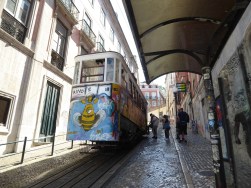
Portugal, like Greece is one of those countries that never fails, with luscious countryside, beautiful historic cities, reliable, warm weather, delicious food [including the famous ‘pastel de nata’ custard pies], a gorgeous coast line and friendly people.

We find Lisbon much changed, with the addition of hideous cruise ships blocking views and throngs of tourists everywhere. Our previous visit was quiet and we were able to stroll the narrow lanes without stepping around selfie-takers. To anyone intending to visit Lisbon and considering an open top bus tour I’d say, ‘Don’t!’ You pay 11 euros to inch along for hours in stifling traffic, a woman wailing Fado songs in your ears. You get to see very little and anything of interest is zipped past or around before you’ve got your finger on your camera shutter.

I can get no purchase on the Portuguese language whatsoever. Spoken, it sounds eastern European with lots of sch, z and cz. Written, it looks remarkably like Spanish and meaning can often be deduced. We know we must take care not to speak Spanish to the Portuguese in spite of so many words being similar, nevertheless Husband is inclined to say ‘gracias’ instead of ‘obrigado/a’ for the first few days. My own knowledge of Portuguese is restricted to ‘obrigado/a’, ‘Bom dia’ and ‘ola’ so it is fortunate that almost everyone here speaks English very well indeed.

The Portuguese are fond of tiling the outside of their homes, which can look beautiful or tawdry; railway stations, hotels, churches-no building is safe from this treatment.

P1070332

And neither are the bone-shaking, tooth-grating streets, which are tiled in cobbles.

The Portuguese countryside is strewn with cork oak trees, the cork continues to be harvested and goods such as cork handbags can be seen in the shops. Perhaps the backlash against plastic will see a resurgence of the cork industry? It does seem to be a versatile material with useful properties: lightweight, water repellent, attractive.

In recent years, wildfires have decimated much of Portugal’s forests and evidence of this is everywhere.

Orange and lemon trees abound, in gardens, parks and along the streets. They are all hung with tons of fruit which nobody seems bothered to pick, the ground around the trees littered with fruit just as the plums lie fallow in Gloucestershire.
P1070325

Before using the [very quiet] motorways you must register your bank card and attempt to forecast how much toll you will be using, which is tricky. Otherwise you can register at the first ‘portagem’ [toll booths] but then you’ll have no clue as to what is being deducted.

We’ll soon be leaving Portugal and crossing back to Spain-but I’ve no doubt at all that we’ll be back!
 

A Dog’s Breakfast of Linguistics

Driving towards the Spanish border and San Sebastian I am attempting to reclaim, renovate and restore my rusty Spanish, a language that’s languished unused for a couple of years. A few words and phrases float in- ‘Si’ ‘No’ ‘por favor’ ‘gracias’ ‘lo siento’ ‘la cuenta’ ‘cervezas’ and ‘banos’. All the essentials. Then I get to wondering what the word for breakfast is and it becomes an irritation. I can find the German word-‘fruhstuck’ but I’m frustrated by Spanish breakfast. This is absurd, mainly because we’ve no need whatsoever to be ordering breakfast in Spain.

P1070024

We locate a site with great mountain views and stretch legs by plunging down a steep, bendy road towards the sea. The weather has turned hot and muggy and by the time we’ve returned and got some chairs out the first drops of thunderous storm have arrived. Rain continues until bed time but by morning it has all cleared and it’s bright, sunny and fresh.

P1070028

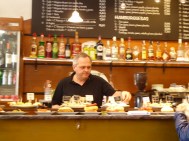
A convenient bus ride takes us into San Sebastian via Monte Igelda [where our site is], stopping at the ancient funicular en route. After locating the tourist office we follow a suggested walking route around the city which takes in major plazas, the waterfront and important landmarks such as the Basilica. We stop for tapas lunch at ‘Tapas Santana’, where a sumptuous display of tapas dishes fills the counter and hordes crowd in. I look at the menu and there it is: desayuno-breakfast. Of course!

Husband waves me to the counter to order, although I’m not ready, not well enough rehearsed in my renaissance Spanish. I muddle through aided by the kindness of the waiter and we are rewarded with a delicious lunch.

We leave next day for San Juan de Gaztelugatxe and get hopelessly muddled when our new SATNAV decides the best route is along unmade mountain cart tracks, but at last we find a sensible coast road, albeit winding and tortuous. The terrain here resembles the Amalfi coast but with fewer tourists even now at Easter time. After a number of glitches, including a near-death experience on the motorway when a bendy bus decides we are a pesky nuisance and attempts to do away with us, we arrive to San Juan de G, a destination better known as a location for filming Game of Thrones than for scenic or religious significance. It is, however spectacular.

P1070079

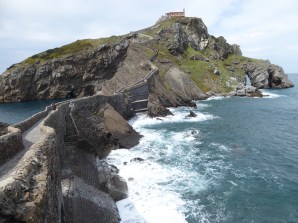
The tiny church of San Juan, dating from AD890,  is perched upon an island rock accessed by a winding path across a stone causeway. The path down [and up!] is steep and arduous. But plenty of people of all ages, sizes and fitness are tackling the walk. Remembering the Tiger Cave Temple climb in Thailand we decide this is a doddle, which it isn’t, but we make it down and up.

It is only a stone’s throw then down to Bakio, where a perfectly nice, free, well-serviced aire awaits. Here is surfing galore so of the many vans parked up a lot are typically bohemian and strewn with the paraphernalia of the sport.

Leaving Bakio we head off towards Comillas, the steady drizzle strengthening into steady rain, which continues throughout the day and is still dropping relentlessly when we arrive to our selected site. On into the evening it rains…and rains. Next morning it is still raining. So the rain in Spain is not restricted to the plain, clearly…

January Travels

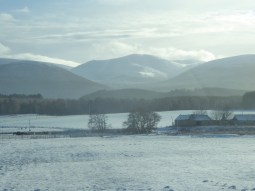
We woke to a crisp, frosty, sparkly morning by Loch Ness, thankful that we’d been warm and were able to continue. We followed the lakeside along to the end [Dorres] and then on to the outskirts of Inverness, before turning to The Cairngorms where we were treated to a full day’s travel of wintery scenes; snow covered hills and roads lined with Christmassy, snow-laden conifers.

p1060693

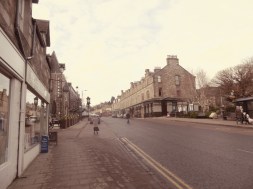
I remembered being given a slender cookery booklet from the Festival Theatre, Pitlochry many, many years ago- a publication that has been lost but that contained recipes for whisky-laden concoctions [none of which I attempted]. We stopped at Pitlochry, a modest one-street town, attractive in a modest way although more yielding to tourists in days gone by, perhaps.

p1060701

At last we came to Fishcross.

At the risk of insulting the residents of Fishcross I feel obliged to say it is remarkable only in its unbecoming appearance-in other words, Fishcross is not a town that you would visit for its stunning architecture or historic value, rather there are row upon row of beige, pebble-dashed terraces punctuated by a Spar supermarket and a cat rescue shelter. Hm…

Nevertheless Fishcross is host, not only to a perfectly acceptable camp site but the site has a great restaurant, frequented by local residents, the poor souls.

But Fishcross is an ideal place to stay for a visit to Stirling, a fine and elegant city which has a stonking great castle on a hill top. So the following day, which dawned damp, dank and misty we caught the local bus there [passing the Wallace Monument en route] and ascended the steep cobbled street up to Stirling Castle.

p1060718

This is a proper classic castle, such as we used to draw in history lessons at school, for some obscure reason which now escapes me-

The castle has been restored to within millimetres of its long, historical life-even to the extent of its tapestries, which took years to construct and have their own exhibition.

p1060723

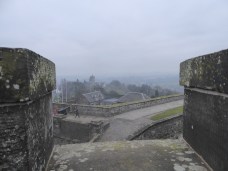
Outside was no less fascinating, although the view from the battlements was mist-shrouded and atmospheric.

p1060746

There was so much to see at Stirling Castle that little time remained before the bus returning to Fishcross but we managed a whistle-stop tour taking in the bagpipe shop, the kilt shop and Darnley’s house [Darnley was a husband of Mary, Queen of Scots]. Then it was back to the delights of Fishcross, taking care to watch out for the cat rescue centre, since this was our cue to exit the bus.

It was time to head south again, striking out firstly to the Lake District, an area that becomes overstuffed with tourists in summer but is undeniably beautiful.

At our lunch stop at Lockerbie services I weakened on my way out of the building and bought scrumptious, mountainous scones and we were entertained by the many cars arriving with dogs and owners to use the surrounding parkland for walkies.

Then we were at Keswick and this was the reward:

p1060774

Next January’s trip may well be to the Lake District!


The Ups and Downs of the Highlands

p1060643

We moved on, north from Glasgow towards the Highlands and the lochs [lakes], driving through suburbs crammed with beautiful sandstone mansions; first to Loch Lomond, Bannoch and Bannoch Castle. We are limited, at this time of year to sites that are open, yet many are-and all boasting five-star provision.

The castle [pictured above] is picturesque enough in its setting but all that visitors can see of the interior is a torn lace curtain.

Since Glasgow I’d been mentioning to Husband that a faint, high-pitched whine drifted intermittently through our vehicle, a comment that he dismissed in his customary airy fashion.

Loch Lomond, immortalised in song, surrounded by hills and adorned with small leisure craft and a steamer is of course beautiful, although Balloch village is nondescript, apart from some droll touches:
p1060647Having spent the night in Balloch’s excellent site we moved on and towards Loch Ness while I puzzled over the fizzing, crackling sound that appeared to come from the passenger side air vent.
There was little in the way of grocery stores but a plethora of farm shops indicated that my lust for pies might be about to be satisfied and it was. After our visit I concluded that if we lived in the vicinity of such a shop we’d be a] bankrupt in a very short space of time and b] obese.

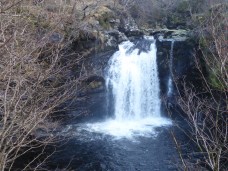
Back in the van with the spoils the fizzing noise began to be accompanied by a burning rubber aroma, which even dismissive Husband admitted smelling. There were no indicator lights on the dashboard but we halted while Husband peered into the engine. Nothing amiss. We continued, as did the fizzing and the smell. There was a short stop to see ‘The Falls of Falloch’:

p1060656

Then we stopped to consume ‘Scotch’ pies here:

p1060662

At last we came along the Caledonian Canal side and to the shores of Loch Ness, check-in, plug-in and Horrors! 

The leisure battery under the passenger seat was too hot to touch! This was certainly where the smell had originated. No more plug-in as everything needed to be switched off; no lights, no water, no cooker, no heat-no heat? The temperature was -6C and a light dusting of snow. From Reception I got the number of a motorhome specialist in Inverness. We prepared to vacate and trek up to a hotel in the village. Then the mobile repair fellow messaged to say he’d be with us at 6.00pm.

There was an anxious wait, but he arrived, managed to isolate the offending battery, leaving us with 2 that continued to function and informing us that the stench was of noxious boiling sulphuric acid and very, very dangerous. Lovely. We’d been breathing it in all day. Ho hum…

Thanks to the cheerful, able mobile repair fellow we could plug in, get warm and be lit, waking next morning cosy and snug and to this view:

p1060688


January Odyssey 1

p1060535

January in the UK is my least favourite month. Gloomy, often cold and wet and with the remnants of Christmas and New Year celebrations clinging like grey cobwebs, it seems to go on too long.
In an unaccustomed surge of January optimism, we’ve heaved ourselves out of the post-Christmas languor to pack up the van, load it with our warmest and most weather-resistant gear and head northwards towards Scotland, a trip we’ve been meaning to do for a few years and only now decided to tackle.
The van, having languished unused for a couple of winter months needed a little de-moulding in its nether regions, otherwise it felt purposeful to be loading up and re-acquainting ourselves with our little holiday-home-on-wheels. There are enough sites open to enable us to travel up [first to Gloucester relatives, giving us a head start] and get around once we arrive. The weather was set to be manageable and Husband assured me that at the first sign of snow we would return, since I was somewhat nervous about getting ‘snowed in’ and unable to return in time for the next [contrasting] excursion in February.
Motorways have conveyed us here and while there were works being carried out almost everywhere the journey was incident-free. Our first, uneventful day took us to ‘Whittingham Club’, a site near Preston and not too far from Blackpool and a perfectly acceptable overnight stop. I assume this is an ex ‘working men’s club’ as it has a club house with a bar, large screen TV, snooker tables and darts plus a bowling green outside. The site facilities are an add-on but serviceable.
Next day we covered the remaining miles to Glasgow by early afternoon, arriving at the holiday park in time for a quick excursion into the city; two stops on a small train from the nearby station.

p1060537

Glasgow is just as a city should be; elegant, decadent, grand and squalid. It is busy and vibrant, the architecture both beautiful and innovative, with ugly inserts. The honey and rose sandstone buildings dominate and there is no shortage of galleries, museums and historic sights-too many in fact to see in a single visit. There are areas of development as well as hideous, high rise blocks. The shopping streets are packed with all the usual stores, from up-market fashion to restaurant chains. There is a vast a number of theatres and concert venues as well as lively clubs and pubs.

p1060623

Next day we returned in full daylight to take in the award-winning transport museum, the modern art museum, the Necropolis, [a steep hill crowded with mausoleums, obelisks and fancy gravestones] and the cathedral [sadly closed]. From the summit of the Necropolis the tower blocks of outer Glasgow can be seen as well as the grey ribbon of the Clyde. We had no time to tour the art museum, People’s Palace or botanic gardens.
Next day we drove north west towards Lock Lomond, out through suburbs of impressive Georgian sandstone terraces and while I felt it must be a pleasant place to live, I also realised we’d given the more depressed areas such as Paisley a wide berth. It feels good to travel to the outer reaches of the UK and understand that all life does not revolve around the London and the south.

When the High Tide of Expectation Drops to a Catastrophic Low

The research took some time. It was tricky finding a suitable date, near enough to the actual big day plus an itinerary that would be acceptable. It had been impossible to find a Rhine cruise that allowed us to drive overland to the embarkation point, so I’d had to select flights then change them [at a cost] because they were at some obscene hour of the morning like 6.30am. A 6.30am flight, as I pointed out to the lady on the phone hardly constituted a birthday treat, especially as airports these days require you to be there two hours before take-off. This would be 4.30am. 4.30am!
Then there was the complimentary taxi to the airport, which would need to collect us at 2.30am. 2.30am! How would anyone manage this? Would you sleep beforehand, retiring at a ridiculous hour then getting up at 1.30? Or would you stay up and be almost comatose for the first couple of days of the trip?
No. I changed the flights. I reserved a room at the Heathrow Hilton. The taxi would take us to Heathrow at a respectable hour of the afternoon, we’d check in to the hotel and enjoy a leisurely meal, get a decent night’s sleep and be at terminal 5 at around 8.30am for a 10.30am flight. Sorted.
Husband had chosen a Rhine cruise as his birthday treat. These days there is precious little ‘stuff’ that he wants or needs, and being a man, if he wants or needs something he gets it. As regular readers know, Husband, that character who features in many posts, had a particular milestone birthday two weeks ago and as a result had an entire post written about him…
I’d been startled by his choice of a cruise, as we are great avoiders of such holidays [this, reader has also been much documented on Anecdotage], but river cruises are as unlike sea cruises as cycling is to motor bikes. The boats are not vast, floating monstrosities and passengers must not endure days and days at sea getting stuffed with gargantuan meals, enduring endless, tedious cabarets, ‘dressing’ for dinners and making small talk with those with whom they are incarcerated. The modest cruise boat makes frequent stops at places you can walk around and the ambience is casual. There would always be something to see, even from the cabin. We’d have begun at Amsterdam and finished at Basle. I was frustrated that we’d had to fly such a short distance [Amsterdam is a city that can be driven to in a day from Dunkirk] but when the detailed itinerary arrived in the post it looked thrilling. We’d be stopping each day at beautiful, historic places and get walking tours, as well as travelling through the beautiful Rhine gorge and seeing the Lorelei rock.

I bought new suitcases [ours hailing from a bygone era], bought shoes, organised, laundered, ironed, primed the neighbours.

‘You should see this’ Husband informed me as I returned from shopping. It was an email from the river cruise holiday company to the effect that they were changing the itinerary to mostly coach travel. This was due to a lack of water in the Rhine. He [and I] never at any point wished to embark on a coach tour. I cancelled.

I must admit to feeling slightly nauseous [yes, yes I realise it is a ‘first world’ issue].

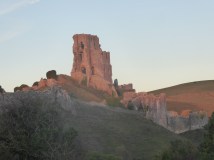
We packed our camper van and drove off to the beautiful Isle of Purbeck, 30 miles away from our home and parked in the sunshine overlooking the hillside at Corfe Castle. We strode out over the hills and enjoyed the breath-taking views of our lovely Dorset coast. I stopped feeling bereaved.

Out in the van, we are never disappointed. Yes, there are sometimes challenges or difficulties. Yes, we must make the odd meal, wash up, empty various tanks. But we are not dependent on flights, hotels, plans others have made.

P1060375   P1060383  P1060386


Next week Fiction Month begins! Check in to Anecdotage for fresh, new fiction…

How We Roll Back…

We’ve spent a lot of time visiting south west France now, which means familiarity with the route, as well as the entire area. Nevertheless we still search for new ways to get there and back [avoiding motorways and their tolls]. A few weeks ago I wrote how we set off, where we like to embark, the entire routine.

So then, after a few weeks ‘bimbling’ [Husband’s word], we have to turn the van northwards and consider how we might return. We select a day. On this occasion, Husband came up with a plan to return overnight in a cabin, which appealed until we discovered that the ferry sets off late, leaving little or no opportunity to schmooze in the restaurant and bar. Who wants to drive on, locate the cabin, clean teeth and get straight into a berth?

These days it is neither necessary nor desirable to scramble up the length of France in one, long day and we prefer a gentle, staged journey – still attempting to find hitherto unexplored places.

We opted to return from Ouistreham [Caen] knowing there is a very convenient aire next to the ferry terminal for our last night. We decided to spend a couple of nights at Dinard, which is only a couple of hours away and left us time to explore as well as execute the all-important pre-return shopping spree that is obligatory at the finale of all trips.

P1060319

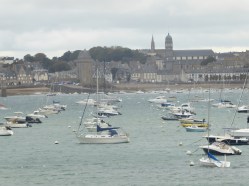
Dinard is situated across the bay from St Malo and probably suffers for it’s glamorous, historic neighbour but we’ve stayed at St Malo enough times. A look at one or two lacklustre ACSI [off season discount card ] sites confirmed that the municipal site at Port Blanc would be a good choice and so it was-with an uninterrupted view of the beach and bay from our van.

The weather by this time had become blustery and drizzly-a reminder that we were on our way home.

The site offered  a bar and pizzas-surprising at this end of season period but not an option for us [I am unable to eat pizzas]. A five minute walk up the road led us to a lively area with bakeries, bars and brasseries. On Sunday afternoon a small stage was hosting a display of line dancing-

P1060293

The restaurant we chose was old fashioned but proved popular, as after we’d been seated every table was occupied.

P1060295

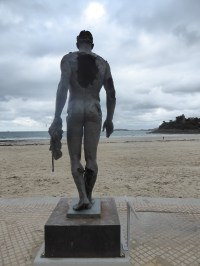
Dinard is a hilly seaside town reminiscent of Scarborough, with an air of faded elegance-enormous old hotels, a smattering of art deco, luxuriant gardens and promenades as well as ice cream parlours and bars. There is evidence of an interest in the arts, with a film festival running and some impressive sculptures dotted along the prom.

P1060324

We walked back to site via a path around the sea wall which wound around the town cliffs, narrow in places and in a bracing wind, but thrilling and with dramatic views.

P1060329

We left Dinard to scoop up items on our wish-list from a Carrefour complex the size of five football pitches then drove up our well-trodden route to Caen and to our customary spot next to the ferry. We dodged the motorhome-bore [‘I’ve Been Everywhere, Man’], showered and went to get a meal. next day the ferry’s engines woke us at 6.30am, just right for packing up and trundling the 500yards into the check-in queue. Drive on, climb up to the coffee bar, grab coffee and croissant, settle into a couchette. That’s how we roll back…

How we Roll-

P1060057

These days we cross the English Channel [our most trodden travel path] by taking the line of least resistance-and since we live a few miles from Poole that line is Brittany Ferries to Cherbourg, a four-hour crossing leaving at 8.30am.
Despite the proximity we know better than to hang about and we are sure to leave home by 7.00am. Once, inspired by Husband’s ‘It’s only half an hour away-we’ve got oodles of time-we don’t need to be there until five minutes before’, we arrived at the barrier just as the ferry was about to leave and winged it up the ramp with minutes to spare.
The ferry, the ‘Barfleur’ [named after a Normandy coastal town] is comfortable and familiar by now. We know that once on board there will be good coffee and fresh, buttery croissants as well as comfortable reclining couchettes in a quiet salon in the bowels of the ship. We know that we can mooch around the small boutique and peruse the eclectic array of merchandise both useful and otherwise. There will be WiFi and television news.
Mostly, these days the ship is peopled with retirees or young couples with pre-school children because since retirement we have the choice of avoiding school holidays. This time, however by setting off a little earlier we are beset by knots of excited, shrieking children who still have time for a quick taste of France before knuckling down to learning their tables. They gallop about the ship, throng around the games room, chase each other from the bar to the restaurant, use loud devices and shout to each other. I surprise myself by enjoying their excitement, which reminds me how I felt on early trips abroad when every experience was new.
A sulky boy wearing a onesie in a bear design makes several circuits past our table with his lecturing mother, prompting me to wonder what he has done and if his excitement got the better of him. A tiny, table-height toddler staggers about, chased by his doting father and shielded from protruding table corners by the various diners he is entertaining.
In the quiet zone I open my Kindle and continue reading Alan Bennett’s ‘Keep On Keeping On’, which is part diary/part memoir/part lecture in itself and a treasury of informative and amusing anecdotes. A couple of rows behind us two men slumber whilst between them a young boy plays on and with a mobile phone, the sound of which is just a little distracting-loud enough to hear but not enough to decipher. Husband, whose own hearing has been compromised during the last few years is immune to such irritations and dozes off easily.
We arrive to Cherbourg, disembark and set off-not tearing southwards as usual but this time meandering across the Cherbourg peninsula to the coastal town of Barfleur itself, where we have lunch and a wander around the curving harbour followed by drinking coffee. Then we continue a few miles on to St Vaast, another harbour town with a convenient aire for us to park up in.

P1060046  P1060055  P1060053

St Vaast is a delectable place; full of seafood cafes, narrow alleys lined with pretty seaside homes and beautiful gardens, boulangeries packed with luscious pastries, breads and tarts, a crowded marina and a working fishing harbour where sturdy mussel boats are tied up.

There are many, many West coast ports like this, with harbourside brasseries serving the freshest shellfish you can get. We take advantage and I am able to enjoy my favourite treat-a plate of fat oysters nestling on a bed of ice and tasting of the sea.

We stay 2 days despite the drizzly intervals and walk the coastal sea wall to see ‘La Hougue’, part of some anti-British defences of 1664. Then it’s time to move on.


Bulgaria: Beauties and Beasts

P1050284

We left beautiful, spectacular Delphi, swishing around a series of hairpins into a mizzly mountain rain and on towards Thessaloniki and the seaside town of Nea Moudania for a last blast of sun before the long trek north. In the event, both Nea Moudania and the sunshine failed to excite and we cut short our last blast in favour of discovering the delights of Bulgaria.

Hitherto my one experience of Bulgaria was a solo skiing trip to Borovets, where the skiing, social life and scenery were all delightful, the hotel food atrocious and the staff gloomy and depressed.

Having negotiated the border we knew we’d have to buy a road tax ‘vignette’ and  obtain some currency. The road on Bulgarian side of customs is lined with stalls selling all manner of goods from liquor and cigarettes to bottled water, also currency [exchange-euros for ‘lev]’.

P1050342

We set off towards ‘Sapareva Banya’, using the co-ordinates from the German website we’d had to use to find sites. The rolling, green countryside was delightful; the towns were the ugliest I have ever seen-crumbling, grey blocks and abandoned factory sites. This is the legacy of the iron curtain. I wondered how it was possible to create such brutal ugliness and how will it ever be possible to eliminate?

P1050362

The co-ordinates took us down an increasingly rutted track and through some gates. It looked promising. Inside the gates the driveway rounded a large, stately building in wooded grounds but nothing resembling a camp site. I ran around to the front of the building and climbed once-grand steps into a huge, gloomy hallway containing booths housing white-coated people with clipboards and papers. My hesitant enquiry as to whether anyone spoke English yielded blank shrugs. I’d stumbled into some kind of sanatorium; clearly not a camp site.

Husband was all for turning back, although we’d had a long day’s travel already. I determined to find the site, striking out down a track I’d spotted where builders were constructing a bar by a pool. A kindly builder explained in good English how to navigate to the site, [next door].

Yes-there it was, down another rustic lane. We pulled in. When there was no response to my ringing a bell at ‘reception’ I thumped on the door which after some minutes was answered by a lugubrious young woman, bleary eyed and shoeless. I imagine I’d dragged her off the sofa and away from an afternoon of daytime Bulgarian soap operas. We could stay, she told me but they were very busy and had little room. This proved to be true, as a large tour group of Dutch caravans was occupying all of the field. We manoeuvred into a sloping slot behind some chalets, relieved to have somewhere to spend the night.

Sapareva Banya had given us no cause to linger and we drove off again in the morning to head north again and find a site called ‘Madona Inn’ from the German website.

P1050364

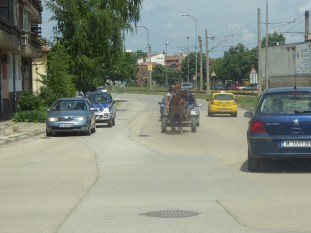
Bulgaria is poor. Horse-drawn carts are commonplace among the town traffic and most small village homes are in need of repair, resources being too scarce to squander on paint, render or window frames.

Madona Inn is easy to find, a guest-house and camp site with bar and restaurant along the road to Belogradchik, where a 1-3rd century AD fortress lies in an imposing position between the dramatic sandstone rocks of the area. With time to explore before checking in we drove up to Belogradchik, a town that has made no concession whatsoever to tourism in terms of beautification. We climbed up to the stunning fortress.

P1050376

Madona Inn was everything Sapareva Banya was not, with cartloads of rustic charm, although the Bulgarian cuisine on offer seemed eccentric to our uninitiated taste-an omelette topped with soggy toast topped with pork slices topped with mushroom sauce topped with…a boiled egg.

P1050413

It was a beautiful, quirky site and well worth the visit-but little did we know what impact the terrible road surfaces would have later…


Lower Your Expectations!

A wonderful lady I worked with years ago sometimes used to say ‘Lower your expectations’. She would use this phrase whenever we felt jaded or that events were taking a downward turn. It was intended to be droll-and it was, because it always brought a smile to our faces.

But the idea of lowering expectations is not without advantage. If I consider a worst case scenario in life then the outcome will either be a] as I expected or b] not as bad as I expected, both of which are better than a disappointment.

I can apply this approach to all aspects of life. We have just embarked on a new expedition into Europe, intending to travel in directions hitherto unexplored [by us]. The preparations for this odyssey seem endless and difficult, partly due to it’s being the first major road trip of the year and partly because my brain is losing its propensity to be sharp. I appear to spend a great deal of time writing lists and forgetting to add items, or writing lists that prompt further lists. I begin a task and become distracted by another. I forget what I do, forget how to prepare.

Eventually, however we seem to be ready. We get away on time. We arrive at the ferry port on time. The crossing is uneventful-pleasant, even. We breakfast, we slump, we snooze in the recliner seats of the quiet lounge [both of us having had a fitful and short night’s sleep]. The weather is warm and sunny. This is a bonus, since cold, wet weather was expected for a few days at least. See what I mean? Expect the worst, lower your expectations.

It is easy to see why many prefer the simple process of buying ready-made holidays. Everything is done; everything laid on. You are transported somewhere, you are ferried to sights and brought back [as on cruise ships]. You follow an itinerary someone else has prepared. You look, perhaps take snaps, perhaps buy a souvenir. You are taken home.

The road trip requires planning and preparation. We [mostly Husband] plot each day’s route, we search out possible destinations, we fuel up, shop, service the van [water, waste]. We make decisions, try to agree. We problem-solve. Sometimes we are successful. In the two days since we began we’ve had to overcome irritants like lights that will not switch off, devices that bleep in the middle of the night, van alarm going off [also in the night] and no internet access. Above all we have to adjust back into camper-van life, remembering where we store stuff, routine when we park up, routine when we leave each day.

But we know we must make our brains and bodies work for us if we want to get into healthy old age and I imagine that it’s one of the reasons there are so many ancient motor-homers out here in Europe, just like us. Oh-and there’s the freedom of course. Who wants to be told what to do and where to go? Now what on earth has happened to all my ‘Word’ documents???