Moving on…

A letter to the new owners of this house:

Welcome to your new home. If you can be just a fraction as happy here in this rather grand, elderly house with its unbeatable location and its creaking, gurgling idiosyncrasies as we have been you will have made the right choice. Estate agents like to describe it as having ‘kerb appeal’ and judging by the attention it is given from passers-by this may be correct.

P1020091

When we first came to look at it twenty years ago we’d no clue it would be located on the cliff top, a short stroll down a zig-zag path to the vast sweep of Bournemouth Bay, since there was no mention of its position in the small, black and white advert in the local newspaper, merely a smudgy photo of the front door. It seems incomprehensible now that a sea-front location would be unmentioned. Upon entering the house I experienced that immediate recognition that this was the house for us, even though Husband needed convincing.

P1020098

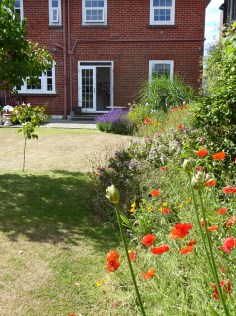
To begin with it was locked into an earnest, seventies style décor and many of the original. 1920s features had been replaced with teak-effect and wood chip wallpaper but the beautiful staircase and elegant doors were all there. We set about alterations, combining three rooms to provide the spacious kitchen/dining area that is still a popular choice today. Much later, longing to be elevated to a level where we could enjoy a sea view, we had a section of the roof cut away and the loft converted to provide a crows’ nest. It altered the appearance of the house in a way many would consider a travesty but has been the room we’ve lived in the most. The garden is unrecognisable from the bland space it was and now boasts mature borders, a beautiful pond, trees, a summerhouse and two patios. The old garage is adorned with Virginia creeper and climbing hydrangea and a riotous tangle of honeysuckle, jasmine and ornamental hops tumble together from the fence.


Every home carries in its fabric stories of the inhabitants down through the years-even if they are untold. Here there have been wedding celebrations [two], arrivals, departures, parties, Christmas gatherings, murder mysteries, milestone birthdays, air show gatherings, musical soirees, a new generation coming along to explore, visitors, a burglary, barbecues and so much more.

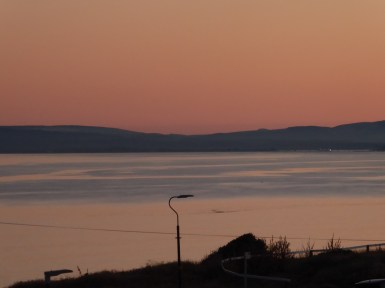
My homecoming from work was always a joy, the sky becoming vast as I came nearer, the sunsets stunning and the winter gales a thrill.

P1020107

Our next home is a complete contrast, having been built much more recently with a light, contemporary interior, loads of glass and an open-plan design. We are swapping our sea panorama for a view over the river and the water meadows and the garden is a wedge of lawn leading to a small wooded area containing giant trees. The historic centre of the provincial town is just a few minutes’ walk along the road. Will we be as happy there as we have been in the old house? It remains to be seen.


What’s Cooking on the TV?

In its wisdom, the BBC has opted to schedule on Channel 2 a big, blockbuster ‘food season’. This is much heralded and promises to inform in ways we have never before been informed about-food. Yawn. Really? How many more programmes about food can we take? And how many more times must we be told that refined foods, salt, fat, fast food, takeaways, sweets, chocolate and the demon sugar will be the undoing of us?

Let me see. ‘Masterchef’, ‘Hairy Bikers’, ‘Nigella’, ‘Saturday Kitchen’ and on and on-the programmes exhort us to produce more, varied and extravagant meals using more, varied and exotic, unheard-of ingredients. We sit and watch, munching our takeaways or our toasted cheese sandwiches and nodding-‘mm, yes, that looks nice’. How many viewers rush out to the supermarket next day for Tahini paste, syrup of nasturtium seed or essence of wild boars’ scrotum? How many search online for a high temperature vacuum bath or a freeze-drying machine? Heston Blumenthal has much to answer for.

It was all vastly simple decades ago. My childhood diet followed a weekly timetable that varied little beyond which meat to cook for a Sunday roast or what was available in the back garden vegetable plot. Mondays would yield up something with the remains of Sunday’s roast, the remaining days repasts would revolve around Spam-with mashed potatoes, with chips, with beetroot or eggs from the hens at the end of the garden-omelettes, fried eggs and mash or chips. We children never questioned or grumbled. We had no dislikes and would clamour only for an orange or a banana since these were prized items [rationing was not yet a distant memory], although as I’ve mentioned before we were only permitted a banana if it was accompanied by a slice of bread.

If the first course was a little sparse there would be a vast rice pudding or a suet sponge for the purposes of filling us up. Meals always consisted of two courses. Not only did we survive on this regime, but we were relatively healthy and never became in the slightest bit overweight, still less obese, even though the occasional day out to the seaside would conclude with fish and chips wrapped in newspaper.

How ironic that the more elaborate and fiddly TV chef meals become, the more the population capitulates to fast food and fry-ups, snacks and sweet treats.

Here in Portugal, where we have fled to escape the UK’s wintery temperatures we de-camped on our first evening-after five days of driving- to the village restaurant where we were shown a box containing assorted, gargantuan fresh fish, from which we selected our favourites. They were taken away and grilled with a little salt and served with a salad, crusty rolls and a plate of fried potatoes. No sauces, ‘beds’ of anything, snotty-looking foam or those stupid drips and smears dotted around the plates. The result? Completely delicious.

A Matter of Time [part 1]

Frith steps out into the grey, depressing familiarity of the patch she still thinks of as a garden at a time she knows is morning from her ancient alarm clock. She glances up into the hazy fog as she does each day, to assess the extent to which a semblance of light may be penetrating. This morning, within the billowing folds of damp cloud a sulphurous, bilious glow hovers like a searchlight beam, providing little in the way of illumination and no warmth, although Frith allows a small thread of encouragement to weave into the start of her day.

Along the cinder pathway fresh layers of fine dust display the prints of the girl’s boots as she moves towards a network of raised beds rising like ghostly islands in the gloom. She pauses by the first rectangular slab, a dark oblong mound constrained by timber planks, crumbling a little now from prolonged exposure to damp and housing what would have been a robust crop of potato plants. Frith adjusts the filter masking her nose and mouth before bending to inspect the nearest plant. A few dark, brittle leaves have struggled to the surface of the dusty heap of soil. She peers at them, unsurprised by their insidious coating and searches for any sign of a flower. They will need to be earthed up again, she decides, grimacing at the idea of the task; digging into the tainted earth will produce a storm of silver powder pluming up and coating all in its descent, including herself.

She walks to the apple tree, a spectral giant in the mist hung with fringes of dull spores and remembers her grandmother describing summer afternoons as a child lying in the shade of it with a book or clambering to the top to teeter on a spindly branch and marvel at the view across the sunlit valley. She shivers, conscious of the oppressive silence that hangs over the garden like the fog. On the tree’s lower branches one or two tiny, misshapen fruits cling in a valiant effort to perpetuate.

Beyond the tree, by the low stone wall that once marked the boundary with a neighbouring property there is a brave, rebellious clump of brambles making a stand against the suffocating effects of fungal invasion, producing fierce, protective thorns and exuberant, wet foliage tinged with hints of green amongst the smoky coating. Frith allows herself to hope for blackberries later on, in the time that used to be called autumn when there were seasons marking changes in climate; months when days were warm, hot even, and periods of fierce cold when the land lay dormant.

The greenhouse is barely visible at the end of the monochrome garden until Frith is near enough to touch its damp and slimy surface. She pulls the door open and steps inside. The tender plants here have not escaped the blight and she surveys the spindly pepper bushes, brittle stalks smothered in grey and moves slowly on towards the end of the small structure where she’s been nursing the tomato seedlings. She stops; holds her breath.

Where the Wild Things Are.

                I can imagine, within a couple of generations, how society will be. In my mind’s eye society is a kind of dystopian techno nightmare like Paul Theroux’s ‘Ozone’, or Aldous Huxley’s ‘Brave New World’, where everyone stays inside except for helicopter visits outside to see anything green, natural or wild. Or perhaps going ‘outside’ will involve some sort of virtual travel using screens, 3D and surround sound.

                An enduring memory from my children’s early childhood is of settling my daughter, aged about three, outside the back door of the house with some paint, water, brushes and paper, only to return to check on her and find she had ignored the paper and employed the paint and brushes in a project to enhance the appearance of the diminutive woodlice as they went about their business around her feet. This embellishment seemed to have no effect at all on the insects, although it may have transformed them into easily tracked, tasty titbits for predators.

                As a tot she loved the garden creatures, making baths for earthworms from flowerpot drip-trays, cradling long suffering frogs and making pets of snails. One such snail was a favourite, nurtured, fed tasty leaves and given regular baths. One day, in a fit of sibling rivalry her brother threw the beloved snail over the fence into the unkempt jungle of next door’s garden, prompting his sister to howl in inconsolable misery at the loss.

                “Don’t worry!” I reassured her. “I can get it back for you.” I ventured into the tangled maze next door, waist high in grass and weeds. The property of an elderly brother and sister, it had languished untended for many years, visited only by the many stray cats they’d acquired. I did not have to wade too far to find a snail, since the entire plot was a gastropod’s paradise. I returned, triumphant with the replacement. Her face was still contorted with rage and wails continued to issue from it.

                I proffered the captured snail, which had wisely shrunk back into its shell as if it had some premonition of the specialised treatment in store. There was a small moment of silence as she scrutinised the creature on the palm of my hand, before she yelled an ear-splitting shriek.

                “Waaah! That’s not the one!”

                Apparently, children today play outside half as much as their parents did, which strikes me as a depressing fact. Even now I far prefer the outside to the inside. As children we were outside all the time unless it was pouring with rain or we had to do homework [or Dr Who was on, in which case we’d have had our ‘tea’ anyway]. We were never supervised, but were always occupied. Quite a lot of the time, I seem to remember was spent on ‘digging for treasure’.

                The more our outside green space shrinks, the more we should be in it-protecting and appreciating it; and no one more so than our children, otherwise those works of fiction could become scarily real.