


Our trek in the mountainous region of Ladakh took us close to villages and down through some. Sometimes our camp for the night would be next to one, on a flat area by a stream. Though the villages were rustic idylls during the summer months, the roofs of the homes covered in drying apricots, families working in the surrounding terraced fields, animals grazing, the long winter months would be cruelly hard. Those working in the fields would always straighten up to greet us as we passed by. A smiling ‘Julay’, we’d hear and do our best to reply.
We were privileged to be able to visit a village house, the home of our Ladakhi guide, Sonam’s parents. We were invited inside and offered ‘butter tea’, a beverage I’d been warned to avoid if possible. The tea was presented in beautiful, painted porcelain teacups. But the trick, I knew, was to take the smallest of sips so that the rank taste was barely perceptible, then smile, nod and replace the cup in its china saucer on the table.


The kitchen was cosy, a wall of shelves holding burnished cooking pots, a black iron stove for cooking and heating. For tea we sat on colourful rugs before low tables in a room whose windows looked out over meadows, summer green; and a backdrop of towering mountains. Outside, Sonam’s father demonstrated basket-making, deftly weaving one in minutes.

Later, at our encampment, Adrian wondered aloud if anyone would be interested in a beer. Beer? During our long hikes we’d not spotted anything resembling a retail outlet-not an off-licence, a corner shop, a mini-market, a stall or a kiosk. There were no roads-hence no roadside offerings. At our universal cries of affirmation he leapt up and disappeared, returning some time later with a crate of bottles and an air of nonchalance.
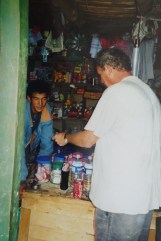
The mystery of his providence was solved on another occasion when our route took us past some rough, wooden doors covering a rocky cave like Aladdin’s. Once unlocked, the doors revealed a ‘shop’, containing all manner of items. How the goods were transported to such an inaccessible area is a further mystery, but we did not go beer-less on our trek.
Each day when we stopped for a breather and to rest aching legs we’d open our lunch packs, provided for us by our hard-working crew. And each day the lunch would be the same: a boiled egg, a [cold] baked potato, a cereal bar. I remember that we’d fall upon these lunches that seemed the most delicious meal in the universe as we’d sit on a rock or a mound of grass overlooking the highest mountain range in the world, sometimes also getting mugged for our food by tiny pygmy goats!
Occasionally there would be an option to clamber up to a higher point while others rested, Adrian leading; an option that Welsh Gareth was always keen to choose, fit as a flea on his chocolate and bread diet and sometimes we would follow, burning muscles a small price to pay for such amazing views.


 Anecdotage