Whatever Have We Come to See in the Sea?

This week’s post is a continuation of a travel thread. For previous episodes, please track back to past weeks.

We’d booked an ‘island tour’ for one of our last days on Sal, Cape Verde. Our driver and supposed tour guide, Elton, is a man of few words, we’d discovered. Nevertheless, he is taking us around this tiny island and showing us what there is of note, even if he is a little short on imparting information.

On booking this tour, we’ve received no kind of itinerary and have no clue whatsoever as to what we might see or not see. We are entirely in the hands of Elton, which, as it transpires, is a mixed blessing.
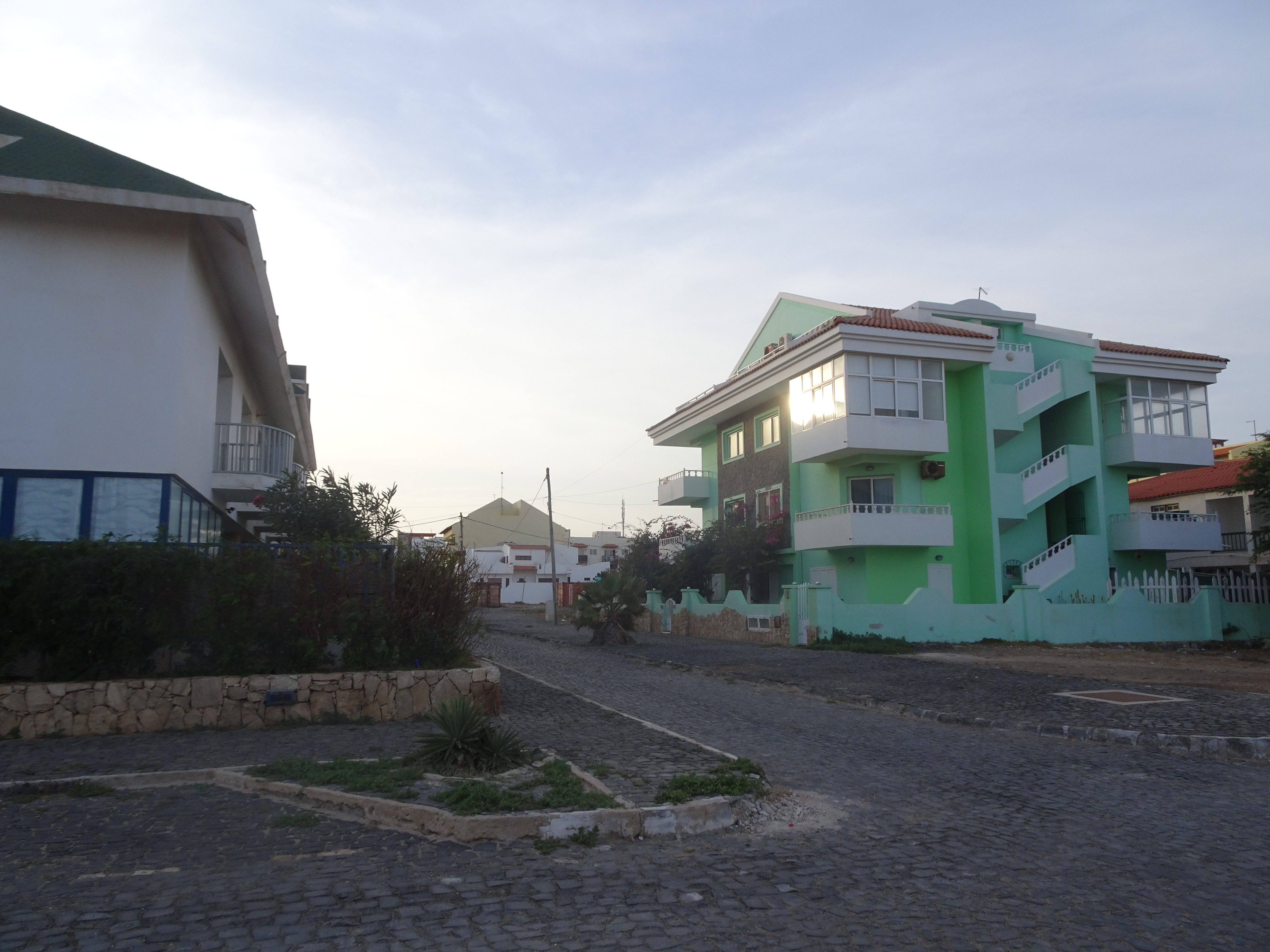
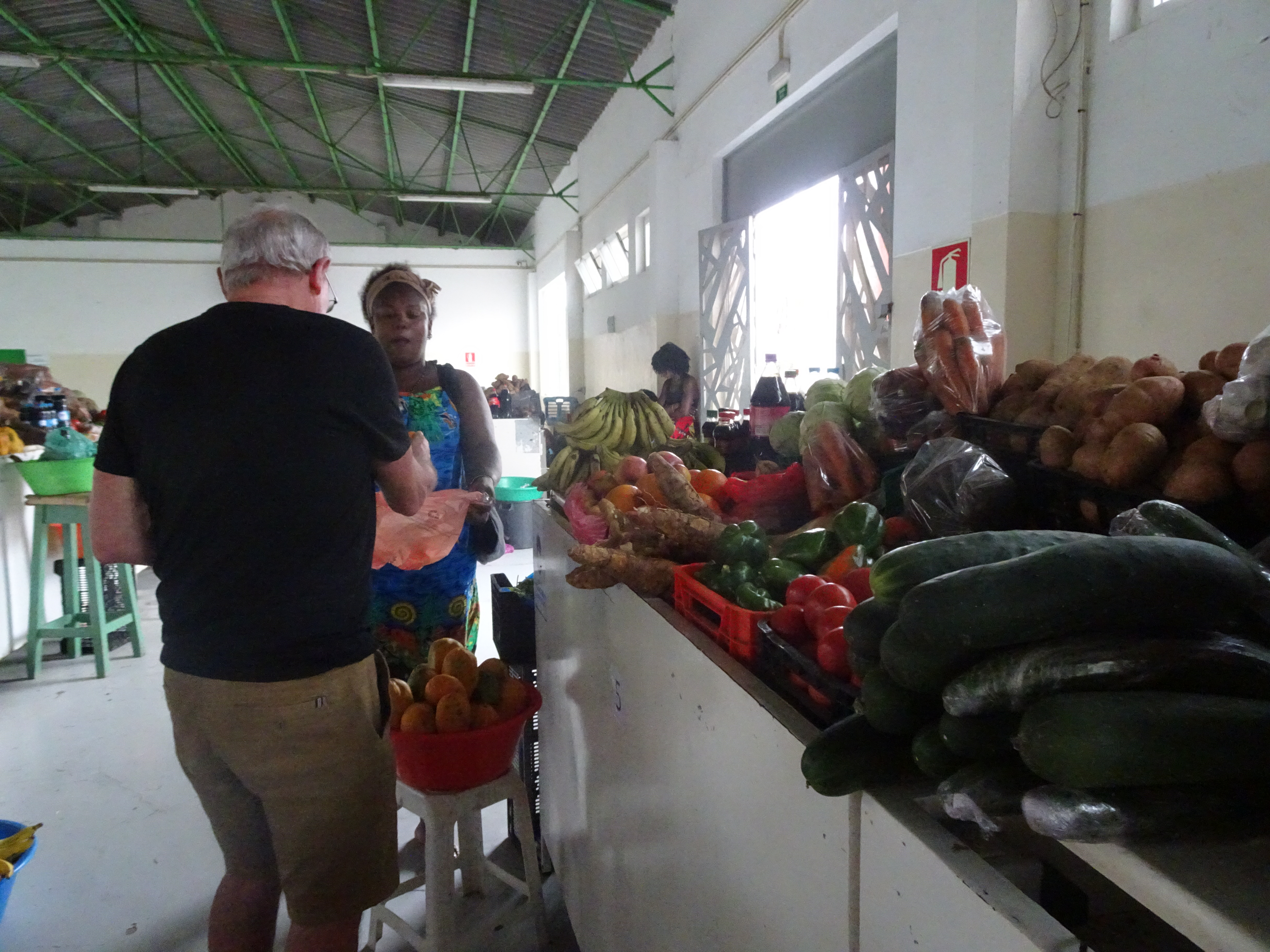
After leaving Palmeira ‘fishing village’, we travel on towards the next destination, whatever it will be. During the very brief drive we’ve had in the streets of Espargos, the island’s capital I’ve been intrigued and would have liked to have had some time to explore properly. It’s a fascinating mixture of brightly painted homes and buildings and run-down, dilapidated structures or scruffy, ruined plots. It’s also hilly. Elton draws to a halt outside a large, corrugated building and lets us out. We enter and discover it’s a market, or rather it was a market earlier in the day. Now it boasts three stalls, two of them selling fruits and vegetables, although I’ve seen no evidence of crop growing on the island so presumably it has been imported from other, greener islands. There’s no way to find out as Elton has withdrawn to the car. We buy a couple of items and make use of the market’s bathroom facilities before rejoining our reluctant tour guide to continue the drive.
We go on quite a long way then turn off abruptly, off road and on to an unmade track. It winds about all over the place, dust billowing around us as we bump along. Ahead we can see the ocean and vehicles parked; then as we draw nearer we spot a gathering in the surf- many tourists standing in the waves to look at…what? We’ve no idea but must assume it’s what we’re here for, too- to look at something.
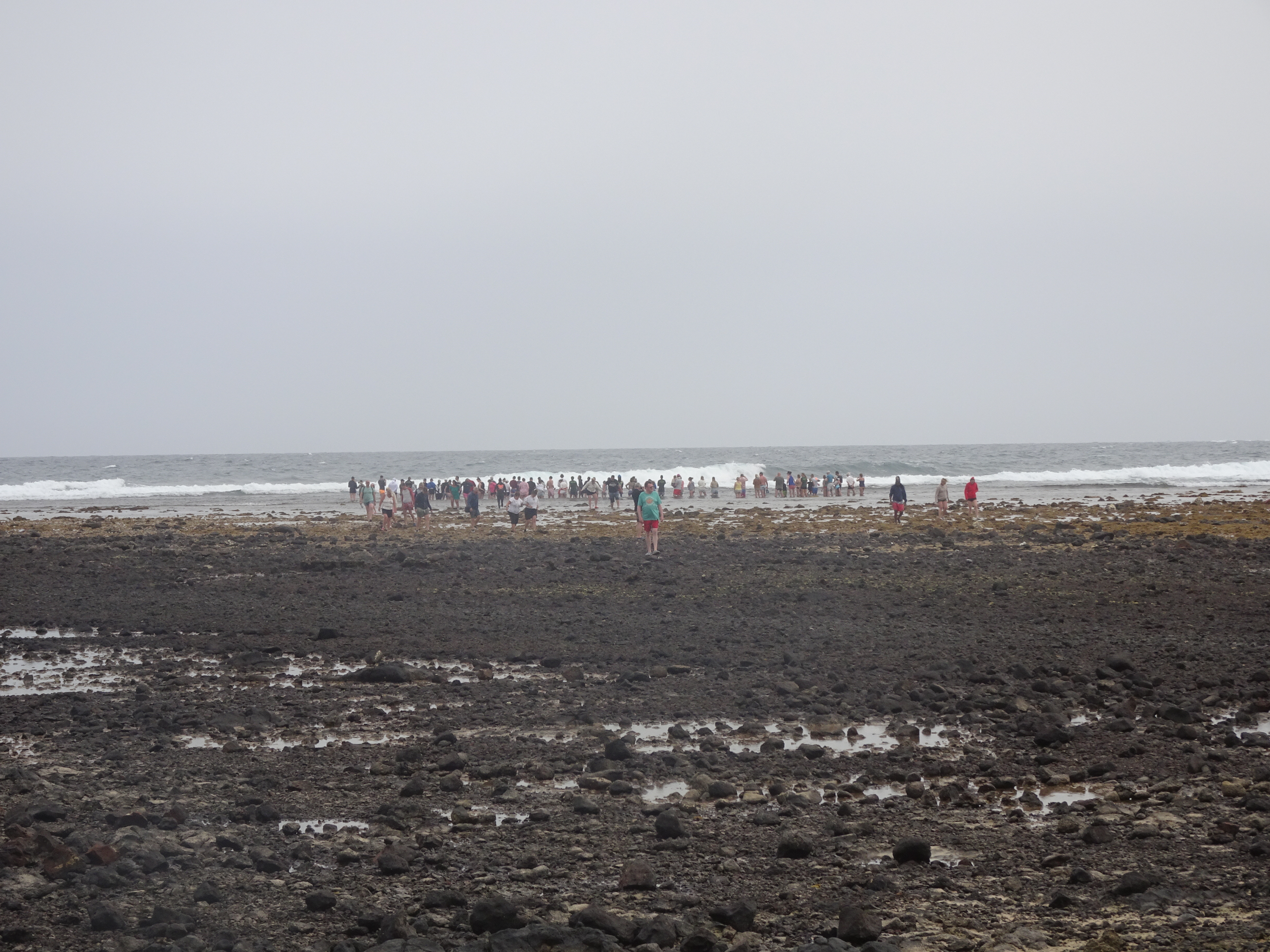
We stop at a haphazard collection of huts and stalls and are released from the car. Elton motions us to follow him and we’re taken to a hut with shelves outside housing a collection of rubber overshoes and croc-style footwear. Of course we’re to be joining the crowd in the waves to look at…something; clearly something worth looking at. In order to hire the rubber shoes we must, of course hand over cash, which we do. Husband gets a pair of sturdy crocs and I, I get a thin pair of rubber galoshes. A young man emerges and Elton gestures at him, ‘your guide’ he says, with no more of an explanation. The ‘guide’ [Girondelo, he tells me when I ask his name] moves off, beckoning us to follow, across the sand and then on to the rocky coral and volcanic stone beach, where I instantly discover that the flimsy soles of the rubber shoes offer no protection at all from the sharp, pointy rocks we are treading on. ‘OW!’, ‘OUCH!’ I yowl, falling behind as Husband and Girondelo as I stumble on. Giro turns to grab my hand very tight and pulls, and there’s no option but to press on, the soles of my feet feeling every step like walking across a watery football pitch covered in Lego bricks.

I should add that I’m further hampered by a small rucksack bag plus, in my right hand, my trusty camera which I must keep dry at all costs…

We’re getting nearer the crowd, but now we’re also getting into water, deeper and deeper. We’re wearing shorts, but as we progress I’ve no hope of staying dry, since shortness of stature and length of shorts preclude it and soon I’m wet up to crotch level, with the added instability of feisty waves buffeting. By now, aware of my inadequacies in the coral-walking field, Giro has tucked my hand under his arm as he continues to pull, simultaneously ordering me to ‘slow down’. Slow down? He’s dragging me along!

‘Would you bring your grandmother out here, Giro?’ I ask him, but I’ve discovered by now that his command of English is as minimal as my Portuguese…

By now we’re aware of what we’ve come to see, as, swimming around our legs there are dozens of sharks. ‘Look!’ yells Giro, ‘Baby shark!’ I’m far more terrified of the waves and the prospect of losing my camera to the frothy waves than I am of the sharks, which are smallish and unthreatening, but how on Earth am I to take photos with one hand? Then, without warning, Giro lets go of my left hand and I’m on my own, teetering in the rolling surf on an unsteady, coral strewn base. As a large wave approaches I feel myself wobble and my arms begin to flay in a desperate attempt to keep myself and the camera from submersion…

Grace is the alter ego of novelist and short story writer, Jane Deans. To date I have two published novels to my name: The Conways at Earthsend [https://www.amazon.co.uk/Conways-at-Earthsend-Jane-Deans-ebook/dp/B08VNQT5YC/ref=sr_1_1?crid=2ZHXO7687MYXE&keywords=the+conways+at+earthsend&qid=1673350649&sprefix=the+conways+at+earthsend%2Caps%2C79&sr=8-1 and The Year of Familiar Strangers [https://www.amazon.co.uk/Year-Familiar-Strangers-Jane-Deans-ebook/dp/B00EWNXIFA/ref=sr_1_1?crid=2EQHJGCF8DSSL&keywords=The+year+of+familiar+strangers&qid=1673350789&sprefix=the+year+of+familiar+strangers%2Caps%2C82&sr=8-1 Visit my writer Facebook page [https://www.facebook.com/search/top?q=jane%20deans%2C%20novellist%2C%20short%20fiction%20and%20blog or my website: https://www.janedeans.com/

Sal- a Mysterious Tour Without Magic

At our small, relatively isolated hotel on Sal, Santa Maria, Cape Verde, fellow holiday makers come and go. At times, the breakfast community is full to bursting, with barely an empty chair. At other times it’s sparse, with no queues for the coffee machine or lengthy waits for omelettes. At the end of the room, the door is kept open and hoards of cheeky sparrows have learned that there is a feast to be had once the bread rolls, cakes and fruit are served, helping themselves at the tables if they can get away with it. Sometimes when the diners leave there’s a sparrow party as they dive in for the leftovers.

Our Island tour day comes around. The car is a sturdy, silver 4×4 and we are to learn why it’s essential later in the day! Our driver/tour guide, Elton introduces himself; we clamber in and buckle up and are soon bumping along the unmade road towards the edge of town. It soon becomes apparent that Elton is more driver and less tour guide, since his monosyllabic replies to questions give away minimal information and, in any case, whilst driving, he’s on his phone more often than off.

We travel out past a couple of service stations and on to the duel carriageway that leads to the airport. There is very little traffic and Elton takes advantage by driving in the outer lane where there are fewer ruts and holes. His driving style is gung-ho and often ‘hands-free’ [from the steering wheel], his approach to roundabouts is to pretend they don’t exist. It’s one of those times, like flights, when you just have to surrender yourself to the hands of the person in control- i.e. Elton.

Now that we’re in the interior [though seldom far from the coast] we can see how barren and dry the landscape is, with nothing grown in the windswept, sandy soil, nothing resembling a tree or shrub, only patches of scrubby grass.

During a lull between Elton’s calls I ask him where Sal’s water comes from and he grunts ‘de-salination’, pointing to the walled factory we’re just passing, on the outskirts of Espargos, Sal’s capital. It’s the only de-salination plant on the island. I think of all the hotels, swimming pools, showers and homes on the island and wonder how this one, seawater processing plant copes.

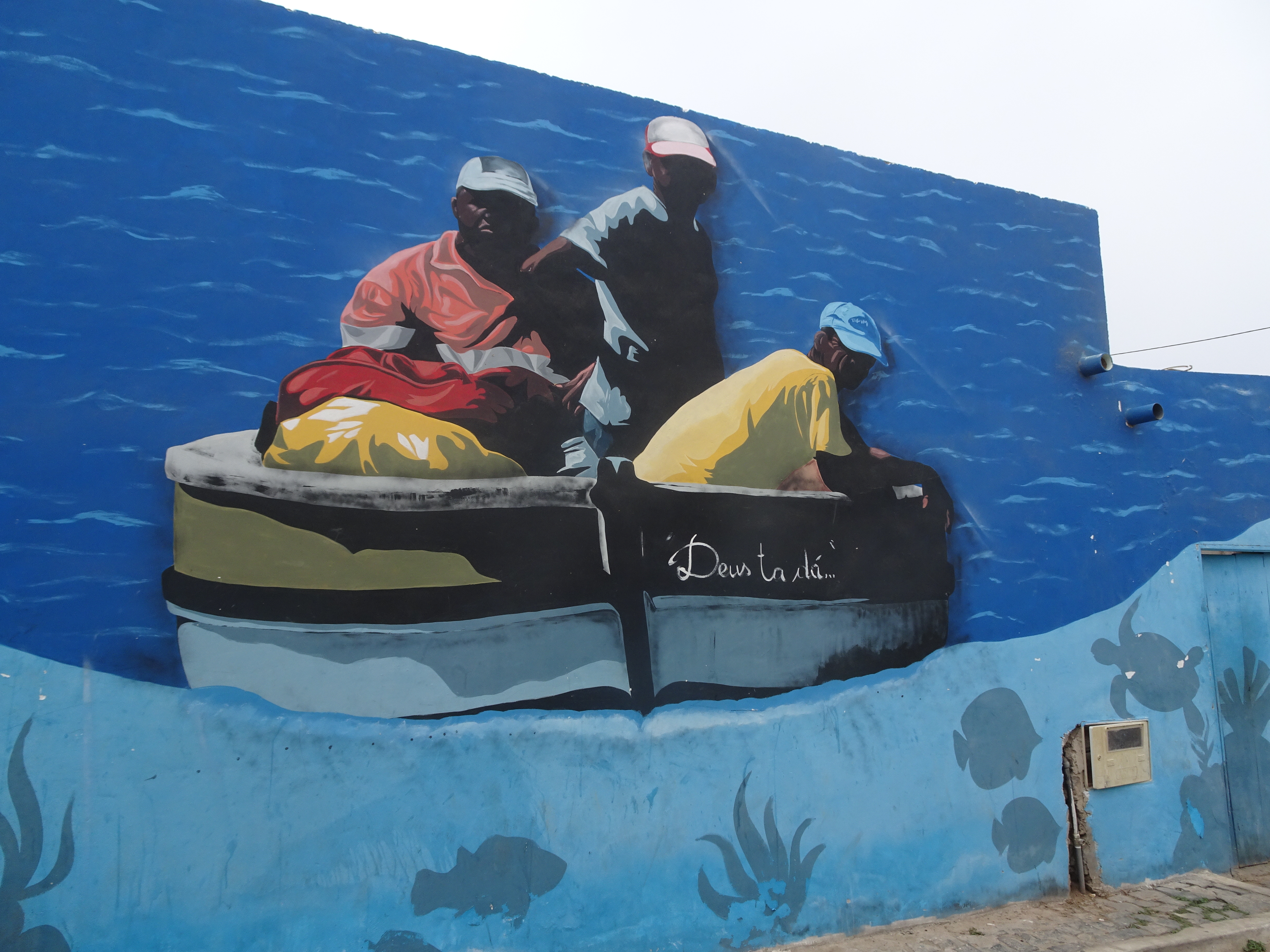
We skirt the edge of Espargos and drive on to Palmeira, which is, apparently a ‘fishing village’. In the event it’s an area on the fringe of town with a few, colourful, picturesque cottages sporting murals, a church and a marina housing fishing boats. On the quayside there’s some fish preparation going on and up on the narrow road a stream of pickups and tour buses is lining up. Elton opens the doors for us but it takes next to no time to walk the two or three streets. He stays behind with the car and gestures feebly at the tiny harbour and I wonder if he’s disappointed we are not inclined to visit the gift shop or spend longer looking at the harbour. We climb back into the car.

The tour continues [in next week’s post!]…

Grace is the alter ego of novelist and short story writer, Jane Deans. To date I have two published novels to my name: The Conways at Earthsend [https://www.amazon.co.uk/Conways-at-Earthsend-Jane-Deans-ebook/dp/B08VNQT5YC/ref=sr_1_1?crid=2ZHXO7687MYXE&keywords=the+conways+at+earthsend&qid=1673350649&sprefix=the+conways+at+earthsend%2Caps%2C79&sr=8-1 and The Year of Familiar Strangers [https://www.amazon.co.uk/Year-Familiar-Strangers-Jane-Deans-ebook/dp/B00EWNXIFA/ref=sr_1_1?crid=2EQHJGCF8DSSL&keywords=The+year+of+familiar+strangers&qid=1673350789&sprefix=the+year+of+familiar+strangers%2Caps%2C82&sr=8-1 Visit my writer Facebook page [https://www.facebook.com/search/top?q=jane%20deans%2C%20novellist%2C%20short%20fiction%20and%20blog or my website: https://www.janedeans.com/

Highs and Woes in Cape Verde

The first few days after arriving to a new destination are all about discovery and exploration. After our breakfast on the first full day on Sal, Cape Verde we divide our time into relaxation and walking, since walking is one of the best ways to get around. There is very little traffic around our area and what vehicles there are tend to be taxis or other tourist transport. Some are pickups in which tourists are required to sit at the back in the open air and we are not tempted by them since a] the winds are brisk and cool and b] there is nothing resembling any kind of seat belt.

I’ve woken with a sniffly, runny nose since our arrival. A child in the queue at the airport was stricken with a streaming cold, which has, presumably affected most of the passengers on the Lisbon plane.

Nevertheless we wander to Santa Maria, our nearby town and then further still, to beyond the town and along a decked walkway to a much more upmarket area of chain hotels- Radisson, Hilton etc. The beaches are vast and unsullied by sunbathers [it’s not warm enough!] but attended by windsurfers and kite surfers. There are many companies doing a roaring trade in board and sail hire, also tuition. There is an abundance of cafes and restaurants- as well as the ubiquitous ‘Irish pub’.

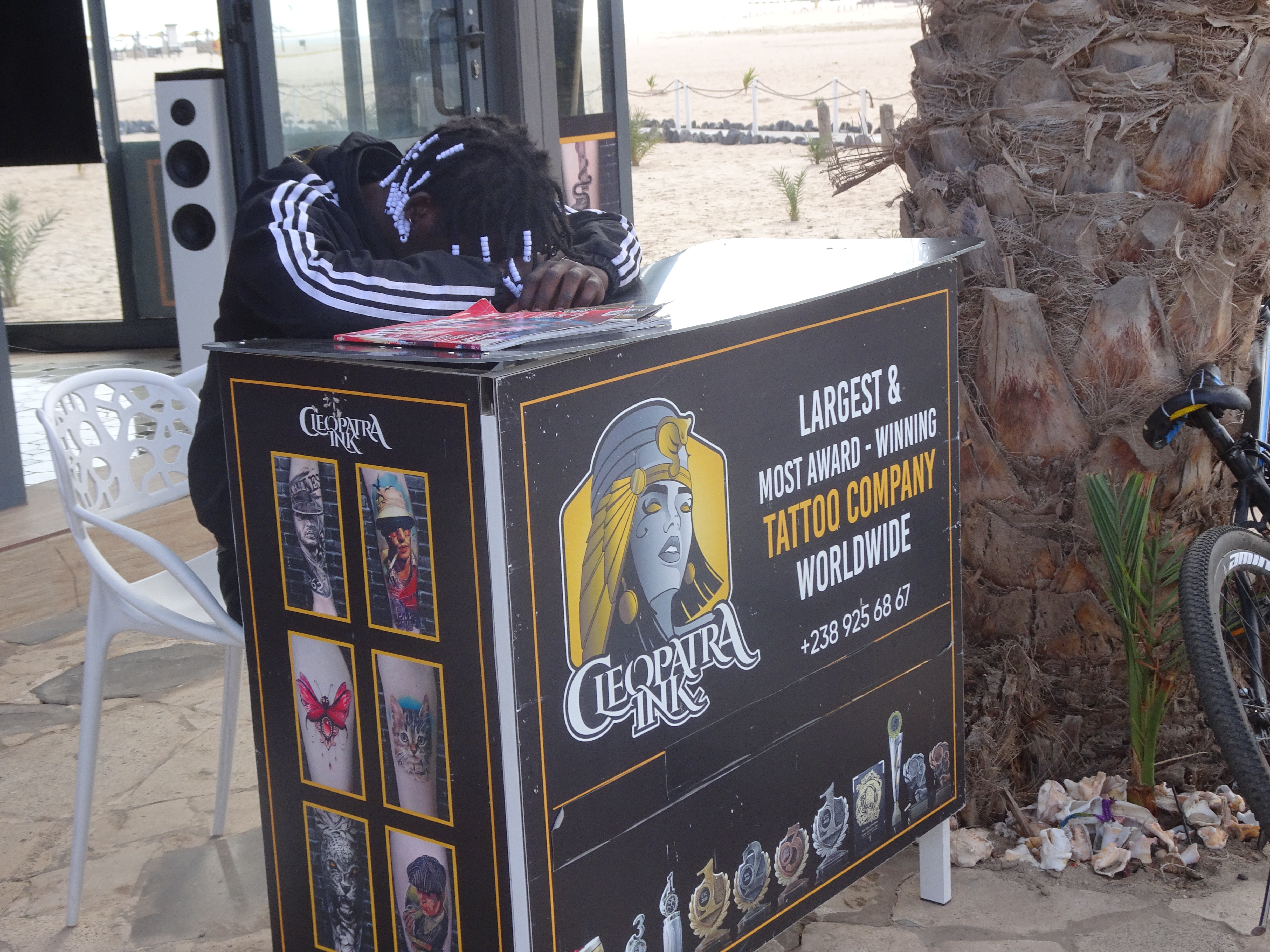
Along the walkway we spot horses, tattoo parlours [not too busy!], gift shops and hawkers of small items spread on sheets and we are waylaid countless times by sellers hoping to catch our attention. Many of the items for sale are made of recycled/upcycled materials and a huge amount of it is from shells. In fact I’m struck by the plethora of recycled and repurposed items around; planters from halved containers, beach shelters from tyres, bar furniture from old pallets and so on.

We’ve dined in the hotel on our first evening, which happened to be Valentines’ Day, an acceptable though not stupendous meal, accompanied by a lacklustre guitarist/singer warbling out ballads from the likes of Ed Sheeran. Now we’re up for a more adventurous evening and we opt for a busy restaurant on the way into town, Porto Antiguo, where there’s a jollier guitarist and a lively atmosphere. It is to become one of our preferred restaurants for its friendly service, good food and fun atmosphere.

Husband succumbs to the cold and has a much worse experience, streaming and sneezing for the next few days.

The hotel manager comes to the room to tell us ‘Your room is ready’, which is mystifying. Later, her colleague comes to explain that this is not our room and we must move, that the enormous room we’ve been occupying is a ‘suite’, that our booked room is a modest, balcony-free room somewhere else and that the night receptionist should have informed us upon check-in. Hm…

We move. We’re not too unhappy. We’ve a kettle and a better fridge and the shower is nicer. We still have an ocean view and can use the poolside loungers- except that the weather continues to be rampantly windy in between bouts of sun.

Husband’s cold gets better. I begin a UC flare [for more recent readers, here’s the link: https://gracelessageing.com/2014/12/07/journey-to-the-centre-of-the-colon-a-gastric-odyssey-with-apologies-to-jules-verne/] I’m well prepared with meds, although it sheds a blight over activities, dining and enjoying an occasional beer. Bleurgh!

But we’re aware we haven’t seen much of the island and will need to book a tour, which we do, with the hotel. It’s to be a ‘private’ tour in a 4X4 rather than a pickup and will also need to be an afternoon jaunt, owing to the flare [always worse in the mornings]. We settle on a day nearer to the end of our stay to allow some degree of recovery for both of us…

Grace is the alter ego of novelist and short story writer, Jane Deans. To date I have two published novels to my name: The Conways at Earthsend [https://www.amazon.co.uk/Conways-at-Earthsend-Jane-Deans-ebook/dp/B08VNQT5YC/ref=sr_1_1?crid=2ZHXO7687MYXE&keywords=the+conways+at+earthsend&qid=1673350649&sprefix=the+conways+at+earthsend%2Caps%2C79&sr=8-1 and The Year of Familiar Strangers [https://www.amazon.co.uk/Year-Familiar-Strangers-Jane-Deans-ebook/dp/B00EWNXIFA/ref=sr_1_1?crid=2EQHJGCF8DSSL&keywords=The+year+of+familiar+strangers&qid=1673350789&sprefix=the+year+of+familiar+strangers%2Caps%2C82&sr=8-1 Visit my writer Facebook page [https://www.facebook.com/search/top?q=jane%20deans%2C%20novellist%2C%20short%20fiction%20and%20blog or my website: https://www.janedeans.com/

Starting Back

4 Revisions

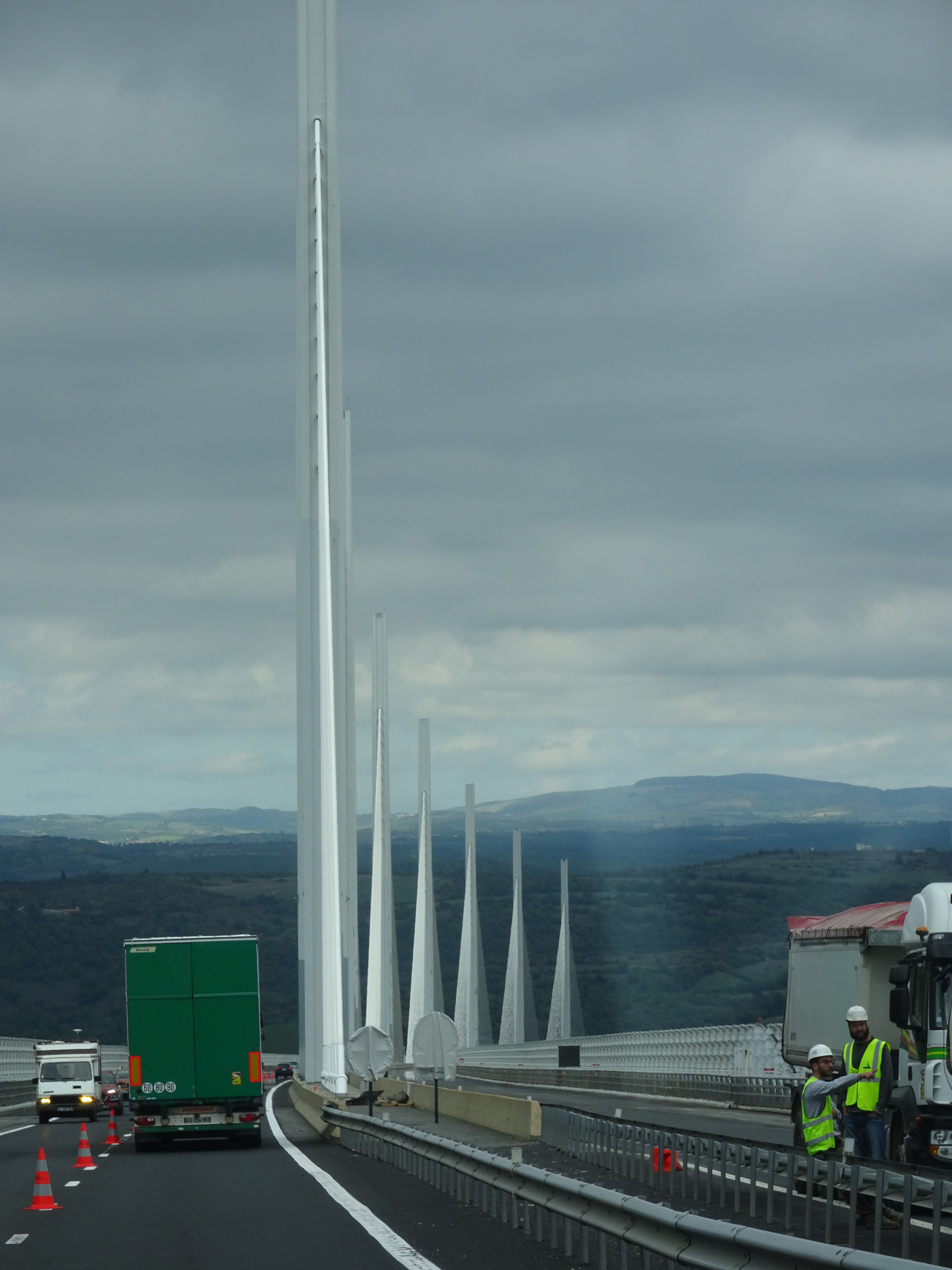
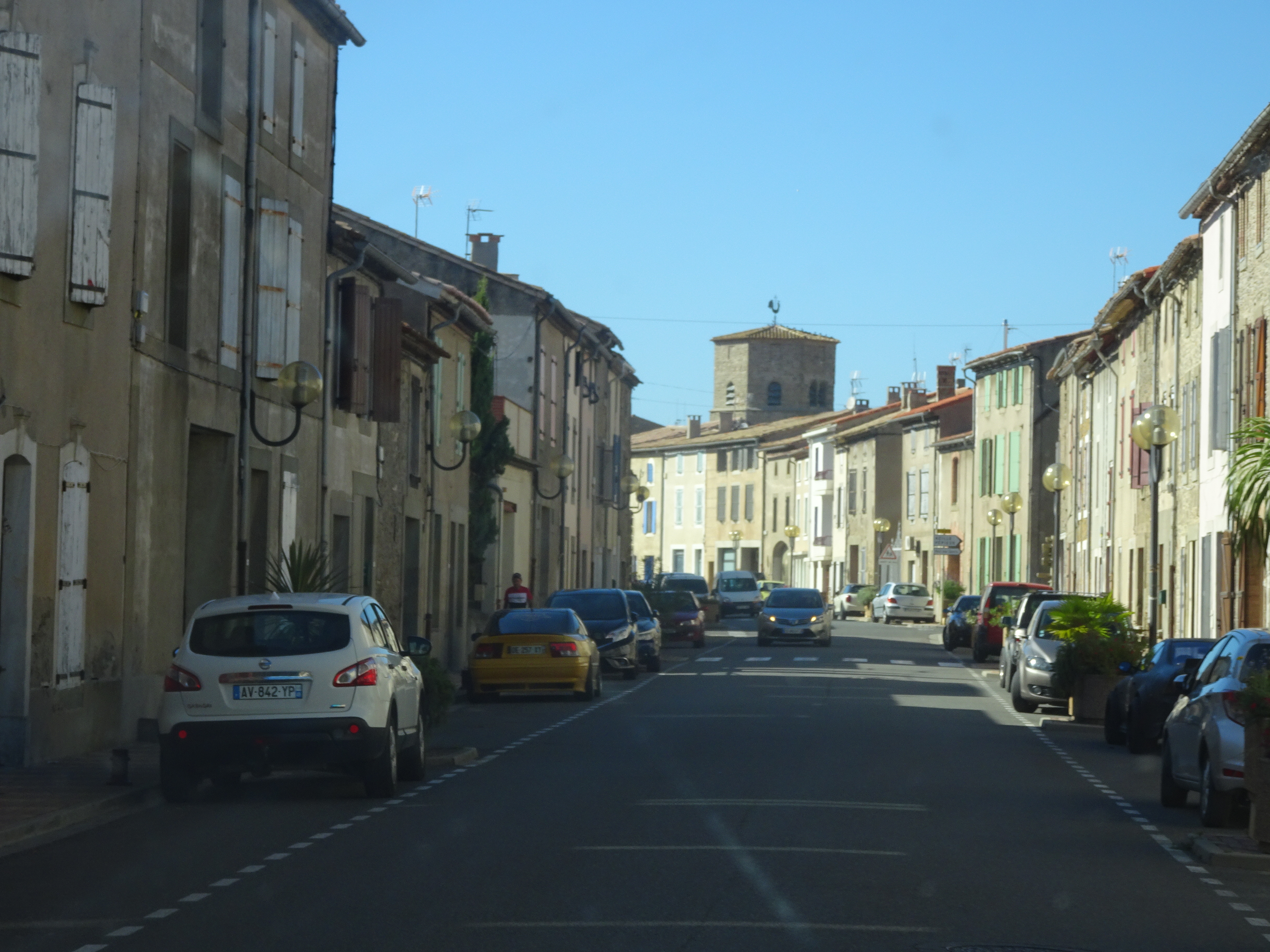
After leaving Caunes Minervois in the far south of France, and an arty interlude, we set off north. And while we’ve journeyed up through France many, many times it’s still a pleasure to meander up through the country and experience the differing landscapes, the changing crops, the divers architecture. We’ve crossed the fantastic bridge at Millau on numerous occasions but it continues to inspire awe, even though this time there is work being done.

We opt for autoroutes for a good deal of the way on this occasion. We head up towards the Loire. We’re constrained, now by campsites that are still open this late in the season but there will be enough places to stay on the way home. It helps, too, if there are sites near to towns or villages where we can enjoy an evening, perhaps get a drink in a bar or a meal.

There’s a likely place across the bridge at Chateauneuf-sur-Loire. We think we’ve stayed at the site before but once we arrive and enter the long avenue that is their driveway we realise it isn’t the one we thought it was. This happens often- either we think we’ve stayed somewhere and haven’t, or we think it’s new to us and then remember we’ve been at the site before. This is a combination of memory loss and sheer number of sites visited!

We park on the long avenue/driveway and go to reception, where there is a lengthy wait while someone booking in enjoys a chat with the receptionist about where they’re from etc and the receptionist tells the someone how much she enjoys speaking in her fluent English. Once we get our turn in the small office, the young woman is determined to use her English once more, even though it is not so fluent and we’d have got on better in French. Still, we eventually book in and can choose where to go except not near the river, where it is decidedly soggy.

There is still enough sunshine to sit outside the van, although we’re accosted by an English couple from the VW van opposite who are keen to talk about their grandchildren and how they’ve had to go home and return in order not to fall foul of the 90/180 day rule. This rule is news to us, and when we check it transpires we’ve used 87 of our 90 days. Phew!

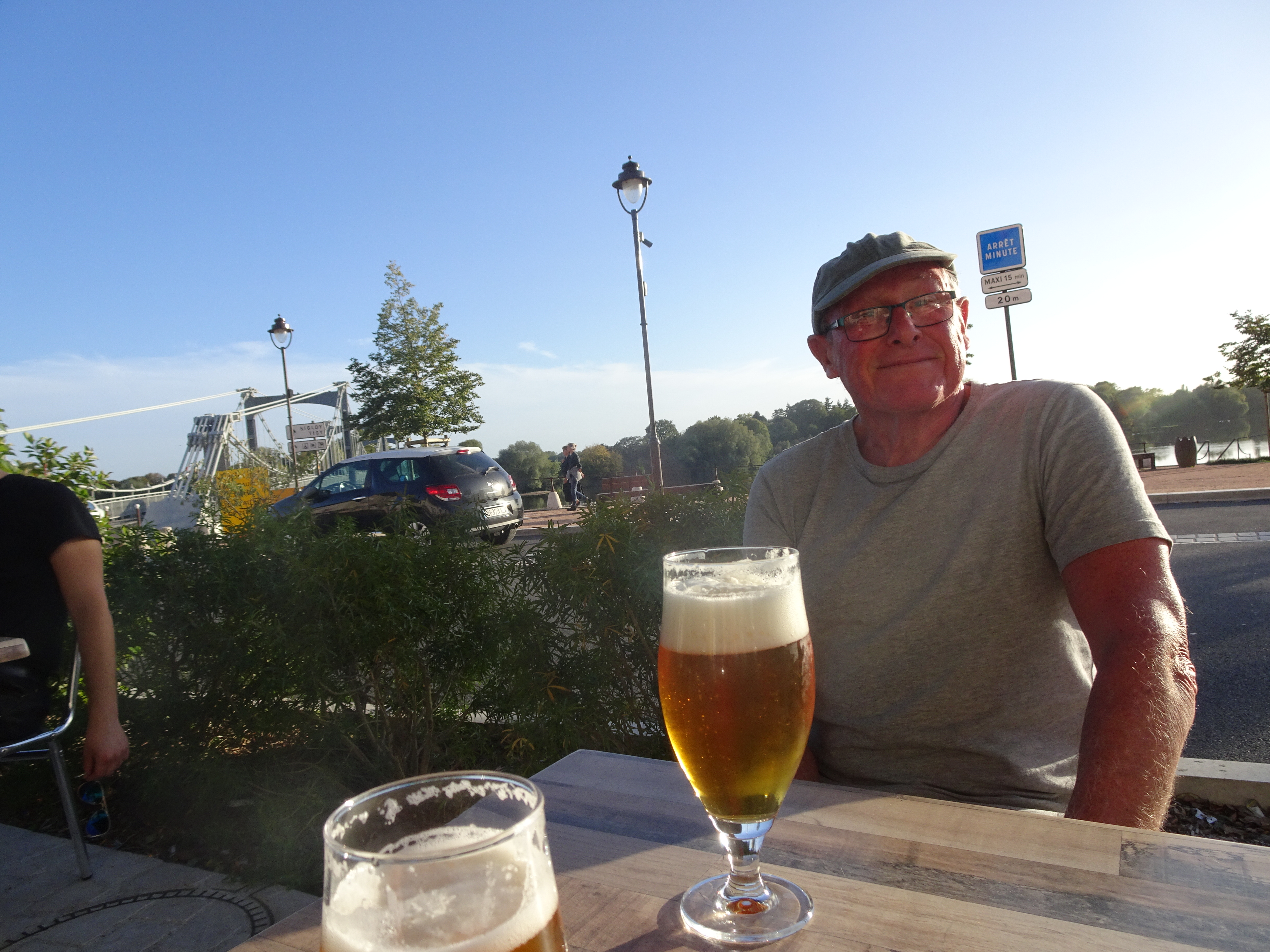
We wander across the bridge to the town, which is pleasant enough, with a tiny chateau and park. The shop windows are full of autumn displays. Nothing restaurant-related pops out, but a riverside bar has tables in the sun so it seems churlish not to take advantage for a beer in the sunshine.

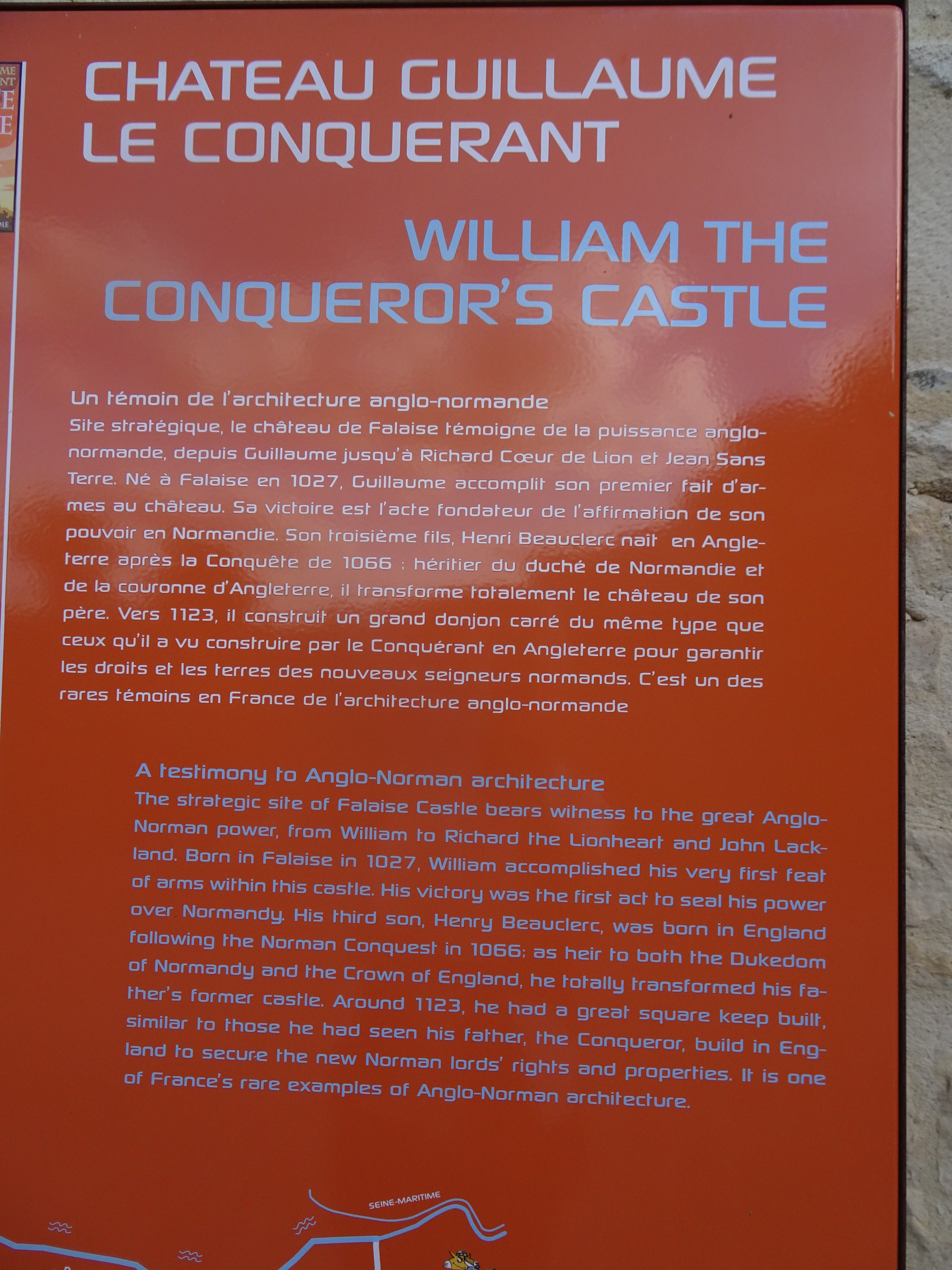
Next day we’re unable to detect anything resembling a hosepipe for water filling and the waste emptying is coyly concealed. We make an exit and embark on the next hop- up to Falaise, which holds some pleasant surprises! The municipal site is beautiful, with excellent, modern services and a stunning view of the stand-out castle- William the Conqueror’s castle, no less! By the time we get up the hill to look at it there’s only about half an hour of visiting time left, so it’s not worth buying tickets, but the exterior is lovely and boasts great views of the surroundings.

It’s just as well we’re on our way home, since the van’s leisure batteries have now given up and there’s no point in hooking up as nothing seems to happen when we do. So we’re without electricity.

Then we’re off up to Caen-via a supermarket, of course, for a good stock-up. The trusty campsite at Ouistreham is open and, best of all, the lovely canal-side restaurant has a table available. Husband drops me off to rush in and do a booking. It’s all getting end-of-trip now and I’m experiencing my usual mix of regret and anticipation. What kind of state will the house be in? And the garden? We’re limping home with some van problems to sort out. There will be plenty to do!

Grace is also known as the novelist, Jane Deans. Her latest novel, The Conways at Earthsend is available from Amazon, Waterstones, Goodreads, W H Smith, Pegasus Publishing and many more sites. Visit my website: janedeans.com or my author page on Facebook: (1) Jane Deans, Novelist, Short Fiction and Blog | Facebook.

The Lost Van and the Art Village

Our Ferry from Corsica arrives back to Toulon, south on the French mainland. It’s early enough to still be dark and I’m feeling stretched from lack of sleep, having spent a wakeful night on a mattress I’ve dragged from the top bunk. But we stumble out and make our way out of the cabin decks and in the general direction of the car decks. But which one? We came up from our deck in a lift, but there is more than one. I definitely recall a large, shiny space when we exited the lift- but where is it?

We begin to search all exits, trying staircases, of which there are many, descending to car decks, lorry decks, dead ends. Which deck is ours? Which side? And which end? We squeeze between gigantic lorries, searching for our van. Outside in the half-light of dawn, vehicles are streaming out and off while we continue to do a frantic search for our campervan. We’re starting to despair as we go back upstairs to try again to find our lift area- then we spot a group of foot passengers in a waiting area which is…shiny, spacious and outside some lifts. At last! We push through the foot passengers and go down to the depths. And there is our van, in almost solitary splendour except for a few vehicles trapped behind it, their drivers waiting for us to arrive and a few extremely irritated ferry crew members. We’re sheepish as we drive off and I’m mouthing ‘sorry’, although it doesn’t feel entirely our fault.

We’ve to navigate Toulon in the half-light then off up the motorways. We’re heading towards home now, although France is big [by our terms] and we’ll be making a small diversion to see a friend and ex-colleague of Husband’s. Nick was an art teacher and is now a successful painter living in a small village in the Minervois area. This entire region is almost entirely given over to wine production, with a spot of tourism thrown in- as well as art, of course.

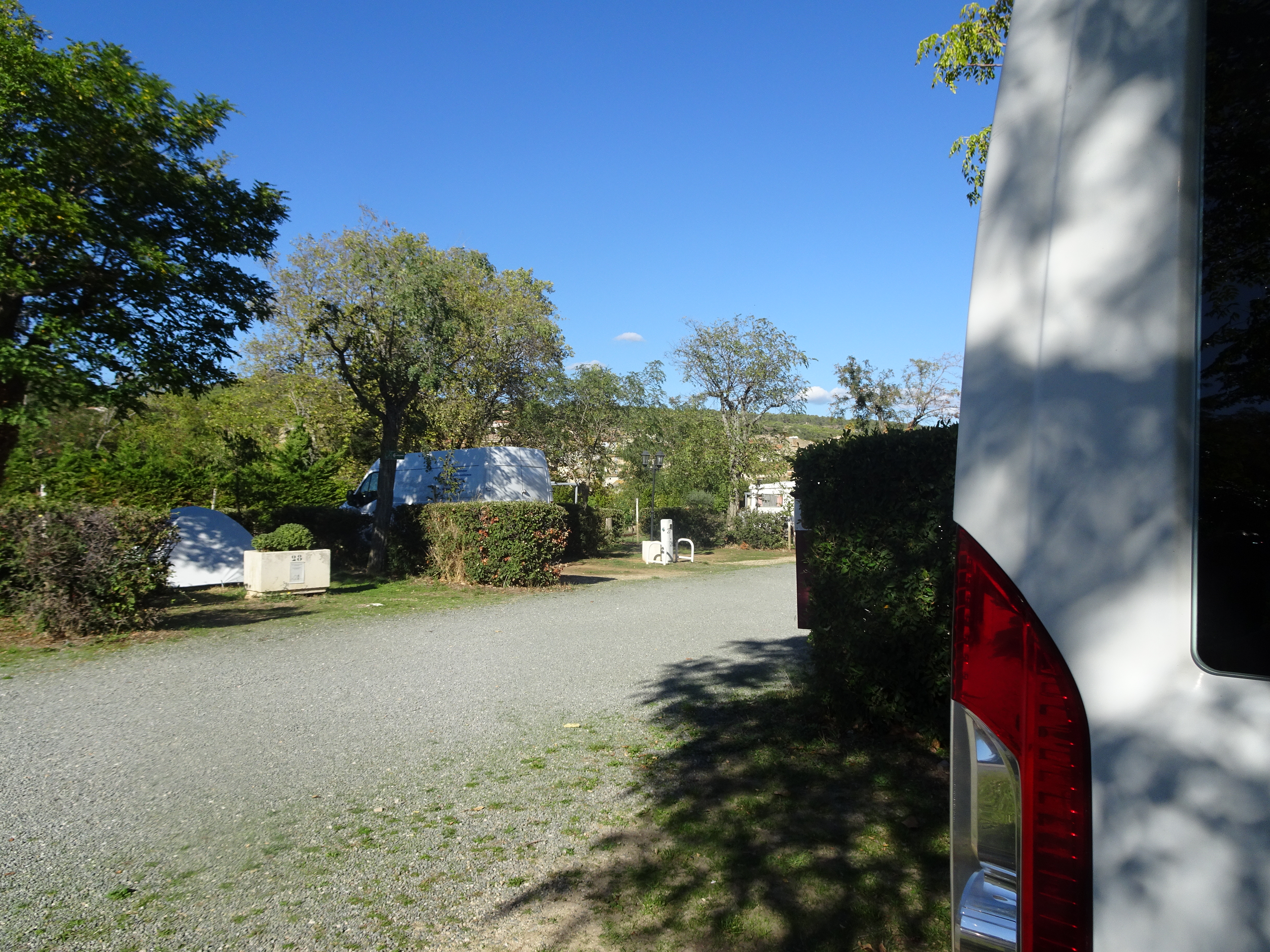
The village where Nick lives, Caunes Minervois, has a community of artists including potters as well as painters. We arrive mid-afternoon and search for the village’s handy campsite, which, as Nick has established for us, is open. The entrance isn’t obvious, although it’s by the sport complex, which is commonplace for a municipal site. There’s nobody manning reception but we’re directed, via a notice, to find a place and see someone later. The site is tiny but lovely, with a view of the cute village. It’s beautifully maintained and has everything we need- and all for 12 Euros per night!

Husband strides off up the village to see his friend while I get an hour or so of sleep. We wander up to Nick’s cottage later in the evening, strolling through the lanes. It’s hilly, narrow streets flanked by stone, terraced cottages. There’s a stone cross and a beautiful bell tower on the church. It’s all idyllic. Opposite Nick’s house, on the sloping lane, lives a potter, Lionel- examples of his ceramics adorning his front yard.

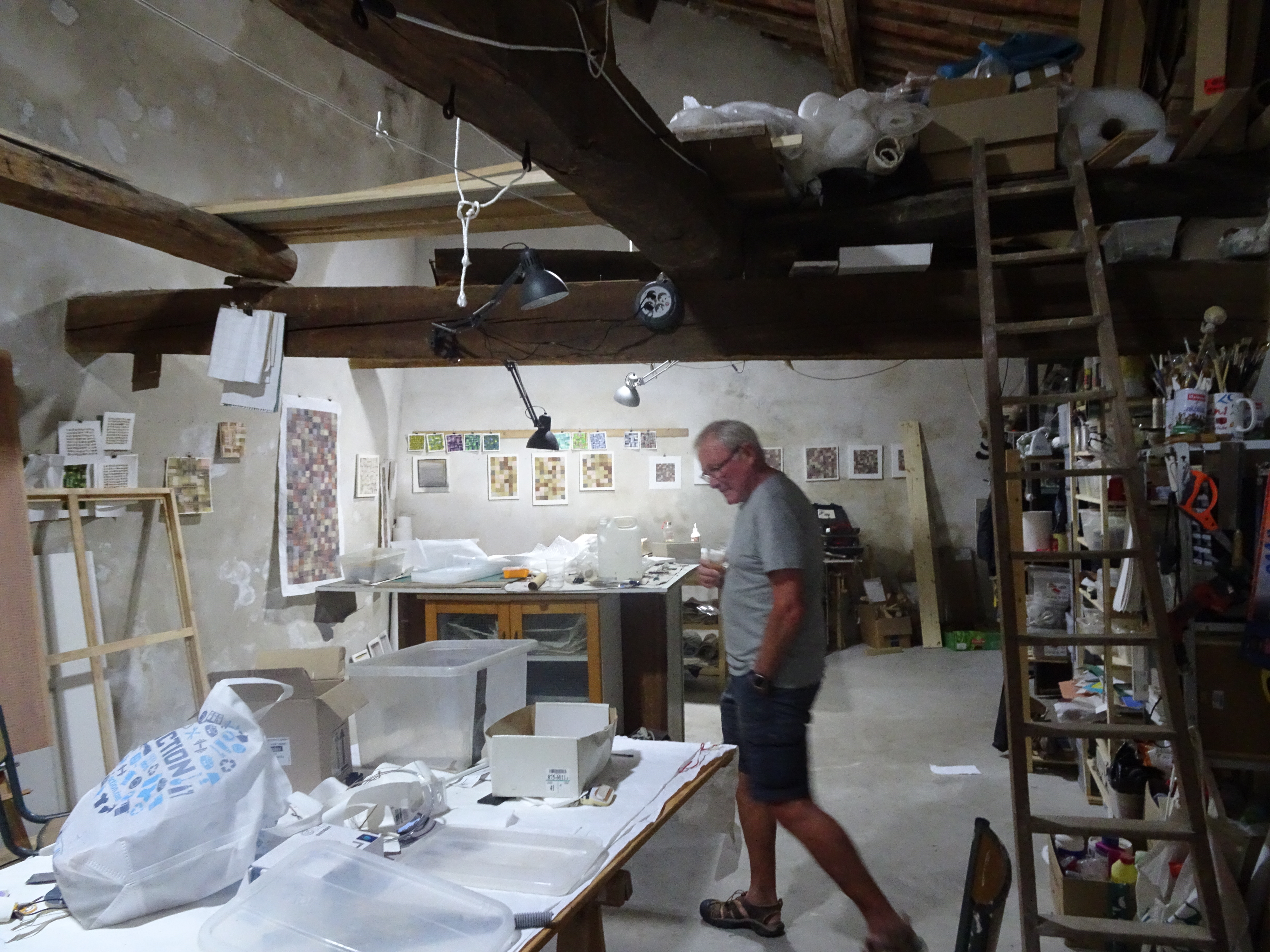
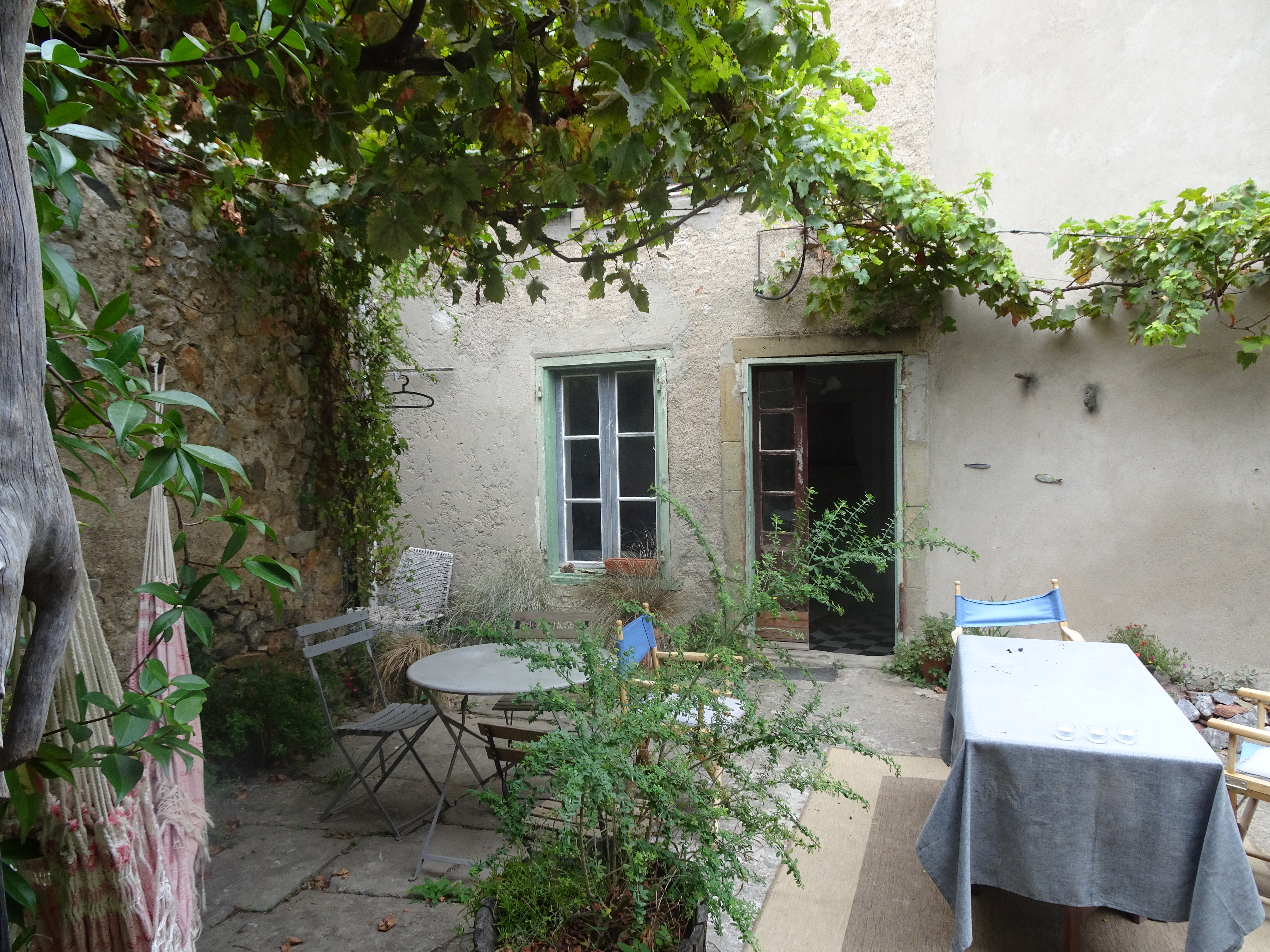
The inside of Nick’s house is as quaint and cute as everywhere else, with small rooms leading on to a courtyard partly covered by a vine. The rooms are filled with his art works, large canvases, swirling and vigorous. Across the courtyard is his huge studio, rustic and criss-crossed with beams. It’s warm enough to sit in the courtyard to eat.

It’s late when we walk back through the village to the campsite. Nick has warned us that the streetlights will be off and indeed, it is dark, but there’s enough light to see to walk and there’s something lovely about the ancient village, silent in the dark.

In the morning Nick comes to us for coffee and we ask to buy a painting, making a quick second visit to the studio to choose. It’s tricky! Nick’s work is shown in many, prestigious exhibitions, including the Saatchi Gallery and Brazilian locations. https://www.saatchiart.com/account/profile/938067 But we reach an agreement and he wraps it carefully for us to take away.

I feel reluctant to leave but we must make progress north now that Autumn has taken firm hold so we bid Nick ‘au revoir’ and we’re off again…

You can visit Nick’s Facebook page here: https://www.facebook.com/search/top?q=nick%20rands

Grace is also known as the novelist, Jane Deans. Her new novel, The Conways at Earthsend is available from Amazon, Waterstones, Goodreads, W H Smith, Pegasus Publishing and many more sites. Visit my website: janedeans.com or my author page on Facebook: (1) Jane Deans, Novelist, Short Fiction and Blog | Facebook.

Ajaccio and Away!

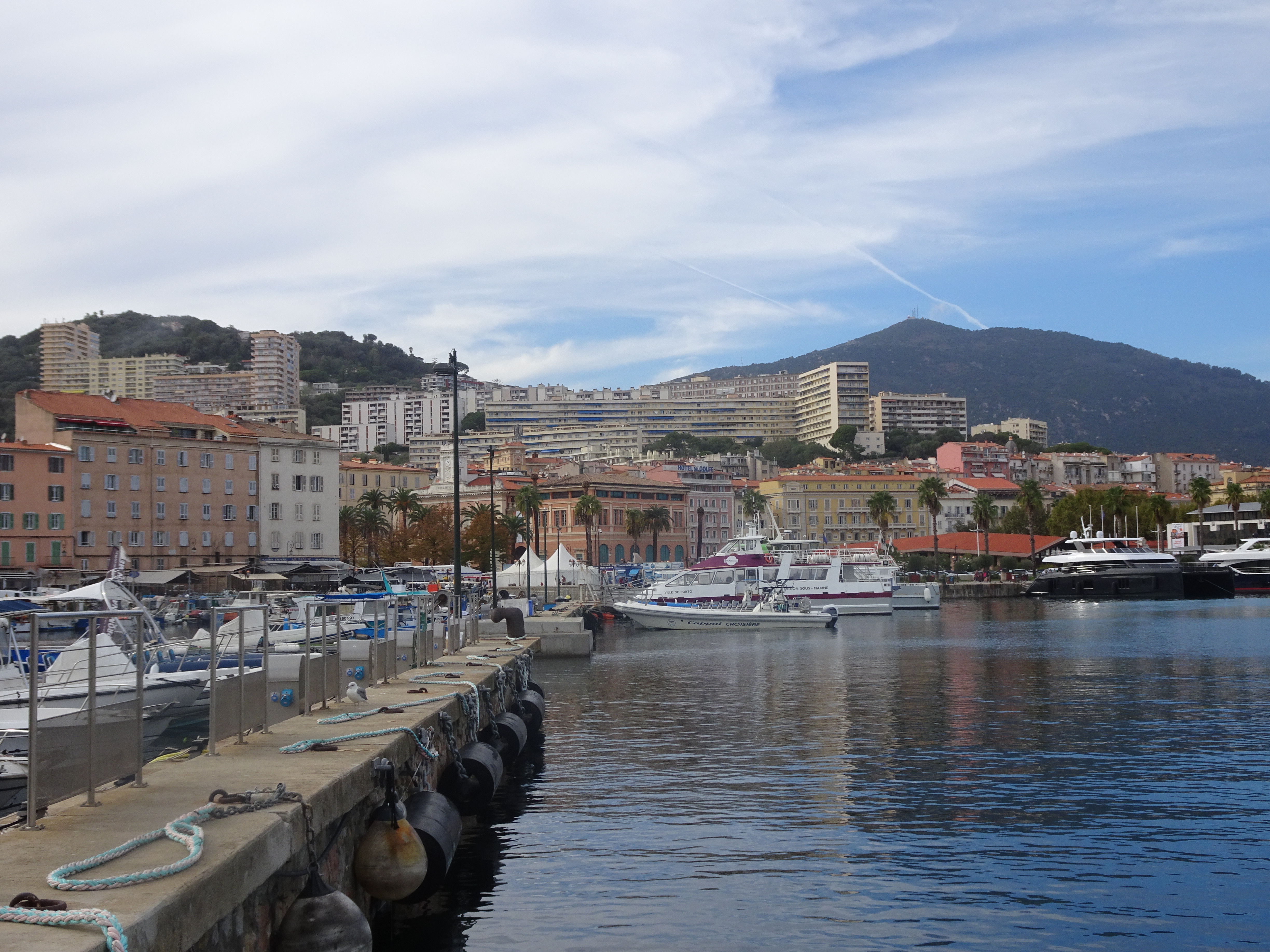
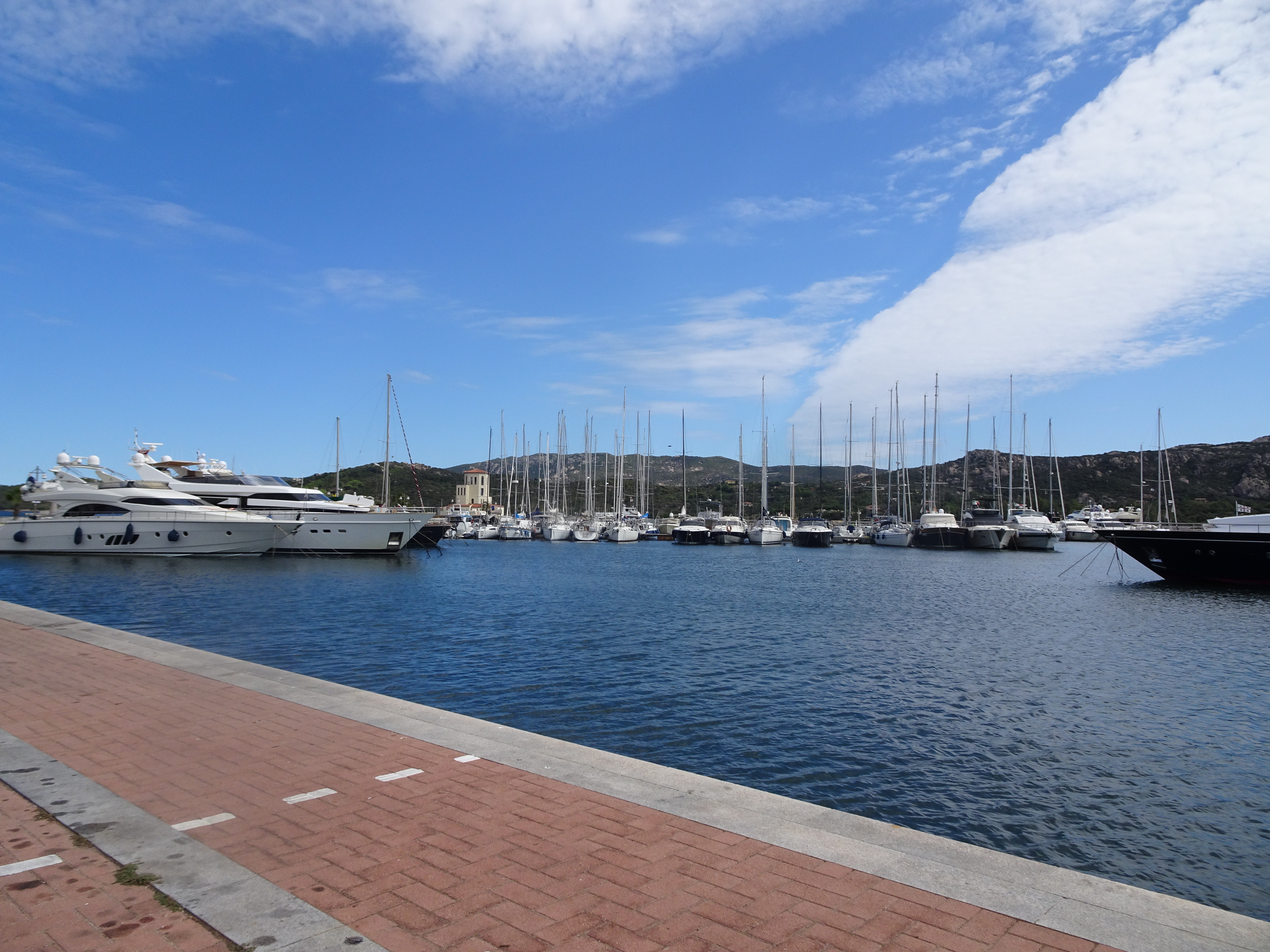
Ajaccio, Corsica’s capital, is a beautiful, pastel-coloured city sweeping around a bay in the west of the island. It has a busy port with ferries coming and going, a few cruise ships stopping by and a marina full of expensive yachts.

One of our first jobs in the town is to find the ‘Orange’ shop and renew the SIM card in our mobile wifi device. This is the only way, for now, that we know how to keep internet costs down while travelling in Europe and I’m nostalgic for the pre-Brexit days when we never had to consider such things.

The city is everything you’d expect from a grand, old Mediterranean municipality- narrow streets edged with tall, terraced buildings, grand squares dotted with palms and a beachside citadel, sadly not open to the public but picturesque all the same.

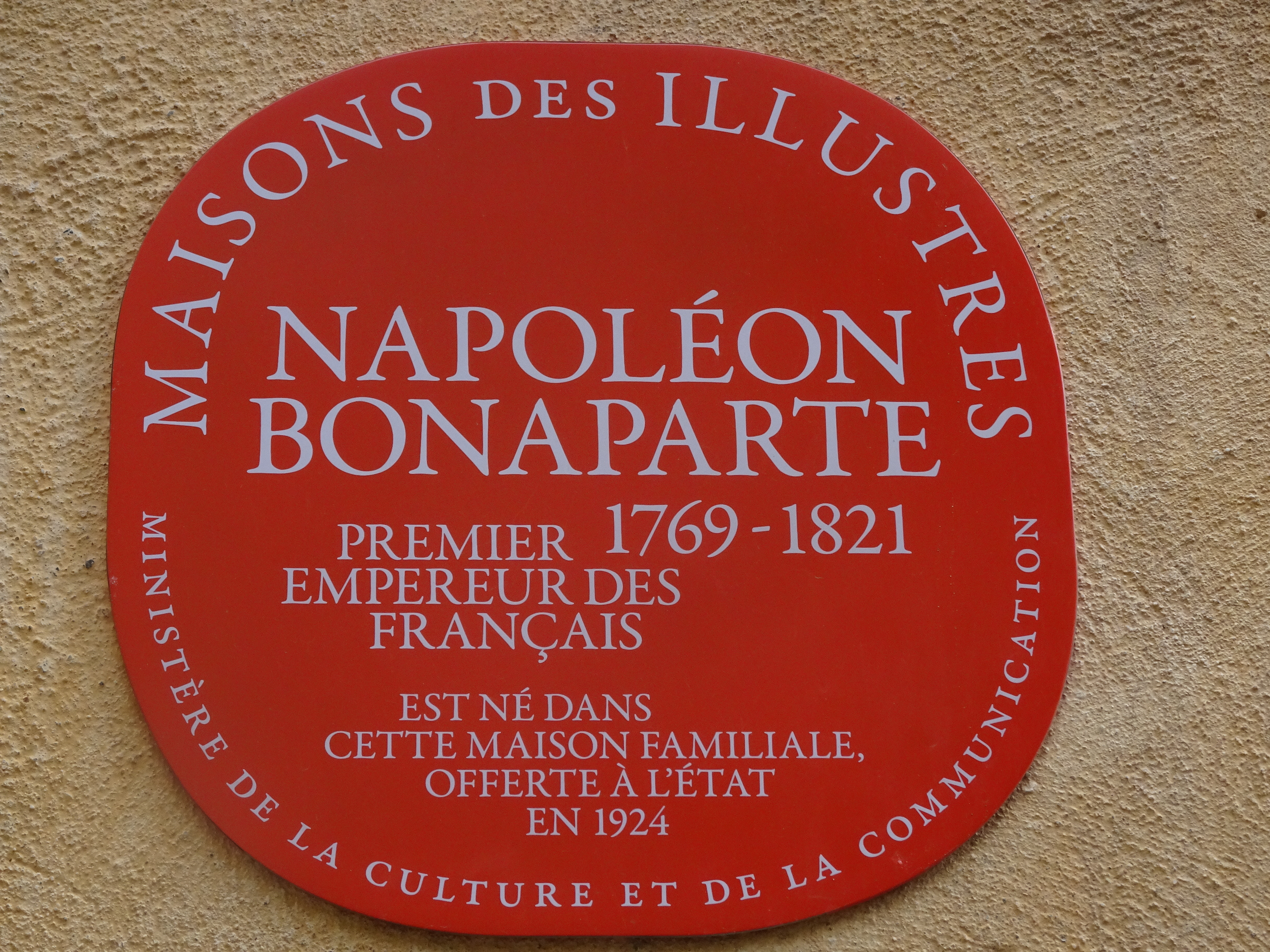
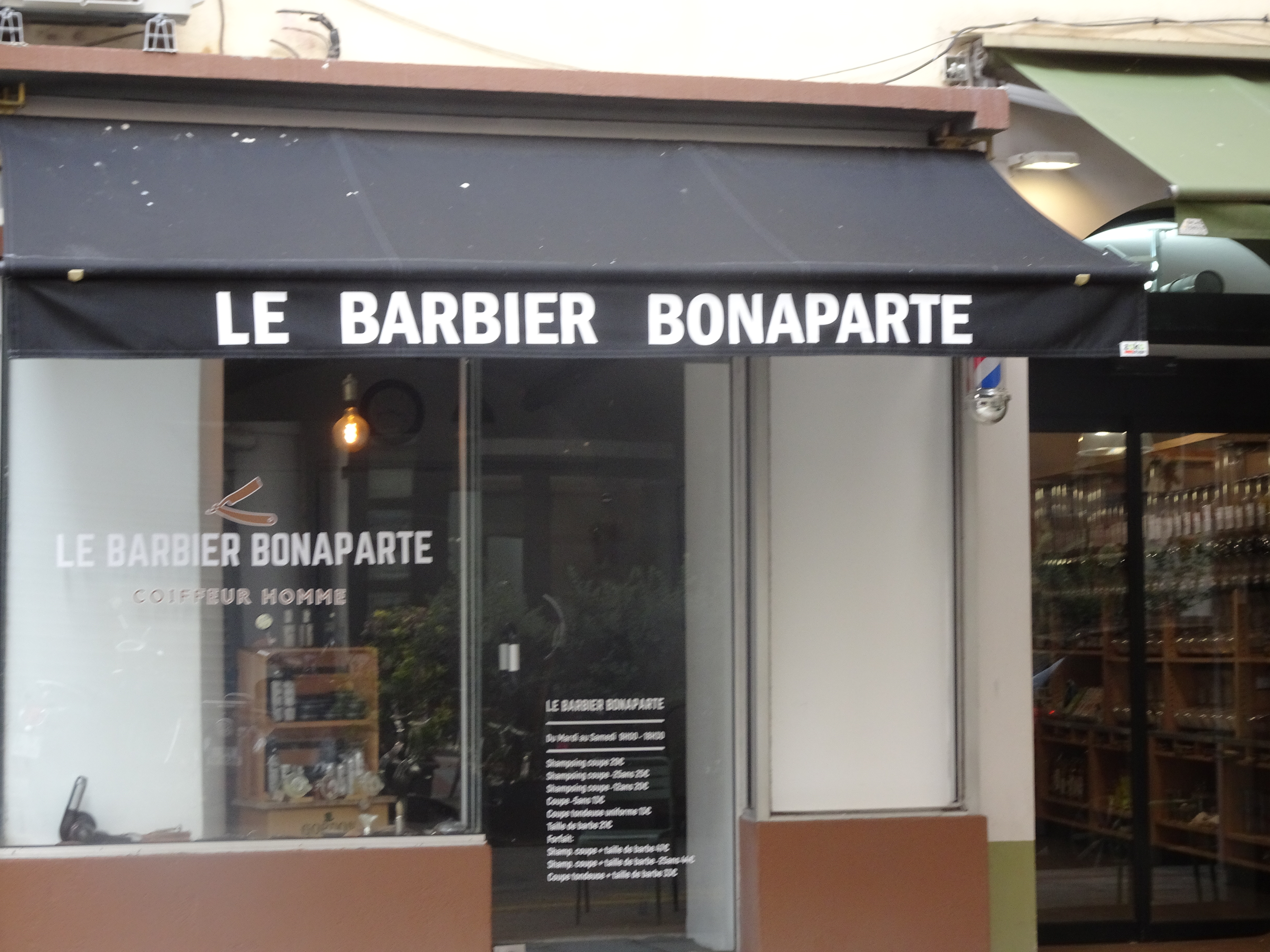
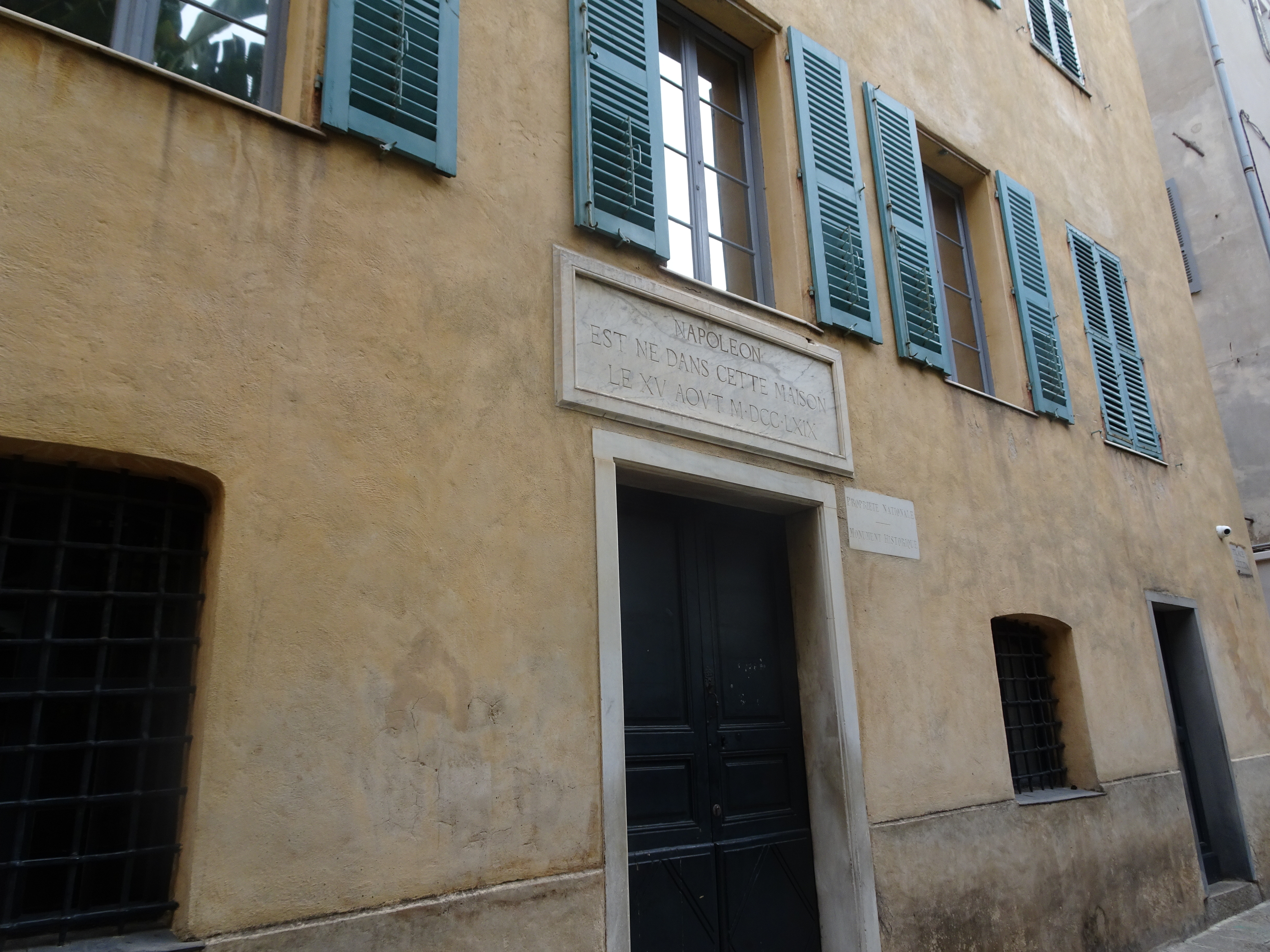
One of Ajaccio’s claims to fame is being the birthplace of Napolean Bonaparte, a historical event much capitalised upon. Boney is everywhere, from pubs to barbers’ shops. We find his actual house in a tiny, cluttered street; a modest building next to a bar. Almost everything in the street is Napolean-related and there are groups of tourists eagerly snapping away.

The town’s main square is huge and houses the Hotel de Ville as well as ornate fountains. There is, of course a plethora of gift shops, bars and cafes. They are competing for cruise passengers’ cash. There’s a huge, white floating hotel in the harbour and it’s easy to spot its occupants as they wander the town dressed in their cruise outfits. They’ll be returned on board by the time we begin to look for a restaurant, so we’ll have plenty of choice.

In the late afternoon we need to look for somewhere to eat, principally because we’ll need to get in the queue for the ferry in a couple of hours. It’s tricky. Here in the Med, folks tend to eat late, with or without children, which means the restaurants don’t open until late, either. But most have a 7.00pm opening, which is just about ok for us to be in time to queue. We gravitate towards the dockside, a location that we know from experience is likely to provide a good choice of eateries. It’s fair to say that the meal we choose is fine, though not as inexpensive as most of our restaurant meals on Sardinia and Corsica have been.

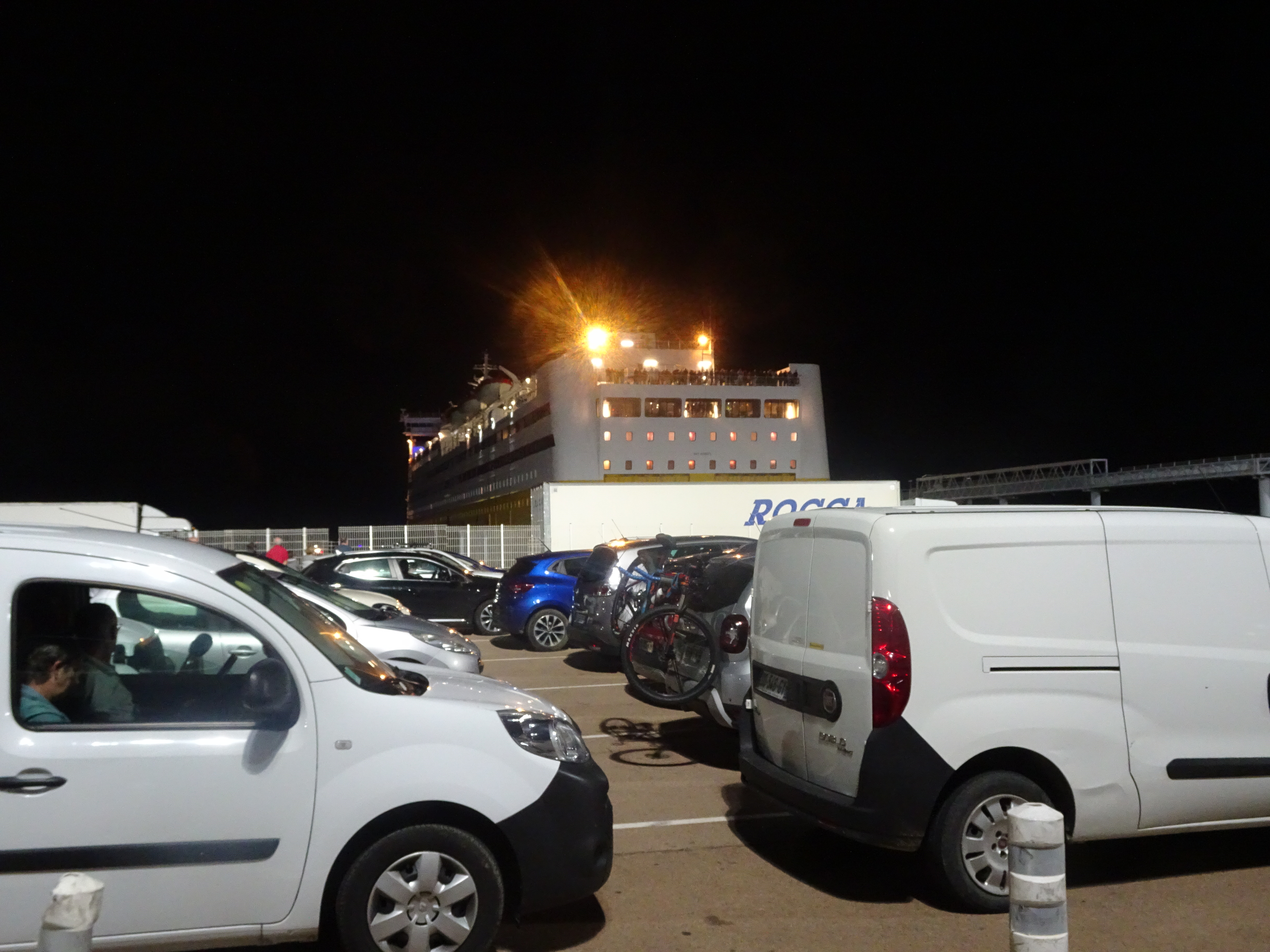
Then we’re negotiating the complex maelstrom of roundabouts and slip roads which take us to the port and thrusting phone screen barcodes at various neon-vested ferry workers. A group of three lads seem to have a bantering discussion over the size of our van, despite us telling them the length but at last we’re directed into the appropriate lane and just have to wait. We’ve done all this enough now, to know the routine. There’s a long wait but once the ship arrives everything happens quickly, the inbound vehicles streaming out and disappearing into the [by now] dark and the processing of the outbound traffic. It’s like some complicated puzzle, fitting all the assorted cars, vans and motorhomes into the hold and then it’s our turn.

There’s little information or direction to the way we must access the passenger decks. This is not Brittany Ferries- where a member of staff hands you a ticket with the coded exit and stairs you need to use. We are left to work it out. We’re sandwiched tightly between huge lorries but there is a lift nearby that we can squeeze our way through to. When we get up to the passenger deck we exit into a large, shiny space with lifts either side of us. I’m weary by now and in an addled state, neglect to notice where we are. We’re intent on 1] finding our cabin and 2] finding the bar, both of which we manage to do.

I’m a little dismayed to find that our cabin has bunk beds, meaning that one of us will have to clamber up and down a ladder. This is not good. Nowadays, both Husband and I need to take nightly trips to the toilet, which is housed in a bijou en-suite in a corner. There’s a hiatus while we both ponder whether we will be the one to undertake this, then I volunteer to sleep on the floor and remove the mattress from the top. There’s just about room to put it on the floor with the end tucked under the bottom bunk.

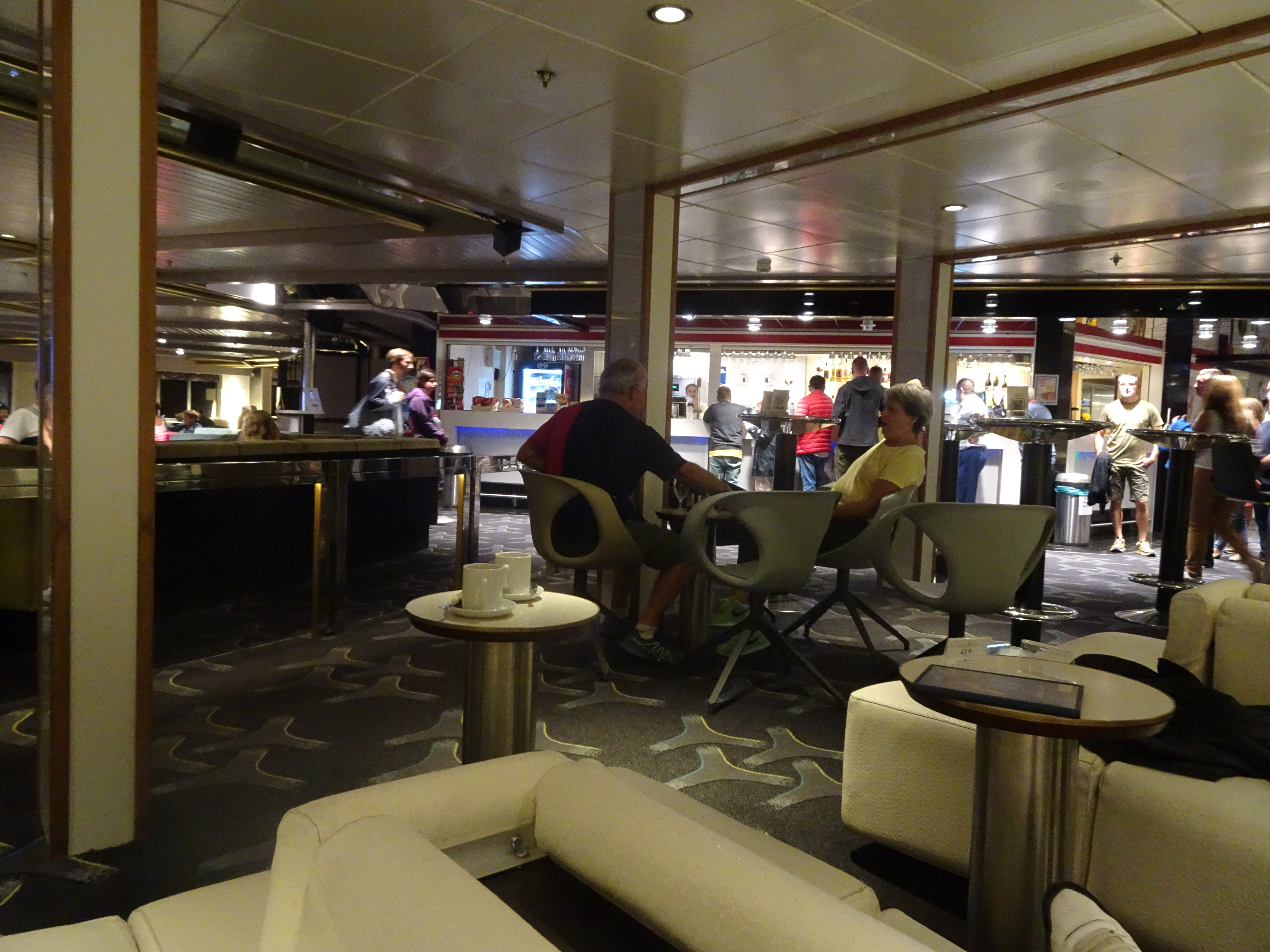
We decamp to the bar, where we toast our departure amongst a throng of fellow passengers. Through the blurry windows Ajaccio recedes. There’s nothing else but to retire to the cramped cabin. I tuck myself into the duvet on the floor, hoping not to be trodden on by a bathroom visiting Husband.

In the event, it’s not a restful night’s sleep and I’m glad of my Kindle for whiling away the hours until we pull into Toulon. I’m unrested, stretched and brain-fogged from lack of sleep as the ship shudders up to the quayside. It’s still dark outside as we stumble up and stow our things. Now, how do we find the van? Hmmmmm……

Grace is also known as the novelist, Jane Deans. Her new novel, The Conways at Earthsend is available from Amazon, Waterstones, Goodreads, W H Smith, Pegasus Publishing and many more sites. Visit my website: janedeans.com or my author page on Facebook: (1) Jane Deans, Novelist, Short Fiction and Blog | Facebook.

Corsica- the Last Gasp

When we get back to the south of Corsica from Sardinia we head towards Propriano, slightly to the west, although en route we’ve a plan to see a startling outcrop of coastal rock called the ‘Rocher de Lion’. It’s more wiggly, mountainous terrain but worth it, as the lion rock is amazing. We’re lucky to be able to stop for photographs in a small lay-by which houses a cafe, closed when we arrive. It’s also a convenient place for us to make a coffee.

There’s an ancient, neolithic site we’d like to see, inland at Finistola. We’ve left it until now as it’s not too far out of our way. It’s on the outskirts of the village and has a roomy car park, empty when we arrive. There’s a modest charge for tickets but once we’re through the site is extensive and has a wow factor, huge, mossy boulders framing cave entrances, stepped pathways and standing stones everywhere. The Corsicans have done a good job restoring and preserving the site and there’s an excellent visitors centre, too.

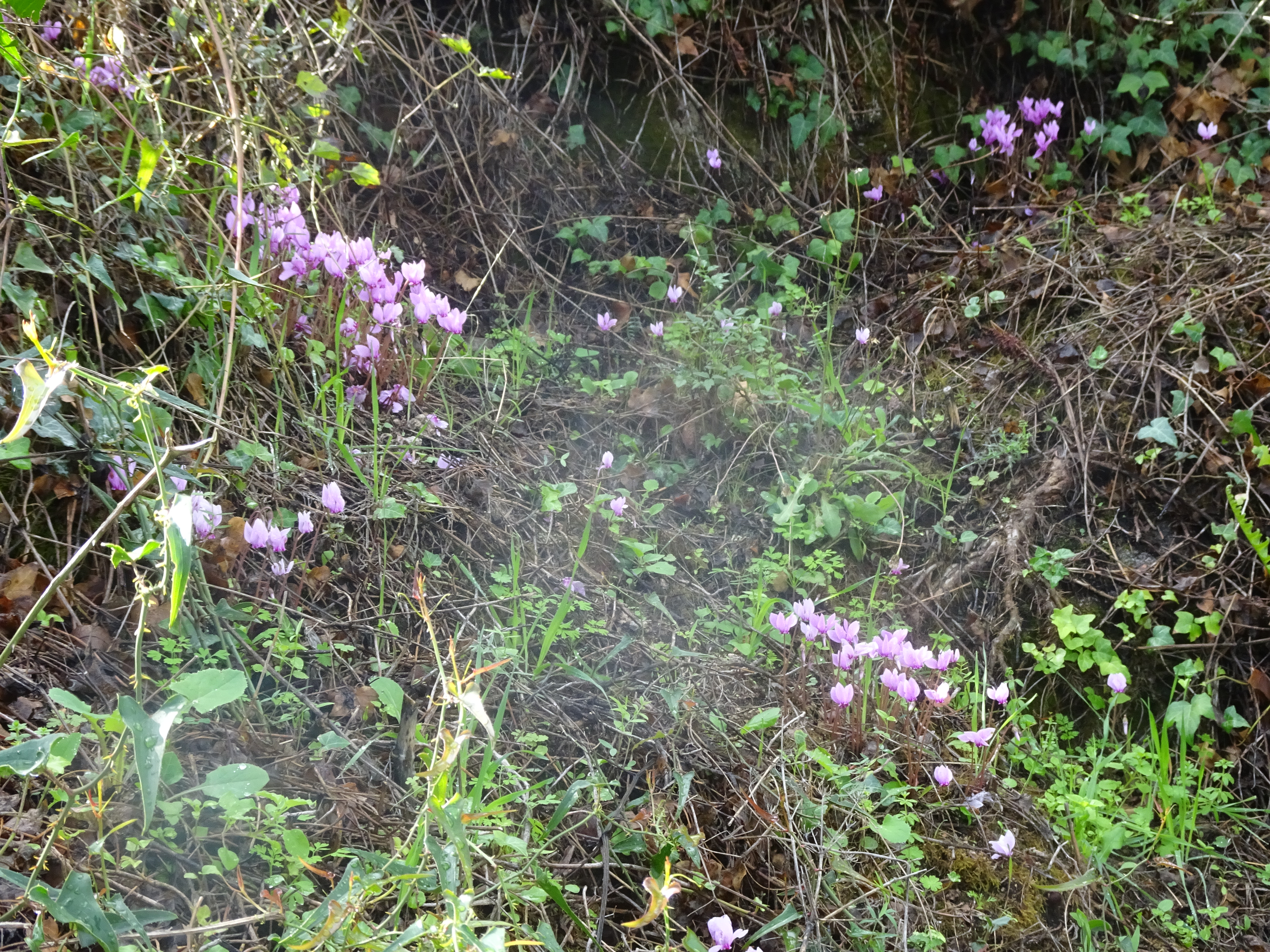
There are carpets of tiny, pink cyclamen everywhere, reminders that even here, in the Mediterranean, Autumn is hovering.

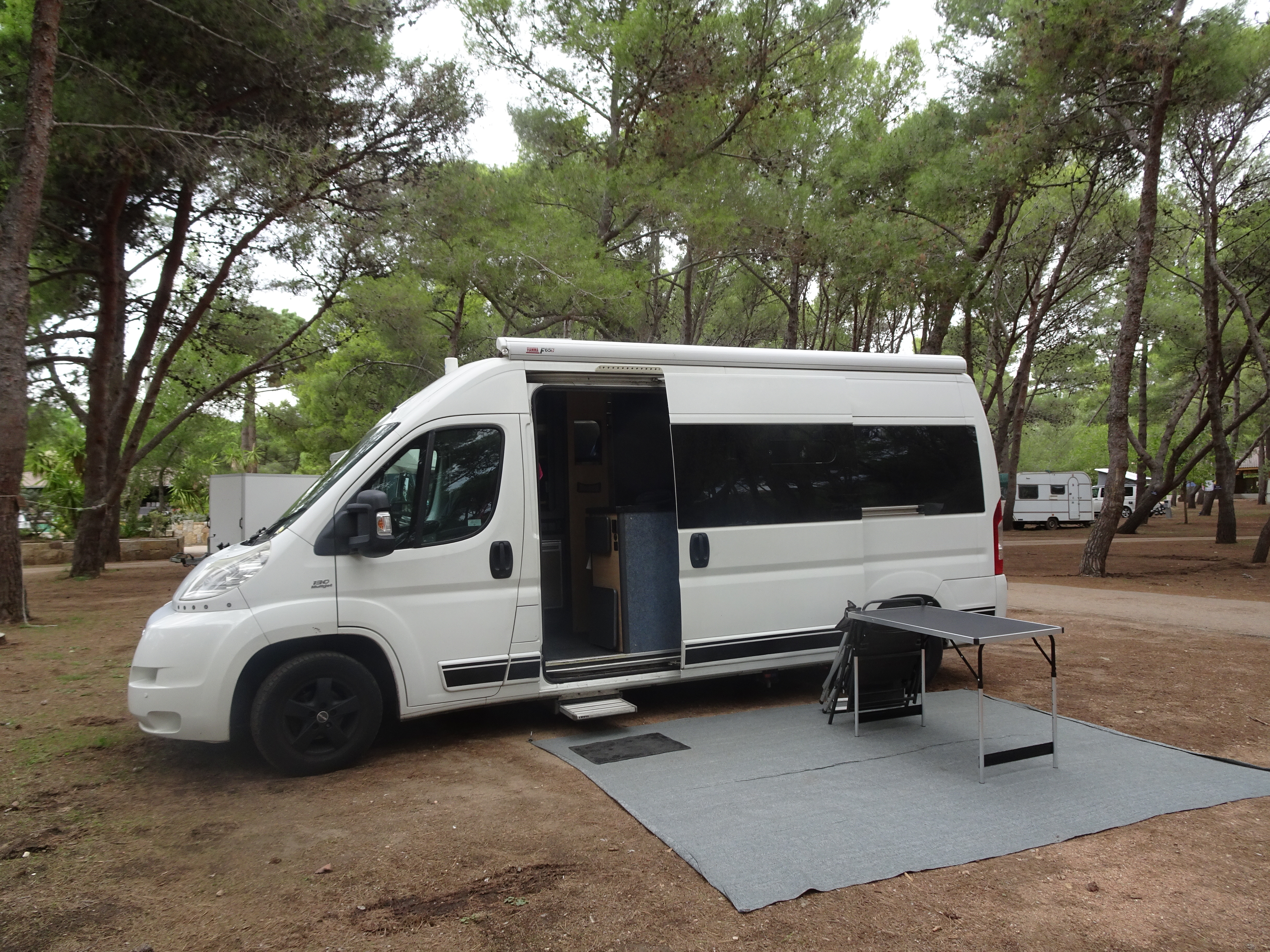
Then we’re off again, making for a site around the bay from Propriano. There’s a descent down to the coast before a long strip along by the beach. Again, the site is away from town in a residential area opposite the sea. It’s wooded and very, very quiet with only a handful of vans and one or two tents.

The weather has turned truly autumnal now and begun to be wet and windy. The ground in places is waterlogged too. End of season is upon us! There’s a longish walk to the nearest bar or restaurant, not tempting in a squally gale. A walk along the road in the opposite direction takes us a short way before the footpath peters out. In addition to this, the campsite bar and restaurant seems to be closed, meaning we’ll be thrown back on our own resources once more. I’m full of admiration for those who’ve pitched tiny tents on the soggy, puddle-ridden ground. We’ve brought our half-dried laundry from the previous site, which I hang out between the trees in a dry spell in hopes it will dry.

Two nights is enough and we move on again, this time near to Ajaccio, Corsica’s present capital, to a site near Porticcio, just around the bay. The pitches are a little soggy and the services antiquated but it will do until we depart. A tabby cat takes a liking to us and makes himself at home on our groundsheet but we’re not inviting him inside!

This time we’re in walking distance of the small seaside town so we take advantage and go to look. And it’s just that- a seaside town, with beachside bars, restaurants and shops. Ajaccio can be seen across the bay. It’s tempting to book a table for the evening but the walk home is quite long to be doing late at night. There is also a small bar outside the entrance to our site but it closes in the evening.

Our ferry from Ajaccio to Toulon does not leave until late evening, leaving us a full day to explore the city. It’s not far to get round to the outskirts but finding somewhere to park for the day seems impossible. There’s a car park on the way in, although the town is miles away around the bay. We drive through the centre, which is completely jammed with every kind of traffic. All car parks are full. We drive to the other side, beyond a long strip of cemetery and find a seaside car park, again, a long way from town.

After a coffee we try again, travelling back through the snarled-up streets, parking in a space near the port for a short time, just to have some lunch then noticing the railway station car park is opposite! Hooray! We’re off to explore the town!…

At Last! Return to Corsica

We’re aware that we must pay up for our stay at the site near Santa Theresa Gallura the evening before we leave, while reception is still open, as we’ll need to be early next morning to catch the ferry to Corsica. Feeling noble, I volunteer to make the descent down to the gate and pay, negotiating all the levels then flogging back up all the slopes and steps to our pitch at the top. Getting to the door of the van, I see Husband talking on his phone and once he’s done, he shares the news that our ferry for next morning is cancelled due to inclement weather and we won’t be departing for another couple of days.

‘Your turn’ I tell him. And he makes the steep descent back down to reception to re-book for two more nights. It leaves us with the knotty problem of how to occupy two days here in relative wilderness without beach weather. But it’s true that the skies are overcast and the stiff breeze is strengthening to gale level. Later, squally rain is added to the mix. I’ll admit to disappointment that we’re not leaving for Corsica just yet. There are a few places there left to see and not a lot besides reading or internet we can do here in the middle of nowhere except beach, which is not tempting in the wind and wet. Hmm-

With a day to fill, we opt to secure the van’s interior and go for a look at Santa Theresa Gallura, where we’ll be leaving from when the coast is clear. It’s only a couple of miles down the road. The town is hilly, with narrow streets but we find a car park that will accommodate the van and walk towards the beach front area. It’s very windy though not raining and when we reach the sea, we can see the strip of limestone cliffs that is the coast of Corsica across the choppy waters.

If you cross the sand into the corner of the small, sea-front beach there are steps up to a cliffside walkway. It doesn’t go all that far but is fun to walk round, especially with choppy waves splashing up, although the only option is to return via the same route. After this, we wander the town a bit. It’s pleasant enough, with some attractive squares and plenty of gift shops. Then it’s on to have a look where we’ll be getting the ferry and to ‘Eurospin’ for groceries.

Next morning we’re up early to prepare for the crossing, arriving at the port to join a queue for the ancient ferry, which is already waiting. We get a coffee and pastry from the portside cafe then I’m told to vacate and board as a pedestrian while Husband waits. Soon I can watch while he turns the van and reverses into the mouth of the boat whilst being shouted and gesticulated at. We’re learning, by now, that this is the way of Italian ferry workers.

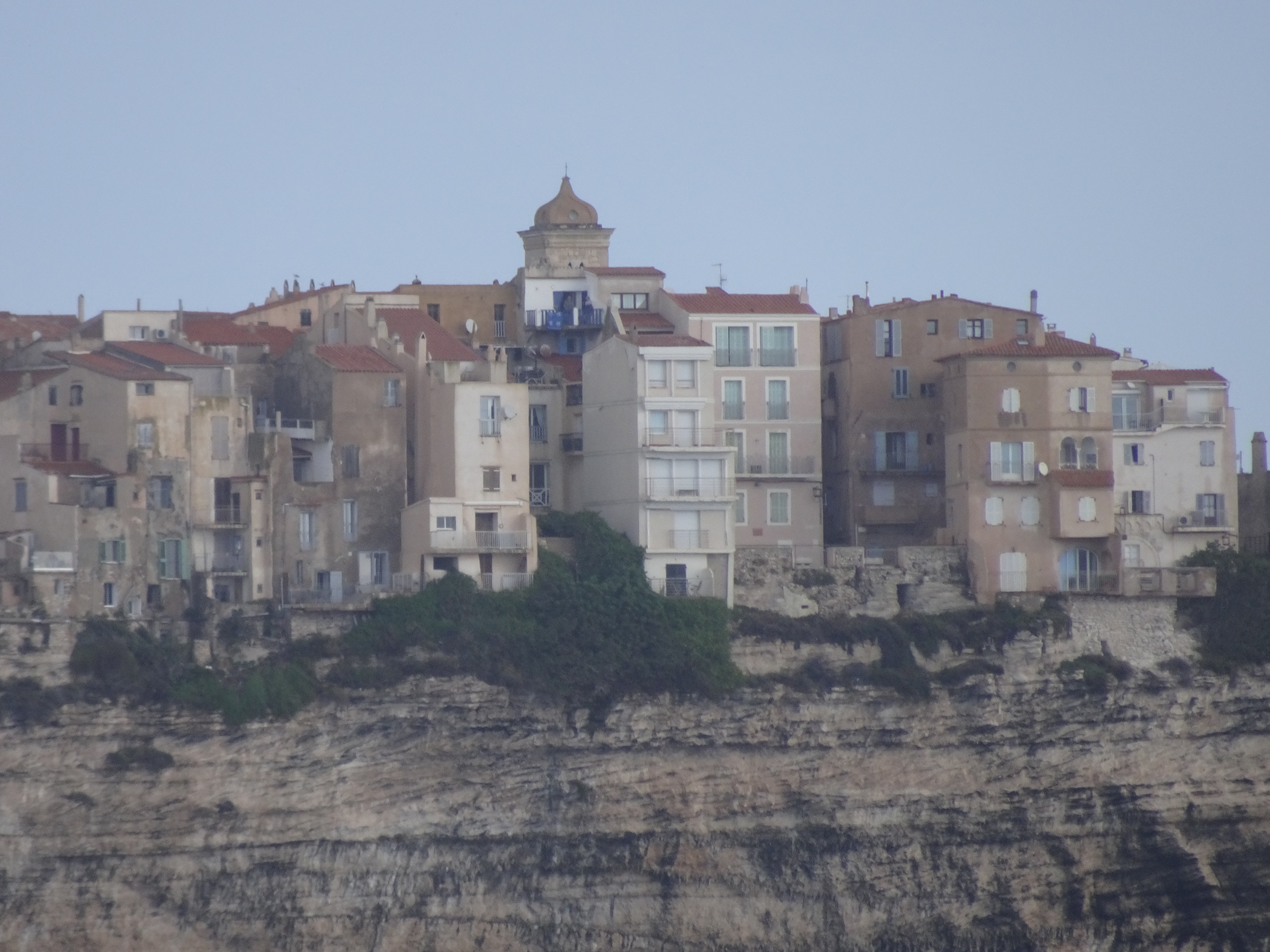
There’s not much sun, but I can’t help standing to watch as our vessel approaches Bonifacio, the white cliffs growing larger, the medieval buildings on their overhanging ledge. I’ve already taken far too many photos of this picturesque city! Then we’re rounding the cliffs into harbour and as Husband descends to the hold to get the van, I follow the pedestrian walkway out to meet him. There’s just the steep ramp of road up from the quay to negotiate- thankfully without obstacle or need to pause this time. We’re back on Corsica!

Grace is also known as the novelist, Jane Deans. Her new novel, The Conways at Earthsend is available from Amazon, Waterstones, Goodreads, W H Smith, Pegasus Publishing and many more sites. Visit my website: janedeans.com or my author page on Facebook: (1) Jane Deans, Novelist, Short Fiction and Blog | Facebook.

Isuledda? Yes we is…

In a typical episode of senile dementia fog memory lapse, neither Husband nor I remember the Costa Smeralda site of Isuledda until we’re about half a mile away, then bells begin to ring and once we’ve turned off the road and up their driveway we pass a spot with a hosepipe where we’d washed our [previous] van prior to departure and I’m certain. Yes. We stayed here in 2016, on our way up from Sicily.

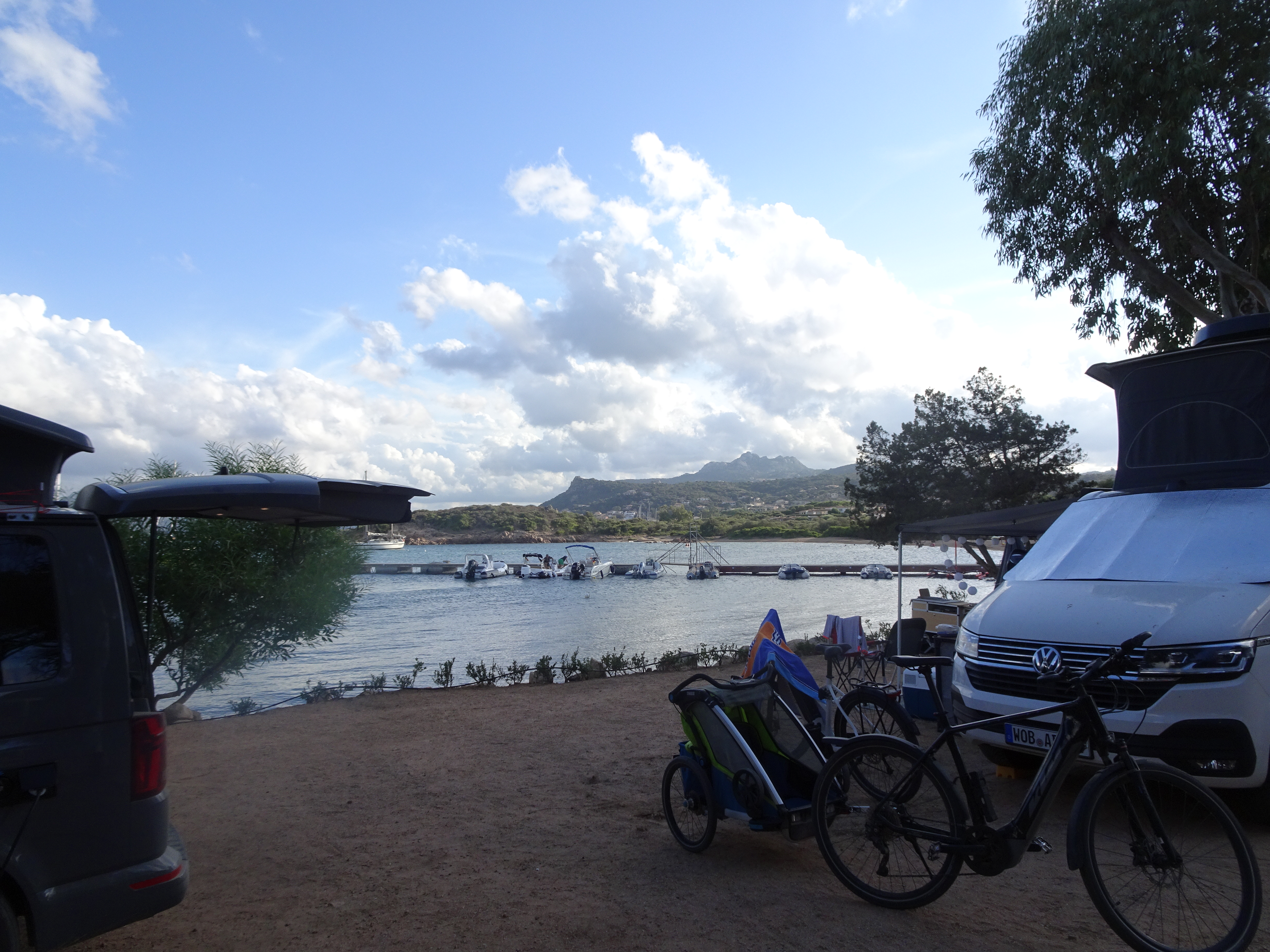
But wow, has it changed! Their reception building is familiar, but that’s about all. Last time we chose our pitch, down by the water on a terraced section. This time the waterside pitches are ‘premium’, meaning you pay more. We’re taken on a zooming golf cart ride to view available pitches away from the water, round some bends, up a hill and along some lanes. There’s been an explosion of chalet installation and the entire place has expanded, spreading over far more land. We choose a place and get returned to reception, where we check in and we’re soon installed among the German vans. This trip, as well as the last excursion to the south-west of France, has been dominated by German tourists. We’ve no problem or complaint with this. They are always friendly, chatty and pleasant. But we’d have liked a more cosmopolitan set of neighbours- for variety.

In the next aisle there’s a bus. It’s there for a group of Czech cyclists, who are camping just down the lane from us, have their own caterer and pile on to the bus each day with their packed lunches, followed by a trailer carrying their bikes. They are brave and fit to be cycling the roads here in Sardinia!

We’re on a kind of hillock, almost overlooking the sea. If it felt like end of season was approaching in one or two of the previous sites, here there’s no sign of it. The place is full to bursting. There’s a waterside cafe and a new bar area, besides the restaurant that was here before, also some kind of performance arena- not in use this late in the season, for which we can be glad.

We spend our first day walking along to the nearest town, Cannigione, to get lunch. We’ve been before but it’s a pleasant walk with lovely coastal views. There isn’t a lot to the town but we find a pleasant cafe on the front and afterwards it takes next to no time to see the rest of the place.

We can access the beach near our pitch but an attempt to spend time relaxing there next day is thwarted by a strong, cool breeze so we opt to walk instead, falling foul of the billowing drizzle that begins to fall. It all lends more ‘end of season’ to the days, especially after all the heat.

It’s time to move on to our last Sardinian destination, a couple of miles outside Santa Theresa Gallura, where we’ll be getting the ferry in two days’ time. The site is steep and terraced, the road curling up and up. We opt for a pitch at the top, near the bar and restaurant where wifi is available.

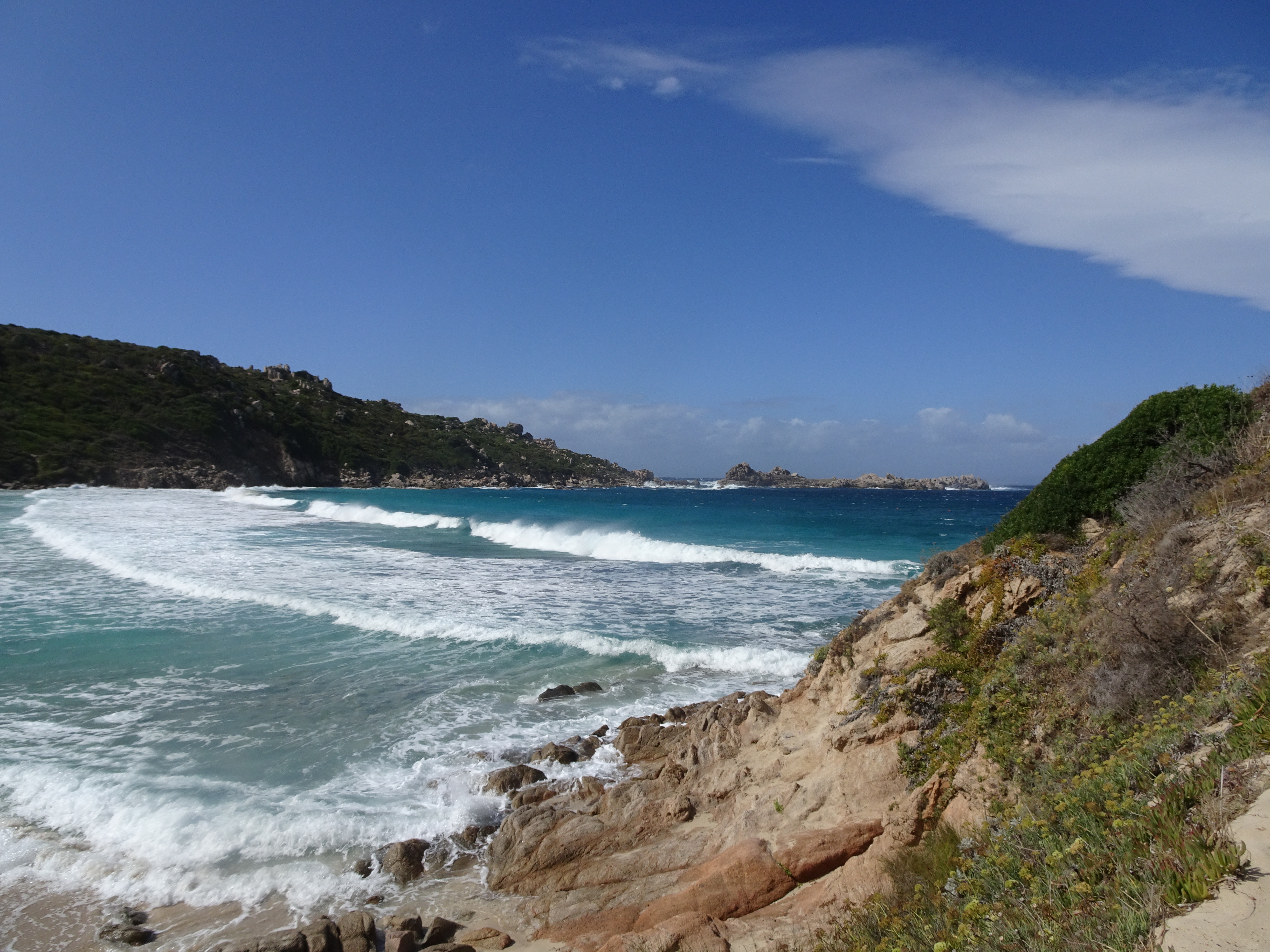
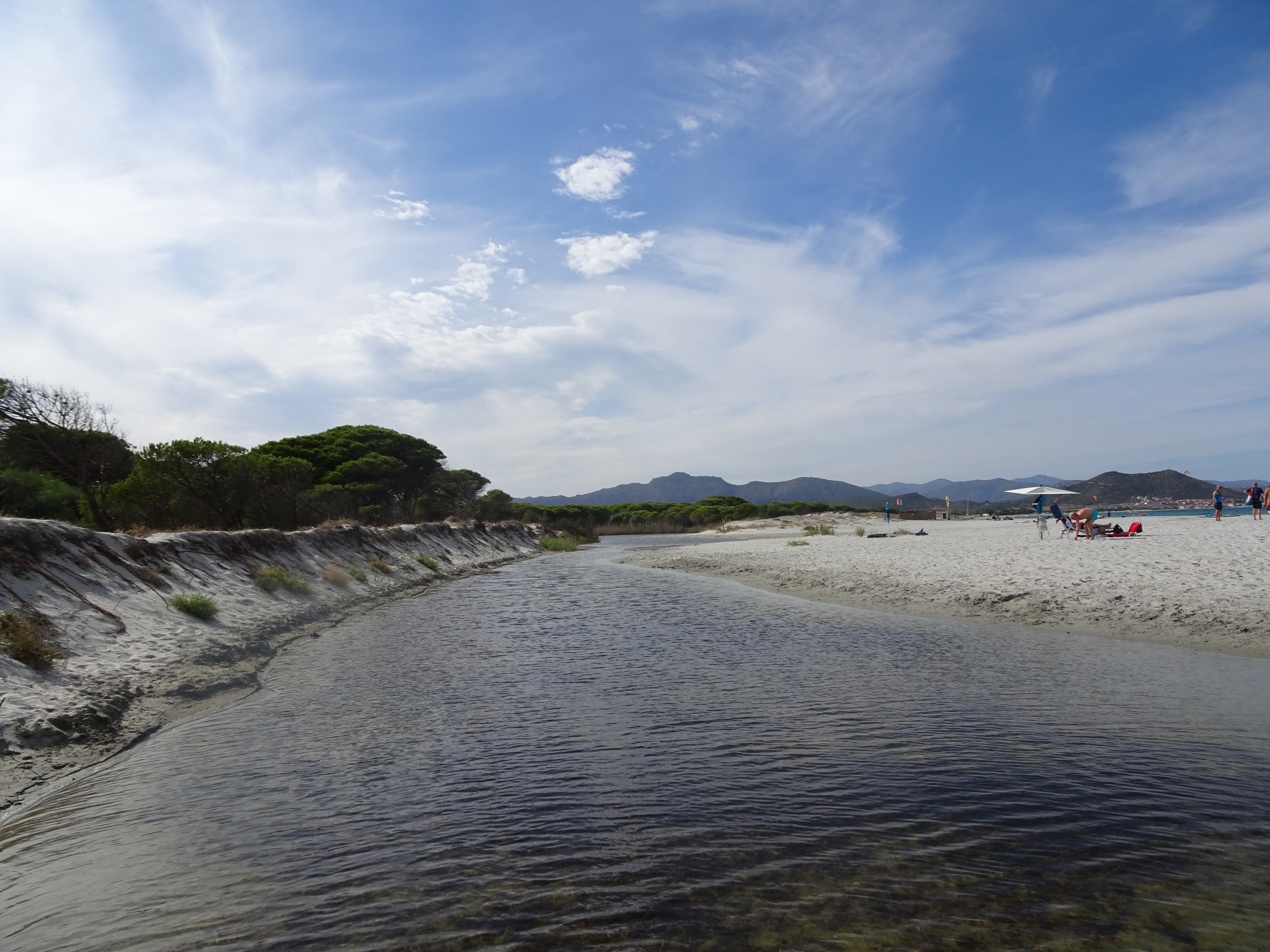
There’s beach access down a steep and rocky track but it’s worth the walk and the climb back up. The coastline here is rocky and characterful, although there’s a stiff breeze again.

Our neighbours on site are a couple from Luxembourg, very proud owners of a brand, new VW van. They are new to touring but enthusiastic. We show them our https://www.acsi.eu/en/ discount card and campsite book and they discover the savings they could have made!
Grace is also known as the novelist, Jane Deans. Her new novel, The Conways at Earthsend is available from Amazon, Waterstones, Goodreads, W H Smith, Pegasus Publishing and many more sites. Visit my website: janedeans.com or my author page on Facebook: (1) Jane Deans, Novelist, Short Fiction and Blog | Facebook.

Two Sites and a Funeral

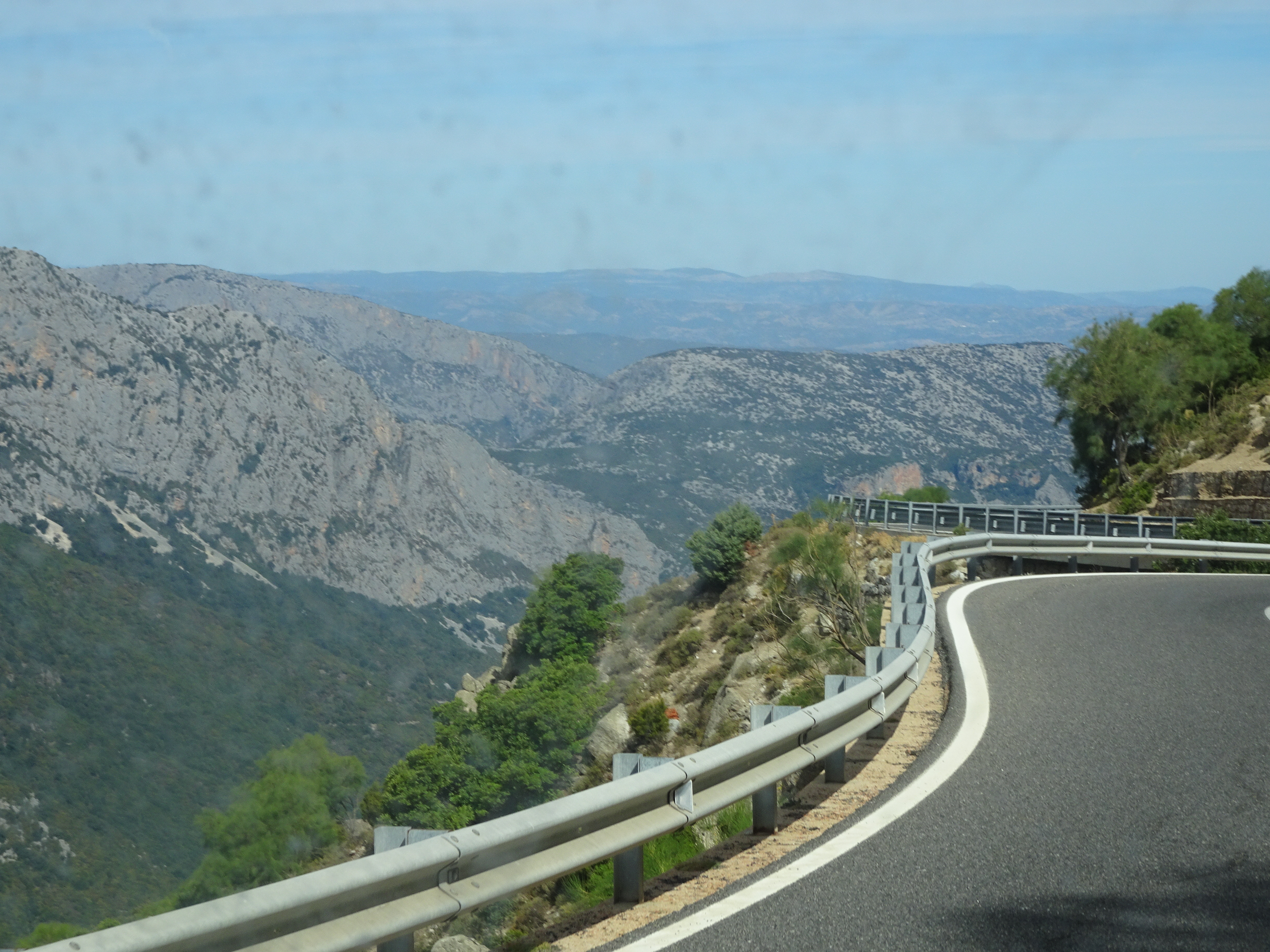
With all avenues having been explored at the Tortoli site on the Sardinian east coast, in other words a short, hot walk along the road as far as it goes and back again- we up sticks once more and ready the van for another hop north, this time towards Siniscola. There’s a site at Santa Lucia, a small seaside village. I look at the map. The road is ominously wiggly, heralding more mountain road terrors.

You’d have thought I’d be getting used to staring dizzy drops and horrific hairpins by this time, but rather than finding it all thrilling [as, admittedly. does Husband] I continue to perspire and grimace. But I’ve perfected the art of taking long, slow breaths as we approach bends or vehicles career towards us. This time, the journey is not aided by the scores of motor bikers who roar up behind us and swerve away at breakneck speed, sometimes enhancing the thrill by zig-zagging across the road. It’s clearly a favourite for motor cycles, also the one and only road where we spot three- yes, three British vehicles- all in one day; and having not spotted a single Brit during the entire trip to this date.

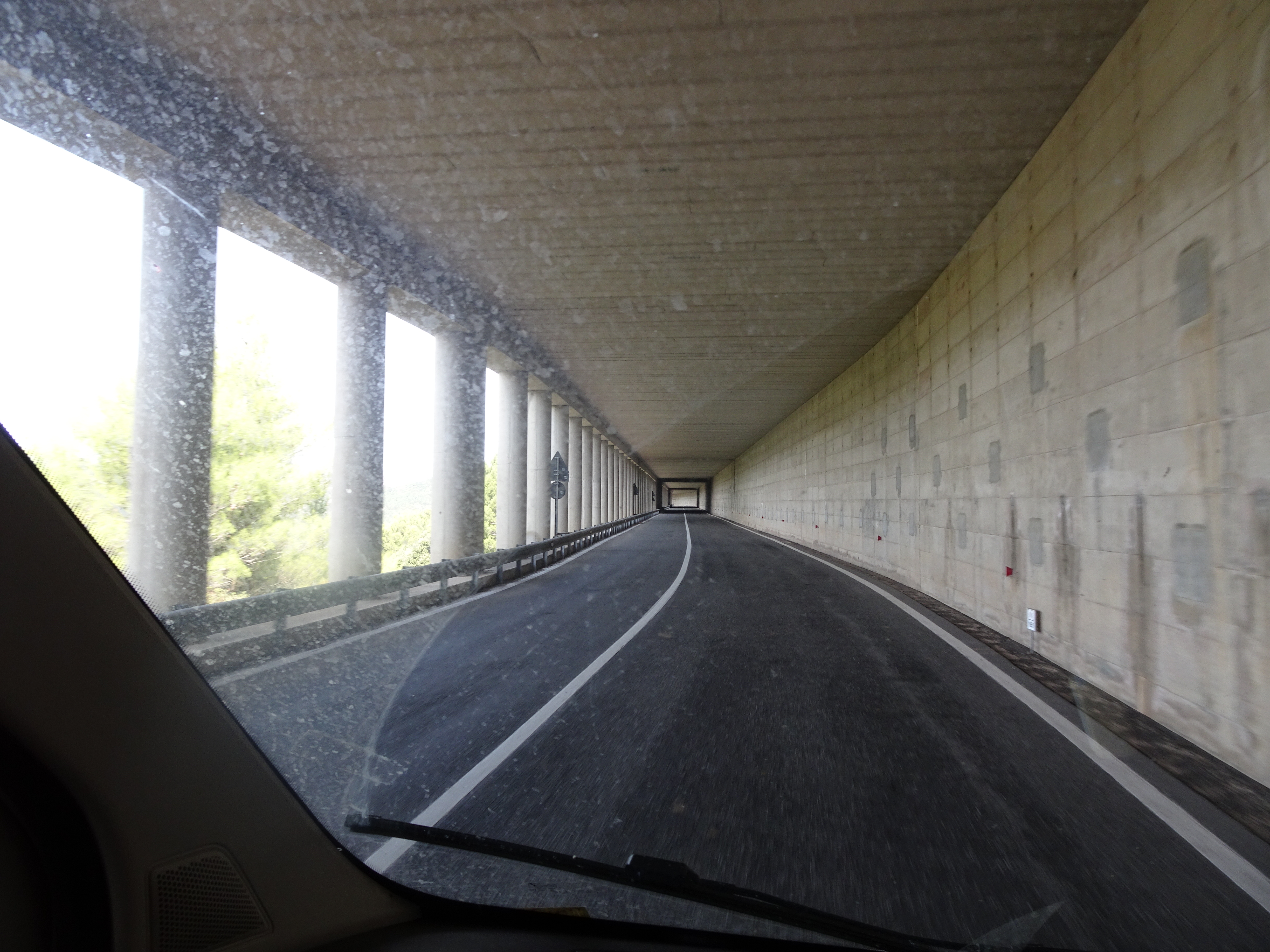
On this route, though there are some short stretches of respite, semi-tunnels where the outside edge is guarded by columns, and by the time we’re dropping down towards Santa Lucia it’s all become much more sensible. A search for a suitable place to stop for lunch gets tied in with supermarket shopping then we’re good to go to the site.

While we’ve been in Sardinia, our own, home, UK news has been full of the Queen’s death- a momentous event for many in our home country. And while any death is sad for those involved and close family of course I can’t help feeling relieved not to be saturated in the details and outpourings all day every day.

We pull up at the gates to our site. The woman in reception is pleasant and welcoming. ‘But you don’t want to watch the funeral?’ she asks me. For a moment I’m not sure what she means. ‘We’re showing it in the bar’ she tells me. I thank her, but say no, thanks, we didn’t know the Queen. [We still haven’t watched any of the ceremony/pomp/footage in spite of it’s remaining on YouTube], which the woman appears to find amusing.

The site is large and wooded with beach access via a woodland path. Getting into pitches is a little tricky, the first we choose being hampered by a gargantuan, Italian motorhome protruding into the access lane. The occupant makes a sudden appearance as Husband begins to manoeuvre into the space, gesticulating and waving like a banshee on speed. As I’m the other side of our van undertaking my own, usual, time-honoured signals, I find this frantic takeover annoying, as does Husband, so we roll across to the next space, away from the hyperactive, oversized-motorhome-owning Italian and his panicky signals.

Again, the site is ideal for beach lovers. This time, we can walk along the road into Santa Lucia, although it is tiny and while it’s attractive and has a relaxing, seaside holiday feel it has nothing of particular interest.

It’s on again, then- this time only a shortish hop north and to the Costa Smeralda, Sardinia’s famous millionaire playboy playground which was developed in the 60s by the Aga Khan, who poured milions into the area. Lucky for us it still has campsites!…

Grace is also known as the novelist, Jane Deans. Her new novel, The Conways at Earthsend is available from Amazon, Waterstones, Goodreads, W H Smith, Pegasus Publishing and many more sites. Visit my website: janedeans.com or my author page on Facebook: (1) Jane Deans, Novelist, Short Fiction and Blog | Facebook.