India 1998. Ladakh Trek 2

Our trek in the mountainous region of Ladakh took us close to villages and down through some. Sometimes our camp for the night would be next to one, on a flat area by a stream. Though the villages were rustic idylls during the summer months, the roofs of the homes covered in drying apricots, families working in the surrounding terraced fields, animals grazing, the long winter months would be cruelly hard. Those working in the fields would always straighten up to greet us as we passed by.  A smiling ‘Julay’, we’d hear and do our best to reply.

We were privileged to be able to visit a village house, the home of our Ladakhi guide, Sonam’s parents. We were invited inside and offered ‘butter tea’, a beverage I’d been warned to avoid if possible. The tea was presented in beautiful, painted porcelain teacups. But the trick, I knew, was to take the smallest of sips so that the rank taste was barely perceptible, then smile, nod and replace the cup in its china saucer on the table.

The kitchen was cosy, a wall of shelves holding burnished cooking pots, a black iron stove for cooking and heating. For tea we sat on colourful rugs before low tables in a room whose windows looked out over meadows, summer green; and a backdrop of towering mountains. Outside, Sonam’s father demonstrated basket-making, deftly weaving one in minutes.

P1000714

Later, at our encampment, Adrian wondered aloud if anyone would be interested in a beer. Beer? During our long hikes we’d not spotted anything resembling a retail outlet-not an off-licence, a corner shop, a mini-market, a stall or a kiosk. There were no roads-hence no roadside offerings. At our universal cries of affirmation he leapt up and disappeared, returning some time later with a crate of bottles and an air of nonchalance.
P1000712

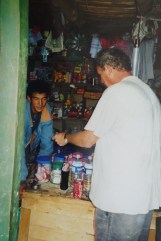
The mystery of his providence was solved on another occasion when our route took us past some rough, wooden doors covering a rocky cave like Aladdin’s. Once unlocked, the doors revealed a ‘shop’, containing all manner of items. How the goods were transported to such an inaccessible area is a further mystery, but we did not go beer-less on our trek.

Each day when we stopped for a breather and to rest aching legs we’d open our lunch packs, provided for us by our hard-working crew. And each day the lunch would be the same: a boiled egg, a [cold] baked potato, a cereal bar. I remember that we’d fall upon these lunches that seemed the most delicious meal in the universe as we’d sit on a rock or a mound of grass overlooking the highest mountain range in the world, sometimes also getting mugged for our food by tiny pygmy goats!

Occasionally there would be an option to clamber up to a higher point while others rested, Adrian leading; an option that Welsh Gareth was always keen to choose, fit as a flea on his chocolate and bread diet and sometimes we would follow, burning muscles a small price to pay for such amazing views.

P1000719


Romantic Romania

The vast and beautiful Danube flows through ten countries-more countries than any other river in the world, also forming several borders including that between Bulgaria and Romania.

Crossing into Romania was a little like stepping into a fairy tale, or into a Constable painting, for while the roads, infrastructure and villages were better kept and looked a little more affluent than in Bulgaria the communities were also quaint and olde-worlde.

P1050445

I’ll admit to being surprised, having assumed Romania to be much poorer than its neighbour. Having said this, there were countless signs that Romania is stranded in a bygone age, such as hand-tilling in the fields, hay-making with horses and carts and horse-drawn transport.

The pretty, tree-lined streets of the villages are made up of tiny, single-story homes-many with tiled exteriors in intricate patterns. Outside many homes there are benches positioned to catch the evening sunshine, often occupied by a couple of women in headscarves having a gossip.

On the road we followed an open truck with a horse tethered in the back. The horse was blinkered and attached each side but even so the truck lurched around corners, swaying and jolting but causing no apparent distress to the equine passenger.

P1050428

We stopped for lunch alongside the Danube basin, where the waters again form a border, this time between Romania and Serbia, so that the wooded hills of Serbia are visible on the other side.

As in the previous country [see last week’s post] we’d scant information on camp sites but headed for ‘Hercules’, a tiny, five-pitch site behind a restaurant opposite a busy road and railway line. We drew into the driveway to be greeted by the owner and shown to a place, which was not a problem since we were the only van there. The sun beat down into the small, neat back yard, a chance to relax after the journey. Though small, the site boasted clean, efficient showers, a washing machine and every convenience.

This being one location where our mobile internet was unobtainable we took devices to the bar and used the site wifi while we had beers. Later an Austrian couple pulled in to be our neighbours for the night. We settled down to sleep. At around midnight we were woken by loud, staccato bangs from a building next door and looked out to see the sky alight with fireworks. Odd timing-but who are we to judge on another country’s customs?

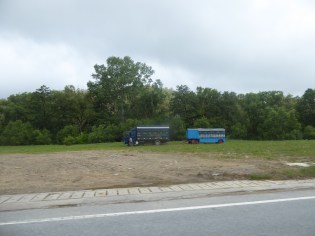
Next day we were off north again towards Hungary, travelling through ravishing green countryside and rustic scenes that included thousands of beehives. I spotted them in industrial numbers along the verges and in the fields, often being tended by veiled beekeepers, the results laid out in modest roadside stalls. Then there were beehive trucks:

P1050444

These unusual vehicles were parked in lay bys or pieces of wasteland. It was uplifting to see such a large-scale industry from bees. At least someone is taking care of them!

Having passed mile upon mile of queued lorries we arrived at the border with Hungary. I felt bereft. We’d whisked through Romania in two days and a part of me clamoured to stay and explore, to wander along the village streets and photograph the countryside. But don’t worry, Romania, we will be back. Besides-a visit to Romania just has to include an exploration of Transylvania.

And then there was Hungary…


TMTE than TOWIE…

               Here in the UK where get our share of reality TV the creative whizzes behind the shows display no signs at all that they are running out of ideas. One such programme is a day-to-day look at life in the county of Essex, a county that has gained itself quite a reputation during the last fifteen years or so, for its characterful populace and their antics.

                I must confess I am not a follower of ‘The Only Way is Essex’ and that all of my knowledge of said show has been gleaned from reading reviews or catching glimpses of the ‘slebs’ in glossy magazines whilst waiting for appointments [as explained in previous posts], but I’m guessing that fans of the programme could be forgiven for thinking that all there is to Essex is London overspill towns, spray tans, vajazzles and estuary vowels [for the uninitiated-Essex edges itself around the mouth of the Thames as it joins the North Sea and the inhabitants speak in a distinctive, unmistakeable accent]. It is easy to gain a preconceived idea of a place.

                I consider myself, as far as the UK is concerned, to be a South Wester-that is to say I was born in the South West I’ve spent most of my life living there, however I did spend some significant periods of my childhood living in both East Anglia [North Norfolk] and Kent, and although I know and recall both of these areas well I knew nothing of Essex until this week, when we journeyed Eastwards to rectify this gaping void of ignorance.

                Of course I was well aware that besides the sprawling conurbations of Basildon and Romford there were whole tracts of beautiful countryside, swathes of marshes teeming with wildlife, charming coastal towns and quaint villages and I have not been disappointed. We made first for Mersea Island in the south-an island only in that a wide, muddy causeway separates it from the ‘mainland’, given over largely to holiday parks, but also home to manicured villages with black, clapperboard houses with voluptuous gardens, village duck-ponds and wonderful pubs. We visited the Oyster Bar, indulging in an enormous sharing platter of crab, prawns, mussels, cockles, smoked salmon, smoked haddock and of course, oysters-accompanied by a Guiness [Husband] and a chilled white wine [me].

                Colchester, towards the East boasts the reputation of being the earliest recorded town in the country, although here my expectations were a little dashed. It is a handsome town, with some fine buildings but not spectacular. It has a modest, well-tended castle but I suspect all vestiges of antiquity were thrashed out of it long ago to make way for the ubiquitous likes of H&M, Marks and Spencer, Greggs and Tesco Express.             

                On again then to the East coast beyond Colchester, where were truly in the depths of the countryside, but near to the ports of Harwich and Felixstowe [across the water to the North in Suffolk]. It is an exemplary scene of rural England. So much for preconceptions-and all about three hours away!