Unknown's avatar

About Grace Lessageing

I am writer of novels, short stories, flash fiction, blogs. I lead a creative writing group. I am an Ex infant teacher, living in Christchurch, Dorset, UK. My brand new novel, The Conways at Earthsend was published on January 28th 2021 can be found on Amazon, Waterstones, Hive and Goodreads and is available in either paperback or e-book versions. You can also read The Year of Familiar Strangers, available as an e-book from Amazon. You can visit my website: janedeans.com or my author page on Facebook: https://www.facebook.com/Jane-Deans-Novellist-Short-Fiction-and-Blog-102757711838272 Happy reading!

Solo to Africa

I followed up my first piece of solo travel, a ski trip to Bulgaria by booking [that same year-1996] a holiday to The Gambia, West Africa. I’d realised I could cope on my own. No, there was nobody to sit next to on the plane. No, there was nobody to make hissed asides about the other passengers to. No there was guaranteed fellow-diner, fellow-planner or fellow-sharer. But neither was there anyone to disagree with my preferred itinerary, to set an agenda, to complain if I wanted to look in a shop, go on a trip or chat to strangers.

Africa, though was a leap of faith; far further from home, far more alien. And this time there’d be no skill to learn, no tuition as a prop, no ready-made group to tag along with. But it was a package, meaning there would be a tour guide and a good, big, anonymous hotel with what looked [from the photos] to be pleasant rooms and facilities.

Profiting from my experiences of the Bulgarian trip, I weathered the flight, the transfer and my first meal without feeling reduced or pathetic this time. But it was curious to note that there was a disproportionate number of middle-aged, single women on the plane. and as we collected our cases in arrivals, taxis began to zoom in and disgorge beautiful, young black men, into whose arms these women flung themselves.

After we’d touched down in Banjul and a tractor had fetched our luggage I went along to the team talk, the one where the tour operator tries to flog you as many expensive trips as they can. One or two sounded appealing and I ended up opting to go along on a two day outing later in the week, to the interior by mini-bus and staying on an island in the Gambia River, which sounded interesting.

The hotel grounds extended to the beach and I ventured along there on that first day. My room, along with most others was situated amongst the landscaped tropical palms and flowers and giant monitor lizards could be spotted weaving their way around the gardens, tongues flickering in and out in a hunt for tasty prey. On the beach I sought help from a friendly gay couple in taking care of my belongings while I set a tentative toe into the sea, where the waves were lively, to say the least. During this cautious bit of paddling a young man who seemed to be passing by engaged me in conversation, offering to be my ‘guide’. I declined.

But from then on, for the next couple of days I was dogged by the young man. Whenever I stepped out of the hotel gates he was there. He accompanied me up the street, followed me around the tourist market, opposite the hotel, approached me whenever I braved the beach, haunted my every waking hour. I was unable to shake him off-even when I took a trip along the beach to a neighbouring hotel to see a girl I’d met on the plane who was on a drumming course. He came with me into her hotel, sitting with us as we tried to chat, until her drumming teacher came along and spoke to him and he made a reluctant exit.

From then I felt free and the week’s adventures began…

Autumn Getaway 2

When I am kept from sleep by a dull ache in my hips and knees I wonder why I’m so enthusiastic about walking the Cornish coast path and then I remember that a time is coming when I won’t be able to.

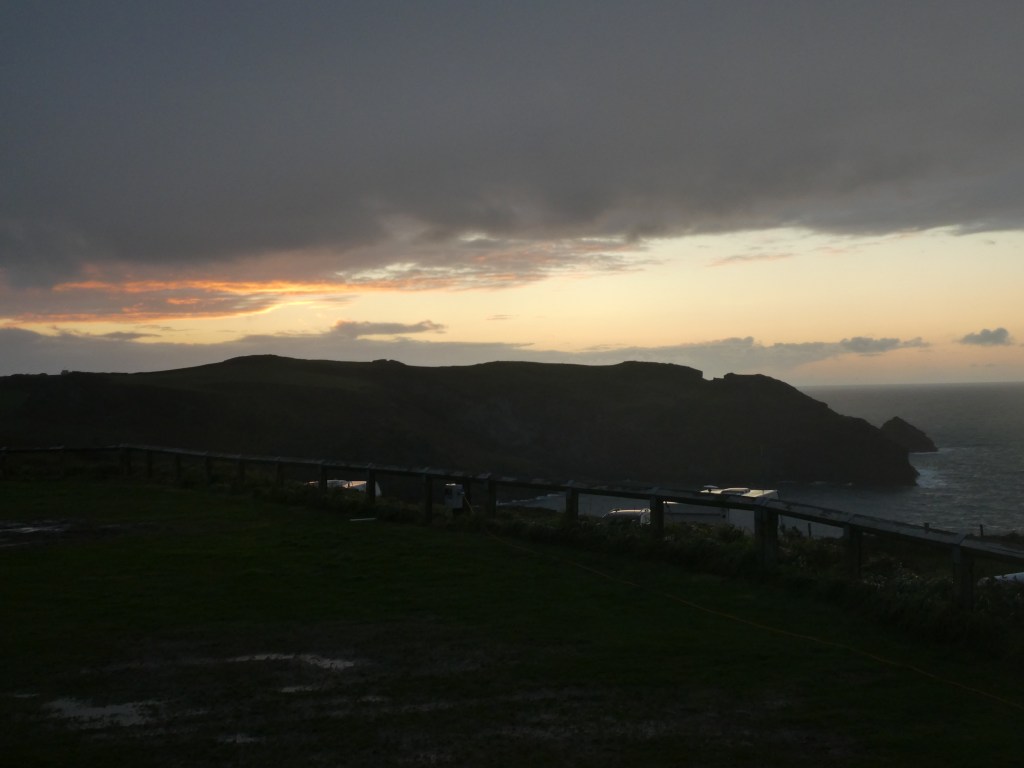
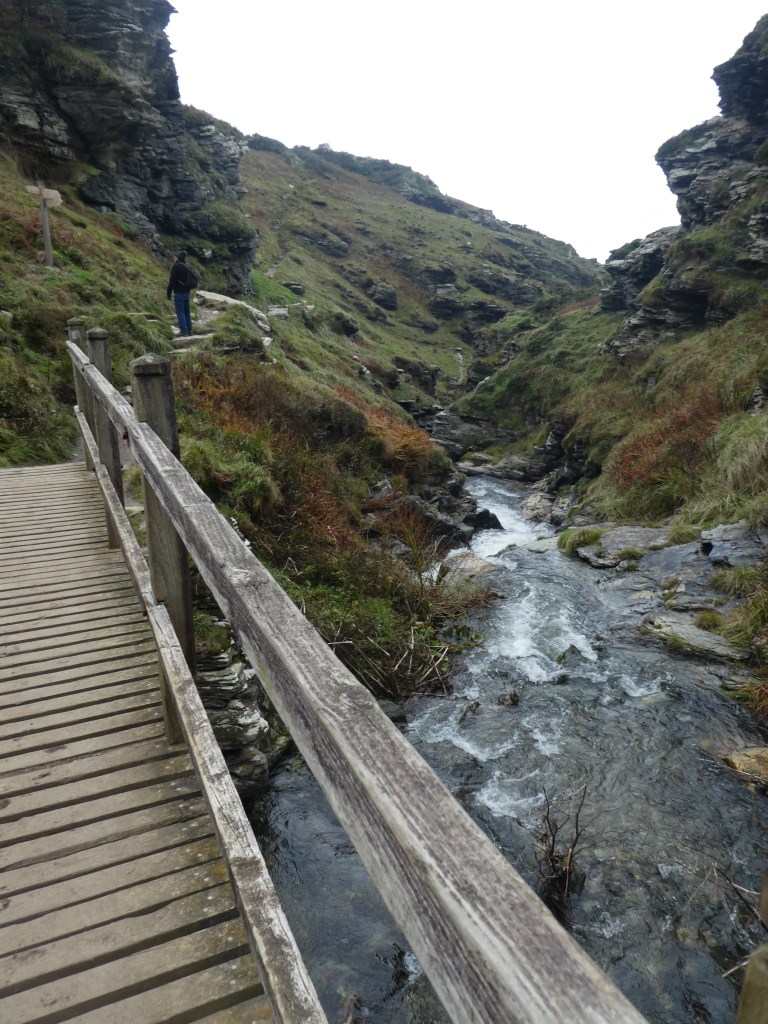
We move on from Batallack, near St Just, to a site with wonderful, dramatic views at Trethevy, near Tintagel. Tintagel always sounds as if it should be a settlement for an elven community and it transpires that there are Cornish influences in Tolkien’s Lord of the Rings. It’s breezy but dry, as once installed, we set off to walk into Tintagel, short in distance and long in time. The descents and climbs begin quickly with a sharp drop from our camp site into a deep ravine and across a footbridge then up the other side with steps and slopes until we reach a gentle, upward field.

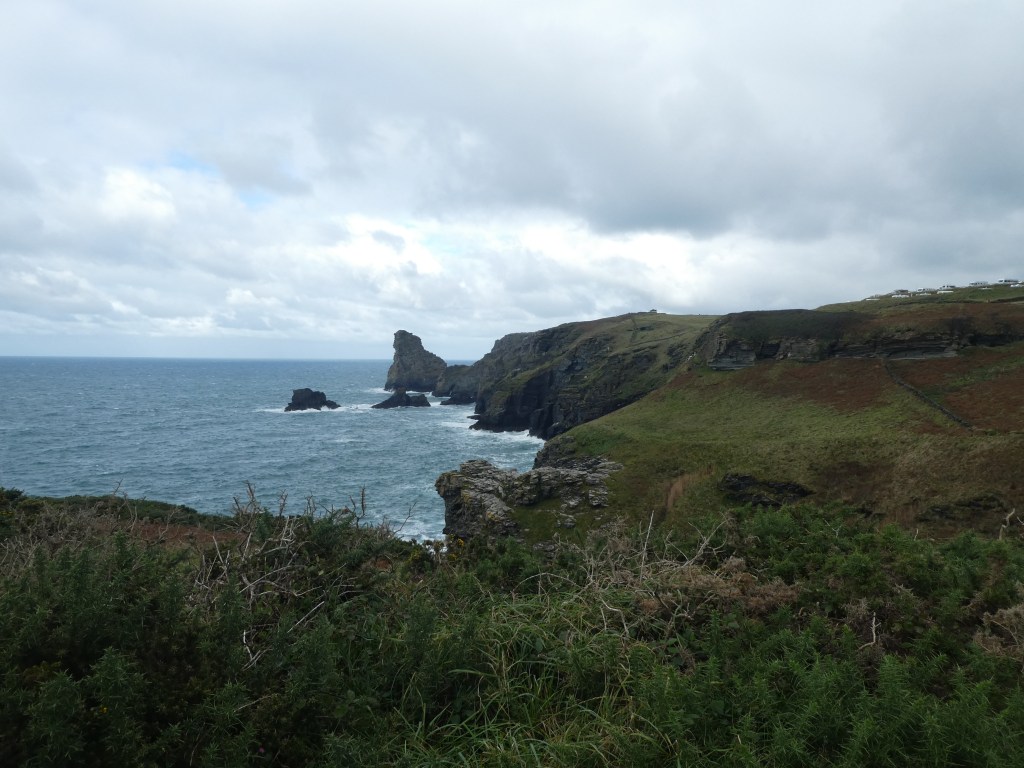
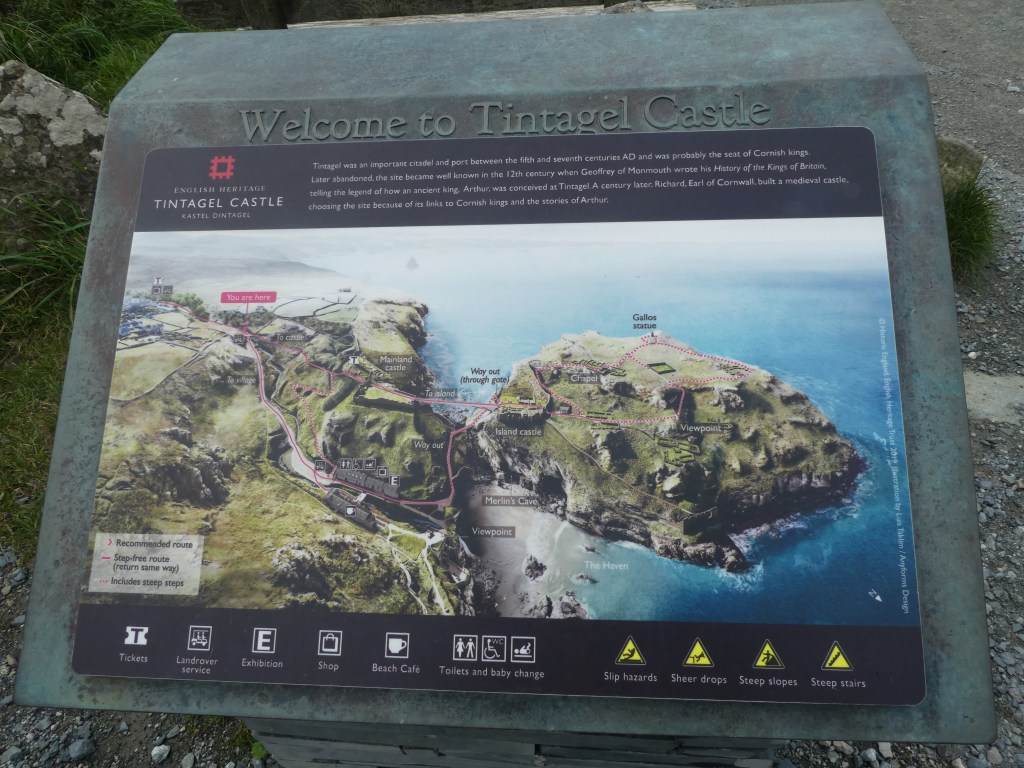
We reach the top of the field where a glimpse of a turret suggests Tintagel Castle but is, in fact a grand hotel, then we round the rocky headland and drop down again, this time for a view of the footbridge across to the castle, now a ruin and accessible only by reserving tickets from ‘English Heritage’. Foiled again, by our ineptitude in booking ahead!

We aren’t devastated. It’s another steep walk up to the village [on the road this time] passed by shuttle runs of land rovers taking sightseers down to the castle and back and those of us who walk it feel smug, if not achey, from gaining the top under our own steam.

We’ve a couple of hours to kill in Tintagel village, which we fritter by having tea then meandering in and out of gift shops and picking up a few things, which helps the local economy in these straightened times.

For once, we’ve been prepared and booked a table for dinner at the excellent ‘Olde Malthouse Inn’, a lovely old stone building in Fore Street. The meal is delicious enough to merit being Husband’s birthday dinner, even though there is still a couple of days until this milestone is reached. There is a relaxed ambience and we are not too out of place in our muddy walking gear. But we are saved from braving the soaring and plummeting coast path home by an elderly, jovial taxi driver who proudly declares he’s never set foot on the coast path.

Next day it’s our last walk, in the opposite direction to Boscastle, famously devastated by floods in 2004. The walk is mostly undulating but punctuated by steep steps in places. We climb to the coastguard lookout in a white tower, where it feels like the top of the world, then down into Boscastle’s tiny harbour, now restored and lined with tourist shops.

Further up there are cafes, pubs and a smattering of shops. It only remains to find the bus stop for our return to the site, where a visiting fish and chip van is the main attraction of the day!

Goodbye Cornwall, for now. But we’ll be back!

Autumn Getaway

I’ve returned from time-travelling travel to present day travel for this week’s post.

It occurs to me that we, [that is to say, Husband and myself] have not got the hang of this Covid thing at all. Yes-we are practised in the art of mask-wearing. Yes-we wash our hands lots. Yes-we keep our distance [not from each other, you understand]. Yes-we don’t throw big parties. But we haven’t got to grips with planning ahead, reserving, booking and being organised.

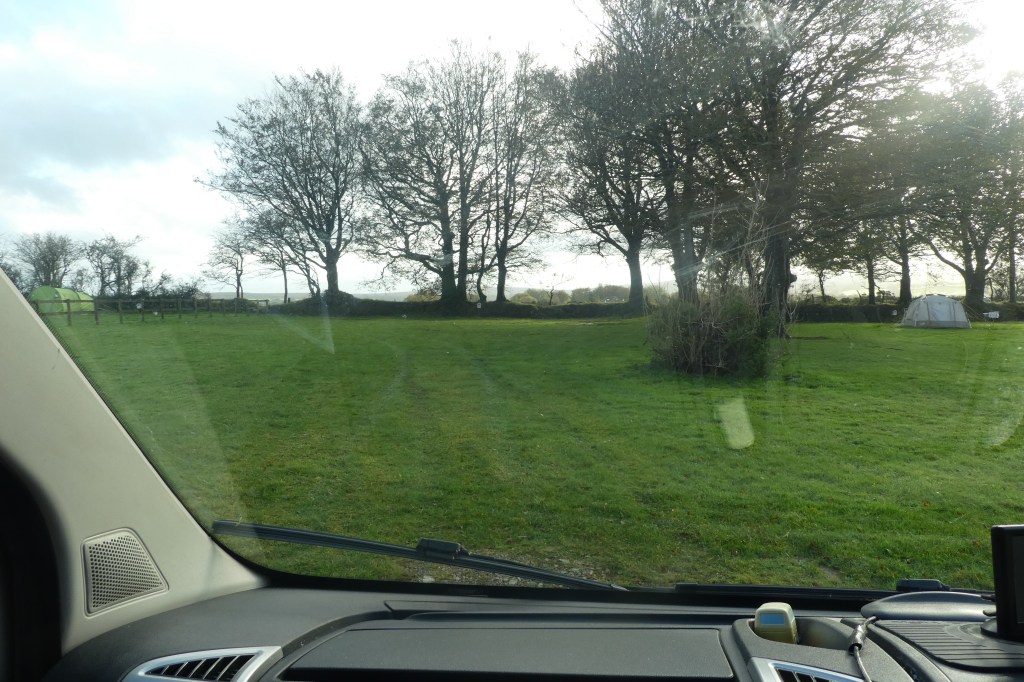
We have come west to Cornwall, via Dartmoor in Devon, where we stayed at a pub campsite and took advantage of the hearty meals on offer. Our departure was delayed due to Biblical quantities of rain which penetrated our house roof [again]. But that is another story. The rain has turned from relentless deluge into squally, intermittent showers punctuated with gusts of wind, a marginal improvement, although I wouldn’t volunteer to swap places with the occupants of the two tents on the site.

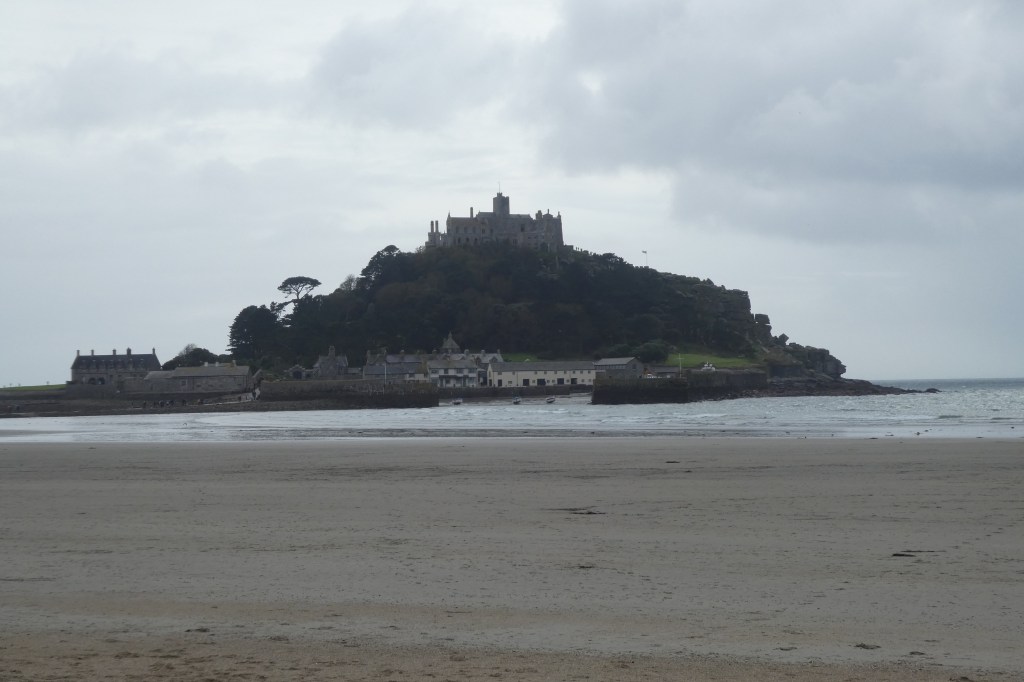
We head off in the morning, making for St Just, beyond Penzance, which is towards Cornwall’s ‘toe’ and on the Atlantic coast. But we aren’t in a hurry and having picked up home-made pasties in a farm shop we attempt to park in Launceston without success then find a picnic area where we can stop, make coffee [a distinct improvement on the kiosk Nescafe from yesterday] and continue on our way. After a blustery drive we stop for a break and spot a castle perched on a hill, poking up behind a field. It is, of course, St Michael’s Mount, twin of French Normandy’s Mont St Michel.

It’s years since I visited St Michael’s Mount. We decide to take a detour. When we reach Marazion, the tiny town that faces the mount, the car parks are choc-a-bloc and having been denied access to the National Trust park we have no choice but to pay a steep £8 to park in the ‘alternative’ one.

Then we battle our way across the cobbled causeway towards the Mount, sandblasted and peppered with rain, but when we get to the threshold there are NT staff in masks checking tickets and there is nothing for it but to turn back. We fight our way back across the causeway, mercifully still not breached by the waves and have a stroll up through Marazion, which, though pretty enough is upstaged by St Michael’s Mount sprouting from the broad beach in a dramatic fashion.

We return to the car park where we feel smug making a cup of tea to utilise our £8 fee.

We head off to our pre-booked site at Batallack, near St Just and a few strides from the coast path. The owner is amenable, the site pleasant, with a smattering of occupants.

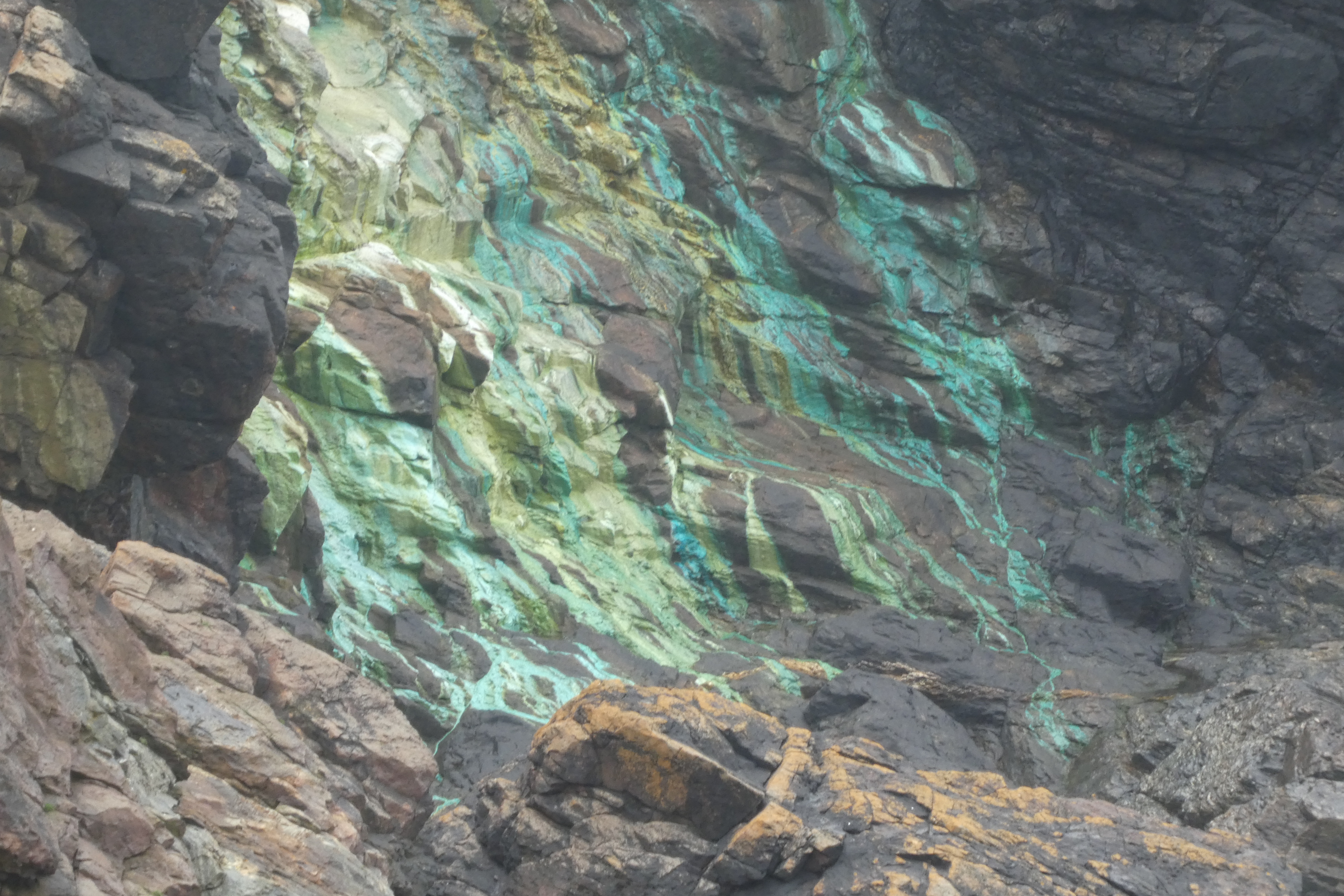
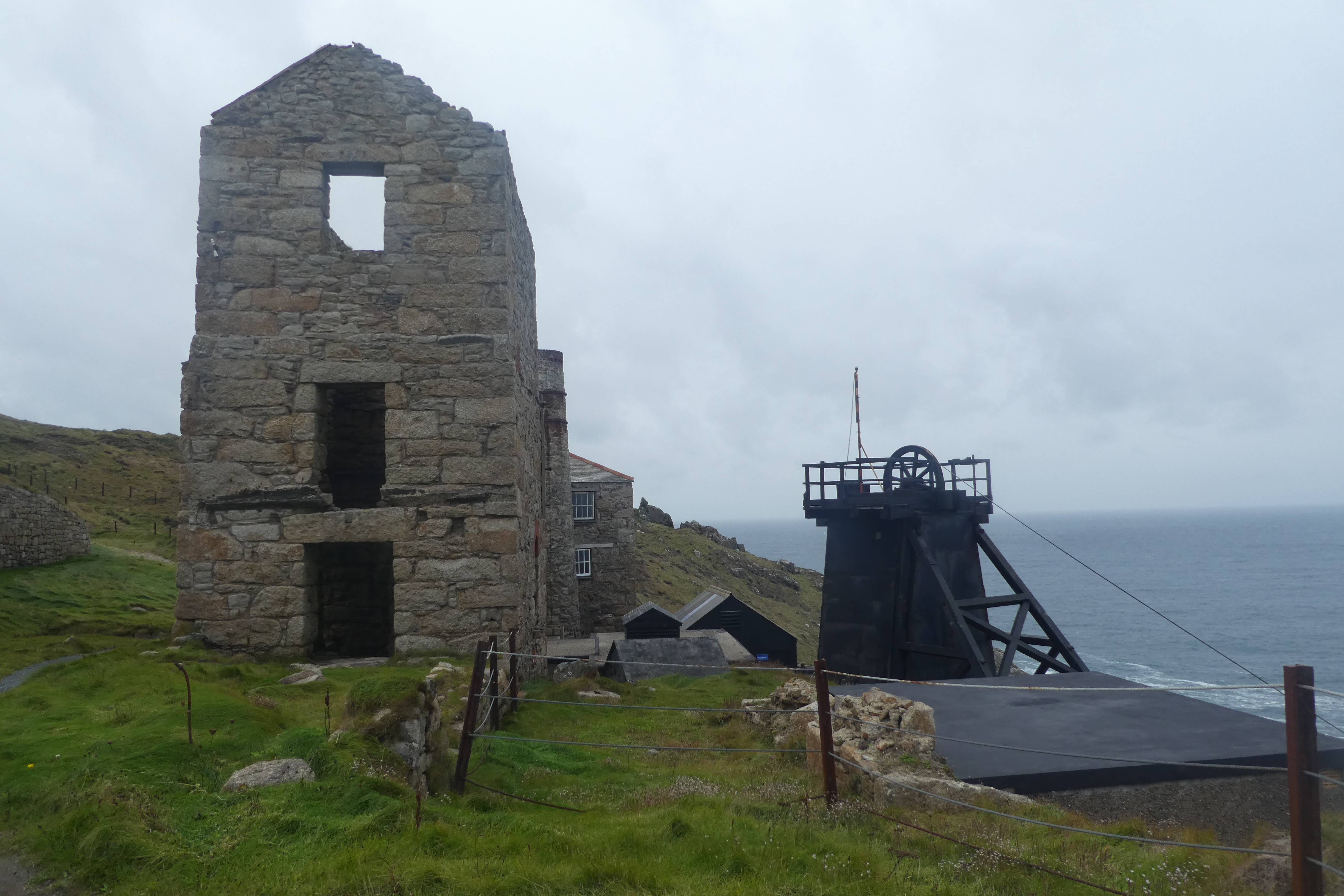
Next day is cloudy but dry as we set off to walk along the coast path towards Pendeen, where we can get a bus back to the site. As soon as we reach the path the scenery is rugged, rocky cliffs falling steeply down the sea and peppered with the remains of chimneys and wheelhouses from all the old tin mines, all of which have been at least partially restored. The path dips and rises, providing some stiff climbs and descents. In one cove the rocky cliffs are striped with green where arsenic has leeched from the old mines.

After a couple of hours a dank October drizzle sets in, soaking us as we climb steeply up towards the road to Pendeen. We reach the village, legs aching, and scan the main road for a bus stop. The map app on Husband’s phone has disappeared so having spotted a car park sign I make the assumption this is the village centre and we make for it, nipping into the village pub to confirm we’re en route. Sure enough there is not only a bus stop but a shelter! and a few minutes later the double decker ‘coastal breezer’ comes around the corner to take us back to our site. Bliss!

Borovets 96: Mastering the Basics.

Borovets was beautiful; a sparkling picture postcard of snow-clad pines and white peaks dotted with rustic chalets. Horse-drawn sleighs adorned with tinkling bells slid by, tempting at the end of each punishing day for a ride back to the hotel, rather than a painful clomp in the excruciating discomfort of the ski boots.

Having just about got the ‘hang’ of the button lift and having mastered the snow-plough stop, after a fashion, by our second day we were to ascend a little higher on the nursery slopes and would need to use the chair lift. It seemed an enormous relief after the nasty button contraption that filled me with dread and I was happy at the prospect of less humiliation. Surely the revolving chair-lift with its comfortable, air-born seats wouldn’t pose any problems? You only had to hop on, skis dangling, ride to the top and hop off. What could go wrong? I was soon to find out.

I waited my turn and sat into the chair as it came round. Then, as the safety bar locked me in the chair began its silent glide up the mountainside between the pines. Mesmerised, I fell into a reverie, woken only by the panicky shrieks of the group. The non-stop chair was about to turn and the lock bar had loosened. In the ensuing moments the ground began to fall away. ‘Jump!’ they shouted. I straightened my skis and hopped from the chair-just as it turned the corner-and I landed on the small hillock of snow before skiing sedately down and receiving yet another round of applause from the gang.

We began to learn how to ski down a slope and use snowplough turns to zig-zag our descent. These were still shallow gradients, nothing approaching a ski-run. At lunchtime, rather than returning to the base of the peak we went to an alpine, wooden shack where the interior was heated by a log brazier and we sat on benches at a long table.

One enduring memory of our Borovets hotel is the meals. They were terrible. Each evening the offerings were much the same; cobbled together stew-like concoctions made with tinned or frozen ingredients. They were barely palatable and the only escape was to order the ‘vegetarian’ option, an inevitable omelette. Wine was offered with every dinner and was always ‘Tesco Bulgarian Red’, which amused us. A more recent visit to Bulgaria revealed that the cuisine has not made monumental progress…

One evening, with some energy left over, we went outside to the floodlit snow and tried the toboggans, which were fantastic fun. Another night out was down to the village and to a dingy bar, where we had beers accompanied by plates of chunky, greasy chips. These tasted wonderful after the bland hotel fare.

The week was passing quickly. We were soon using the glorious ‘gondola’ to ascend to the higher parts of the mountain where the skiing was more challenging. To stand at the top staring down was nerve-shredding, but Georgi coaxed us down each time and we were proud of our progress.

On our last day he left us to our own devices. We were, he assured us, ready to tackle a ‘blue run’, the easiest level of ski run, the toughest being a ‘black run’. We were all up for it but we’d stay together and help each other. By now, some of the snow on the pistes was becoming degraded and icy and we found parts of the run tricky. In order to avoid these glassy, treacherous patches we tried to keep to the sides and it was here that I crashed into a tree, losing a ski and tumbling to the ground, feeling that my arm was, at best, broken. From then it was a painful limp back to the hotel. The arm wasn’t broken but I was to return home with a colourful bruise from shoulder to wrist, although I was not downhearted. I felt like I’d learned to ski.

We had a last evening together, entertained in the hotel bar by a lacklustre group of dancers. Next day I was to take an earlier flight home than most and spend an afternoon touring Sofia before going to the airport. I no longer feared lone travel. At the small airport a backlog of flights was building up as the weather closed in, leaving the tiny departure lounge clogged with waiting passengers, many of whom sat around on the floor. A small kiosk struggled to cope with supplying drinks and snacks. Heathrow this was not.

After several hours of waiting my flight was called and I boarded the plane, its porthole windows obliterated by driving sleet. The plane taxied to the runway and as it began to gather speed it lurched drunkenly across the tarmac then back again like a ghastly parody of a slalem run. We, the passengers, gave a collective gasp and at last the aircraft lifted off and away from Bulgaria.

I grinned to myself. Now I could plan my next lone adventure. Where to? Somewhere hot, colourful and thrilling…

Ski 96: Part 2

It was the first morning after my arrival to the ski resort hotel in Borovets, Bulgaria, 1996. I’d retired to my room the previous evening, having dined with a reluctant but polite couple and was resigned to more humiliation at breakfast, although my mood lightened at the prospect of the day ahead. I knew I’d need to get into my borrowed ski suit and take the lift down to the ‘boot room’, where I’d be kitted out with boots and skis and get to meet the instructor.

The boot room, in the bowels of the hotel was a hive of activity, with instructors marshalling differing ability levels to make groups. I gravitated towards the call for beginners, nervous grins and feeble jokes giving their status away. Whilst I was on the fringe of this group, it consisted of those whose partners were seasoned, or at least intermediate skiers and had gone to other groups, so I was not to be the only single person during the daytime, at least. There was common ground in our shared nerves and soon we were confessing our anxieties as we were kitted out and shown how to put on the boots. Then our long-suffering instructor, Georgi led us, stumbling, out into the bright, white snow as we carried our skis and poles and I thought I’d never worn anything so uncomfortable as ski boots in my whole life.

Outside the hotel, on the nursery slopes, we got our skis on. We were to learn to sidestep up the slope and, most importantly, how to stop, using the famous ‘snow-plough’ method. We all set to, following Georgi’s instructions as best we could and with varying levels of success. We fell over a lot, the tumbles causing much hilarity and I could understand the term ‘break the ice’ as we all bonded over our ineptitude. By lunchtime we were already a bunch of mates with a shared purpose and I could feel the warm relief of belonging even in the freezing snow.

You can’t underestimate how tiring learning to ski is. At the end of the day we were all ready to collapse. I couldn’t wait to get out of the boots, which I was sure had given me blood blisters on my lower legs. But everyone was eager to debrief our experiences in the hotel bar, myself included, so before hot showers and dinner we repaired there for hot chocolate and brandy, a beverage whose restorative powers were a match for the exaggerated recounts of our day.

‘You must come and eat with us!’, one friendly couple told me. There were no more lone dinners. Hereafter we skied, dined, drank, shared stories and spent our evenings as a group-joined by spouses or friends from other groups but firmly a set of companions with experiences in common.

The following day we were to learn to master the button lift. This dastardly contraption was to become my nemesis. A circular seat attached to a line must be grabbed and straddled in order to ascend the slope. Skis, however remain on the snow and must be kept in perfect parallel throughout the ascent, otherwise you must let go and start again. Could I keep parallel? No. I could grab the seat. I could get onto it. But my skis became wayward, uncontrollable limbs, veering off at angles after a few metres. Each turn was a failure and I needed to be fed back through the turnstile by the ever-patient Georgi while the remainder of the group waited at the top. Seven times I tried, finally making it to the top on the eighth go, arriving to a cheering group of what had now become firm friends.

The Loneliness of the Short Distance Skier.

Are you someone who is comfortable to travel alone? Are you confident in crossing borders, boarding planes, boats or trains, or solo driving? Are you happy eating meals alone at a table in a restaurant, nobody to share your day’s experiences or make plans with? Many people are fine with single holidays. There can be benefits. You can please yourself, eat where you want, stay or go, choose to have company or not. But it takes nerve to dine alone, to travel with an empty seat next to you, to explain to a tour guide that you are not with anyone else.

During the 90s I took two lone holidays, both in the same year. The first was an experiment, prompted by a big change in my life and I’d be lying if I said I wasn’t anxious after booking it. In fact, as the departure day approached I became increasingly stressed at the idea, waking at night at the thought that I’d be alone, that I would be an object of pity or derision.

My decision to try skiing turned out to be a sensible one. As I dithered and wondered whether to cancel the trip, a friend convinced me to view it as if I were on a course and since I was used to undertaking training for work this idea gave me more confidence. Skiing has never been a budget holiday option, but this was 1996 and I’d found a week’s trip to Borovets in Bulgaria, including flights, hotel, lift passes, ski hire, boot hire and tuition, for the princely sum of £500. I’d also borrowed a ski suit and was good to go.

You have to remember, however, that this was Bulgaria. Seasoned skiers would baulk at the idea of Bulgarian slopes, which are considered ‘easy’. Easy was fine for me; the easier the better!

The fact that I don’t recall the flight out indicates that it was no problem. I arrived to the airport at Sofia and found the ‘courier’ waiting at the barrier. Then I got my first experience of singleton stigma.

‘Which party are you with?’ asked the young man.

‘I’m not with a party’, I replied. This confused him. It was several minutes before he gave up the question and indicated the coach I was to board. I slunk to the back of the bus and sank down into the seat, where I stared out of the window until we arrived at the hotel.

I checked in and found my room, after which I was to get a second wave of humiliation in the restaurant. Armed with a book, I made my way to a table laid for four. It took some time for a waiter to approach, presumably due to my solitude. The tables around me began to fill up with chattering ‘parties’ until the only remaining spare seats were at my table. A couple entered the room and surveyed the scene, in which there were no remaining empty tables, then slowly made their way to mine-and sat down. I thanked them for sitting at my table.

Next week: The transformative power of shared activity…

The Power and the Story

A chance meeting with neighbours on our site at Felixstowe, who’d recommended a site to us, had sent us scuttling back to the coast at Sizewell. Sizewell was an old fishing village once. Now it is better known for accommodating a notorious nuclear power station, Sizewell ‘A’, now decommissioned and encased in 3 metres of concrete. Sizewell ‘B’ sits next door to this huge, grey, man-made monolith and is sky-blue with a white dome, like a space-age cathedral. On arrival to Sizewell I experienced an irrational frisson of trepidation, perhaps brought on by a recent viewing of the hit series, ‘Chernobyl’.

Sizewell ‘C’ is now on the agenda, unpopular with many, judging by the signs dotted around the surrounding villages.

An extensive wind farm, Greater Gabbard was just about visible on the horizon out to sea. Once we were installed at our site and settled outside the bar, [which overlooks the wild beach], I eavesdropped on a neighbouring conversation in which a woman expressed vitriolic hatred for the wind farm, barely visible even on this clear, sunny evening. To her near left the twin power stations rose up menacingly, compounding the irony of her invective.

But despite the power monsters in their varied forms, this is a wonderfully wild and unspoilt piece of coastline, rich in wildlife. There are extensive marshes, forests and beach habitats. At the entrance to the beach car park a jaunty cafe, ‘Sizewell ‘T”, was doing a roaring trade in chips and ice creams.

It is a popular spot for locals and the touring section of our site was busy with a steady stream of visitors, although the shower blocks are closed.

We strode out along the beach, the weather clear and balmy and then down into Thorpeness, a cute, coastal village, thronged with visitors on this sunny afternoon. The village boasts a ‘mere’. Here was the original ‘Wendy’s House’ of J M Barry fame, also an immaculate windmill and the famous ‘house in the clouds’, which can be rented for holiday stays.

Aldeburgh is supposedly a simple cycle away from our site, though the path morphed from flat tarmac to rutted, sandy track in no time. Again, the town was busy with tourists, too many for the High Street pavements to cope with. It’s a pleasant seafront with fish smokeries and a broad, green swathe on which stands the ‘Moot House’, a half-timbered building housing what must be a tiny museum.

It took longer to queue for the checkouts at Aldeburgh’s High Street co-op than to explore its two or three streets. Provisions were running low and Sizewell is short on grocery stores [there are none].

Next day, with the promise of rain on our last day we cycled again, this time to Dunwich. The route was hilly, a surprise for the knees. Dunwich is a minute village, one street of cottages dominated by a pub/hotel, but with a cafe and kiosk near the beach. There is also a ruined abbey and a museum of sorts. Taking what Husband termed a ‘short cut’ back to our site at Beach view, we found ourselves in the National Trust reserve. ‘Strictly no Admittance without Tickets’ stated the sign as Husband rode through, oblivious. A second turning before the entrance booth took us along a heather lined track. ‘No Horses, no Bikes!!’ proclaimed the sign, which Husband peddled past, heedless. After several wrong turnings we arrived at a ‘kissing gate’ and were obliged to manhandle the bikes through it by up-ending them.

Our last day at Sizewell dawned humid and drizzly. After lunch we walked, taking in the beach and a dripping forest, sweltering in rainwear; and returning to our site for tea and cake.

The Back and Front of Beyond

Kessingland may sound like it’s a theme park, but it’s a sprawling village on the Suffolk coast between Lowestoft and Southwold.

We arrived to our first site, located at the ‘top’ end of the village next to a zoo. i’ve no complaints, but to access the very best part of Kessingland, the bit at the ‘bottom’, by the sea entailed a long, boring walk down a street in which the immaculate allotments provided the only interest. During a wild, windy walk along Kessingland’s unspoilt, shingle beach we discovered another, beachfront site and, feeling a little treacherous for having booked 4 nights at the top end site, we moved.

On the new pitch we faced the iron grey North Sea and a wide shingle beach dotted only with clumps of hardy vegetation and a few dog walkers, miniature tankers and container ships making stately progress towards Harwich broke the horizon, lit up like decorations at night.

Kessingland is devoid of massed terraces of gift shops or coffee shops, boasting only 2 pubs and a tiny Tardis of a shop, ‘The Beach Hut’, in which a customer must vacate before another can enter [and this, even before the advent of the dastardly virus!].

Too windy for cycling, we opted for a long walk along the broad beach and dunes, almost to Lowestoft, meeting few others. Back at Kessingland we ‘helped out’ by eating at the pub, ‘The Sailors’ Home’, where the meals are a triumph of economy over gourmet dining.

Next day we took a bus into Southwold, Kessingland’s opposite; tourist Mecca, with gifts, galleries, bakeries, coffee shops, a pier, a market, rows of colourful beach huts, amusements and thousands of visitors, few of whom seem able to observe the pedestrian one-way system. There are some tenuous links to George Orwell, a dedication to whom is splattered over a large wall on the pier.

Following our 4 nights in Kessingland, we headed inland, first to Oulton Broad, a large lake and a marginal draw for visitors, although the neglected pleasure boats languishing at their moorings tell a Covid story of their own. Some access to the lake is restricted due to private homes but we could see the old ‘wherries’, flat, barge-like vessels that were once used for freight. In the afternoon we struck off into the marsh, following paths through the reed beds.

Then it was off to our next destination, a pub site in an inland village near Diss, Norfolk. The weather was turning gloomy and rain threatened as we turned into the entrance. Here a few pitches had been carved out of the land behind the pub and a shower shed constructed for the half dozen units. We adopted a ‘beggars can’t be choosers’ mentality as the rain closed in. The pub is clearly in difficulties, offering some meals and entertainment but attracting few revellers.

Next day rain was firmly established and we set off to Norwich, using the ‘park and ride’ system and well prepared with raincoats and umbrellas. Norwich is a beautiful and historic city, which compensates, perhaps for some of Norfolk’s less gorgeous attributes. There is a magnificent cathedral, a renowned market, numerous museums [closed], a castle [closed] and ‘the lanes’, a series of narrow, cobbled streets flanked by old buildings. Having met friends for lunch we wandered for as long as we could manage in the rain.

Though dry, the next day was cold and having cast around for a nearby sightseeing tour we decided on Diss and Bury St Edmunds, Diss being a smallish but not unattractive place with a ‘mere’ and Bury St Edmunds a well-to-do town with an abbey and immaculate gardens.

I was not sorry to leave the pub site. We were to head back out to the coast and the sun was shining…

Unknown Territory in our Back Yard

Four years of my childhood were spent in north Norfolk, in the environs of ‘The Wash’, a flat, featureless, agricultural landscape devoid of trees or anything of interest. You would only consider holidaying there if you were an obsessive ‘twitcher’. The Wash has a large population of water and shore-loving birds.

Other than this area, I know little of the area of the UK known as East Anglia, the part that sticks into the North Sea like a rounded carbuncle and boasts the largest container port in the UK, Felixstowe, in Suffolk. The town is also a seaside resort of the traditional British kind, with an abundance of fish and chip shops, ice cream vendors and gaudy amusement arcades. If you look along down along the handsome promenade from the north end, towards the pier you will see the pier head and rows of tall, port pylons rising above it. It makes for an interesting view.

Looking for hitherto unexplored parts of our island we stop at a site here, near enough to hear the cranes grinding and clanging at night as they reach down for each container and hoist it up high on to the impossible stack of the ship that is to transport them somewhere.

Next day we cycle through the nature reserve on a stony track dotted with clumps of hardy sea cabbage and when we reach the end the giant ship with its towering cargo is almost within touching distance, rearing up behind a shingle beach scattered with bathers and sunbathers.

Away from here, back at the seafront, the prom and gardens are pristine monuments to tourism, without a trace of irony. After a cycle northwards up the coast we take a ferry ride across the Orwell estuary, a staggering £12 return for a 2 minute voyage! But the last ferry returns at 5pm and we’ve scarcely half an hour’s cycling. When we get back the cafes and kiosks have closed.

On a patch of grass by the prom we can sit in the sunshine with a beer and watch the container ships queuing to get into port. Later we dine at the Steak and Lobster Restaurant, taking advantage of the cut-price, early weekday deal the government has provided, though we need no motivation!

The UK weather unleashes its predictable inclemency and a whole day is spent confined to van, writing. Valuable but not physically tiring enough to allow sleep.

Unable to reserve nearby sites we are forced outwards to Hertfordshire, to spend 3 nights outside the county town, which is ok, since neither of us has visited before. A late afternoon stroll around the town in the sunshine is enough to see the place-a pseudo castle, one or two historic buildings and a welter of pubs besides the usual high street carrying the usual stores.

But it does have a creditable cycle path along the Herford canal, continuing along the River Lea, and with a dry-ish day we spend a few hours cycling the tow path, past more narrow boats and barges than I’ve seen on one stretch, ever. The water is busy with river revellers, shouting, splashing, occupying locks, attempting to open/close locks, or [for those whose boats are their homes] pottering on their rooftop gardens and undertaking repairs.

Later, in a quiet, more picturesque part of town we find ‘The Barge’, a beautiful old pub by the canal offering splendid food in a lovely setting.

Then it’s time to move back East…

The Way we Were

Having resorted to trips down the highways of past excursions for inspiration, this week ‘Anecdotage’ returns to present day. 2020. The internment year.

I’ve had to take a break from my long-term photo-essay on French net curtains. I realise this is going to sound like figurative nimbyism, but I’ve taken camping holidays all my life and now everywhere is blocked up with new campers. And I’m deeply suspicious that these are the same, lip-curling, sniffy holiday makers that have turned their noses up at the very thought of camping until now.

We’ve never felt the need to plan-or wanted to. The spontaneity of our kind of travel is one of the joys. We have a vague idea of where we’d like to go. We set off. We research nearby sites. Where is the weather lovely? What is of interest? Where looks good? Are there accessible bars and restaurants for some evening life? Are there walks and cycle paths? Having selected a few possible sites we head for one. In reception we are asked how many nights we’d like. We choose. Maybe two? Maybe more if need be?

Once we’ve explored a place we leave; we move to the next desirable location. We stop en route for some groceries or to have lunch overlooking a beautiful view. If we are travelling in Europe and want to do some distance we may only want overnight stops, in which case we can stay in ‘aires’, often paying only a few euros, sometimes paying nothing. Some aires are in the centres of iconic cities, such as one in Reims. You can park up and be sitting in the sunshine outside a bar sipping a glass of champers in the champagne capital of the world within five minutes of arrival.

Now here we are in 2020. We are contained within our own island of the UK. Many people are contained within their own homes. We must be content with travel within our shores.

But what is this? In an unprecedented rush, a huge portion of the nation wants to camp! Each and every site is as full as they can be [given the distancing] with new vehicles, hastily bought tents, hired rigs. In an instant, pre-booking is mandatory. Spontaneity? Not a hope in Hell. We have to plan ahead. This does not come easily to us.

We are on our third van outing of the year, the first having been a short, local break on the Dorset coast, close to where we live. Stuck with booking, these were possibly the first cloudy, drizzly days of the summer. We walked. We made the best of it. The second trip was to the Kennet and Avon canal at Devizes and it rained-and rained.

Now we are attempting to tour in East Anglia, a place where some of my childhood was spent. We came via Chertsey, where the Thames Path provides some wonderful walks and cycling, as we know from a previous visit. So far so good. We had reserved a place. Now we’ve moved on up to Suffolk, to another pre-booked place [Felixstowe]. This is as far as our bookings went. We had thoughts of visiting Cambridge, Southwold, Aldeburgh.

It is all full. And while the sun shines this morning, rain is promised.

Felixstowe is an odd mix of gargantuan port and archetypal British seaside. Tall pylons and cranes form a backdrop for garish amusement arcades and fish and chip shops.

There is scope for walking and cycling-if the weather holds.

We’ll be continuing our exploration of the Eastern UK-bound by where there is availability.

I’ll let you know…