India 1998: Ladakh. The Donkey and the Dzo-

To undergo a trek in a remote region with a group of strangers can be an interesting and sometimes challenging experience. In our group of a dozen or so, most people were amenable, adaptable types-as you would expect for anyone choosing to take a hike in some of the most inhospitable landscapes the world has to offer. Added to this, our two guides, Adrian and Sonam were both amiable and fun.
P1000830

But a small group holiday is ideal for singletons and while most of us were in couples there were also some singles; a rather unfit guy, a youngish woman, a teenage boy [with parents] and two older women. One of these older women, Anna, a widow, was pleasant, open and friendly and made for a good, conversational walking companion, as I often found when falling into step with her [the two of us frequently bringing up the rear]. The other woman, let’s call her Margaret, was a bit frosty and possessed of little sense of humour, also perhaps somewhat unworldly in certain areas.

We were walking down a slope into a valley one afternoon, the bare, rocky terrain giving way to vegetation as the path flattened, when we came across some donkeys grazing. The animals were friendly, happy to be stroked as we stopped to greet them. Margaret became unusually animated by the encounter, though not as animated as the donkey, whose excitement on gazing at Margaret was expressed in an immediate erection. This reaction went unnoticed or unrealised by Margaret, who exclaimed ‘The donkey likes me!’ but was nevertheless witnessed and enjoyed by all of the rest of the group, so that most of us found it necessary to impose self control over the general hilarity that ensued.

P1000836

On another occasion we reached the top of a climb to meet a family dressed in their Sunday best, on their way to a festival in the Gonpa [monastery] at the next village-the next village being many miles away across a mountain pass. They were carrying all the essentials for a picnic-including a well-used teapot!

On our descent into Ang village we were to see the wondrous beast of burden that is a ‘Dzo’, an odd mixture of yak and cow. But sometimes our very presence at a village was as of much interest to the locals as they were to us!

At Thimmisgamm village we made our last camp, where we had to bid farewell to our lovely crew and goodbye to this beautiful place. The next day we walked back to Leh and our delightful hotel where we had one more day to get a last explore before we were to travel back towards Delhi-by coach this time-to ride over the second highest road pass in the world, among other notable experiences!

India 1998. Ladakh Trek 2

Our trek in the mountainous region of Ladakh took us close to villages and down through some. Sometimes our camp for the night would be next to one, on a flat area by a stream. Though the villages were rustic idylls during the summer months, the roofs of the homes covered in drying apricots, families working in the surrounding terraced fields, animals grazing, the long winter months would be cruelly hard. Those working in the fields would always straighten up to greet us as we passed by.  A smiling ‘Julay’, we’d hear and do our best to reply.

We were privileged to be able to visit a village house, the home of our Ladakhi guide, Sonam’s parents. We were invited inside and offered ‘butter tea’, a beverage I’d been warned to avoid if possible. The tea was presented in beautiful, painted porcelain teacups. But the trick, I knew, was to take the smallest of sips so that the rank taste was barely perceptible, then smile, nod and replace the cup in its china saucer on the table.

The kitchen was cosy, a wall of shelves holding burnished cooking pots, a black iron stove for cooking and heating. For tea we sat on colourful rugs before low tables in a room whose windows looked out over meadows, summer green; and a backdrop of towering mountains. Outside, Sonam’s father demonstrated basket-making, deftly weaving one in minutes.

P1000714

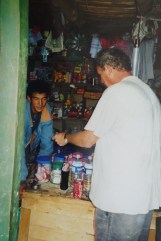
Later, at our encampment, Adrian wondered aloud if anyone would be interested in a beer. Beer? During our long hikes we’d not spotted anything resembling a retail outlet-not an off-licence, a corner shop, a mini-market, a stall or a kiosk. There were no roads-hence no roadside offerings. At our universal cries of affirmation he leapt up and disappeared, returning some time later with a crate of bottles and an air of nonchalance.

P1000712

The mystery of his providence was solved on another occasion when our route took us past some rough, wooden doors covering a rocky cave like Aladdin’s. Once unlocked, the doors revealed a ‘shop’, containing all manner of items. How the goods were transported to such an inaccessible area is a further mystery, but we did not go beer-less on our trek.

Each day when we stopped for a breather and to rest aching legs we’d open our lunch packs, provided for us by our hard-working crew. And each day the lunch would be the same: a boiled egg, a [cold] baked potato, a cereal bar. I remember that we’d fall upon these lunches that seemed the most delicious meal in the universe as we’d sit on a rock or a mound of grass overlooking the highest mountain range in the world, sometimes also getting mugged for our food by tiny pygmy goats!

Occasionally there would be an option to clamber up to a higher point while others rested, Adrian leading; an option that Welsh Gareth was always keen to choose, fit as a flea on his chocolate and bread diet and sometimes we would follow, burning muscles a small price to pay for such amazing views.

P1000719


India 1998: Ladakh Trek

At breakfast, taken in the beautiful garden of our Leh hotel before we began our trek, I discovered that some members of our group had taken preventative medicine for altitude sickness. I’d wondered why I’d been the sole sufferer of our group to have succumbed to this debilitating condition! But I had rallied and was now feeling up for a trek. We were used to vigorous exercise at home, being habitual daily runners.

This second tour group consisted of several couples [including ourselves], a couple with a teenage son and some singles; a couple of older, single women [one rather type-cast spinster and the other a charming widowed lady who I walked alongside for much of the route], a somewhat unfit looking, younger man who’d brought walking poles, a youngish woman. One half of a Welsh couple, Gareth had the most extreme eating phobia I’d ever witnessed [including the fussiness of my own children as toddlers] and seemed to exist solely on bread and chocolate, a tragedy in a country such as India. Despite this he was the fittest of all of us, with calf muscles like beer bottles and an ability to run up a mountain slope faster than a goat.

P1000699

While the mountain scenery was often stark and unmarked with vegetation in the higher levels there were stunning views as well as encounters along the way. On our first day we paused on meeting a group of schoolchildren making their way to school, an arduous hike they must make twice daily. They were cheerful and friendly, wanting to show us their exercise books, shaking our hands, their warmth shining from their smiling expressions.

Further along we caught up with a lady whose sheep had escaped and who’d clearly had to track the animal for miles across the peaks before capture, so some of our group [Husband included] gamely took turns to carry the sheep for her. The creature was extremely smelly, which resulted in a transfer of aroma to Husband, of course.

At the end of each day’s walk the bathing facilities on offer were a small bowl of warm water or a bathe in the snow-melt stream using eco-friendly mountain suds. Most chose the freezing water after a sweaty hike up and down slopes but it needed to be undertaken quickly while the sun was still up because, as is typical in mountain terrain the daytime temperature was hot, the nights cold. Toilet provision en route consisted of ‘behind the nearest large rock’ and in camp there would be a small tent over a hole in the ground, which was filled in on our departure.

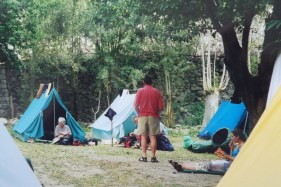
Our tiny, 2-man ridge tents would be up and ready by the time we got to camp, also the the dinner table. The pack ponies would be set free of their loads and be enjoying a well-earned graze. Then we’d sit together at the long table and enjoy a meal prepared by our crew.