India 1998: Ladakh. The Donkey and the Dzo-

To undergo a trek in a remote region with a group of strangers can be an interesting and sometimes challenging experience. In our group of a dozen or so, most people were amenable, adaptable types-as you would expect for anyone choosing to take a hike in some of the most inhospitable landscapes the world has to offer. Added to this, our two guides, Adrian and Sonam were both amiable and fun.
P1000830

But a small group holiday is ideal for singletons and while most of us were in couples there were also some singles; a rather unfit guy, a youngish woman, a teenage boy [with parents] and two older women. One of these older women, Anna, a widow, was pleasant, open and friendly and made for a good, conversational walking companion, as I often found when falling into step with her [the two of us frequently bringing up the rear]. The other woman, let’s call her Margaret, was a bit frosty and possessed of little sense of humour, also perhaps somewhat unworldly in certain areas.

We were walking down a slope into a valley one afternoon, the bare, rocky terrain giving way to vegetation as the path flattened, when we came across some donkeys grazing. The animals were friendly, happy to be stroked as we stopped to greet them. Margaret became unusually animated by the encounter, though not as animated as the donkey, whose excitement on gazing at Margaret was expressed in an immediate erection. This reaction went unnoticed or unrealised by Margaret, who exclaimed ‘The donkey likes me!’ but was nevertheless witnessed and enjoyed by all of the rest of the group, so that most of us found it necessary to impose self control over the general hilarity that ensued.

P1000836

On another occasion we reached the top of a climb to meet a family dressed in their Sunday best, on their way to a festival in the Gonpa [monastery] at the next village-the next village being many miles away across a mountain pass. They were carrying all the essentials for a picnic-including a well-used teapot!

On our descent into Ang village we were to see the wondrous beast of burden that is a ‘Dzo’, an odd mixture of yak and cow. But sometimes our very presence at a village was as of much interest to the locals as they were to us!

At Thimmisgamm village we made our last camp, where we had to bid farewell to our lovely crew and goodbye to this beautiful place. The next day we walked back to Leh and our delightful hotel where we had one more day to get a last explore before we were to travel back towards Delhi-by coach this time-to ride over the second highest road pass in the world, among other notable experiences!

India 1998: Ladakh Trek

At breakfast, taken in the beautiful garden of our Leh hotel before we began our trek, I discovered that some members of our group had taken preventative medicine for altitude sickness. I’d wondered why I’d been the sole sufferer of our group to have succumbed to this debilitating condition! But I had rallied and was now feeling up for a trek. We were used to vigorous exercise at home, being habitual daily runners.

This second tour group consisted of several couples [including ourselves], a couple with a teenage son and some singles; a couple of older, single women [one rather type-cast spinster and the other a charming widowed lady who I walked alongside for much of the route], a somewhat unfit looking, younger man who’d brought walking poles, a youngish woman. One half of a Welsh couple, Gareth had the most extreme eating phobia I’d ever witnessed [including the fussiness of my own children as toddlers] and seemed to exist solely on bread and chocolate, a tragedy in a country such as India. Despite this he was the fittest of all of us, with calf muscles like beer bottles and an ability to run up a mountain slope faster than a goat.

P1000699

While the mountain scenery was often stark and unmarked with vegetation in the higher levels there were stunning views as well as encounters along the way. On our first day we paused on meeting a group of schoolchildren making their way to school, an arduous hike they must make twice daily. They were cheerful and friendly, wanting to show us their exercise books, shaking our hands, their warmth shining from their smiling expressions.

Further along we caught up with a lady whose sheep had escaped and who’d clearly had to track the animal for miles across the peaks before capture, so some of our group [Husband included] gamely took turns to carry the sheep for her. The creature was extremely smelly, which resulted in a transfer of aroma to Husband, of course.

At the end of each day’s walk the bathing facilities on offer were a small bowl of warm water or a bathe in the snow-melt stream using eco-friendly mountain suds. Most chose the freezing water after a sweaty hike up and down slopes but it needed to be undertaken quickly while the sun was still up because, as is typical in mountain terrain the daytime temperature was hot, the nights cold. Toilet provision en route consisted of ‘behind the nearest large rock’ and in camp there would be a small tent over a hole in the ground, which was filled in on our departure.

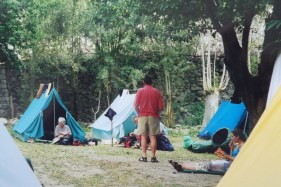
Our tiny, 2-man ridge tents would be up and ready by the time we got to camp, also the the dinner table. The pack ponies would be set free of their loads and be enjoying a well-earned graze. Then we’d sit together at the long table and enjoy a meal prepared by our crew.

India 1998: Ladakh

Before I ever experienced altitude sickness I’d assumed it meant breathlessness, struggling to inhale and chest problems. How wrong can you be? I first suffered mountain sickness on a trip to Peru and Bolivia, succumbing to a debilitating headache and accompanying nausea, so I knew when the tell-tale signs grew that I was heading for another bout there in Leh.

As we travelled back to our hotel, following our visits to some local Gonpas my headache became worse and I needed to exert some strict control over the nausea that overwhelmed my system. Once back in our room I began throwing up and continued to do so throughout the night, kneeling on the concrete floor of our little shower room, grateful for this small luxury, at least.

Our tour guide, Adrian was aware of my problem. As we were due to go rafting on the River Indus the next morning he explained that I’d have to miss out on it, which did nothing to lighten my mood. Worse still, if I didn’t improve there’d be no trekking either. The walking would be hard, with some steep climbs and long days at altitude. I missed out on dinner and tried to sleep. Maybe I’d have rallied by the morning.

I did manage to sleep, waking next day and feeling wrung out but much improved. When I begged to go on the river trip Adrian relented but instructed me to ‘sit at the back and do NO work’, meaning I wasn’t to take an oar but was allowed to do some light baling, using a plastic bucket. In the event the rafting was quite tame, the rapids mild and we all survived intact. The Indus here was monochrome, sepia, without vegetation and flanked by steep, rocky peaks.

As I’d no ill effects and seemed to be acclimatising it was decided I’d be ok to trek. We gathered to meet Sonam, the Ladakhi guide who was to accompany us, a slim young man about Adrian’s age with a charming smile. We’d be visiting his parents’ home along the way.

We were to carry day-packs, small rucksacks packed with our water [minimum 2 litres], small items we’d need, and our picnic lunch, made for us firstly by the hotel and thereafter by our crew. The crew consisted of three guys and a string of small, hardy ponies who were to carry our main luggage as well as the tents, the cooking gear and all of the food we’d need for the next few days while we were tramping around in the foothills of the Himalayas. These brilliant guys went ahead of us, taking our luggage, pitching our tents and preparing our evening meal whilst we trudged up and down mountains and hills experiencing some of the most extraordinary scenery the world has to offer.


India 1998: Leh

To follow a tour of India’s Golden Triangle by travelling to Ladakh, in Northern Kashmir feels like stepping away from the set of ‘Ghandi’ into ‘Lost Horizon’. First of all it is high altitude, earning its title of ‘Little Tibet’ and secondly it is the least populated area of India. Many of the inhabitants [40%] are Buddhist and much of the area is cut off for many months of the year.

Before leaving Delhi we met our new guide for the new tour, Adrian, who was as unlike Paratha as Obama to Putin. A few of us were leftovers from the first trip. Others were new. At our first gathering, the one where protocols are explained, he asked us about Paratha and was shocked to hear how she’d led the tour, exploiting her status and behaving in a controlling and condescending manner. This behaviour, he told us, is at odds with the company’s philosophy. They’d be unhappy to hear of it. Whilst I had no wish to lose Paratha her job I thought it best that subsequent tour groups should not experience the Golden Triangle in the way that we had.

Having had the team talk: be sensitive when taking photos, be mindful about altitude sickness [about which, more later], carry plenty of water, leave nothing but footprints etc, we boarded a flight to Leh, the largest city in Ladakh, flying up above snowy peaks to the highest airport in the world, one that also provides the fewest and most basic facilities, as we discovered when disembarking and needing to use the toilets.

To begin with we’d spend a few days in Leh, to look around and to acclimatise to the very high altitude before starting our trek. I looked forward to this second tour with a little trepidation, having had altitude sickness before, in Peru and Bolivia. I knew how nasty it can be but hoped that this time I might escape it. How wrong could I be?

We were charmed by our hotel, whose accommodation was basic but full of rustic character, with a beautiful garden and rooms furnished with chunky wooden beds and spartan, concrete shower rooms.


As advised, we took it easy walking around gorgeous Leh, but it was hard to restrain the urge to rush about looking at everything, since everything was either beautiful or interesting or both.


For our second day in Leh we took a trip out to view some of the more accessible and picturesque monasteries [‘Gonpas’] that were dotted around in the mountains. This is a landscape that is both dramatic and outrageously magnificent, the monasteries themselves built into the sides of the mountains as if they’ve grown there and carved and painted in ornate and beautiful designs and frescoes, with none of the formality of mosques but with life and expression.

To visit the Gonpas we needed to dress modestly and cover up extremities. I’d had the presence of mind to add a light sarong to my daysack that morning [a habit I’ve become accustomed to], meaning that Husband was not left bare-kneed. There is a gentle, homely atmosphere in the gloomy interior of each Gonpa and as the monks go about their daily tasks they greet tourists good-naturedly, sipping tea and nibbling a biscuit or two as they pray!

In order to view the buildings we needed to clamber up and down steps in the thin, cold air, which proved more arduous than the previous day’s sightseeing in Leh. Sometime during the afternoon I began to feel the onset of a headache, something brewing up, becoming more painful as the day wore on. Before long it was accompanied by a powerful nausea, then I knew I wasn’t to escape the mountain sickness I’d experienced before in Peru…