Hungarian Calamity [Part 2]

Last week’s post saw our intrepid travellers, Grace and Husband marooned in their camper van in supermarket ‘Auchan’s’ car park a few miles north of Budapest…

We lunched in the car park, keeping an eye on the access road for a pick-up truck and bickering a little [Husband wanting to reverse to be located more easily, me wanting to let things be].

My phone rang. ‘My neem ees Eleezabet’. We confirmed that I was me. We went over the vehicle’s vital statistics. ‘Pleeeese beee patient’ pleaded Elizabet, before ringing off. Time crawled on…

Husband went for a stroll around the shopping centre and returned. I went for a stroll into Auchan and returned. Time passed. Slowly. Elizabet called again. ‘Eees veery imbortant about your vehicle’ she reiterated, and I gave her the dimensions once more. ‘I ‘av to find a veehicle to peek you up’ she said.

We waited.

At half past four a rescue truck appeared, driven by a white-haired, boiler-suited, moustachioed Hungarian, looking apprehensive. He’d struck unlucky, summoned to collect a Ducato van and ignorant foreigners. It took time to attach the van to the truck then we clambered into his cab as he nodded and gesticulated.

Waiting is exhausting, so by now, as we swept back towards Budapest and an unknown garage we looked forward to a respite, an opportunity to set reparation in motion. We trundled along some minor roads in a small industrial estate before coming to a halt in front of ‘Schiller Fiat’. Boiler-suit got out, uncoupled us, said ‘Schlafen’, placing his hands by his head to mime sleep and left. It was 5 o’clock. The garage had closed at 4.30pm.

Having gnashed teeth and torn hair for a few moments we deliberated our options: bed down on the sloping forecourt at the roadside/lock up, pack essentials [into shopping bags as no suitcases] and stagger to the nearest hotel [found on Husband’s phone]/wait for something to happen/phone the insurers-again.

We opted for calling the insurer, bypassing Elizabet and going back to the source-Adam, [who’d gone off duty and been replaced by Ali]. I explained our predicament. We sat back to wait. Time passed. We made tea. Ate bread and cheese. Sniped a bit. Yawned.

In a compound next to the forecourt a security man was locking the gates up. ‘That’ I told Husband, ‘is where our van should be’. Once or twice a taxi came past, prompting a slight stir, which ebbed away as it went out of sight. We drank beers. Waited.

Elizabet called to tell us a taxi was on its way, prompting us to watch for it. The several taxis that passed were not ours. We rang back, got  someone else. ‘Eet is not appropriate for meee to speeak to you’ she said.

It was dark. At some time after 8.00pm a taxi appeared from the gloom and pulled up. On arrival to the IBIS hotel in central Budapest we approached the check-in desk with our shopping bags of essential items and were met by the first smiling competence of the entire, dismal day, then dispatched to a small room, basic but adequate. We showered and staggered across the alleyway to a comfortable café where I cast caution to the still night and had two large glasses of wine before retiring to the narrow bed in our stuffy little room.

To be continued. Check in next week for Hungarian Calamity Part 3…


Hungarian Calamity [Part 1]

Budapest. Full of Eastern promise; the streets lined with ornate statuary, outrageously opulent architecture from myriad eras and cultures. Onion-topped, gilded, tiled, carved, stuccoed and frescoed to within an inch of its life. Every corner housing a kebab shop yet room for a ‘Tesco Express’.

This is grandness on the top of the scale, except that the opulence falls short at the campsite gates, where a ‘refurbishment’ [something we’ve seen a lot of, this trip] meant porta-cabin showers and no functioning washing machine. The women’s showers, complete with flimsy curtains opened on to a car park, offering no privacy to those groping for a towel. Ho hum-

After some deliberating we navigated by Metro to the centre of the city, where ‘hop on hop off’ awaited, touristy but acceptable to anyone who has a great deal to see and not much time to see it.

P1050465

Budapest is made up from two cities-‘Buda’ on one side of the Danube and ‘Pest’ on the other. ‘Buda’ houses the opulent palace and the castle, ‘Pest’ accommodates the glitzy shopping streets, the cathedrals, the buzzing restaurants and cafes and the outrageous parliament building, like a fanciful wedding cake on speed.

After an afternoon of sightseeing, hopping on and off, we were left waiting for the last bus up at the area of Heroes’ Square, where there is a zoo and the old Thermal Baths-an amazing sight in themselves, both the outside and the interior.

P1050535

We’d only nibbled the edge of Budapest’s sights, nevertheless as we relaxed on the top deck of the bus [relieved to have caught it] we felt ready to move on. Palaces, castles, monuments and statues are delightful but there are only so many iconic structures anyone can cope with in one visit.

Since Budapest is choc-full of Turkish-style cafes and restaurants we opted for a self-service kebab house, where a plethora of delicious looking concoctions lay behind the counter and judging by the popularity of the place it was a good decision.

One leisurely beer later we made our way back.

Next day, with grocery shopping in mind we set off towards the ‘bend in the Danube’, stopping off at an ‘Auchan’ supermarket [of which Hungary has many] to stock up. Once we’d swung out of the car park and located the correct road an ominous ‘thump’ became audible, seeming to emanate from the passenger side wheel arch. Horrors!

‘It’s the road surface’ bluffed Husband [more confident than he felt, I assumed] and ‘No’ from me [not confident]. Having managed to secure a safe place to pull in we conducted a brief examination which revealed…nothing. The noise persisted, prompting us to find yet another safe place to stop-a car park at the next ‘Auchan’ supermarket [as I said, there are many].

I struck out to ascertain our whereabouts before phoning the roadside rescue arm of our insurance, then spoke at length with ‘Adam’ who dithered with a blithe lack of concern whilst scrutinising Google maps to search for us. I scrambled out of the van to provide him with a list of the stores surrounding us: H&M, Bauhaus, Auchan… ‘Is there a cinema complex?’ he interjected. I sighed. ‘There are no leisure facilities, Adam. It’s a shopping centre’. He deliberated some more while I cast around. ‘There’s a MacDonalds’ I told him. ‘Bingo!’ he said. ‘I’ve got it!’

To be continued…


Romantic Romania

The vast and beautiful Danube flows through ten countries-more countries than any other river in the world, also forming several borders including that between Bulgaria and Romania.

Crossing into Romania was a little like stepping into a fairy tale, or into a Constable painting, for while the roads, infrastructure and villages were better kept and looked a little more affluent than in Bulgaria the communities were also quaint and olde-worlde.

P1050445

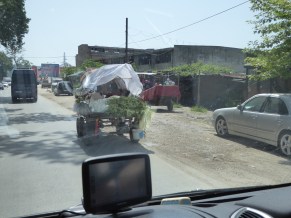
I’ll admit to being surprised, having assumed Romania to be much poorer than its neighbour. Having said this, there were countless signs that Romania is stranded in a bygone age, such as hand-tilling in the fields, hay-making with horses and carts and horse-drawn transport.

The pretty, tree-lined streets of the villages are made up of tiny, single-story homes-many with tiled exteriors in intricate patterns. Outside many homes there are benches positioned to catch the evening sunshine, often occupied by a couple of women in headscarves having a gossip.

On the road we followed an open truck with a horse tethered in the back. The horse was blinkered and attached each side but even so the truck lurched around corners, swaying and jolting but causing no apparent distress to the equine passenger.

P1050428

We stopped for lunch alongside the Danube basin, where the waters again form a border, this time between Romania and Serbia, so that the wooded hills of Serbia are visible on the other side.

As in the previous country [see last week’s post] we’d scant information on camp sites but headed for ‘Hercules’, a tiny, five-pitch site behind a restaurant opposite a busy road and railway line. We drew into the driveway to be greeted by the owner and shown to a place, which was not a problem since we were the only van there. The sun beat down into the small, neat back yard, a chance to relax after the journey. Though small, the site boasted clean, efficient showers, a washing machine and every convenience.

This being one location where our mobile internet was unobtainable we took devices to the bar and used the site wifi while we had beers. Later an Austrian couple pulled in to be our neighbours for the night. We settled down to sleep. At around midnight we were woken by loud, staccato bangs from a building next door and looked out to see the sky alight with fireworks. Odd timing-but who are we to judge on another country’s customs?

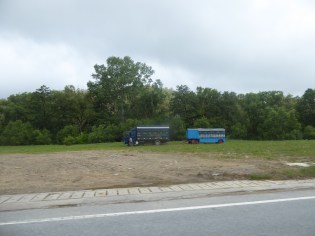
Next day we were off north again towards Hungary, travelling through ravishing green countryside and rustic scenes that included thousands of beehives. I spotted them in industrial numbers along the verges and in the fields, often being tended by veiled beekeepers, the results laid out in modest roadside stalls. Then there were beehive trucks:

P1050444

These unusual vehicles were parked in lay bys or pieces of wasteland. It was uplifting to see such a large-scale industry from bees. At least someone is taking care of them!

Having passed mile upon mile of queued lorries we arrived at the border with Hungary. I felt bereft. We’d whisked through Romania in two days and a part of me clamoured to stay and explore, to wander along the village streets and photograph the countryside. But don’t worry, Romania, we will be back. Besides-a visit to Romania just has to include an exploration of Transylvania.

And then there was Hungary…


Bulgaria: Beauties and Beasts

P1050284

We left beautiful, spectacular Delphi, swishing around a series of hairpins into a mizzly mountain rain and on towards Thessaloniki and the seaside town of Nea Moudania for a last blast of sun before the long trek north. In the event, both Nea Moudania and the sunshine failed to excite and we cut short our last blast in favour of discovering the delights of Bulgaria.

Hitherto my one experience of Bulgaria was a solo skiing trip to Borovets, where the skiing, social life and scenery were all delightful, the hotel food atrocious and the staff gloomy and depressed.

Having negotiated the border we knew we’d have to buy a road tax ‘vignette’ and  obtain some currency. The road on Bulgarian side of customs is lined with stalls selling all manner of goods from liquor and cigarettes to bottled water, also currency [exchange-euros for ‘lev]’.

P1050342

We set off towards ‘Sapareva Banya’, using the co-ordinates from the German website we’d had to use to find sites. The rolling, green countryside was delightful; the towns were the ugliest I have ever seen-crumbling, grey blocks and abandoned factory sites. This is the legacy of the iron curtain. I wondered how it was possible to create such brutal ugliness and how will it ever be possible to eliminate?

P1050362

The co-ordinates took us down an increasingly rutted track and through some gates. It looked promising. Inside the gates the driveway rounded a large, stately building in wooded grounds but nothing resembling a camp site. I ran around to the front of the building and climbed once-grand steps into a huge, gloomy hallway containing booths housing white-coated people with clipboards and papers. My hesitant enquiry as to whether anyone spoke English yielded blank shrugs. I’d stumbled into some kind of sanatorium; clearly not a camp site.

Husband was all for turning back, although we’d had a long day’s travel already. I determined to find the site, striking out down a track I’d spotted where builders were constructing a bar by a pool. A kindly builder explained in good English how to navigate to the site, [next door].

Yes-there it was, down another rustic lane. We pulled in. When there was no response to my ringing a bell at ‘reception’ I thumped on the door which after some minutes was answered by a lugubrious young woman, bleary eyed and shoeless. I imagine I’d dragged her off the sofa and away from an afternoon of daytime Bulgarian soap operas. We could stay, she told me but they were very busy and had little room. This proved to be true, as a large tour group of Dutch caravans was occupying all of the field. We manoeuvred into a sloping slot behind some chalets, relieved to have somewhere to spend the night.

Sapareva Banya had given us no cause to linger and we drove off again in the morning to head north again and find a site called ‘Madona Inn’ from the German website.

P1050364

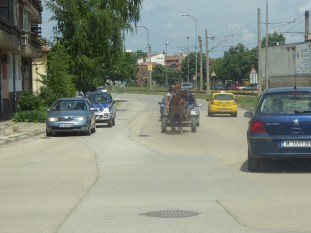
Bulgaria is poor. Horse-drawn carts are commonplace among the town traffic and most small village homes are in need of repair, resources being too scarce to squander on paint, render or window frames.

Madona Inn is easy to find, a guest-house and camp site with bar and restaurant along the road to Belogradchik, where a 1-3rd century AD fortress lies in an imposing position between the dramatic sandstone rocks of the area. With time to explore before checking in we drove up to Belogradchik, a town that has made no concession whatsoever to tourism in terms of beautification. We climbed up to the stunning fortress.

P1050376

Madona Inn was everything Sapareva Banya was not, with cartloads of rustic charm, although the Bulgarian cuisine on offer seemed eccentric to our uninitiated taste-an omelette topped with soggy toast topped with pork slices topped with mushroom sauce topped with…a boiled egg.

P1050413

It was a beautiful, quirky site and well worth the visit-but little did we know what impact the terrible road surfaces would have later…


The Bad, the Good and the Muddly

It was all going so well. When I left you last week we’d found a place to stay in Budva, Montenegro, we’d seen the town and enjoyed a meal on the harbourside.

Next morning the local bin men obliged us by waking us up early, giving us a good start for our entry into the next country-Albania. Before we got there, however there was a dramatic mountain pass to negotiate, a journey that afforded stunning views of the Adriatic, it’s coastline becoming miniature as we climbed higher. Then it was a steep descent with hairpin bends. The landscape gradually flattened and there were lakes and marshes.

P1050001

Montenegro is a tiny country-smaller than Wales-so it doesn’t take too long to get to the border with Albania; but it does take a little time to get across the border. Again there is the issue of motor insurance. Whilst we queued at passport control a casually dressed young man sporting a badge on a lanyard approached and spouted a cascade of Albanian at us, seeming to be a question. ‘Yes’, said Husband-and ‘No’ said I. There was a short hiatus, during which Husband and I conducted what I shall term a mild dispute as to whether he was enquiring if we had motor insurance or enquiring if we needed motor insurance.

The discussion was swiftly concluded by Husband’s handing over of a fifty euro note, with which lanyard man disappeared up some steps. His companion-[a would-be translator] waved us into the queue. At this point Husband’s heels dug firmly into the footwell and would not budge; he glowered until he saw a return on the fifty euros.

‘Oh ye of Little Faith’. Lanyard returned brandishing a sheet of paper embossed with a gold stamp-an advance on the scruffy scrap of Montenegro. Whether it was worth any more than the paper on which it was inscribed is doubtful, however we would not have wished to put it to the test.

On then-to Albania’s highways, upon which cows, dogs, donkey carts, pony carts, moped  carts and an altogether eclectic mix of vehicles, animals and humans besport themselves. This is a country where the population has the utmost faith in other road users-so much so that they feel confident to wander across a ‘motorway’ or wheel a barrow along the central reservation.

P1050040

The driving is outlandish, with meandering across to the other side of the road commonplace. Somehow we arrived at the campsite we’d selected near Berat and swung through the gates to see a smattering of van and motorhomes-as usual the intrepid Germans-and even another British van.

This was a little oasis with shaded pitches, beautiful showers, a bar and a restaurant. We heaved that inward sigh that follows an anxious day of travel and determined that we should follow our site neighbour’s advice and take a look at Berat, The White City, Albania’s poster-boy city.

P1050031

Ever-hopeful, and armed with a scribbled map that Donna, the camp-site owner had drawn us, we drove into Berat.

Five hours and three attempts to find the road south later we retraced our route back past the camp site and back towards Montenegro. Frazzled, frustrated, hot and defeated we acknowledged that the road marked on the atlas could not possibly exist. Mrs TT [the satnav slag] had taken us in circles or onto unpaved, rutted tracks.

At last, at the end of a long, hot, dusty day we arrived to the Greek border and it was with a mixture of sense of achievement and relief. Greece!


The Wild Frontier

Last time we made the long trek to Croatia we were still using a tent, which means it was very many years ago. It seemed intrepid then, to go so far; but although the roads were basic the camp sites were beautiful, the people welcoming and the produce wonderful.

There are still hundreds of roadside stalls selling local fruit and vegetables and home-made concoctions but Croatia has developed a great deal since our previous visit, with efficient roads, signs and facilities in abundance. Having previously stayed on a few islands and seen Dubrovnik we chose to go to the Unesco site of Plitvicka, an area of outstanding natural beauty with lakes and waterfalls. At this time of year, with the snow-melt water cascading down everywhere under a faultless blue sky it was spectacular, exceeding all expectations and only marred [as the day grew later] by the hoards of selfie-takers, tablet-snappers and those who consider themselves ‘serious’ photographers in that they must use a tripod for every shot. There were also, near the end of our chosen trail a number of coach parties, mainly Japanese-some of whom had chosen to wear face-masks for their day out, an inexplicable sight in the pristine environment of Plitvicka.

P1040845

Next day we were off early, continuing through the inland part of the country which is quiet and beautiful, a backdrop of mountains and occasional lakes but precious little tourism. All tourists want Croatia’s coast [which, to be fair is dramatic and beautiful, too]. Then we were back on the coastal highway ourselves, spending our last night in Croatia in a small, seaside village and enjoying an uproarious evening with another British couple, sitting outside by the Adriatic, the sound of the waves an accompaniment.

We sped off again in the morning, south towards Montenegro, a new country for us. At the border we bought our obligatory motor insurance-fifteen euros for a scruffy scrap of paper-, made deferential noises at the officials and set off towards Budva, whose alleged reputation as a mini version of Dubrovnik is a little exaggerated. In all of the books, websites and information that we’ve amassed there are no places whatsoever mentioned in Montenegro so all we had was a dubious site I’d discovered on the internet somewhere around the back of town, the location of which we’d programmed into Mrs Tom-Tom with more hope than confidence.

‘700mtrs’ said Mrs Tom-Tom as we stopped in the first car park we found. 700 meters to the camp? In the midst of the city?

We drove towards it. I spotted the edge of a caravan between the houses of the street. We drove round the corner and through a gateway and parked under the olive trees. Yes, it was basic. No, not everyone would have wanted to use the shower [although it was clean]. But it was a twenty minute walk from the old, walled town of Budva and best of all it was safe and secure.

P1040984

While Budva cannot hope to compete with Dubrovnik it is nevertheless a pleasant and attractive old town. having strolled through the narrow alleyways and visited the ‘Citadela’ we found a seaside bar, bought a beer and sat to watch Budva’s population enjoying the evening sun. What would our next day’s travel involve? I’d read enough about the perils of Albanian roads to give me nightmares! We were about to discover it for ourselves…


Lower Your Expectations!

A wonderful lady I worked with years ago sometimes used to say ‘Lower your expectations’. She would use this phrase whenever we felt jaded or that events were taking a downward turn. It was intended to be droll-and it was, because it always brought a smile to our faces.

But the idea of lowering expectations is not without advantage. If I consider a worst case scenario in life then the outcome will either be a] as I expected or b] not as bad as I expected, both of which are better than a disappointment.

I can apply this approach to all aspects of life. We have just embarked on a new expedition into Europe, intending to travel in directions hitherto unexplored [by us]. The preparations for this odyssey seem endless and difficult, partly due to it’s being the first major road trip of the year and partly because my brain is losing its propensity to be sharp. I appear to spend a great deal of time writing lists and forgetting to add items, or writing lists that prompt further lists. I begin a task and become distracted by another. I forget what I do, forget how to prepare.

Eventually, however we seem to be ready. We get away on time. We arrive at the ferry port on time. The crossing is uneventful-pleasant, even. We breakfast, we slump, we snooze in the recliner seats of the quiet lounge [both of us having had a fitful and short night’s sleep]. The weather is warm and sunny. This is a bonus, since cold, wet weather was expected for a few days at least. See what I mean? Expect the worst, lower your expectations.

It is easy to see why many prefer the simple process of buying ready-made holidays. Everything is done; everything laid on. You are transported somewhere, you are ferried to sights and brought back [as on cruise ships]. You follow an itinerary someone else has prepared. You look, perhaps take snaps, perhaps buy a souvenir. You are taken home.

The road trip requires planning and preparation. We [mostly Husband] plot each day’s route, we search out possible destinations, we fuel up, shop, service the van [water, waste]. We make decisions, try to agree. We problem-solve. Sometimes we are successful. In the two days since we began we’ve had to overcome irritants like lights that will not switch off, devices that bleep in the middle of the night, van alarm going off [also in the night] and no internet access. Above all we have to adjust back into camper-van life, remembering where we store stuff, routine when we park up, routine when we leave each day.

But we know we must make our brains and bodies work for us if we want to get into healthy old age and I imagine that it’s one of the reasons there are so many ancient motor-homers out here in Europe, just like us. Oh-and there’s the freedom of course. Who wants to be told what to do and where to go? Now what on earth has happened to all my ‘Word’ documents???


Slip Sliding Away

I’ve never been much of a sports spectator. Other than a brief phase of tennis watching in the 70s [I happened to live in a flat a few minutes’ walk away from Wimbledon’s famous club]. I’ve positively avoided watching the sporting activities of others. Exceptions include international rugby games [I’m currently enjoying the six nations championship] and winter sports.
There is something magical about the winter Olympics. The settings are beautiful; other-worldly and mountainous landscapes providing a background for breath-taking races and stunts. Watching daring ski jumpers hurtling down a slope and flinging themselves skywards before landing the right way up and sliding away is enough to make your stomach lurch, as is the downhill skiing or the crazy free-for-all of the speed-skating.
Most of all the new [since 2014], tricksy snow-boarding contests are spectacular and a compelling watch.
It is more than twenty years since I had my own, brief taste of snow-related activity, when I took myself off for a week of beginner skiing in the much-poopooed [by seasoned skiers] resort of Borovets, Bulgaria. I’m sure it wouldn’t do for those who take to the slopes on a regular basis or those for whom a fashionable resort matters most. But for someone who was new to skiing-and approaching middle age, Borovets was just cheap, cheerful and more than demanding enough.
To this intrepid week of discovery I’d added an extra anxiety-inducing element. I was travelling solo. I did have the advantage of being physically fit, having undertaken running and aerobics in the preceding years but I was also reeling in the aftermath of a relationship breakdown, which meant that solo travel would be a risky business for my battered emotions. Would I be able to forge friendships, find some kind of transitory support network, have any conversations, bond with fellow novices? Friends counselled for and against but in the end the ‘for’ camp won for advising me to see it as learning a new skill-just like going on a course, which of course, I was!
There is an art to lone travel. When I boarded the transfer bus at the airport I was asked which ‘party’ I was travelling with, a difficult question. When a couple, faced with no spare seats at the hotel’s evening meal, were forced to share my table I thanked them for joining me, shifting my novel [a prop] across to make room. Next morning’s breakfast was a solitary affair.
Then I had to find my ski class. I headed down to the boot room, where we virgin skiers were to be parcelled up into groups, get our lift passes and our boots and skis. Once I was in a group everything changed. We were united in anticipation, endeavour and terror! We laughed, clutched each other, fell over, encouraged one another, made progress. At the end of that first, exhausting, exhilarating day I had a group of friends. We ate together, went out together, drank together, shared our stories.
I loved skiing, but I never did it again. It was not long before he who was to become Husband came along and lone holidays became a thing of the past. There is no doubt that, like most sports, skiing needs to be taken up when young. But that holiday holds fond memories for me, as does skiing, so for anyone who is wavering about skiing-or indeed about holidaying as a singleton I’d say go for it! What can go wrong?

The All-inclusive Trap

Searching for winter sun, an escape from the dreary, grey drizzle or the bitter winds of this UK winter means travelling long-haul. The options are: far east [Thailand etc], Africa [tried, tested and now not tempted] or Caribbean. We’ve sampled a few islands in the West Indies now, with pleasing results, Barbados and Antigua having proved particularly lovely destinations. Mexico, last year’s experiment boasted beautiful weather but was less fun in that there were few options outside of the hotel.
And here’s the difficulty. In choosing a Caribbean or most other long-haul destination you are stuck in the inevitable groove of ‘all-inclusive’ deal, as after intensive research we have found it to be cheaper than either flying and booking hotels separately or B&B. An all-inclusive deal is likely to mean a vast, corporate hotel sprawling on a coastal strip and boasting several restaurants, bars, pools, terraces, a spa, a gym, shops, ‘entertainment’, beach with loungers and umbrellas and the ubiquitous ‘buffet’.
Hotels like these are betting on the hunch that most guests prefer to stay within the confines of the hotel complex and couldn’t give a cow’s udder about setting foot outside the gate to meander in the environs and hobnob with the locals. And it is true for many, who like to get up, sling their beach towels on their preferred loungers, wander into breakfast, order a cocktail and slump then slump on their sun bed until a member of staff bearing a tray offers more refreshment. There’ll be a further stint of slumping followed by lunch…
For some with a more active schedule in mind there might be a short session of aquarobics or pool volleyball-but then it’s back to the more serious business of slumping, punctuated by propping up one of the many bars.
We can manage a day or so of this, given sunny weather and a beach walk. But after a while some ennui creeps in. This is when we need to get out.
On our recent trip to Cuba the few days in Havana was perfect. We had breakfast in the hotel, we were within walking distance of the delights of the city and had the remains of our days free, at liberty to explore. Once we’d moved to the beach hotel, however there was a short stretch of beach to walk and everything else required a taxi or a bus ride-both of which we did. In one direction lay a sterile and uninspiring marina; in the other the town yielded more sightseeing and entertainment and it was there that we avoided incarceration.
One of the reasons for avoiding cruises is the enforced imprisonment aboard a floating, all-inclusive hotel, with nothing to do but eat and drink.
Our next expedition, already in the planning stages will be very different, involving an extensive road trip by camper van. On our journey we’ll stay where we want for as long as we want, moving on when we’ve had enough of a place and opting to explore by foot or bicycle. What a pity we can’t take the van to winter sun destinations!


Fresh from Cuba-

P1040382


We have returned from ten days in Cuba, leaving the frozen, grey UK and taking almost ten hours to fly to a warm, bright and colourful Havana. After hearing about the plight of tourists to Jamaica, who must remain in hotel lock-down due to violent crime I’d advise anyone with Caribbean travel plans to choose Cuba-one of the safest holiday destinations in the world.

Even in my deprived-sleep-addled state, on the journey to the hotel I could see that there is NO advertising of any sort along the roads, not on the highway from the airport or in the suburban streets and nowhere in the bustle of the city. It is refreshing not to be faced with hoardings and neon everywhere.

Continuing this theme, there is nothing anywhere that resembles a ‘chain’ company. No Starbucks, MacDonalds, KFC, Wagamama, TGI Fridays, Specsavers, H&M, Monsoon, Wallmart, Top Shop or IKEA. Magic! It is, in fact difficult to determine where there are any shops at all. There are tiny corner kiosks nestling among crumbling facades or murky windows displaying manekins sporting faded, dusty outfits. There are also alleyways with market stalls touting Che Guevara T-shirts, baseball caps and a range of hand-made items. There is also a riot of lively, busy bars and restaurants thronged with tourists and locals alike and often alive with a band of musicians.

Bars. There is no shortage of these; some mere holes in the wall, others ornately panelled, art-deco monuments to a rum-and-salsa culture much celebrated by writer Ernest Hemingway [whose heritage is much exploited by Havana traders]. There is a limitless supply of musicians. In a small street outside a Hemingway-themed bar where exuberant music is entertaining the area an impromptu accompaniment was played on water bottles as several individuals ran fingernails up and down the furrowed sides [proving my theory that almost anything can be employed as a musical instrument].

Cars. Cuba is well-known for its old, American classic cars. I was unprepared for the number of them [allegedly 150, 000].They range from lovingly restored, smooth, gleaming limousines to pitted, filled and battered jalopies. All, however spew out a filthy, noxious cloud of lung-clogging fumes which requires some adjustment of the respiratory passages when out walking.

People are friendly, happy and not above exploitative. We were offered welcome, advice, conversation and cigars or a visit to an outlet. We were never, at any time hassled or pursued. Rejection was accepted with relaxed, good-natured smiles. There were a small number of beggars, some of which had gone to lengths to create artful outfits to enhance their plight-a frayed and patched jacket or [in one case] a masterpiece of sackcloth trousers. There was no evidence at all of rough sleeping.

There was an overall sense of well being. Nobody appeared embittered or unhappy with their lot. The population is a mixture of black and white with all groups of diners, musicians, shoppers and travellers joining in together as one, never allied to one or other ethnic type. It is safe; a tourist could walk alone anywhere at any time of day or night without fear of molestation. We were unlucky with the weather, which was uncharacteristically overcast and windy. Otherwise it was a fun-filled and happy experience. Thank-you Cuba!