Unknown's avatar

About Grace Lessageing

I am writer of novels, short stories, flash fiction, blogs. I lead a creative writing group. I am an Ex infant teacher, living in Christchurch, Dorset, UK. My brand new novel, The Conways at Earthsend was published on January 28th 2021 can be found on Amazon, Waterstones, Hive and Goodreads and is available in either paperback or e-book versions. You can also read The Year of Familiar Strangers, available as an e-book from Amazon. You can visit my website: janedeans.com or my author page on Facebook: https://www.facebook.com/Jane-Deans-Novellist-Short-Fiction-and-Blog-102757711838272 Happy reading!

The Bad, the Good and the Muddly

It was all going so well. When I left you last week we’d found a place to stay in Budva, Montenegro, we’d seen the town and enjoyed a meal on the harbourside.

Next morning the local bin men obliged us by waking us up early, giving us a good start for our entry into the next country-Albania. Before we got there, however there was a dramatic mountain pass to negotiate, a journey that afforded stunning views of the Adriatic, it’s coastline becoming miniature as we climbed higher. Then it was a steep descent with hairpin bends. The landscape gradually flattened and there were lakes and marshes.

P1050001

Montenegro is a tiny country-smaller than Wales-so it doesn’t take too long to get to the border with Albania; but it does take a little time to get across the border. Again there is the issue of motor insurance. Whilst we queued at passport control a casually dressed young man sporting a badge on a lanyard approached and spouted a cascade of Albanian at us, seeming to be a question. ‘Yes’, said Husband-and ‘No’ said I. There was a short hiatus, during which Husband and I conducted what I shall term a mild dispute as to whether he was enquiring if we had motor insurance or enquiring if we needed motor insurance.

The discussion was swiftly concluded by Husband’s handing over of a fifty euro note, with which lanyard man disappeared up some steps. His companion-[a would-be translator] waved us into the queue. At this point Husband’s heels dug firmly into the footwell and would not budge; he glowered until he saw a return on the fifty euros.

‘Oh ye of Little Faith’. Lanyard returned brandishing a sheet of paper embossed with a gold stamp-an advance on the scruffy scrap of Montenegro. Whether it was worth any more than the paper on which it was inscribed is doubtful, however we would not have wished to put it to the test.

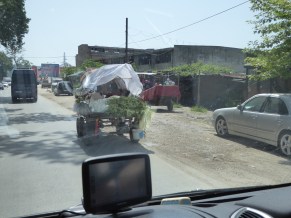
On then-to Albania’s highways, upon which cows, dogs, donkey carts, pony carts, moped  carts and an altogether eclectic mix of vehicles, animals and humans besport themselves. This is a country where the population has the utmost faith in other road users-so much so that they feel confident to wander across a ‘motorway’ or wheel a barrow along the central reservation.
P1050040

The driving is outlandish, with meandering across to the other side of the road commonplace. Somehow we arrived at the campsite we’d selected near Berat and swung through the gates to see a smattering of van and motorhomes-as usual the intrepid Germans-and even another British van.

This was a little oasis with shaded pitches, beautiful showers, a bar and a restaurant. We heaved that inward sigh that follows an anxious day of travel and determined that we should follow our site neighbour’s advice and take a look at Berat, The White City, Albania’s poster-boy city.

P1050031

Ever-hopeful, and armed with a scribbled map that Donna, the camp-site owner had drawn us, we drove into Berat.

Five hours and three attempts to find the road south later we retraced our route back past the camp site and back towards Montenegro. Frazzled, frustrated, hot and defeated we acknowledged that the road marked on the atlas could not possibly exist. Mrs TT [the satnav slag] had taken us in circles or onto unpaved, rutted tracks.

At last, at the end of a long, hot, dusty day we arrived to the Greek border and it was with a mixture of sense of achievement and relief. Greece!


The Wild Frontier

Last time we made the long trek to Croatia we were still using a tent, which means it was very many years ago. It seemed intrepid then, to go so far; but although the roads were basic the camp sites were beautiful, the people welcoming and the produce wonderful.

There are still hundreds of roadside stalls selling local fruit and vegetables and home-made concoctions but Croatia has developed a great deal since our previous visit, with efficient roads, signs and facilities in abundance. Having previously stayed on a few islands and seen Dubrovnik we chose to go to the Unesco site of Plitvicka, an area of outstanding natural beauty with lakes and waterfalls. At this time of year, with the snow-melt water cascading down everywhere under a faultless blue sky it was spectacular, exceeding all expectations and only marred [as the day grew later] by the hoards of selfie-takers, tablet-snappers and those who consider themselves ‘serious’ photographers in that they must use a tripod for every shot. There were also, near the end of our chosen trail a number of coach parties, mainly Japanese-some of whom had chosen to wear face-masks for their day out, an inexplicable sight in the pristine environment of Plitvicka.

P1040845

Next day we were off early, continuing through the inland part of the country which is quiet and beautiful, a backdrop of mountains and occasional lakes but precious little tourism. All tourists want Croatia’s coast [which, to be fair is dramatic and beautiful, too]. Then we were back on the coastal highway ourselves, spending our last night in Croatia in a small, seaside village and enjoying an uproarious evening with another British couple, sitting outside by the Adriatic, the sound of the waves an accompaniment.

We sped off again in the morning, south towards Montenegro, a new country for us. At the border we bought our obligatory motor insurance-fifteen euros for a scruffy scrap of paper-, made deferential noises at the officials and set off towards Budva, whose alleged reputation as a mini version of Dubrovnik is a little exaggerated. In all of the books, websites and information that we’ve amassed there are no places whatsoever mentioned in Montenegro so all we had was a dubious site I’d discovered on the internet somewhere around the back of town, the location of which we’d programmed into Mrs Tom-Tom with more hope than confidence.

‘700mtrs’ said Mrs Tom-Tom as we stopped in the first car park we found. 700 meters to the camp? In the midst of the city?

We drove towards it. I spotted the edge of a caravan between the houses of the street. We drove round the corner and through a gateway and parked under the olive trees. Yes, it was basic. No, not everyone would have wanted to use the shower [although it was clean]. But it was a twenty minute walk from the old, walled town of Budva and best of all it was safe and secure.

P1040984

While Budva cannot hope to compete with Dubrovnik it is nevertheless a pleasant and attractive old town. having strolled through the narrow alleyways and visited the ‘Citadela’ we found a seaside bar, bought a beer and sat to watch Budva’s population enjoying the evening sun. What would our next day’s travel involve? I’d read enough about the perils of Albanian roads to give me nightmares! We were about to discover it for ourselves…


The Lure of the Lakeside

We crossed from the French Alps into the Italian, driving over the border inside the Tunnel de Frejus, a 12k subterranean road that can be used for the outrageous sum of 58 euros!

P1040724

To leave France and enter a different country is to go out of my comfort zone. We’ve holidayed a great deal in France, so much so that it feels like putting on a comfortable old pair of slippers. We visit France every year at least once and far more than say, our own capital of London. For those of us with motor homes the travel is easy. After so many years of confusing the population with my basic French I’m finally able to make myself understood and elicit a response in French without smirks, blank incomprehension or arrogant ignorance.

Last year, with the help of a phrase book I began to feel my way around the Italian language, at first mixing it up with Spanish, a language it resembles and then grasping a few useful words. ‘Lavaccine gietone’ was one phrase I practised rolling around my tongue-enough that I was able to go and request a washing machine token and actually get what I asked for.

So having crossed the border I rifled around in the book box- a box that contains all our useful travel documents, atlases and guide books-for the Italian phrase book. I reached the bottom of the box to find two French phrase books, neither of which we need, but no Italian one. Husband, who’d spent days preparing the box declared ignorance on the subject and I suppose I only have myself to blame for the omission. Ho hum…

We are passing through the north of Italy on our way south towards Croatia so the lack of phrase book is insignificant. We’ll be crossing a number of countries whose languages I’ve no clue about at all, meaning that stressing is pointless. In any event we have arrived on the shores of Lake Garda in late afternoon sunshine, a soft haze like gossamer hanging over the water which laps gently on the quayside here at Pescheria.

P1040772

Is it any surprise that people flock to the Italian lakes? Pescheria is outrageously beautiful, with pastel painted buildings along the water, bars and restaurants lining the streets, their tables outside on the cobblestones, their lights reflected in the lake. A flotilla of leisure boats is moored in the marina. The evening continues warm enough to stroll without a jacket.

The sun becomes a bright tangerine casting a gold column down across the water. We are here for two nights but I am sure we will return and next time I’ll make certain I have the phrase book-just in case I need something else besides the lavaccine gietone…

P1040759


Lower Your Expectations!

A wonderful lady I worked with years ago sometimes used to say ‘Lower your expectations’. She would use this phrase whenever we felt jaded or that events were taking a downward turn. It was intended to be droll-and it was, because it always brought a smile to our faces.

But the idea of lowering expectations is not without advantage. If I consider a worst case scenario in life then the outcome will either be a] as I expected or b] not as bad as I expected, both of which are better than a disappointment.

I can apply this approach to all aspects of life. We have just embarked on a new expedition into Europe, intending to travel in directions hitherto unexplored [by us]. The preparations for this odyssey seem endless and difficult, partly due to it’s being the first major road trip of the year and partly because my brain is losing its propensity to be sharp. I appear to spend a great deal of time writing lists and forgetting to add items, or writing lists that prompt further lists. I begin a task and become distracted by another. I forget what I do, forget how to prepare.

Eventually, however we seem to be ready. We get away on time. We arrive at the ferry port on time. The crossing is uneventful-pleasant, even. We breakfast, we slump, we snooze in the recliner seats of the quiet lounge [both of us having had a fitful and short night’s sleep]. The weather is warm and sunny. This is a bonus, since cold, wet weather was expected for a few days at least. See what I mean? Expect the worst, lower your expectations.

It is easy to see why many prefer the simple process of buying ready-made holidays. Everything is done; everything laid on. You are transported somewhere, you are ferried to sights and brought back [as on cruise ships]. You follow an itinerary someone else has prepared. You look, perhaps take snaps, perhaps buy a souvenir. You are taken home.

The road trip requires planning and preparation. We [mostly Husband] plot each day’s route, we search out possible destinations, we fuel up, shop, service the van [water, waste]. We make decisions, try to agree. We problem-solve. Sometimes we are successful. In the two days since we began we’ve had to overcome irritants like lights that will not switch off, devices that bleep in the middle of the night, van alarm going off [also in the night] and no internet access. Above all we have to adjust back into camper-van life, remembering where we store stuff, routine when we park up, routine when we leave each day.

But we know we must make our brains and bodies work for us if we want to get into healthy old age and I imagine that it’s one of the reasons there are so many ancient motor-homers out here in Europe, just like us. Oh-and there’s the freedom of course. Who wants to be told what to do and where to go? Now what on earth has happened to all my ‘Word’ documents???


The Haves and Have-nots of Old Age

Prince Philip [for the unaware or hermits, Prince Philip is the husband of Queen Elizabeth 2nd, queen of The United Kingdom and Northern Ireland] who is ninety-six years old, is going into hospital for a hip operation.
You have to assume that the Prince will not have been hobbling around in agony for about two years. He has not had to first visit his GP [local doctor], waiting a couple of weeks to get an appointment, having had to convince the receptionist that he is in great discomfort. He has had some difficulty for ‘about a month’. He will not have had to get himself to a hospital for an appointment, pay to park, sit around in various waiting rooms and corridors, wait for scans, x-rays and investigations. He will not have had to return home with the vague promise of an operation, his name having been placed upon a waiting list.
No-the Prince will have attended a private hospital. He will have been given a prompt appointment, been chauffeur-driven to a luxurious venue akin to a top-class hotel, sat on a plush sofa to drink tea and nibble pastries while his personal consultant explains how they will fix his hip.
This extraordinary treatment will all have been paid for, reader, by we, the tax-payers.
I’m finding it difficult not to relate this my father’s death, at ninety-one in his local hospital’s men’s geriatric ward, in a bed with curtains drawn around it. I sat next to the bed as he wheezed and stared uncomprehending, while visiting times came and went, greetings sounding from outside the curtains and sometimes a chair pushed back into our tiny space by visitors to the adjacent bed’s occupant. Occasionally a staff member would come to tell me my father was dying and administer to him another dose of morphine.
The Queen Mother, I learned, had two hip operations in her nineties. Surgeons have to be confident that the very elderly are fit enough and well enough nourished for a general anaesthetic to be administered. Not much chance of the royals being under-nourished, is there? And Prince Philip has enjoyed the benefits of plenty of fresh air and exercise over the years, on royal estates and various jaunts.
Of course, in a democratic society we allow privilege and the way that life is for the [increasing numbers of] elderly is under debate. Some will always be able to afford any kind of care they would like, for as long as they like. Others must fend for themselves. For most, financial circumstances will play the largest part. While it’s as well to be prepared it is also a blessing that we don’t know what’s in store for us as we age. We can try to stay fit, eat sensibly, follow the rules, ensure that pension provision is adequate. But how many of us, if we achieve the age of ninety-six, would get a hip replacement operation within a month?

Easter Circus

A bright spark at the BBC has hatched a cunning new celebrity, reality TV programme called ‘The Road to Santiago’. With scheduling aplomb, it is airing now in the run-up to Easter. It consists of seven individuals, some of whom are minor celebrities [a comedian, a comic actor, a singer and the widow of a semi-famous magician] one lady vicar, one ex-convict and someone else. They are an eccentric mix prompting you to wonder why they’ve been selected, or if they were selected at all-more a random sweep of anyone whose flagging career needed a kick or who has designs on fame.
The comedian [Ed Byrne] and the comic actor [Neil Morrisey] provide some much-needed entertainment during the walks to historic Santiago de Compostela, although spiritual enlightenment or succour is on neither of their agendas. Ed is a habitual walker, Neil has probably been pointed the way by his agent. The widow [Debbie Magee] is seeking ‘answers’-the questions, presumably not having been answered by taking part in ‘Strictly Come Dancing’, another celeb series, which aired before Christmas. I’ve no idea about the ex-con or the other person but it is the vicar who interests me, since she appears to become less Godly as the series progresses.
That this is not one sustained walk but a series of selected walks along the way feels like cheating. Nevertheless, the vicar struggles up the hills, complaining and sweating, neither svelte [like me] nor used to exercise. She is not spiritual, serene or exemplary. In one comical scene her group happens upon a tap offering an unlimited supply of wine free of charge, a blessing of which she avails herself by glugging the wine directly into her open mouth in a most un-Godly fashion, after which she straightens, smacking her red, dripping lips and rejoicing in the best freebie since communion wine.
I’m always amused by the antics of religious nuts. Returning [late] from the pub a week or so ago Husband and I passed a stream of cross-wearing hikers wending their weary way through our little town. Where they were from or where headed we’d no clue, but I remembered that years ago, when on an American west coast road trip with a friend we stopped in San Francisco for a few days. It was August. We were taking in the sights of the city, beginning with the iconic Golden Gate Bridge which was half-swathed in cloud-commonplace weather for San Francisco. As we sat to enjoy the spectacle of the rose-tinted towers rising from the mist a small, excitable group of young adults arrived, one of whom trailed an extremely large cross on his shoulder and prepared to tramp over the bridge with it. I raised my camera, only to spot, at the base of his cross, a small trundle-wheel. Was Jesus afforded this convenience, I wonder? And why was this little charade taking place in August? I will never know; but it was one of those wonderful, whimsical moments that make life entertaining.

Plastic Angst

I am ancient enough to remember Bakelite. It had been around for a while before the 50s but by the time I’d emerged it had become commonplace around the house, used for radios, toys and homeware.
A little later there was Melamine and its spin-off ‘Melaware’. My father took to these products with enthusiasm because at the time, light, unbreakable Melaware was a marvellous replacement for many of the metal and enamel items he packed into our modest, family car to go camping. Plastic was a wonder material. Homeware, toys, implements, storage boxes [‘Tupperware’], games and upholstery and much more besides were all reproduced in plastic. But back then we still had recyclable containers. We used glass milk bottles, glass soda bottles [which we children could capitalise on by returning them], glass jars, tins. We bought fish and chips wrapped in paper [newspaper on the outside], food items in waxed paper or paper bags.
Fifty years on and plastic has become the devil; the demon we must eradicate from our lives. To be precise it is single use plastic we must reject. Having been in love with the wonder product plastic for over a hundred years we are now faced with a monster of our own making. Plastic is overrunning the world, forming gigantic, unwanted islands in our oceans and lying suspended in our seas ready to ensnare fish and mammals; or clogging up our beaches, rivers and countryside, filtering itself into systems by breaking down into minute particles that can be detected even in the expensive water that people are foolish enough to buy in our supermarkets [packaged in single-use plastic bottles].
Faced with all this, plus the fact that China no longer wishes to accept our garbage, what are we to do? We are willing to change, yes. We would like to reduce our single-use plastic waste. But how can we do it? Plastic packaging abounds in the supermarkets. Unlike trendy London liberal-land we don’t have innovative green stores flogging organic turnips wrapped in jute. There are no entrepreneurial milkmen trundling round at five o’clock in the morning. As far as I can see the supermarket does not stock milk in glass bottles either.
And even if all these anti-plastic alternatives were available here in the provinces everyone would need a six-figure salary to avail themselves of their facilities. Going plastic-free does not come cheap. Some years ago a forward-thinking initiative opened stores called ‘Weigh and Save’, selling dry goods loose for customers to fill their own containers but they closed, perhaps due to public distaste for contamination from grubby fingers. It can’t, however be beyond the wit of designers to prevent direct access to dispensing machines.
We do our best. On the rare occasions when we buy a ‘takeaway’ meal we re-use the containers. We don’t buy take away coffees, preferring to sit down in a coffee shop with a china cup. We dutifully sort our waste, recycle, re-use. But expecting us to go single-use plastic free really is beyond us [for now].

Spying in Salisbury

You could not, as they say, make it up. Gentile, refined, sedate, medieval, touristy cathedral city Salisbury has been the unwitting scene for a clandestine but audacious attempted murder of an international spy.
This is a bizarre story. We are used to the spy yarns of fiction. They are the tales that have informed we lay people over the years. We think of The Third Man, staged melodramatically in a post-war, crumbling, gothic Vienna or of Le Carré novels such as     The Spy who came in from the Cold, set in the cold war era of the 1960s with brooding double agents and East German backdrops. Or our experience of spies may be based upon James Bond, whose daring exploits, car chases, gadget-ridden confrontations and glamorous lifestyle has become increasingly divorced from reality.
On a serious note, the use of a lethal nerve poison in a public space is a frightening prospect and who is to know what the effects on the fellow diners at Zizi’s restaurant have been? I think, ‘I’ll never go to Zizi’s restaurant again’ and then of course  I realise that I have never been to Zizi’s and never will, since there is a plethora of beautiful, cosy independent Italian bistros to frequent.
As the substance is Russian made it is safe to assume that the attacker is Russian, particularly since so are the victim and his daughter. How should we respond, then to this outrageous assault in poor, provincial Salisbury? Should we, it was suggested, boycott the football world cup? I’ll admit to finding this idea hilarious as a] Who would care if little old England was not there and b] The absence of our national team [whose track record at world cups is less than exemplary] serves a useful purpose in terms of face-saving for we English.
So now our government has slung out a number of Russian diplomats-those deemed to have been conducting espionage and perhaps, amongst them, the attacker him or herself? The Russian government [Putin] has responded by holding up their hands and saying, ‘What, us?’ The next action will be expulsion of British diplomats from Moscow. Wonderful. Back we go into a cold war. We are advised against travel to Russia in case we are ‘harassed’. ‘Does this mean,’ I ask Husband, ‘that a visit to St Petersburg must be crossed off my list?’
Personally, I’m all for ousting Russian property investors from our little land. Goodness knows we’ve enough need of the housing. I’d love to think that all those homeless people displaced by the Grenfell fire and those in sub-standard accommodation could reside in the glitzy towers that lie empty in the capital. I doubt, however that the government would have the backbone to requisition the properties.
I am sorry for the terrible toll wrought on the victims of the crime and hope that they will be able to recover; but at the same time I’m intrigued by the story and to learn how the repercussions might play out.
In the meantime I’m off to persuade Husband to build a bunker in the back garden…

What not to Eat [clue: anything]

OK. New government health advice. We eat too much [we know this]. We must restrict our intake to 1,800 calories per day. The recommendation is 400 at breakfast, 600 at lunch and 600 at dinner. Great.
I watched the ‘experts’ on a daytime news programme showing us how this looks in terms of meals. Breakfast was a child’s bowl with porridge and a few blueberries. Lunch was two miniscule ‘spinach’ muffins and some tiny, doll’s house dishes with miniature tomatoes and a strawberry. Dinner was another child’s bowl with some chicken risotto. The expert generously suggested that the risotto could be accompanied by a small side salad. There, readers. Don’t eat it all at once.
Here at Lessageing Manor we don’t actually do breakfast, which leaves us a whole 400 extra calories to have at lunch! Whoopee!
It is certainly true that Husband and I have consumed too much during the winter and have been attempting to correct the ensuing spare flesh by cutting down on carbs and so on. But I can’t help feeling that these suggestions of tiny, dolly-sized helpings are not going to convert the mountainous, British obese into svelte, MacDonald and KFC refuseniks.
In other, dangerous-food-related news there was a long, detailed item on the subject of that most lethal of breakfast staples: BACON.
Some time ago the demon bacon was heralded as the greatest poison known to man and the consumption of it foremost in the list of behaviours most likely to cause bowel cancer. Like many such revelations this is not a happy discovery for those who’ve based a lifetime of breakfast experiences upon it. This bacon scare, having frightened devotees of the ‘Full English’ enough to prompt a boycott of the sausage/ham/cured meats aisle then appeared to die away and bacon consumers resumed their perilous habit, returning to Greggs for their bacon rolls and Burger King for their additive rashers.
Now however the bacon threat is re-awakened. This is not due to bacon itself, or any other treated meats, but the mass-production technique of adding nitrates to them.                Following advice, I prowled the aisles of Waitrose in pursuit of nitrate-free bacon and ham, with limited results.
Every day, it seems another food aisle is closed off. Don’t go near biscuits! Keep away from crisps! Touch fizzy drinks at your peril! Don’t touch fruit juice with a barge pole!
It’s no to alcohol, bacon, carbohydrates [especially evil sugar], processed foods, red meat and fruit! Fruit, apparently will not only make you fat but will simultaneously rot all of your teeth. This is the single most depressing news amongst all of it.
Perhaps the simplest approach would be for our health gurus to suggest what would be acceptable for us to eat and drink. What would they say was alright? I’m guessing kale, lettuce, lentils and beans washed down with water would be the answer. Am I right?


Playing Host to the Beast

In what is clearly a gift to 24-hour news broadcasters, newspapers and weather people, ‘The Beast from the East’ has chosen to visit the UK. I’m sceptical. I’m inclined to think that this blanket of snow, ice and bitter winds has been engendered by the Russians [or to be clearer, Putin] in order to further de-stabilise poor, beleaguered Europe; to undermine the infra-structures, to disrupt our transport systems, to bring manufacturing to a halt.
Once all this has happened, Russia can flood our [and for the purposes of this post I’m considering we are part of Europe-mere wishful thinking on my part] markets with their own products. So along with the eventual thaw we can expect a deluge of potatoes, petrol, samovars, beetroot and nesting Russian dolls. This is fortunate for me, since I’m partial to beetroot and potatoes and have two small granddaughters, although there is a limit to the quantity of petrol our lawn mower can consume in one season.
Conspiracy theories apart, this late spell of winter sparks the usual flurry of journalistic activity, producing every kind of article from ‘how to care for the homeless’ to ‘what to wear in cold conditions’ to ‘what to carry in the boot of your car in the event of becoming stuck in snow’. This is all very useful and informative-to someone who has recently moved here from Death Valley, California or the Australian Outback. The rest of us are only too aware of what to put on [layers of woolly clothes], how to provide for the homeless [inviting them in to your spare bedroom, lobbying your local council/contributing to homeless charities/adding blankets and scarves to their belongings] and what we should put in our vehicles [hot drinks/blankets/spades].
I know I’m risking eye-rolling as I mention it, but anyone who was born before the 1960s and especially in a rural location will have experienced winter weather in a home without central heating and perhaps without a bathroom. Ice on the insides of windows and across the surface of the cess pit outside in the garden latrine was the norm. We did, of course have lovely, sooty coal fires to sit around and even to bath in front of.
As a child I loved snowy, icy days; loved splintering up the ice on a frozen puddle and making footprints in virgin snow. School playtimes were a riot of fun without any health and safety guidelines or gritting procedures as we worked together to manufacture the longest, smoothest, glassiest, most slippery ice slide imaginable in a diagonal strip that we queued up for whenever we were released from the classroom. We’d return to find our beautiful little, third-of-a-pint milk bottles were filled with lumps of ice so large they had pushed the foil lids up.
This morning we woke in our centrally heated house to find glassy ice had frosted all the windows, creating an interesting, bathroom-type effect; not the fancy, curly patterns I used to find on my bedroom windows as a child but at least this ice is on the outside, which is progress.