Snippets from Four Countries-

I last visited Strasbourg as a teenager. But Husband had never been and one advantage of becoming ancient is that you can revisit old haunts and not remember a thing about them.

       It is a gloriously hot, blue-skied day. We are able to cycle from the site into the city, which is thronged with shouting school parties but still gorgeous with its covered bridges, medieval architecture and sparkling waterways. We stop to rest our feet [a feature of sightseeing these days] at a table outside a bar in a pretty square and remember why we like to travel this way.

        Next day we are off through Germany, taking in the edge of the Black Forest, which is all cuckoo clocks and cow bells, and catching some squally rain as we climb higher, the temperature having plummeted as we arrive at Salem, near the Bodensee, our stop for the night. Just outside the village on a hillside, the site has a small bar with the type of German beer that Husband likes. The night turns icy enough for our little heater and extra blanket to be barely adequate.

The following afternoon we cycle to the Bodensee, a magnet for German tourists though precious few foreigners. Few places are open but look set to begin the season in earnest for Easter weekend. We lose the next day’s travel due to over-excited consumption of beer, but set out for the German/Austrian border on the next morning, settling for Wertach as an overnight stop. It is a pleasant, Alpine farming town. I am startled by the cigarette machine in the washing up area.

As we are leaving an older German fellow tells me ‘We CAN NOT understand the Brexit’ and I can only reply that ‘No, neither can we’.

On to Austria, a slow crawl across the Fern Pass on an ill-chosen, holiday Saturday. But the scenery compensates for the traffic jam-snowy peaks glistening in the sun, ski runs zig-zagging down under gondolas and ski-lifts. Our chosen destination-Feriensparadies on the Natter See- is elusive, confusing Mrs Garmin, our austere SATNAV lady, who sends us off up winding mountain tracks filled with pole-wielding hikers in an unlikely quest for the site. At last we arrive to Feriensparadies, which justifies its coy location by being spectacular; a sun soaked hollow in the snow peaks with pitches facing the cherry blossom fringed lake. The staff are charming, the views are breath-taking, a free shuttle bus can take us to Innsbruck, where we can ride the funicular and gawp at the splendid medieval buildings and the services are nothing short of luxurious. All power to the Austrians!

Regrettably, after 2 nights it is time to crack on-and so on to Venice, which I don’t need to describe since a great deal has been written elsewhere about this extraordinary, watery city. It is another re-visit for me and new to Husband. As we meander the alleyways and over the bridges with our cornettos I ask him if it lives up to the hype. ‘90%’ he says, not revealing the 10% in which it fails…

Starting Out

I am standing in our kitchen, one hand holding the pull-out pantry door open. I am frowning at the shelves, thinking, ‘what the Hell do I pack into the van to go on an extended trip?’

We are preparing for our first trip of the year and have worked through the administration tasks; channel crossing booked, euros loaded on to travel card, banks informed, van serviced and cleaned, insurance [personal and vehicle] updated, guide books and atlases collected, neighbours and family told, lists compiled.

Laundry is ready, clothing and bedding and towels [two sets to ease laundry while away]. Much to non-motorhome owners’ surprise we don’t sleep in sleeping bags but use a duvet and fitted sheet, just like home, but with the addition of a blanket in case of cooler nights.

Then I am flummoxed by the culinary provision. We are in the habit of starting off with a basic set of tins, jars, herbs and sauces but for the life of me I cannot recall what. I DO know that industrial quantities of Yorkshire tea bags will be required, since proper tea is not something that can be found in a European supermarket. We are constrained by the space, which consists of two very small drawers and a tiny shelf with an area like the bottom of a single wardrobe underneath [used mainly to house Husband’s beer supplies]. I wait. I know this will all come back to me and sure enough, as I begin to select tins it does: 2 tins of tomatoes, 2 mini tins of peas, some baked beans and any other vegetables that might be handy. I add rice, pasta, miniscule pots of mixed herbs, cornflour and ‘Bisto’, mustard, tomato sauce and puree and a bottle of olive oil. I’ve just about done it. Then there’s the fridge…

We stumble up at what is an indecent time for late-rising retireds and I take whatever is left in the fridge out to the van’s little fridge. While it looks a modest quantity in the house fridge it takes more ingenuity than is readily available at an early hour to squeeze into the van’s cold storage. But it is done.

At last we are en route and wending our way up to Folkestone for Le Shuttle, a journey we have not made for some time, but is without mishap. Before long we have rolled into our place along the austere interior of the shuttle train and it is underway; little more than a half hour later and we’ve arrived in France for the first leg of this year’s odyssey.

We head towards northern France, equipped with a new ‘Aires’ book to inform our overnight stops. I realise we’ve left the new loaf in the bread bin at home. It will be colourfully hairy by the time we return but nobody is perfect and France, above all is not short of the odd Boulangerie. Alsace is luscious in the spring sunshine.

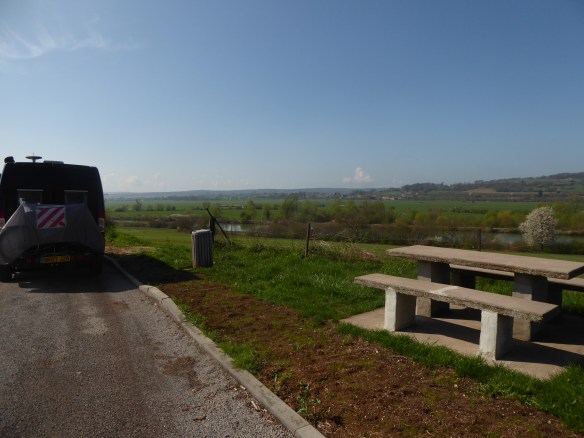
The first aire looks dubious; nothing more than a roadside parking lot and no other vans installed. We move on to another, next to a park off a quiet road, with ‘vidange’ provided. Almost simultaneously a French motorhome pulls in beside us and we are fine for the night.

Next morning is bright and sunny as we make tea and swing into van routines. It’s all coming back to me. I stroll up to the Boulangerie for a loaf, dithering over what to choose. There isn’t much left so I settle on two 60 cent baguettes. ‘Deux euros!’ The stern Madame, folds her arms in resolute emphasis as she sees me glance at the price label on the shelf. I am not willing to argue. I pay up in meek submission. Is this the Brexit effect? It remains to be seen.


P1020835


The Horrors of Rentrer d’Ecole

My school friend, Paula Booth and I were much taken with everything French. My parents took us camping in the Vendee-a long strip of beach-laden coast devoted almost entirely to camp sites and all things holiday. These days very little has altered there from those sixties summers. Paula and I were earnest students of the French language, revelling in all opportunities to practise the discipline. Opportunities came thick and fast due to my parents’ knowledge of the language being confined to what could be written on the back of un timbre sur un carte postale.

We loved the department stores, spending hours wandering around ‘Monoprix’ or ‘Au Printemps’ searching for small gifts to take home and lusting after the clothes. Back then French clothing was expensive.

But even then one element of the shopping experience was tantamount to torture for us; there would always be large banners plastered over every window bearing the words: ‘Rentrer d’Ecole’. Horrors! No sooner had we escaped into our own summer adventure than we’d be dragged back to reality by this sinister reminder.

Becoming a teacher did little to assuage the ‘back to school’ syndrome. You’d flog your way through the last, painful weeks of the summer term buoyed only by the prospect of the long break. You would manage the last days, despatch the little charges to their disgruntled mamas, pack up everything, recycle the ‘best teacher’ mugs and the scented candles then set off in a haze of exhaustion and euphoria-only to drive past a plethora of shop signs bearing the hated exhortation to purchase the Autumn term’s necessities.

[This is the point that elicits, from those in non-education related occupations a deluge of remarks about ‘easy life’ where the teaching community is concerned. ‘9-3’, ‘part-time job’, ‘nothing but holidays’-yes, yes. My one answer to all of those is ‘why aren’t you doing it, then?’]

And while the ‘taking them out of school’ debate rages on Husband and I are finally able to take advantage of the off-season benefits that others enjoy after careers of being stuck with peak season prices. I’m not launching into a diatribe this time about why children shouldn’t miss school, but it always seemed to me that it was the parents who wanted the Spanish beach or the Disney park. Frankly-most kids like nothing better than messing around in a rocky stream in wellie boots or riding round a camp site in a pack of bikes. Most parents of young children would agree that to be a success, adult and child holidays have to be centred on the children.

So if you want a holiday like you had pre-children your options are a] leave them behind with a doting relation or b] wait until they are grown up.

Since Husband and I are in our dotage we fall into the latter category. Not only can we holiday when we please but also where. Hooray! We are off to Europe!


A Potted Driving History

I learned to drive when I was twenty four. It was the mid seventies and I had all my lessons in the dark of a snowy winter in London. As my first test approached the instructor suggested I have some lessons during the day because I’d had no experience of driving in daylight.

I hadn’t needed a car for work, as I walked there. I was motivated by a need to be independent. I remember going to a party, staying late and having no means of getting home to my shared flat in Putney. A man I’d been chatting to offered me a lift back to my flat, which I gratefully accepted. Feeling I should reciprocate, when we arrived I offered coffee-an offer that was rejected. He didn’t want coffee, but he did want sex. I considered myself worldly as a twenty something-having been a student through late sixties hippy-dom, the freedom of ‘the pill’ and beyond into laissez-faire student territory, nevertheless I was shocked that someone would offer a lift and expect sex in return.

I needed two tests, failing my first [in Guildford] and taking the second only two weeks later [in Teddington]. Neither test venue was familiar to me. While waiting for the second test, with a new, female instructor we got a coffee and she proceeded to regale me with a tearful discourse on the subject of her messy divorce, an experience that I later conjectured as a device to avert pre-driving test nerves.

I got a car, a classy Austin A40 with a steering wheel so enormous that simply rounding a bend almost wrenched my arms from their sockets and only one door that would open; this was the rear tailgate. Entering the vehicle involved climbing into it and diving to the front seat-not a dignified manoeuvre. None of this mattered. I had my independence.

I got to like driving-I still do, but roads, traffic and vehicles have changed in the intervening years. Here in the UK there are few major roads that don’t become clogged with traffic for at least some time during every day. A few days ago, sitting overlooking the M1 motorway at Leicester Forest services the road seemed like some future dystopian world where colossal titans spewing noxious gas had taken possession of the planet and had multiplied until every vestige of space and air were exhausted.

I’ve also noticed that age strips some driver confidence away, resulting in fearfulness of the speed and aggression you find amongst traffic in large conurbations or on five-lane motorways. I am spooked by angry hooting, vehicles cutting across mine at roundabouts or pushing out from junctions in front of me. ‘Be my guest’ I want to squeak, ‘you go first-if your need is so urgent you must terrify everyone else to satisfy it’.

Symptomatic of today’s society? Perhaps. In larger countries with more space and in less populated areas driving can be reminiscent of my early driving years. This is often true for travel away from the autoroutes in France, although time must be no object. How will it all pan out? I can only imagine the vehicles nose-to-tail habit will progress to being conjoined-and then what? Oh of course-railways.

Laugh and the World Laughs with You?

An old man goes to a church, and is making a confession:Man: “Father, I am 75 years old. I have been married for 50 years. All these years I had been faithful to my wife, but yesterday I was intimate with an 18 year old.” Father: “When was the last time you made a confession?” 

Man: “I never have, I am Jewish.” 

Father: “Then why are telling me all this?”
Man: “I’m telling everybody!”

Is this religious joke offensive? It might be deemed by either Catholics or Jews to be so, although I doubt it-because all of those of Catholic or Jewish faiths that I have ever known have had mature, balanced senses of humour. All of them would be able to enjoy, share or even initiate a joke about their own religion and I believe people of the Jewish faith, particularly are fond of Jewish jokes.

The world has experienced a dispiriting couple of weeks. The ghastly events in France, more grim action in Belgium and Germany.

In Saudi Arabia a perfectly peaceful man who wished to share his views has not only been imprisoned for them but is to publicly flogged every week for months. Again in Saudi Arabia unseasonal snow has led many to commit the sin of having fun by constructing snowmen. The building of snowmen is now forbidden. If you were to read this in a satirical magazine it would be funny, but it isn’t-it’s true.

In Nigeria such horrendous atrocities have been committed in the name of religion that it is difficult to believe humans can have wrought them.

To me, a sense of humour is one of the most basic qualities of humanity. One of the fundamentals that sets us aside from the animal kingdom and makes us recognisable to each other. Aside from crying in order to address its most pressing needs, a baby’s first communication is generally a smile, followed swiftly by laughter.

The ability to be self-deprecating, to not only participate and enjoy in a joke against yourself, your appearance, your age, your gender, your disability or your race but to tell one; this must be one of the most engaging aspects of any personality.

Whatever has happened to the world? Have vast swathes of people had sense of humour amputations? Or has some odd mutation taken place that has resulted in them being born without it?

Nevertheless there are still many brave, balanced, intelligent people prepared to satirise religions, and still some who will joke about their own faith-even Islam.

For myself, I am an atheist. If anyone wishes to joke about atheism I would be delighted. I take my atheism very seriously, but not as seriously as my dedication to humour and to humanity.

Eating Lessons

We are approaching the end of another extended trip, meandering around the South of France but this time, with somewhat more sophisticated facilities we have taken advantage of what the French call ‘aires’. The French have taken to motor-homes more than any other nation. The vehicles are becoming larger, more equipped and more elaborate. One result is that an industry has sprung up to address the needs of ‘camping car’ owners with numerous, vast areas set aside for, and only for campervans. Tent campers and caravanners can eat their hearts out. They are not invited.
An ‘aire’ will typically have a services point consisting of clean water, electricity, waste water disposal and a ‘vidange’ [for emptying toilet cassettes]. These facilities are more than enough to satisfy the needs of your average motor-homer. Increasingly aires are unmanned, with entry via a machine like a parking meter. Some are little more than vast car parks with electric points and waste disposal. Others are beautiful, landscaped spaces with attractive planting.
Getting sandwiched in our modest van between two gargantuan motor-homes allows plenty of opportunity to study the dining habits of others. In fact, anyone who is thinking of swapping their regime of TV dinners for something a little more formal, sociologically developed and a more gratifying gastronomic experience should look no further than the French model of dining, which can, it seems take up almost all of each day.
Take the three elderly folk sharing an equally elderly motor-home in an aire at Hourtan Port [for 10€ per night-a lovely, spacious, shady, tree-lined area]. They ambled out together mid morning-two mature monsieurs and a madame-returning at midday laden with bulging plastic bags plus several, substantial ‘artisan’ loaves. The bags turned out to contain dozens of fat, glistening oysters. Lunch was sorted! Later in the afternoon they wandered off again and reappeared with more bags, this time containing kilos of mussels. The next day’s catch was a batch of enormous fish, one of which filled an entire plate. Each meal, of course was accompanied by a bottomless bottle of wine.
At an unashamedly seaside aire in Gruissan a couple nearby would take their breakfast [plucked from the nearest ‘artisan’ boulangerie] of croissants, orange juice and coffee, then cycle off together purposefully. By lunch time their bike baskets would be laden with all the goodies they’d acquired. Lunch was prepared together-a serious and painstaking task of cleaning, chopping, table laying and cooking [no quick sandwich job for them!] There would be three courses and of course, wine. Later they would disappear again to seek out the components of the evening meal, when the procedures would be repeated.
In the small town of Gruissan, market day clogs the streets as everyone turns out to fill their basket with cheeses, charcuterie, fruit and vegetables, olives and preserves. Everything can be sampled before purchase, making the shopping excursion a gastronomic pleasure in itself. We joined the crowds, queuing for tasty lunch items and bearing home the spoils in anticipatory glee.
In contrast, the weekly supermarket drudge seems an impoverished experience, as does the regular ‘what can we have tonight?’ conundrum. Ho hum!

Smaller is more beautiful…

                In a somewhat treacherous and hypocritical move, we have executed a kind of ‘upgrade’ of our travel vehicle and are now using a slightly larger camper van. I say this because I’m aware that I posted on the pecking order and the relative sizes of travel vehicles at around this time last year. We were always the smallest unit in the village, the runt of the litter, dwarfed by the gargantuan motor-homes that surrounded us. The ironic outcome of this change is that we are still the smallest camper van wherever we go, owing I presume to the fact that everyone else has acquired a larger one also.

                Husband mourns the tiny van and was reluctant to exchange it for the current home-on-wheels. I accept it is trickier to manoeuvre and cannot be used as an extra car at home, but the advantages are undeniable. It has a large, comfortable bed constructed from the two plush sofas lining the walls, a walk-in shower and toilet cubicle, a cooker complete with oven, swish windows complete with blinds and pull up insect screens, skylights and a wondrous amount of storage. All this luxury is quite enough two people. It makes me a little curious to know why other couples would need such enormous wheeled dwellings. And how much must it cost in fuel? And where on Earth do they keep it, assuming they have a bricks-and-mortar house elsewhere?

                How bizarre it is that in the present day, when technological advances seem concentrated on producing ever smaller devices- tiny ‘watch’ style internet consoles, Google’s strange glasses with internet screen [won’t everyone be bumping into each other?] etc, other items become larger and larger. TV screens, lattes, beds, cruise ships, aeroplanes, McDonalds’ meals and people are growing bigger by the day.

                Wouldn’t make more sense for the collected, obvious genius behind such marvellous and desirable, tiny objects such as slimmer tablets and phones to direct their talents into technology that reduces our need for so much power to use them?

                The French have constructed a cunning new law for owners of motor-homes so massive that little cars needed to be towed behind them. A HGV licence is necessary for the additional vehicle to be hauled along behind the mother ship. The lack of these small cars rolling along behind is starkly noticeable, although how the inmates are coping with their daily needs is not altogether clear. For us, little in this respect has changed. We shop in between one destination and another, we park up, we free our bikes from the back and use them to collect what we need. We also get to cycle around the lanes in the Provencal sunshine looking at the rural landscape and stopping at an occasional hostelry for a glass of vin [me] or a beer or two [Husband].

                We have learned not to dash around ticking off sights in an ‘if it’s Wednesday it must be Rome’ way, getting to know a small area; the beautiful, medieval villages, the vineyards and the orchards-currently clouded with pink blossom. Small [even if a modicum bigger] really is better.

It’s all about the Story

                We have made good our escape from windy, waterlogged England and are making for [hopefully] warmer, drier lands to the South.

                In preparation for this first jaunt of 2014 I loaded up my e-reader with some novels I’ve missed, some I was seduced by, having read reviews [though not Amazon’s-having been fooled more than once before] and some I feel it my duty to read.

                The first book is one that surprised me by its 99pence price tag, since it is the book from which the current blockbusting, award winning, sweep-the-board movie was made from-‘Twelve Years a Slave’.

                Now I have yet to see this film, and I’ve no doubt I will, but in my view films rarely match up to their book form. Although I am less than 25% through the story, ‘Twelve Years a Slave’ has gripped me and held me in its absorbing clutches. Solomon Northup’s account of his capture and subsequent subjection as a slave is both dignified and moving. He recounts the horrors that he and his fellow slaves endure in a measured, matter of fact narrative. Some of his descriptions are particularly moving, such as his account of the people of the Indian village celebrating with their visitors, enjoying a meal and dancing around a camp fire accompanied by music played on a fiddle [Solomon is himself a fiddle player]. He is captivated by the scene, whilst not once pointing out the irony of their freedom against his captivity.

                There is much to be said for personal accounts of horrific events in history. They tug our emotions more than facts. We all know of the dreadful horrors wrought on so many during the war, but Anne Franck’s diary story, documenting her life and including domestic trivia, teenage angst and family squabbles brings to life the awful reality of the events. It is the story of an ordinary family, one that we can relate to. How much more poignant than factual accounts!

                At school we were taught the dry, fusty dates and facts of history; the reigns of Kings and Queens or the politics behind the wars. If we’d have been given the personal stories behind the events I think we’d have been more interested-interested enough, perhaps to have ceased the passing round of a particularly smutty and sexually explicit paperback that some miscreant had purloined and divided into lesson-sized portions.

What would Solomon make of all the Oscar hullabaloo, I wonder. After all, the success of the film relies entirely on his story, whatever the performances and direction were like.

                We have reached the South of France, where the early March weather is already warm enough during the day to bring a blush of heat to the skin, though plummeting sharply at night. We cycled 25 miles up and down the Canal du Midi in glorious, unbridled sunshine without a cloud, the vineyards laid in neat rows ready to come into leaf. Along the side of the canal those who’ve made their houseboat homes in Dutch barges are busy spring cleaning and sprucing up. Spring must surely be the nicest season, with a promise of long, warm days to come.


Nudity Laid Bare

                In the developed world the cult of worship of lean, youthful, beautiful bodies continues. The evidence is everywhere-on posters, adverts, TV, internet and on the street. Here in France there is a move to ban child beauty pageants, a move all our countries should be making. We should not be soaking our children in the idea that looks are the most valuable, the most important quality they can possess, neither should we be ‘hyper-sexualising’ them [to quote the French minister responsible for the action].

                Yet here in France, nudity is not only acceptable, but positively celebrated. I’d like to say that on the many naturist beaches, camp sites and resorts that exist in France the nudity is natural, innocent and innocuous, but when we’ve encountered them, traversing them during bike rides or walks [it is difficult not to in some areas], you cannot help but suspect there is an element of ‘display’ to the exposure. It is tricky, as a clothed person, not to look, when crossing a beach where everyone is unclothed. This is no discreet sunbathing amongst the sand dunes. Many [men especially] stand in the sea or at a vantage point, as much to be seen as to see.

                I was a teenager of the sixties and a young woman of the seventies, when hippie-dom, flower power and ‘free love’ were the mantra we all followed. In this era of what our elders termed the permissive society we became unleashed from the previous generation’s prudish attitudes. At music festivals kids frolicked naked in the mud, made love not war; anything went. There was an innocence to this behaviour. Then there was AIDS, conservatism, an end to free university education and ultimately the big recession.

                It is always said that in an era of boom hemlines rise, then plunge when times are tight. Nudity these days is not the innocent muddy frolicking of the early seventies, but a cynical exploitation seen in music videos or advertising. Outside of the media there has been a return, even on UK beaches, to the wearing of clothes, no ‘topless’ sunbathing, longer swimming shorts, more of what my mother, who was constantly shocked by the notion of ‘free love’ and all that accompanied it,  would have termed ‘modesty’. In the USA there has always been a more conservative approach to beach wear, ‘topless’ in my experience of US beaches, being against the law.

                Years ago I accompanied two friends on a 48 hour trip to Dieppe, the idea being to have a look round and collect some spoils from the supermarché. It was a warm day. We sat on the pebbly beach with ice creams. A large group of mixed middle aged singles and couples appeared and trudged down to the water’s edge, where they stripped off without the need for towels for concealment and donned swimwear. This was all undertaken without a scrap of self consciousness or awareness of anyone’s eyes. They then plunged into the sea as if no one else was there, simply to enjoy the swim; refreshing in more ways than one…


Site Behaviour

                ‘Flight Behaviour’ is a recent novel by the established American writer, Barbara Kingsolver. It is a noble attempt to use fiction to bring climate change issues into popular consciousness, although somehow it fails to grip the imagination. Barbara must have worked hard on her research, insinuating much scientific jargon and information into the story, but it is this very insertion of earnest scientific knowledge that reduces the impact of the story, rendering it clunky and uneven. The story concerns the plight of thousands of Monarch butterflies deflected from their normal migratory course from Mexico to the Appalachian Mountains, an event that is celebrated by the local community who are unaware of the catastrophe it portends.

                As I finished the book I reflected on the migration that we now make as summer comes to an end, in search of a warmer climate, along with hundreds of other Northern Europeans fleeing Autumn’s first chilly blasts. There are Germans, Netherlanders, Danish, Czechs, Belgians and more. They are here with us along the Mediterranean coasts of France, Spain or Portugal, filling up the camp sites and exhibiting what I now like to think of as ‘Site Behaviour’.

                After many years of staying on campsites, first with tent and now with a camper van, I’ve had plenty of time to study site behaviour and etiquette. Take shower blocks, for instance. It is customary to greet anyone you encounter within the shower facility, using the language of the host country. A mumbled, hasty ‘Bonjour’ is enough [since we are in France] and eye contact, if any, should be brief. You should not launch into lengthy discussions about the weather or travel plans, or which part of the UK you are from whilst your companion is applying deodorant or cleaning their teeth. This being France, shower blocks are not divided into genders so you must expect to have to sidle past a urinal or a man at a basin trimming nasal hair on your way into a cubicle.

                You may have to carry toilet tissue to the block with you, in which case no one will be in any doubt as to your intention. A way around this for those sensitive to anyone knowing their purpose is to stuff a wodge of tissue into your pocket. Years of less-than-luxurious travel have taught me never to go anywhere without a tissue in my pocket.

                Many [particularly women] make their morning/evening trip to the ablutions wearing such attire as they might habitually sport at home; in other words they wear a dressing gown, slippers and often-curlers. In Yorkshire, UK recently there was an inexplicable plethora of Onesies on show. Myself, I do not own either dressing gown or slippers, and have never mastered the art of curlers, so a version of day wear [shorts and T-shirt] suffices.

                A site is a transient village, inhabitants changing daily, their temporary homes, paraphernalia or pets a subject of interest for those already established. What might they be preparing on their elaborate barbecue? Why do we see the husband and never the wife? For some, the activity involved in setting up, building the awning, hammering in pegs, putting up a washing line, adjusting the awning, oiling the bikes, putting up a wind break, taking it down-these are the end itself, the reason for the trip. These scenes are the soap opera that is a camp site. Long may they continue!