Unknown's avatar

About Grace Lessageing

I am writer of novels, short stories, flash fiction, blogs. I lead a creative writing group. I am an Ex infant teacher, living in Christchurch, Dorset, UK. My brand new novel, The Conways at Earthsend was published on January 28th 2021 can be found on Amazon, Waterstones, Hive and Goodreads and is available in either paperback or e-book versions. You can also read The Year of Familiar Strangers, available as an e-book from Amazon. You can visit my website: janedeans.com or my author page on Facebook: https://www.facebook.com/Jane-Deans-Novellist-Short-Fiction-and-Blog-102757711838272 Happy reading!

India 1998: Leh

To follow a tour of India’s Golden Triangle by travelling to Ladakh, in Northern Kashmir feels like stepping away from the set of ‘Ghandi’ into ‘Lost Horizon’. First of all it is high altitude, earning its title of ‘Little Tibet’ and secondly it is the least populated area of India. Many of the inhabitants [40%] are Buddhist and much of the area is cut off for many months of the year.

Before leaving Delhi we met our new guide for the new tour, Adrian, who was as unlike Paratha as Obama to Putin. A few of us were leftovers from the first trip. Others were new. At our first gathering, the one where protocols are explained, he asked us about Paratha and was shocked to hear how she’d led the tour, exploiting her status and behaving in a controlling and condescending manner. This behaviour, he told us, is at odds with the company’s philosophy. They’d be unhappy to hear of it. Whilst I had no wish to lose Paratha her job I thought it best that subsequent tour groups should not experience the Golden Triangle in the way that we had.

Having had the team talk: be sensitive when taking photos, be mindful about altitude sickness [about which, more later], carry plenty of water, leave nothing but footprints etc, we boarded a flight to Leh, the largest city in Ladakh, flying up above snowy peaks to the highest airport in the world, one that also provides the fewest and most basic facilities, as we discovered when disembarking and needing to use the toilets.

To begin with we’d spend a few days in Leh, to look around and to acclimatise to the very high altitude before starting our trek. I looked forward to this second tour with a little trepidation, having had altitude sickness before, in Peru and Bolivia. I knew how nasty it can be but hoped that this time I might escape it. How wrong could I be?

We were charmed by our hotel, whose accommodation was basic but full of rustic character, with a beautiful garden and rooms furnished with chunky wooden beds and spartan, concrete shower rooms.


As advised, we took it easy walking around gorgeous Leh, but it was hard to restrain the urge to rush about looking at everything, since everything was either beautiful or interesting or both.


For our second day in Leh we took a trip out to view some of the more accessible and picturesque monasteries [‘Gonpas’] that were dotted around in the mountains. This is a landscape that is both dramatic and outrageously magnificent, the monasteries themselves built into the sides of the mountains as if they’ve grown there and carved and painted in ornate and beautiful designs and frescoes, with none of the formality of mosques but with life and expression.

To visit the Gonpas we needed to dress modestly and cover up extremities. I’d had the presence of mind to add a light sarong to my daysack that morning [a habit I’ve become accustomed to], meaning that Husband was not left bare-kneed. There is a gentle, homely atmosphere in the gloomy interior of each Gonpa and as the monks go about their daily tasks they greet tourists good-naturedly, sipping tea and nibbling a biscuit or two as they pray!

In order to view the buildings we needed to clamber up and down steps in the thin, cold air, which proved more arduous than the previous day’s sightseeing in Leh. Sometime during the afternoon I began to feel the onset of a headache, something brewing up, becoming more painful as the day wore on. Before long it was accompanied by a powerful nausea, then I knew I wasn’t to escape the mountain sickness I’d experienced before in Peru…

India 1998. Taj.

It must be safe to say that the first iconic sight anyone thinks of in relation to India would be the Taj Mahal. It is, of course a large mausoleum, built by hundreds of workers over many years by emperor Shah Jahan to house the tomb of his favourite wife, Mumtaz Mahal, a fact that spoils the romance a little in that she was not, exclusively his wife. A terrific novel, Taj, [Taj] tells the story of the building of the monument and Shah Jahan’s relationship with his wife, who died giving birth to their 14th child.

In my memory, Agra as a city was not a stunner. It may well be now, but then, as we entered the conglomeration by coach, it did not immediately reveal impressive buildings or elegant streets. We became entangled in a traffic jam, as usual, which allowed us time to study the mesmerising spaghetti of electric cables that crowned every roof corner. The jam, we learned,  was caused by a demonstration by primary school teachers…

We checked into the Hotel Ammar, modern and featureless, otherwise fine. Next day we would visit the Taj.

Our transport to this jewel in India’s crown was by camel cart, the animal amenable and well-behaved despite its arrogant expression.

We enjoyed some trundling along, sitting in the cart then, never one to pass up an experience I embarrassed Husband by taking up the driver’s offer to sit and ride the camel.

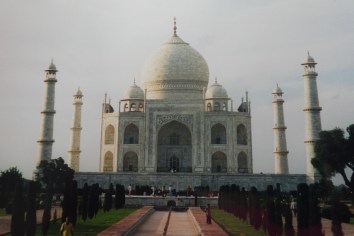
Before long we’d arrived at the Taj Mahal. And there it was, just exactly as it is in every photo, a perfect white wedding cake perched behind a rectangular pool. Except the pool was empty.

P1000642

Some work was being undertaken at the monument. The pristine lawns were being mown and some decorative panelling restored.

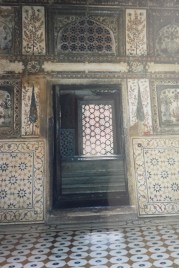
The Taj is not, in fact, perfectly white. Up close it is covered with an intricate tracery of pattern on each and every surface and it is this, rather than the shape of the building which takes the breath away.

P1000646

The interior holds the two tombs, of Shah Jahan and of his beloved[ish] wife. These, too are encrusted in ornate designs.

P1000651

The Taj is built beside the River Amuna, which provides a stunning setting, especially at sunset.

For the duration of this first leg of our India adventure I’d been seeking the ‘Holy Grail’ of naff shelf discoveries and had thought it would be found somewhere in the Golden Triangle. [The Naff Shelf]. At this time I was still swapping keepsake atrocities with a friend. And so it was, following the Taj Mahal visit, amongst the jumble of gift stalls peddling all manner of tat, I found the best horror of a souvenir I have ever seen, before or since. Regrettably I have no photo of it; a replica of the Taj, nestled in a small perspex box decorated with pink swirls, flanked by two miniature Christmas trees. Two wires protruded from the base of the box meant that it could light up!

Flushed with success, we boarded the bus, but my pride in my purchase was lost on a few members of the party whose sense of irony was not so well developed.

Back in our hotel room with Steve and Jane it was decided we should try out the electrics and see the mini-Taj illuminated, so in the absence of a plug Steve suggested we should jam the wires into a socket and ‘see what happened’. The experiment was not without result, as there was a crack and a flash, then the hotel’s electrical system was caput, everything dark and quiet [without air-con] including the model Taj, which we never did get to see lit-up.

In the morning we left Agra to visit a deserted city called Fathepur Sikri, beautiful and a little melancholy, we the only visitors, then on to ‘Akbar’s mausoleum’ which appeared to be run by monkeys.

It was time to return to Delhi. We’d seen a wealth of iconic sights and were ready for a change of terrain, climate and activity. And we’d need to say goodbye to our tour friends, Steve and Jane, who were returning to the UK rather than embarking on the second tour as we were. For we were to meet a new tour guide and fly up to the highest airport in the world-in Ladakh!


India 1998. Hot!

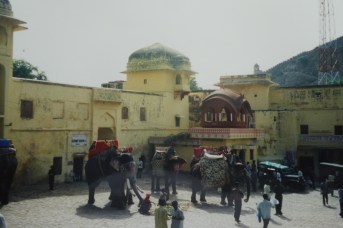
We completed our visit to Jaipur with a look at its Red Fort, perched high above a lake in a picturesque setting and more impressive for it than Delhi’s Red Fort. Since access to the fort was by an ascent of a steep hill-and in searing heat, we were treated to elephant transport, climbing up to a scaffold and waiting to be loaded on to the howdah [a seat strapped to the elephant’s back which accommodates several passengers]. Once we were installed on the howdah our elephant commenced its stately, swaying saunter up the hill, accompanied by numerous peddlers of gifts and goods, who called up and gestured to us en route.

P1000574

Husband’s attention was captured by one of the traders, who was keeping up with us whilst carrying a large selection of hats. Husband is prone to buying wide-brimmed summer headwear and continues to expand his hat wardrobe to this day, littering the house with them, bought from varied sources and countries, so as we continued swaying up the path to the fort he negotiated for a hat he fancied, finally reaching a satisfactory price and having the hat tossed up to him where he sat.

We disembarked on to an identical platform at the top, the fort entrance and went to the interior, which was ornate and beautiful, with mirror-inlaid frescoes and intricately patterned ceilings.

Afterwards, waiting  for our coach we were entertained by watching the off-duty elephants bathing in the lake with their mahouts. And as we stood, the mahout, astride his elephant, approached us and gestured for us to place a rupee note on to the end of the elephant’s trunk, which we did, delighted as the elephant passed the money back to the handler. A cunning trick, and the kind of activity that Paratha frowned upon, but by now we’d had enough of her control freakery and were opting out of some of her rules, at one point asking the bus driver to let us off on the way to yet another of her factory outlets.

Next day we were off on the coach again, this time to a bird sanctuary where we were to take a tour of the reserve by rickshaw before spending the night in the custom-built hotel.

The temperature at the bird reserve was uncomfortably hot-and exacerbated by its humidity. This was a damp, marshy piece of land, a haven for birds but an endurance trial for tourists. Enthusiastic as we are about wildlife we wilted in the sticky, cloying heat. We took our bicycle rickshaw tour, accompanied by another rickshaw carrying Steve and Jane.

The reserve was home to, among others, weaver birds, who’d woven their tiny basket nests and suspended them from the pendulous branches of palm trees.

The hotel was a modern, concrete, two-story block. We were allocated a first floor room flanked by a wide balcony that ran the length of the floor. As dusk fell this balcony gathered a covering of beetle-type insects so thick we couldn’t walk anywhere except on the top of them. It was a thick, crunchy, beetle carpet and the air and every surface crackled with them. Walking into our room was like entering a steam oven. We would never be able to sleep inside it. We contemplated hauling the mattress on to the balcony and quickly pushed the thought aside when we looked at the beetle layer.

But we were lucky. Our friends’ room was directly below and many degrees cooler. Would we like to sleep on their floor? We didn’t hesitate and hefted our mattress over the rail.

Next morning we were to travel to the last point of the Triangle. Agra!

India 1998. Part 3. The Pink City.

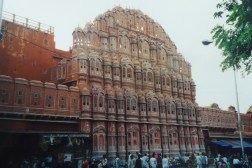
P1000545

Jaipur. Of all the world famous sights and sites in India’s Golden Triangle this was to become my favourite. I began to fall in love with The Pink City as we drew into its centre, past the beautiful Palace of the Winds and on towards our hotel, The Bissau, a grand old merchant’s house in an inauspicious side street. It was comfortable enough, with an ancient but serviceable swimming pool and within walking distance of the city.

Along the street camel carts and tuk-tuks jostled for position and cows wandered unperturbed amongst the teeming traffic. As yet we’d had no chance to wander unsupervised, to peruse the street stalls or to take a ride in a tiny, noisy, careering tuk-tuk and we couldn’t wait. Paratha, though had other plans. On no account were we to fraternise with locals, eat anywhere other than the hotel or purchase anything other than in an outlet of her choosing.

With our co-conspirators Steve and Jane we announced that we wouldn’t require a hotel dinner that evening as we’d find a restaurant of our choosing somewhere in the town. Paratha baulked, telling us that ‘nowhere would be open’. We said we’d take a chance then we set off together to explore the delights of Jaipur, exiting the hotel and taking care to step over the sheep’s head that lolled in a puddle by the roadside.

P1000548

Jaipur was not closed. It was as open as it is possible for a city to be, a riotous conglomeration of traffic, stalls, shops, shrines, animals and commerce. Steve and Husband declared that they’d like to visit the barber’s, a swanky, gleaming grooming parlour for men where Jane and I sat, enthralled while the men were liberally daubed with foam and shaved with terrifying cut-throat razors, swathed in hot towels, trimmed, primped and burnished, after which they must have felt wonderful in the searing heat of the afternoon.

We explored the colourful streets, marvelled at the goods on offer, bought things. We got our white-knuckle tuk-tuk ride, screeching with pleasurable terror as we tore round roundabouts and buzzed along in clouds of noxious fumes. As evening drew on we went to the jewellery quarter where items were sold by weight, and like a child in a sweet shop I was spoilt for choice, buying earrings and necklaces, still my beautiful and much-loved, favourite accessories to this day.

Later we found a restaurant and had dinner together, just the four of us, enjoying local cuisine and a cosy, non-hotel ambience.

Next day we were due to tour Jaipur’s Red Fort, accessible by elephant-and who could argue with that?

India 1998. Part 2. Unrest in the Ranks.

P1000463

I have no record of all the members of our Golden Triangle tour, but inevitably we palled up with like-minded souls, our particular tour buddies being Steve and Jane, a jolly and irreverent couple whose feelings about our tour guide matched our own.

Again I failed to record the lady’s name, although I do recall that it began with P, the reason for my recollection being that amongst ourselves we started calling her all manner of Indian items beginning with P, including ‘Paratha’. Aficionados of Indian cuisine will be familiar with parathas, which are a type of Indian flatbread. I’m not proud of our puerile behaviour but Paratha was a control freak, hellbent on pursuing her schedule in spite of us. She’d laid down the rules already: no fraternising with locals, no eating anywhere except of her choosing [this meant meals in the hotel only], no purchases except from the commercial outlets she’d somehow contrived to fit into the ‘schedule’.

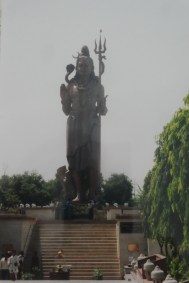
Following our gruelling endurance trial of a Delhi tour we were loaded on to a bus for a trip to Sariska National Park, to stay at the Sariska Palace Hotel and get a tiger sighting. The roads took us on a picturesque journey through villages and past many enormous Hindu statues, dotted around in the countryside. The hotel was originally built as a hunting lodge by a Maharajah. Who would not want to stay in this impossibly romantic and picturesque palace, situated on the edge of the park and boasting unbeatable sunset views from its huge terrace? The fact of its down-at-heel decadence did nothing to dim its glorious appeal. Even the beautiful swimming pool had its own palatial pool house, the bedrooms vast and majestic in their faded glory, though somewhat spartan. We, the four of us, swam in the luxurious pool and partook of cocktails on the terrace as the sun dipped.

After dark we sat in the grounds and watched displays from whirling dancers, tumblers, jugglers and a daring fire-eater, whose gasoline-swallowing provoked alarm. What could it be doing to his insides? Meanwhile hordes of audacious monkeys swarmed everywhere, hoping to snaffle tit-bits.

Next morning we were loaded into land rovers for an exploration of the national park, where we’d been assured we’d see a tiger. There was certainly plenty of wildlife-and no shortage of monkeys, but although we were shown tiger tracks, [at which Husband remarked that someone had been around with a tiger foot stamp-pad] we had to assume it was their day off. There were no commercial outlets and nowhere else to eat but the stupendous hotel, whose catering was at least adequate.

Our next destination was to be Jaipur. By now we’d had enough of the carpet factories, gift emporia and jewellery outlets selected by Paratha and were longing to strike out into a city and find our own restaurants or sample delicious-looking food from the stalls that lined every street, rather than sitting around in hushed hotel dining rooms. Paratha was fond of her food and had an imperious manner with the waiting staff that we found distasteful. Clearly she was collecting a commission from the factories she took us to. Was she also receiving a percentage from the hotel dining rooms she insisted we ate in?

But we were not obliged to tow the line. At Sariska we had no other options. In Jaipur the city would be ours to explore…


India 1998. Part 1.

P1000452

Following a successful and eventful trip to New York in 1997, Husband [though not Husband at that time] and I must have decided we could endure one another’s company for long enough to make a substantial visit to India. Pre he-who-was-to-become Husband’s entry into my life I’d been planning to visit a friend who had taken a teaching job in Indonesia, but it wasn’t going to work out for dates over the summer, so we plunged into booking two, back-to-back tours in India with the travel company, ‘Explore’.

We chose a ‘golden triangle’ tour [Delhi/Jaipur/Agra] followed by a trekking exploration of Ladakh, in the north.

On this occasion I did not keep a travel journal, so my memories must rely on photographic prompts, but at the time I was in the habit of collecting all manner of holiday-related items such as tickets, labels, maps and menus and constructing elaborate albums on my return that included all this collected junk. Nowadays of course photo albums have become virtual and keepsakes have shrunk to one sought after artefact per trip for our naff shelf [of which I have written].

P1000448

I can see that we flew out from Heathrow to Bahrain, initially and then on to Delhi. I also have the itinerary for the first tour, called ‘Moghul Highlights’. This time, rather than blundering along following our own, hopelessly inadequate plans, we’d have the benefits of a tour guide and all planned ahead. This is a regime that many people enjoy, but experience has demonstrated [as it did on this occasion] that tour guides can be double-edged swords. We were to discover the drawbacks quite early in the adventure.

We arrived into Delhi early on a Saturday morning, feeling the effects of time differences compounded by long flights, together with that shock of heat and fumes that you get when stepping out of a plane into a hot climate. Then we were gathered up as a group and ushered on to a tour bus to our hotel. By the time we arrived we were in need of first, rehydration and second, sleep, neither of which was forthcoming! We had a few minutes to deposit bags and must assemble for a lecture, followed by a day’s sightseeing.

Too feeble to protest we duly gathered for the talk, delivered by our guide, a proud Indian lady who was champing at the bit, wanting to get started on showing us her city. So, no water, no sleep, no time to waste-and no currency either, as I’d hoped; we could have sneaked a purchase of a bottle or two en route.

P1000451

In retrospect it was madness to comply. We should have collectively protested. We’d all had long, dehydrating flights and were now embarking on a day’s sightseeing in unaccustomed, searing heat. The guide was lucky that none of us needed to be hospitalised!

Despite the deprivations of that first day I was able to follow, listen, look and photograph as we took in the major sights of Delhi, the huge Jami Mosque, the Red Fort, the Ghandi Memorial and cremation site. At this early point in the tour we did not yet realise that our guide’s insistence on strict adherence to discipline was to become a problem but it was not too long before a minor rebellion in the ranks began to germinate…

New York 1997. Part 6. A Fitting Finale.

We departed Buffalo and arrived late to Penn Station, too late to purchase tickets to Boston next day-another early start.

The subway from Westside to the station was becoming familiar and there was time for coffee before boarding the train, which was packed. Leaving New York via The Bronx was a much more dramatic and interesting journey than going out through New Jersey and there was a fine view of Manhattan’s skyscrapers as we left. Later, though, the scenes were the same dull, monotonous, derelict industrial sites that we’d seen before.

The train pulled into Boston at midday and we walked out into a proper station concourse, fitting for a large city in the way that Buffalo’s facilities were not. There were shops, cafes and bars-all very smart and clean. But we wondered how to go about finding a hotel. An information desk provided travel help, though not accommodation. We persevered and were pointed in the direction of ‘Hotel Reservations’ in a different part of the station, also bizarrely serving as a cigar stall. A sturdy, jovial woman called Marsha claimed to be there to help. After asking our ‘requirements’ she phoned several hotels. They were able to offer one night, but not two. We assured her we’d cope with staying ‘out of town’ provided it was on a subway route and sure enough, Marsha came up trumps. The ‘Hotel Farrington’. ‘You what?’ she hissed. ‘It’s messy? You have a back-packers’ room?’ She cast us an enquiring look. ‘OK-OK. They don’t mind. They’ll take it.’ She gave us a copied set of instructions for the route then we handed her the $5 booking fee and thanked her-feeling relieved and grateful, which was ironic when you consider what was to come.
P1000322

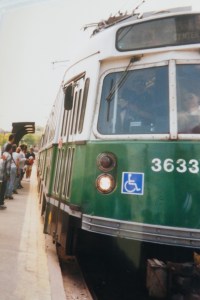
We studied the directions-a ‘red line’ train and a ‘green line’ train. Emerging into the Boston sunshine, towering buildings reared at us as we plunged down into the subway and to an unusually unhelpful ticket clerk. The Boston subway was newer and cleaner than that of New York, the trains quaint and picturesque, like historic trams. A number of lines converged and you had to clamber up steps into these tram-like compartments. ‘Boston College’ was our train. It rumbled along, slowing and almost stopping at intervals then emerged into a sunlit boulevard lined with college buildings and blocks. an ivy-clad ‘Alfred Morse Auditorium’ and several Oxford-like university piles. This was Boston University and Harvard lay just across the river in ‘Cambridge’. Boston is a university city and the society, pace, buildings and people reflected this.

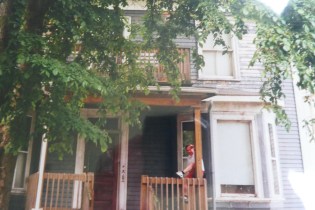
As instructed we stepped down at the 3rd stop, located the street and walked; far, it seemed, carrying bags in the hot sun, but we came to Farrington Avenue and thus to Number 23. Farrington Avenue was elegant and tree-lined with large timber houses, one of which was our hotel, accessed by steps up to the polished doors. We entered into a grand, wood-panelled room, styled with antiques, chaises and a huge, burnished desk for reception. So far so good!
P1000320

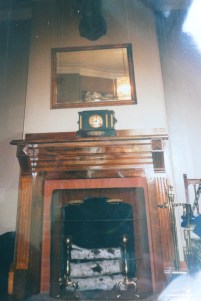
The young woman there motioned us to a sofa. She had an unhurried air. It seemed unlikely that in this gleaming, gracious, stripped-pine, polished building there would be a ‘messy’ room. The woman took our details and searched around in some drawers for a key as one or two people drifted in and out. At last she led us out and up the road to another house of the same style, but here the similarity stopped. It had a neglected, decadent look, it’s wooden floors dusty, dirty and unkempt. We were led up two sets of stairs, weary of bag-carrying by now. The woman dithered at the top as we looked on, aghast. The entire building appeared like some kind of squat. She descended back one flight, apologising, round a corner and past what might have once been a kitchen but a quick glimpse made me shudder, through a once-glorious lounge area. Off this, behind a frosted glass screen was our room.
P1000321

It was dirty, cramped and unpleasant and the sheets worn and threadbare, though clean. The woman left us, saying that coffee and muffins would be served next morning from 8-10am. We threw the bags in and looked around in disgust, venturing out to see the bathroom, which would not have been out of place on the set of ‘The Young Ones’. It was grim. But the towels were clean.

Nevertheless, Boston awaited. We left everything and went to the subway to go into town, alighting at Park Street, where all was green and there were food stalls and folks enjoying the sunshine. Deciding on a trolley-bus tour we were told that next morning would be better due to rush-hour. Instead we walked the ‘Freedom’ trail, following a red line on the sidewalk and taking in the sights. Boston seemed a relaxed city, very conscious of its history and sporting a great many Irish pubs staffed by an unending stock of Irishmen, Bostonians proud of their history and eager to help with sightseeing suggestions. There was a huge market square like Covent Garden boasting gift shops, cafes and restaurants and it was here that we stopped to eat, choosing an outside table in the warm evening.
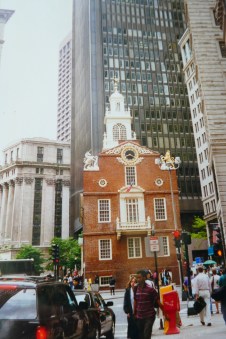
P1000323

Everywhere teemed with people and musicians played South American music as we ate, the food good and washed down with Samuel Adams Boston-brewed beer.
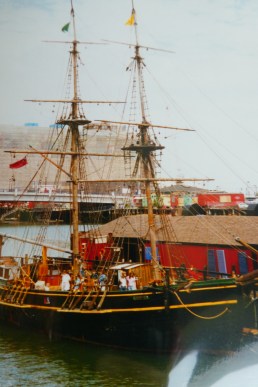
P1000326

By the time we returned we were too tired for a last drink at the Irish bar on our street. In the ‘hotel’ a man was wandering about on our floor looking for a screwdriver as the lock on his door had broken. We braved the shower together, using some discarded towels to stand on then tip-toed back to the room, through the dust and dirt of the lounge, to fall at last into bed. Then someone came into the lounge, putting on lights and TV, neither sound or light muffled by the tatty blind over the glass door. We groaned as a conversation also began, the TV, thankfully as dysfunctional as the rest of the place was extinguished and peace settled.

The Farrington breakfast was dispensed at reception, coffee and enormous muffins dispensed by an elderly. frail man at a table. Chatting to an Australian woman who confirmed the lack of Boston rooms we discovered that it was Graduation Week at Harvard, hence all was booked in advance. We had to grateful for our flea-pit!

We returned to Boston centre for the trolley tour, waiting while crocodiles of schoolchildren were shepherded along the streets. The tour began; the now-familiar, carefully rehearsed monologue punctuated by the odd joke. We got off at Charles Street, a quaint, though expensive row of shops with quirky signs, everything engineered for faux antiquity. We ate then took the next bus which drove past Harvard, through an up-market area and into theatreland where we left to walk on to Chinatown and on to the docks and the Boston Tea Party ship [unimpressive].

In the market square we had coffee and relaxed. The remaining time was dripping away. It would be our final evening in Boston and in the USA. We got a subway to Hynes Convention Centre for an ascent of the Prudential Tower, a tame 50 floors, to look over Boston at dusk. At the top it was quiet but with a stunning view over the blocks and landmarks of the city. It was a contemplative end to the trip.

At the ‘hotel’ a couple had moved into the next door hovel to ours and were complaining loudly, their remarks clear through the flimsy plywood between the rooms. ‘This room’s so Fucking depressing!’ cried the woman and the man’s low voice could be heard placating. We showered and went to ‘Arthur’s’, a small seafood cafe we’d spotted and had a last beer at the Irish bar. On our return the TV was silent, as were the next-door couple.

At the muffin and coffee breakfast next morning, two refined Oregon ladies proudly revealed the were in Boston for a reception in honour of Jackie Kennedy. Their home town had a population of 350 and this was an adventure for them. They were tremulous at the idea of the Boston subway so we told them they’d enjoy the experience for its period charm, and we recommended the trolley-bus tour.

Finally it was time to pack, lug the bags to the subway and to the station, board the New York train and sink back into our seats to watch the New England scenery float past with its quaint and pretty towns and villages, lakes and marinas, white churches and pastel, weather-board houses. The sky clouded briefly then cleared as we came to New York. The trip was done…

New York 1997. Part 5. The Walk to Canada.

During the [albeit sketchy, pre-internet] innocent planning of our New York trip I’d felt sure that Buffalo would be the ideal stopover point for visiting Niagara. It turned out that nobody else ever did this. No single person stayed at Buffalo in order to take a trip to the falls. Except for we two-Husband and myself. We’d made an error.

But we were prepared to make the best of things. After all-we’d overcome the hurdle of having to forego our vehicle [see Part 1], we’d find a way to mitigate this current crisis.

Evening in Buffalo and the streets were deserted, a few pieces of garbage blowing around in a stiff breeze and some tumbleweed rolling down the road in contemptuous abandon. As we approached what could be the centre of town there were cinemas, bars and restaurants, but patronised by no one. We saw no more than 2 or 3 others in the town. We walked on and selected a bar, part of a luxurious hotel complex. You could be forgiven for thinking we’d walked into a dystopian future world where unwitting tourists were lured by aliens to be consumed later.

There were 2 couples in the otherwise empty bar. We ordered beers and watched the TV screen, where ice-skating was being shown. Husband intimated that he’d prefer to watch paint dry. Then 2 men entered and we got chatting. ‘So how come you 2 ended up in a place like this?’ one asked. My thoughts exactly. We explained and I asked why the town was empty and quiet. He shrugged. ‘Used to be a boomtown, but it’s all old industry and now it’s died’. His wife was Scottish and they’d be visiting Scotland in the fall.

We left the bar and walked back up the dead street, now neon-lit but no more lively for it. En route there was the sound of a rock band playing, practising perhaps? A crumbling, stucco-fronted house held the sign ‘The Roxy’ over its porch. The windows were dark. It was a club. Inside was a strobe-lit disco floor [empty] and a bar with a few noisy teenagers [mostly girls] and a loud, blond, gum-chewing barmaid. The girls shouted and argued-mostly for display purposes. We returned to The Lenox, having judged Buffalo to be a sad place.

Next morning we rose quickly and went down to reception. The receptionist rang us a cab and we grabbed a coffee. Back at the bus depot we had time for a ‘biscuit’ filled with bacon, egg and cheese and more coffee. We climbed on to the Niagara bus, which pulled out and went swinging and lurching off to the falls. The one hour drive was unremarkable, although I always enjoy riding through foreign suburbs where the more trivial, domestic aspects of life are played out. There were pastel-coloured timber homes, porches with swing seats, screen doors and all the sights we are familiar with from watching movies.

P1000356

At the falls bus station all went according to the new plan and we deposited our luggage in a locker before walking the 4 blocks down to the Niagara river. Then there was a modest sign: Pedestrian Walkway to Canada. Through some gardens there was a visitor centre which provided a map. There were tantalising glimpses of the river but as yet, no falls. Here the flow was fast and foamed into rapids, separating past small islands and rushing along, a dim roar in the background.

P1000344

We walked down towards the American Falls and there was a sudden cut-off point where the river appeared to stop in mid-air. Moments later the American Falls were in sight, water roaring fiercely over a precipice in billowing clouds of spray and creating a sunlight rainbow. We were awestruck, although once the Canadian Falls, the ‘horseshoe falls’ came into view the American Falls were forgotten. A few hundred yards down the road a semi-circular tract plummeting over a cliff. We’d need to cross a bridge to Canada to see properly. Our Amtrak train would leave at 1.30pm. We’d have time.

P1000348

We spent time looking from different viewpoints, cameras in hand, then walked back, crossed the bridge, through a turnstile, into Canadian customs for a passport stamp before setting foot on Canadian soil, with an increasingly dramatic view of both sets of falls.

Eventually we reached a place at the top of the horseshoe falls where the Niagara river thundered over the cliff in a pale green arc of froth and fell in a billowing spray below. Small sightseeing boats chugged, ant-like into the spray, carrying blue plastic-covered sight-seers.

P1000355

We lingered as long as we dared, until time ran out and we needed to get our bus, then our train, but we felt euphoric to have made the effort. We arrived to the bus depot with 5 minutes to spare, retrieved the luggage and boarded the bus to Buffalo station, where we had an hour to wait, there being nothing but a water tap and the surly ticket clerk.

We were to return to New York, retracing our route before we could set off once more to execute the final part of the plan-to Boston!

New York 1997. Part 4.

P1000306

Tuesday. Train to Buffalo day. After an early start and with a scaled down bag of packed items we went to Penn Station and boarded the Amtrak train, impressively huge, silver and sleek with wide comfortable armchair seats. A small dining car sold snacks-good enough for a breakfast of coffee, bagels and cream cheese.

The journey out from New York was the most diverting part, it transpired as what followed was hours of attractive but not dynamic scenery. Tiredness and monotony led to some gentle skirmishing [if you’ve followed from the start you’ll know that the relationship was in its infancy].

At intervals the train stopped. Albany, Rochester, Syracuse, towns heard of in some way and now in context. Some passengers were travelling direct to Niagara; a few heading on to Toronto. We alighted at Buffalo, expecting to go straight to ‘Tourist Information’ and being disillusioned. Buffalo Station had nothing more than a ticket office-and a tiny one at that. One railway official remained as the train chugged off in the direction of Niagara. He looked at his watch. ‘Aaahm about to close up at fooour!’ he announced. We’d still to find accommodation and the bus station, for getting to Niagara next day.

P1000308

The buildings of Buffalo reared up in a menacing, unwelcoming way as the railroad man pointed vaguely in the direction of the bus station and suggested The Radisson or The Hilton in response to enquiries. We heaved our bags across the road and walked the few blocks to the bus station, where the wall-mounted schedule was incomprehensible. Braving the disdain of the ticket clerk we were none the wiser. I threw myself at his mercy. ‘We’re English’ I told him. ‘We’re all a bit dim. Please would you help explain this?’ He softened. ‘Sure. You go get schedule 40 and I’ll show you.’ I sighed. A cold sore had begun its ominous tingle at the corner of my mouth.

P1000307

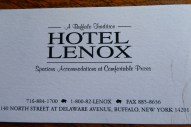
Now we had to tackle the hotel problem. The transit police suggested the Hotel Lenox and that we’d need a cab [of course] to get there. The driver spent the entire journey earnestly trying to persuade us to take his cab direct to Niagara. ‘You can get a motel down there for 30 dollars and give me 30 dollars-that’s less than you’ll spend at the Lenox’. He laboured his point several times, until Husband gently persuaded him otherwise. ‘We’ll stay here now,’ he replied, ‘we like looking at places so we’ll have a look at Buffalo’, at which the driver capitulated and suggested a restaurant-‘The Anchor’, home of the famous ‘Buffalo wings’. Who knew?

The Lenox was once grand but now a decadent pile skulking in front of the Holiday Inn. The room was adequate.

Buffalo was not the tourist Mecca I’d expected. We debated our options, with this town seeming less hospitable by the minute. A connection to Boston, the next destination, was impossible. I suggested a flight, but there was no reply from any of the freephone numbers we called for ticket agencies. Maybe reception could help? The receptionist seemed invigorated by the challenge- a small, pale, bespectacled girl, offering the phone, finding numbers.

We were introduced to ‘Mr Pellegrino’, the hotelier, an effusive character who extolled the virtues of the Anchor Bar. ‘Tell them Mr Pellegrino sent you!’ and gave us a card. He was a portly ex-cop.

The travel research was not going well. Only one airline flew direct from Buffalo to Boston and the ticket was $301.

P1000309

We went out to find The Anchor, a red brick pub standing alone on a corner. The sun was still warm and the evening crisp and clear, the beer excellent. Here in the quiet gloom of the restaurant 3 mountainous men were consuming gargantuan meals while a family in the corner were setting into a banquet, with plates covering the whole table. A nearby couple appeared to be eating the entire menu of food. We were surrounded by eating machines-dwarfed by them. But the famous, spicy chicken wings were very good and following the meal we decided to look at the town…

New York 1997. Part 3.

P1000281

When we are young children our earliest, hazy notions of geography may lead us to associate iconic sights, sites and buildings with countries around the world, perhaps through a child’s atlas or one of those pictorial, world jigsaws. For me, it was kangaroos and Australia, polar bears and the Arctic and The Empire State Building in America; because for so long, throughout my childhood it remained the tallest building in the world.

When we woke on Empire State visiting day I peered out of the window blinds to see bright sunlight, the previous day’s fog and rain entirely dissipated. My suggestion to find breakfast somewhere around Central Park was futile on this Monday, which, it transpired was a state holiday, hence the quiet streets and shuttered diners. The park was busy with runners, cyclists and roller-bladers, their serious intent written clearly in their expressions. Exercise must not be for fun! We trekked back West towards our hotel area to find breakfast and Husband, who was persuaded into sampling pancakes and maple syrup, declared he was not a convert to this American staple. My disgraceful consumption of French toast + maple syrup + butter, however was delicious.

As there were several hours to fill before our ticket time we walked again-to ‘Columbus Circle’, Carnegie Hall and on to Trump Tower, the exterior of which is clad in gold up to the first floor. Inside the atrium an extravagant decor of amber marble and gold. In the basement, where we got coffee, one wall ran with water. ‘You’d think’ I remarked to Husband, ‘ that with all his money Donald would have ensured he didn’t get all this condensation’. Husband agreed. ‘Obviously the roof leaks’ he replied. To a minimalist such as myself the entire building is an excrescence-but each to their own, as they say.

It was a long walk to the Chrysler Building, a beautiful monument to Art Deco dressed in a cone of silver semicircles, the RCA building [radio and TV], the Grand Central Terminal and, at last, The Empire State Building. We could skip the queue for tickets but smugness was short-lived as we joined the elevator queue, though it moved swiftly. We chatted to the jovial Egyptians ahead of us. ‘I am from Luxor!’ announced one, rotund gent earnestly, ‘it is my town!’

‘Beautiful!’ I told him, ‘Beautiful place!’

‘Did you go to Aswan?’

‘Yes,’ I said. ‘I loved it there. I love hot places!’

We reached the lift and piled in for a rapid ascent, quickly up to 80 floors, where there was a viewing chamber, enclosed and still queuing, walking round in a pen. I was worried that this was it, but Husband assured me there must be more. On upwards and suddenly out into an observation area. Stunning! We strolled around-and around, taking shots, looking and looking. In the gift shop I succumbed to Empire State earrings, an item of jewellery subsequently seldom worn that is now lost.

When I peruse the photos of that day, of the crowded observation platform, the excited photographers, gift shop browsers, the views of Manhattan stretching below in all its geometric familiarity, one overwhelming feature cannot be ignored. There is the iconic view, the skyscrapers, the famous landmarks and there among it all, the dark, twin rectangles of The World Trade Centre, jutting up into the blue sky and dominating the skyline because then, for that short time, these were the tallest buildings. And in our innocence of what was to come we marvelled at them.

Washington Square was alive with street entertainers. Three, small black children were playing chamber music, a group of tumblers, glossy and muscular, a scrappy acoustic band of ageing hippies, crowds gathered to watch, to play, to exercise or relax. On to Little Italy, to Sotto and Chinatown and then to the finance houses and courthouses, until Brooklyn Bridge was upon us, dwarfed by the twin towers but no less breath-taking with the sun beginning to set behind it. We had just enough energy to walk across and back, then sank into seats in an Irish bar, the barman happy to converse.

As the skyscrapers became silhouettes we went to the World Trade Centre, eager to ascend the tower at dusk, for a night view of the city. There were few waiting for tickets or the lift, in which the ascent was lightning fast and my ears popped and popped. 107 floors.

The night view from the top of the World Trade Centre surpassed anything we’d seen thus far, rendering us speechless. In my journal there is a faded, pink post-it note of our plans for that day. On the same page I’ve written this passage:

‘They were somewhat speechless; higher than all the other skyscrapers, up amongst the aeroplanes. The road below illuminated like electrical wires, jewelled with sparkling lights. You could sit against the windows on a metal bench and feel that you were hanging over, a dizzying experience.’

The last page of the chapter bears this John Donne quote:

‘When I am gone dream me some happiness; Nor let thy looks our long-hid love confess; Nor praise, nor dispraise me, bless, or curse Openly love’s force;